September 14, 2026:


Blizzard Entertainment revealed a new StarCraft game at BlizzCon 2026 yesterday — and this time, it is not a real-time strategy game. The announcement, made during the convention’s opening ceremony in Anaheim, California, confirms that one of PC gaming’s foundational franchises is making a full genre pivot to open-world shooter, with a Spring 2030 on PC and Xbox target release. The reveal matters not just for what StarCraft is becoming, but for what it took to get here: Blizzard has tried to turn StarCraft into a non-strategy game at least twice before, and both attempts ended in cancellation.
StarCraft: Ghost, announced in September 2002, was a third-person stealth-action game built around Nova, a psychically enhanced Terran operative. It cycled through two development studios — Nihilistic Software and Swingin’ Ape Studios — and spent more than a decade in various states of delay before Blizzard president Mike Morhaime confirmed Ghost’s official cancellation in 2014. Ghost’s collapse is widely attributed to feature creep, a lack of consistent creative direction, and a string of developer handoffs that left the project without stable leadership for much of its troubled run.
A less-known second attempt, Project Ares, began development internally at Blizzard in 2017. Described by reporters who covered it as something like “Battlefield in the StarCraft universe,” it was a first-person shooter in early but reportedly promising shape when Blizzard quietly canceled it in June 2019. Two studios, two attempts, zero shipped games. The new project announced at BlizzCon 2026 is the third time Blizzard has tried to make this work.
The most substantive reason to take this announcement seriously is the person leading the project. Dan Hay joined Blizzard in 2022 as a GM and VP, bringing with him more than a decade of experience as the executive producer and creative director of Ubisoft’s Far Cry series — one of the most commercially consistent open-world shooter franchises in gaming. He oversaw Far Cry 3, Far Cry 4, Far Cry Primal, Far Cry 5, Far Cry New Dawn, and Far Cry 6 — six entries in a franchise built precisely around the kind of large open environments, player-driven pacing, and faction-based combat that the new StarCraft appears to be targeting.
Neither Ghost nor Project Ares was led by anyone with that specific track record. Ghost, in particular, suffered from the opposite problem: a small studio that had not yet shipped a major commercial title was handed one of the most valuable science fiction IPs in gaming history with minimal creative infrastructure in place. Hay’s appointment reflects a structural difference — an experienced open-world game director at the helm from the start, rather than being brought in to rescue a project already in trouble.
Hay took the stage at BlizzCon 2026 to introduce the game in person, describing it as something that puts players “down in the mud, in the fire” rather than commanding from above — a deliberate framing of the genre shift as an additive perspective change rather than a rejection of what StarCraft has been. Working alongside him as associate director is AnaLee Haertling as associate director, confirmed in a post-announcement interview at BlizzCon.
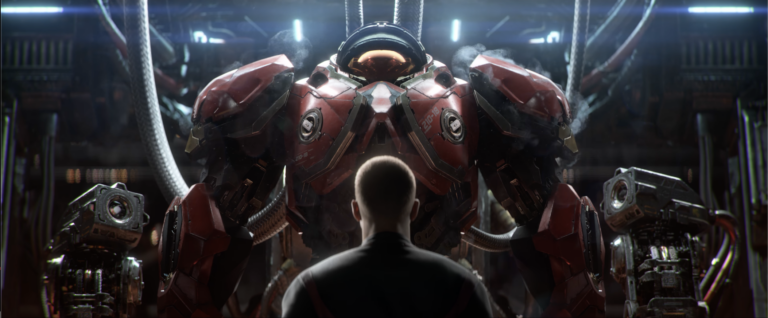
Blizzard released a pre-rendered cinematic titled “Dominion” alongside the announcement. The name refers to the Terran Dominion faction of the StarCraft universe — not a confirmed subtitle for the game itself, which Blizzard is currently presenting simply as StarCraft. The roughly three-minute sequence follows a Terran marine through training, gearing up, deployment, and close-range combat against the Zerg swarm, closing on the recovered and cleaned armor of a fallen soldier waiting for the next recruit to fill it. The visual quality is excellent; the emotional register — sacrifice, camaraderie, institutional loss — maps clearly onto the kind of character-driven campaign that Far Cry’s strongest entries used to anchor their open worlds.
What the cinematic does not show is gameplay. No environments, no mission structure, no combat mechanics, no protagonist, no multiplayer mode. The announcement is at this stage a declaration of intent: a genre, a tone, a director, and a date.
Hay’s post-announcement explanation for the four-year horizon is unusually direct for a game announcement this far from release. He told GamesRadar that 2030 is “a date we feel confident about,” describing the public commitment as something the team puts on a wall to focus development. During the same conversation, he described leading the project as having “won the cosmic lottery” — an honor the team is treating with full seriousness.
For players who know StarCraft primarily as the real-time strategy game that defined competitive PC gaming in the late 1990s and early 2000s, the genre shift deserves a concrete explanation. StarCraft’s original design — and StarCraft II’s — places the player above the battlefield in an isometric view, managing economies, building bases, and commanding large armies with inputs that advanced players execute at hundreds of actions per minute. At its Korean esports peak, the game was broadcast on three dedicated cable television channels, drew 120,000 fans to a single 2005 tournament final in Busan, and inspired the Korean Ministry of Culture to formally designate “pro gamer” as an official job title in 2002. The entire modern esports industry’s infrastructure — team houses, professional coaching staff, structured corporate-backed leagues — emerged from the Korean StarCraft scene of the early 2000s.
The new StarCraft shooter strips away the elevated perspective and the army management entirely. Rather than directing a Terran marine from above, the player will apparently be one. The design reference that industry journalists with pre-alpha access have cited publicly is Warhammer 40,000: Space Marine comparison — a third-person action-shooter set in a sci-fi universe defined by large-scale infantry combat against overwhelming alien enemies, which maps directly onto StarCraft’s Terran vs. Zerg dynamic. Dan Hay’s Far Cry experience gives him a specific tool set for this: Far Cry’s strengths are emergent faction-based world design, player-driven mission pacing, and large environments that reward exploration over linear corridor movement — all applicable to an open-world StarCraft in ways that a traditional FPS or cover-shooter design would not be.
The conversion also explains why the project is being announced four years before release. Open-world shooters of this scale — Hay’s own Far Cry entries required production teams of several hundred people across three to five years of full development — require a longer runway than a more constrained game. Announcing now signals the franchise is alive and active, while giving the team room to build the systems that an open-world game actually requires.
Blizzard did not announce platforms during the ceremony, but Xbox confirmed afterward that the game is coming to PC and Xbox Series X/S at minimum. Whether it will come to PlayStation is not confirmed; the Xbox-driven push toward console exclusivity in 2026 — which included wide staff reductions across Blizzard and a renewed emphasis on first-party titles — creates uncertainty about a PlayStation release that did not exist before Microsoft’s $69 billion acquisition of Activision Blizzard closed in October 2023.
Beyond platforms, almost everything about how the game actually plays remains unannounced: protagonist identity, campaign structure, multiplayer plans, the roles of the Zerg and Protoss factions, vehicular combat, progression systems, and monetization. That level of ambiguity is standard for an announcement of this vintage — and the Spring 2030 window means at least one major industry events cycle will pass before Blizzard is likely to show gameplay.
StarCraft’s last new standalone content was Legacy of the Void in 2015. The original StarCraft went free in 2017 — in April of that year — and StarCraft II followed in November 2017. For eight years, the franchise existed primarily as a preserved artifact — playable, competitive, beloved, and effectively finished. The new game is not a sequel to the RTS line; it is a bet that StarCraft’s universe is worth more than any single genre’s claim on it.
The history of previous attempts makes that bet look risky. The confirmation of a confident date, a named director with the right track record, and a named associate director suggests Blizzard is structuring this attempt differently than the ones before it. Whether that is enough — whether the game ships in Spring 2030, whether it satisfies RTS veterans who wanted StarCraft III, whether it finds the new audience an open-world shooter requires — are questions that four years will answer.
No. The new game is not a continuation of the real-time strategy series. It is an open-world shooter — a separate genre with a separate design architecture — set in the same StarCraft universe. Blizzard describes it as an evolution of the franchise’s perspective, moving from command-center view down to the ground-level experience of a Terran marine. Whether it will connect to the narrative of StarCraft II’s campaigns has not been confirmed.
Twice. StarCraft: Ghost, a third-person stealth-action game announced in 2002, spent more than a decade in troubled development before being officially canceled in 2014 after cycling through two development studios. Project Ares, a first-person shooter internally described as “Battlefield in the StarCraft universe,” began in 2017 and was canceled in 2019 after approximately two years of development. The new game announced at BlizzCon 2026 is the third attempt.
Blizzard has not formally announced platforms, but Xbox confirmed after the BlizzCon ceremony that the game will come to PC and Xbox Series X/S at minimum. A PlayStation release is uncertain: Microsoft’s renewed push toward console exclusivity following its acquisition of Activision Blizzard has introduced a scenario where Blizzard games may ship on Xbox and PC before, or instead of, PlayStation. Blizzard will presumably clarify platform plans as the game moves closer to its Spring 2030 target.
The core appeal of the StarCraft universe — its three-faction sci-fi war setting, its lore, its visual identity of Terran marines against the Zerg swarm — transfers intact to a shooter context. What changes is perspective and agency: rather than directing marines from above, the player will be one. The cinematic’s emotional tone, centered on sacrifice and duty within the Terran Dominion, suggests Blizzard is pursuing the immersive, character-driven storytelling that open-world shooters do well — a complement to StarCraft’s tactical heritage rather than a replacement of it.