September 20, 2026:


Rubber hose gaming is no longer Cuphead’s territory alone. When indie studio Fumi Games released MOUSE: P.I. For Hire in April 2026 — a first-person shooter drawn frame by frame in the boneless, exaggerated style of 1930s cartoons — and watched it MOUSE earned strong Steam reviews from more than 14,000 Steam players with a score of 80 on OpenCritic, the genre confirmed something important: audiences want more games in this style, and the formula works across wildly different gameplay genres. Now indie developer Bugle Duck has released the first official teaser trailer dropped for Moylo, a hand-drawn action game that targets the one gameplay template the rubber hose revival has not yet explored in depth — melee combat with dark-fantasy world exploration.
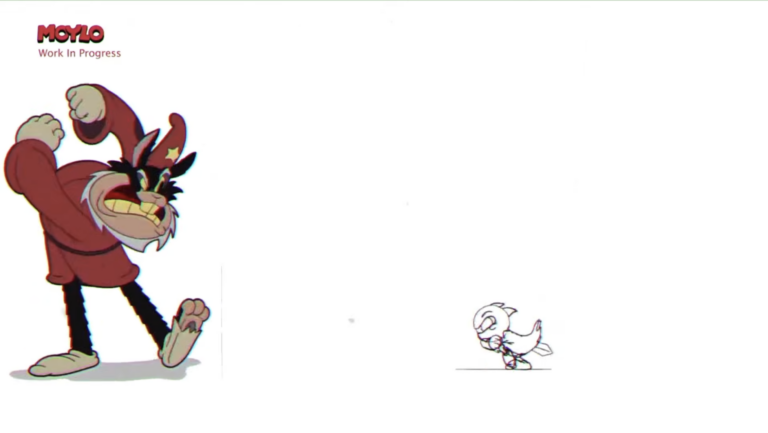
The trailer, which debuted on YouTube on September 18, 2026, offers the clearest look yet at what Bugle Duck is building: a side-scrolling action-adventure rendered entirely in authentic rubber hose cartoon style, animated frame by frame, and set in a world that has already surrendered to permanent darkness.
Rubber hose animation is the oldest standardized American animation style in the country’s history. Bill Nolan defined the style in the 1920s while working on Felix the Cat, naming it for its most visible characteristic: limbs drawn as flowing curves with no articulated joints at the elbows or knees, stretching and bending like rubber hoses. The result is characters that feel physically impossible in the most delightful way — boneless, bouncy, and expressive in a register that no other art style quite matches. Fleischer Studios and Walt Disney Productions built empires on it; Snow White ended rubber hose animation’s reign as the industry standard in 1937 when realism took over.
The style never disappeared — it lingered in Animaniacs and assorted cartoon callbacks — but it only became a serious video game genre with Cuphead by Studio MDHR in 2017. Studio MDHR’s run-and-gun masterpiece Cuphead sold five million copies and demonstrated that players would not only tolerate but actively seek out the demanding hand-drawn aesthetic.
What distinguishes genuinely authentic rubber hose games from visual lookalikes is whether the animation is drawn frame by frame or produced using modern rigged-skeleton systems. In a rigged game, animators pose a character’s digital skeleton and the software fills in the movement between keyframes — efficient and scalable but visually distinct. Frame-by-frame animation means every single frame is independently drawn, the same method Fleischer Studios used in the 1930s. This approach is exponentially more time-intensive but produces the distinctive squash, stretch, and energy that gives rubber hose characters their signature feel. Both Cuphead and MOUSE: P.I. For Hire used true frame-by-frame hand-drawn animation, and Bugle Duck has committed to the frame-by-frame rubber hose animation standard for Moylo — a significant technical undertaking for an independent studio.
Moylo is not a cheerful platformer. Bugle Duck’s Steam page describes a world swallowed by endless night: “Enter a world where death has already claimed everything. Beneath an endless night, dark shadows have consumed the land, and every path leads to a new challenge.” The player enters as an unnamed character in this eternal night — a figure who must grow powerful enough to confront whatever dark forces have swallowed the land, uncovering new powers and secrets along the way.
The central dramatic question is one of survival and escalation: can you master this world’s systems well enough to face its worst? The game’s emotional register sits in a place few games occupy — the visual warmth of a 1930s cartoon pressed against the existential cold of a world that feels like it ended before the story began. The most concrete specific detail in the teaser is one Bugle Duck has made a genuine design pillar: each boss has unique mechanics and its own story, visual style, and themed level. This is not a game of palette-swapped enemies. The boss gallery functions as a dark cartoon menagerie, each creature a distinct personality rendered in its own variation of the rubber hose idiom.
The key design decision separating Moylo from its rubber hose predecessors is the choice of melee combat as the primary engagement system. Cuphead is a run-and-gun: players dodge bullet patterns while firing projectile weapons — a design that maps naturally onto the aesthetic’s high-speed frenetic energy. MOUSE: P.I. For Hire is a first-person shooter: players sprint through 1930s noir levels blasting rodent criminals with Tommy guns and power-ups.
Moylo asks players to get close. Learning enemy patterns, timing strikes, and surviving relentless pressure without the screen-clearing distance of ranged weapons creates a different quality of tension. Melee combat in side-scrollers demands spatial awareness and pattern recognition at the level of the body rather than the projectile — a feel closer to the soulslike tradition than the arcade tradition, whatever the art style might suggest.
The game also builds in metroidvania-style progression, with players unlocking new powers throughout journey as they advance, those powers opening previously inaccessible areas and new ways to fight. This structure distinguishes Moylo from pure boss-rush design and positions it alongside games like Hollow Knight — a hand-drawn metroidvania where Hollow Knight sold fifteen million copies as of August 2025 and remains one of the most cited inspirations for indie developers working in 2D. Both Cuphead and Hollow Knight influenced Bugle Duck’s design, as Cuphead and Hollow Knight inspired the studio per coverage at Crits.gg.
The comparison to Cuphead will be unavoidable — players comparing Moylo to Cuphead already appears on the Steam community page — and it is worth examining honestly. Both games share the rubber hose aesthetic and the hand-drawn frame-by-frame commitment, but they are fundamentally different games in different sub-genres with different tonal registers.
What the comparison reveals is not redundancy but opportunity. No game has yet proven that rubber hose animation works as well in melee-first, exploration-driven design as it has in run-and-gun and FPS. The exaggerated limb physics and squash-and-stretch motion that rubber hose uses could, in principle, make melee combat feel more physically satisfying than any realistic animation approach could — every hit registered, every dodge animated with melodramatic flair. Whether Bugle Duck’s implementation delivers on that potential is a question the teaser raises but cannot yet answer. What it demonstrates is that the studio has the animation quality to make the attempt credible.
One meaningful differentiation is already visible from the description: Moylo‘s world exists to be explored, not just survived. The metroidvania structure implies an interconnected map that rewards curiosity, something neither Cuphead nor MOUSE prioritizes. Players who loved Hollow Knight’s world-building and found Cuphead’s boss-rush design too narrow may find Moylo addresses exactly that gap.
The unusually modest 2026 system requirements listed on Steam include Windows 7 or higher, an Intel Core2 Duo at 3.0 GHz or an AMD Athlon 64 X2 at comparable speed, 3 gigabytes of RAM, a GeForce 9600 GT or AMD HD 3870 with 512 megabytes of video memory, DirectX 11, and 4 gigabytes of storage. macOS users need OS X 10.11.x or later, an Intel Core i5, 4 gigabytes of RAM, and an Intel HD Graphics 4000.
These specs would run on hardware a decade old, a deliberate choice that maximizes the audience for a game whose artistic ambitions don’t require cutting-edge hardware. The frame-by-frame animation is doing the work — not polygon counts or shader complexity.
Bugle Duck has also committed to twelve interface languages at launch, covering English, French, Italian, German, Spanish (Spain and Latin America), Japanese, Korean, Brazilian Portuguese, Russian, Simplified Chinese, and Traditional Chinese. The global reach signals that the studio is not building for a niche audience.
The rubber hose revival now has enough entries to read as a genuine movement. Cuphead established the genre’s commercial viability in 2017. MOUSE: P.I. For Hire proved in April 2026 that audiences would follow the aesthetic into other gameplay genres — specifically the first-person shooter — and rewarded it with strong reviews. Moylo arrives as the movement’s first serious melee-focused entrant, with a darker tone and more exploration-driven design than either predecessor.
The historical context is instructive. Rubber hose animation history declined commercially after the early 1930s, as Disney pushed the industry toward realism after 1937, surviving only in marginal contexts until its modern video game revival. Each new rubber hose game tests a different hypothesis about which gameplay genres the aesthetic can carry. The results so far suggest the answer is: more of them than anyone expected.
Moylo has no announced release date. The game is Moylo live on Steam wishlist as a wishlist entry and Bugle Duck is active on YouTube, Discord, X, TikTok, and Instagram under the handle @moylogame.
Rubber hose animation is the oldest standardized animation style in American history, defined by its boneless, flowing limb movements that resemble rubber hoses — no elbows, no knees, just curves. Bill Nolan defined this style in the 1920s for Felix the Cat, and Fleischer Studios (Betty Boop, Popeye) built its aesthetic identity around it. When applied frame by frame rather than through modern digital rigging, the result is an animation quality that cannot be replicated by any shortcut — every frame is independently drawn. Moylo commits to this frame-by-frame approach sets Moylo apart, which is the same method used by Cuphead and MOUSE: P.I. For Hire, and which is what makes those games look and feel different from games that merely adopt rubber hose shapes without the underlying animation discipline.
Cuphead is a run-and-gun game: players fire projectile weapons at bosses from a distance while dodging waves of bullets. Moylo is a melee combat game with metroidvania-style exploration: players learn enemy patterns up close, unlock new powers over time, and explore a world that expands as they grow stronger. The tone is also different — Cuphead is whimsical and theatrical, Moylo is gothic and atmospheric. Both use authentic frame-by-frame rubber hose animation, but they are distinct games in distinct sub-genres targeting somewhat different player preferences. See the Moylo Steam wishlist and notification page for full game details.
Bugle Duck has not yet announced a release date. The game is available to wishlist on Steam, and players who add it to their wishlists will receive a notification when a release date or launch is announced.
MOUSE: P.I. For Hire, a first-person shooter using the same frame-by-frame rubber hose style, released in April 2026 and MOUSE earned Very Positive status on Steam from more than 14,000 players, with a score of 80 on OpenCritic — suggesting that audiences are actively seeking games in this style beyond Cuphead. Moylo‘s trailer arriving in September 2026 follows that market validation.