HomeAuto ADM Converts Iowa Tanks for Precision Fermentation Egg Protein: Demand Up 550% Amid Bird Flu
ADM Converts Iowa Tanks for Precision Fermentation Egg Protein: Demand Up 550% Amid Bird Flu
August 26, 2026:
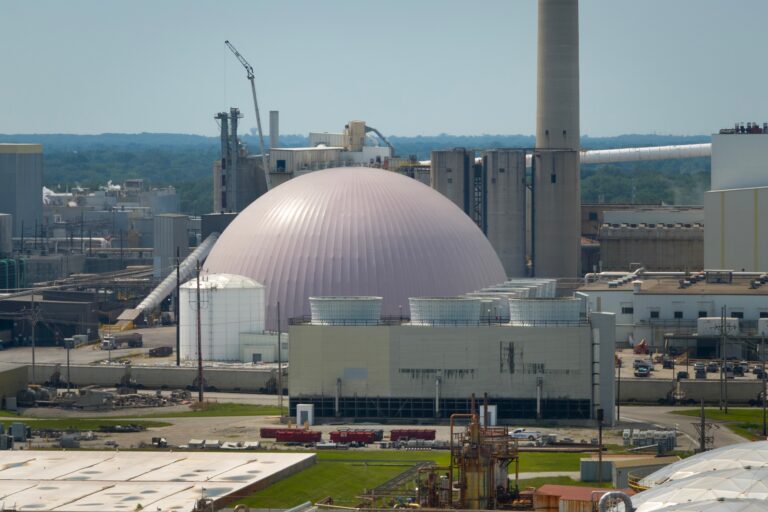
DECATUR, ILLINOIS – JULY 24: An aerial view of the Archer Daniels Midland (ADM) facility on July 24, 2025 in Decatur, Illinois. Shares of ADM fell more than 1 percent today after President Donald Trump announced that he had persuaded Coca-Cola to use more real cane sugar as a sweetener in its drinks rather than high-fructose corn syrup, of which ADM is a major manufacturer. Scott Olson/Getty Images
Demand for a precision-fermented egg-white protein ingredient has already outpaced last year’s orders by 550% — and Iowa just formalized the infrastructure that is supposed to keep up with it. On August 21, the Iowa Economic Development Authority (IEDA) board awarded Archer Daniels Midland $2.23 million in tax credits to convert 463,503 square feet (43,061 square meters) of idle fermentation space at its Clinton corn processing complex into a dedicated precision fermentation production facility, a $55.5 million capital investment that will add 53 jobs at a qualifying wage of $23.57 per hour.
The credits — distributed through Iowa’s Business Incentives for Growth program — represent something more substantive than a routine economic development incentive. State capital has been directed at a facility whose stated purpose is producing recombinant proteins for food, feed, and industrial applications using engineered microorganisms. That is a meaningful policy signal for a state whose bioeconomy strategy has historically been built around conventional agriculture and its direct processing derivatives — ethanol, sweeteners, animal feed, and commodity oils.
The timing is not coincidental. US retail egg prices peaked at $6.23 per dozen in March 2025, fell to $2.19 by May 2026, and have been climbing again since bird flu resurfaced in more than a dozen states this past summer, with more than 12 million laying hens culled since spring. Simultaneously, whey protein concentrate — the dominant protein-fortification ingredient in the US food industry — surged from $1.52 per pound in January 2026 to as high as $2.18 per pound by July as processors ran flat out and some producers reduced output altogether. Food manufacturers working in baked goods, protein bars, and enriched beverages are under pressure from both sides of their conventional protein supply, and the ADM arrangement is specifically designed to give them a third option that carries neither set of risks.
How Precision Fermentation Actually Produces Egg-White Protein
Precision fermentation is not a new technology, but its application to bulk food proteins is. Fermentation-derived rennet is already used in over 90% of US cheese production, and fermentation-produced insulin displaced pancreatic extraction decades ago. What has changed is the ambition: rather than producing a specialty enzyme for a niche application, companies are now trying to produce commodity-volume proteins at commodity-adjacent price points.
The Every Company engineers a yeast strain — Komagataella phaffii, the same host historically used to produce pharmaceutical enzymes — to express the ovalbumin gene from chickens. Ovalbumin is the protein that accounts for approximately 54% of egg white’s total protein content, and it is responsible for the binding, foaming, gelling, and whipping functions that make egg white indispensable in baked goods, confectionery, protein-enriched snacks, and processed meat applications. The engineered yeast is fed dextrose — at ADM’s Clinton site, derived from the same corn wet-milling operation that has supplied the facility’s other fermentation lines for decades — and as it grows in a bioreactor, it secretes ovalbumin into the fermentation broth. That broth is then harvested, the ovalbumin is separated from yeast biomass via centrifugation, purified through membrane ultrafiltration, dried, and packaged using the separation and purification equipment the IEDA credits fund.
The resulting powder carries a protein digestibility-corrected amino acid score (PDCAAS) of 1.0 — the highest rating achievable under the standard nutritional metric — with no fat and no cholesterol. It is shelf stable for up to 24 months without refrigeration or cold-chain handling, a significant logistical advantage over conventional dried egg white, which requires careful temperature management and carries ongoing salmonella and avian influenza contamination risk. What it cannot do yet is serve every application conventional egg white serves. The Every Company’s CEO Arturo Elizondo acknowledged in a detailed August interview that pasta, confectionery, sports nutrition, and pet nutrition applications are still being optimized — meaning the ingredient is not a universal drop-in, and food manufacturers evaluating it should confirm fit in their specific category before committing supply volumes.
OvoPro also retains the same allergenicity profile as conventional egg white — it is produced from the same protein in the same molecular form, which means it cannot be marketed as a hypoallergenic alternative for egg-allergic consumers.
What Makes the Infrastructure Question Relevant
The reason the Iowa award matters beyond its dollar value — $2.23 million is modest relative to the $55.5 million total project cost — is what the facility represents as an engineering solution to precision fermentation’s most documented problem.
Building a commercial-scale precision fermentation facility from scratch typically requires $100 million to $300 million in capital expenditure with four to eight year payback periods. A 200,000-liter fermentation plant can take years to permit, design, and commission, and fewer than 15% of precision fermentation startups that prove their technology at pilot scale ever reach full commercial production. The US is specifically under-served: a March 2026 panel at Future Food-Tech San Francisco heard Shannon Hall, co-founder of biomanufacturing platform Pow.Bio, describe the situation plainly: “We really lack the ability to make stuff in the US, so I think the headline has got to be infrastructure — who enables it, how do we get it done?”
ADM’s Clinton facility bypasses the greenfield problem entirely. The site already contains the stainless-steel bioreactor infrastructure, the upstream corn-processing feedstock supply chain, and the downstream handling and logistics capabilities that a precision fermentation startup working at scale requires. What ADM is funding with the BIG credit is the conversion of space that already existed — the new equipment for separation, purification, drying, and packaging that upgrades the idle infrastructure from a commodity fermentation output to a food-grade, high-purity protein production line. The Every Company brings the biology, the FDA clearances, and the customer relationships. ADM brings the tanks, the dextrose, and the processing infrastructure that would take any startup years and nine figures to replicate.
ADM’s chairman and CEO Juan Luciano described the logic directly during the company’s August 4 second-quarter earnings call: “We are a fermentation company, and we have many fermenters that we can — they are underutilized — that we can utilize forward. There is the benefit of having dextrose to provide to that, and that will pull from the fight for the grind that we have in Carb Solutions.” ADM’s Q2 2026 adjusted earnings per share reached $1.84, with segment operating profit surging 75% year over year, and precision fermentation was explicitly cited in the earnings presentation as one of the company’s organic growth investment priorities.
What the Every Partnership Has Already Produced
The Clinton investment formalizes a commitment ADM and The Every Company announced in mid-July 2026, when they described the partnership as giving OvoPro its first US manufacturing base at genuine commercial scale. The Every Company has been producing OvoPro at commercial scale in Europe through a manufacturing partnership with Huvepharma in Peshtera, Bulgaria, supplying US customers — including products on shelves at Walmart and Target — from overseas production.
When Clinton becomes fully operational, the companies expect OvoPro volumes available to US customers to increase fivefold by 2027 starting in the second half of that year. That production ramp would reduce dependence on European manufacturing and substantially shorten lead times for US food manufacturers sourcing the ingredient.
The demand signal behind that expansion is significant. The Every Company reported that customer orders in the first four months of 2026 exceeded its total 2025 order volume by 550%. The Every Company’s chief revenue officer Mario Patiño described the situation as a “genuine tipping point” in the August FoodNavigator interview: “When ADM invests manufacturing capacity at a major facility specifically for fermentation-derived protein, that signals supply confidence. The barriers now are operational, not technical.” Separately, Rich Products Corporation — one of the largest privately held food companies in the world — announced a commercial agreement with The Every Company in August 2026 to develop and launch OvoPro-based products across its bakery, snack, and foodservice lines in the US, a partnership that provides additional commercial validation for the ingredient’s readiness for mainstream food manufacturing.
Does OvoPro Actually Compete With Whey?
The Every Company’s pitch to food manufacturers frames OvoPro not primarily as an egg replacer but as an alternative to whey protein concentrate in protein-fortification applications — a distinction that matters because the drivers of demand are different from what the egg-price narrative suggests.
“Whey protein prices are through the roof,” Elizondo told FoodNavigator in August, “and other proteins have strong off-notes and can end up drying up the product and making it chalky.” He described OvoPro as a “one-two punch” — delivering protein fortification at the 10-to-20-gram-per-serving range while maintaining the structural and textural properties that keep protein-enriched baked goods from turning dense.
The supply-side rationale for the whey comparison is real. Whey is a by-product of cheesemaking, and even though global dairy production has remained broadly stable, the bottleneck is downstream processing capacity — the filtration and spray-drying equipment needed to convert liquid whey into food-grade concentrate or isolate — which is running near full utilization. Even the roughly $11 billion in US dairy processing expansion announced is not expected to meaningfully ease supply until 2027 at the earliest. That leaves a window in which a shelf-stable, cold-chain-free recombinant protein with good amino acid scores and clean technical performance in bakery applications has a specific competitive case to make to ingredient procurement managers under margin pressure.
How Does the Clinton Site Fit Into ADM’s Broader Fermentation Posture?
The Clinton facility has been running multiple fermentation lines in parallel for years. ADM’s partnership with Spiber — the Japanese biomaterials company headquartered in Tsuruoka, Japan — uses the site’s corn-derived dextrose and large-scale fermentation infrastructure to produce Spiber’s Brewed Protein polymers for apparel, automotive components, and industrial applications. That arrangement, announced in 2020, established the model that the Every partnership is now extending to the food protein side: dextrose from ADM’s corn mill goes into the fermenter; a partner company’s engineered microorganism converts it into a high-value molecule; ADM handles processing and logistics.
ADM Ventures — the company’s corporate venture arm — has also backed Bond Pet Foods, a Boulder, Colorado-based precision fermentation startup that in May 2026 received an FDA no-objection letter for its Lamb Protein Yeast ingredient, developed in collaboration with Hill’s Pet Nutrition. That clearance was the first of its kind for a precision fermentation-derived animal protein in US pet food. Luciano cited both the Every and Bond projects specifically on the August 4 earnings call as evidence that the precision fermentation platform is demonstrating feasibility across multiple food categories.
What Could Slow This Down
The Every Company is operating under a contested intellectual property position. In September 2025, Finnish startup Onego Bio — a spinout from VTT Technical Research Centre of Finland — filed a lawsuit seeking to invalidate The Every Company’s US Patent No. 12,096,784, which covers ovalbumin production across a range of microbial hosts. A Wisconsin federal court dismissed the case in May 2026 on jurisdictional grounds, but the litigation has moved to Delaware, where proceedings are ongoing as of this writing. Onego Bio argues the patent is invalid and interferes with its own ovalbumin production using Trichoderma reesei fungus; The Every Company has asked the Delaware court to sanction Onego Bio for what it calls “duplicative litigation based on knowingly false factual allegations.” VTT has separately challenged the same patent at the European Patent Office. If the foundational patent is narrowed or invalidated, it could change the competitive landscape for OvoPro, affect licensing strategy, and introduce uncertainty for downstream partners. Food manufacturers evaluating the ingredient should be aware that the IP position remains actively litigated.
Does This Mean Protein Fortification Is Moving Away From Animal Sources?
Not necessarily, and Elizondo has been direct about this. OvoPro is, structurally, the same molecule as egg-white protein — it carries the same egg allergen profile and is not positioned as a vegan product in the technical sense. The Every Company frames its ingredient as additive rather than replacing: something manufacturers can add alongside eggs or whey to improve structure, extend protein content, and reduce exposure to supply volatility from either source. Elizondo estimated global annual egg consumption at approximately 1.3 trillion and noted that conventional egg production is growing, not shrinking.
The Animal-Free Egg Protein Market was valued at $237.5 million in 2025 and is projected to reach $287.4 million in 2026, with precision-fermented ovalbumin expected to capture 56.1% of total demand by type this year, according to Future Market Insights. The broader projection — reaching $1.93 billion by 2036 at a 21% compound annual growth rate — reflects an anticipated continued expansion of protein fortification across bakery, beverage, and foodservice categories, not a wholesale displacement of eggs from the food supply.
What Iowa’s $2.23 million investment represents is a state government making a concrete, if modest, bet on a specific technology infrastructure model: that existing Midwestern agricultural processing assets, converted for precision fermentation, can solve a scale problem that has limited American biomanufacturing for a decade. The outcome — whether OvoPro volumes reach the fivefold target by 2027, whether the Clinton facility demonstrates that the asset-light conversion model is replicable, and whether the Delaware patent litigation resolves in a way that clarifies the industry’s IP foundation — will be watched by every precision fermentation startup that lacks the resources to build a plant from scratch.
Frequently Asked Questions
What is precision fermentation, and how is it different from regular fermentation?
Precision fermentation is the process of engineering a microorganism — typically a yeast or fungus — to produce a specific target molecule, such as a protein, rather than the incidental metabolic outputs (alcohol, lactic acid) of traditional fermentation. The microorganism is grown in a bioreactor, fed a sugar source, and then the target protein is harvested from the fermentation broth and purified. It is the same broad technique used to produce rennet for cheesemaking and insulin for diabetics. The difference from conventional fermentation is intentionality: the biology is specifically programmed to produce a designed ingredient, not a fermentation byproduct.
How is OvoPro different from conventional egg white, and why does that matter for food manufacturers?
OvoPro is recombinant ovalbumin — the same dominant protein (roughly 54% of egg white’s protein content) that makes conventional egg white functional in baked goods and processed foods, produced by an engineered yeast rather than a laying hen. Because it is the same molecule, it provides the same binding, foaming, gelling, and whipping performance, carries a PDCAAS (protein quality) score of 1.0, and does not require reformulation in most bakery and protein-fortification applications. Its practical advantages over conventional dried egg white are that it needs no cold chain, stays stable for up to 24 months, carries no bird-flu contamination risk, and arrives at a consistent purity level not subject to seasonal supply variation. Its limitations are that it retains the same egg allergen profile as conventional ovalbumin — it is not a hypoallergenic product — and it is not yet optimized for all egg-white applications, including pasta, confectionery, and pet nutrition.
Why can’t existing US fermentation capacity meet the demand for precision-fermented proteins?
The fundamental bottleneck is that food-grade, commercial-scale fermentation capacity for precision fermentation specifically is scarce in the US. Building a new 200,000-liter fermentation facility from the ground up typically requires $100 million to $300 million in capital expenditure and four to eight years of development time, and fewer than 15% of precision fermentation startups that reach pilot-scale production successfully transition to full commercial scale. Most of the existing US industrial fermentation capacity is dedicated to commodity outputs — ethanol, corn sweeteners, beverage alcohol — and is not configured for the separation, purification, and packaging steps that food-grade proteins require. ADM’s Clinton facility is notable precisely because it involves converting existing underutilized capacity rather than building new infrastructure, which bypasses the greenfield cost barrier.
Does the ongoing patent dispute between The Every Company and Onego Bio affect OvoPro’s commercial position?
The litigation is ongoing and material. The Every Company holds US Patent No. 12,096,784, covering ovalbumin production across a range of microbial hosts, and Onego Bio — a Finnish startup using a different microbial host — has filed suit in Delaware seeking to invalidate it, while VTT Technical Research Centre of Finland has separately challenged the same patent at the European Patent Office. The Wisconsin case was dismissed on jurisdictional grounds in May 2026, but the Delaware proceedings continue. If the patent is narrowed or invalidated, it could affect The Every Company’s competitive position and licensing strategy. Food manufacturers evaluating OvoPro should account for the possibility that the IP landscape in recombinant ovalbumin production could change before they commit to long-term supply agreements.