October 14, 2026:


French indie developer Splashteam — whose 2022 charmer Tinykin became one of that year’s most celebrated indie games — has released a new trailer for its next project, Acornia: Mirror Worlds, as part of IGN Fan Fest 2026: Fall Edition. The game, first announced at Gamescom 2026 in August, solves a puzzle that has challenged every hybrid management-plus-dungeon game since Moonlighter in 2018: how do you make two wildly different gameplay loops feel economically inseparable rather than merely coexisting in the same package? Splashteam’s answer is your squirrel protagonist’s cheek pouches.
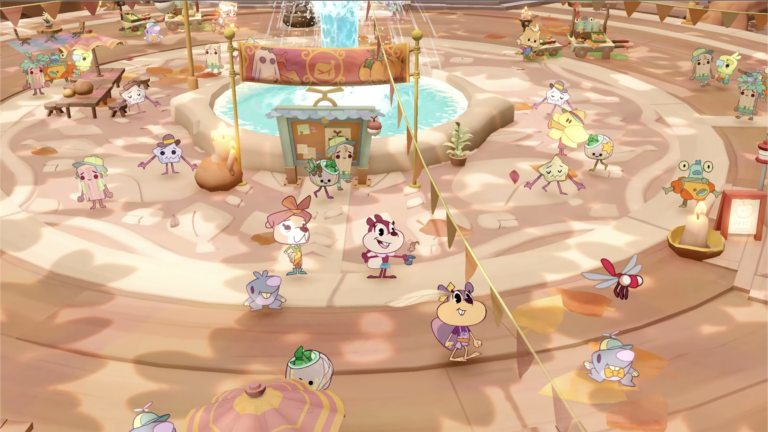
Acornia: Mirror Worlds follows Alva, a young squirrel returning home to find her tree village near ruin. The culprit is the Duramen — a dark mirror dimension that has seeped into Acornia, driving most of its 25-plus residents away and leaving the community corrupted and half-empty.
Alva’s goal is twofold and structurally intertwined: reopen and grow her family’s dessert shop to earn the money needed to restore Acornia, and venture into the Duramen to confront the angry spirits at the source of the corruption. The central dramatic question is whether Alva can hold both fronts simultaneously — pastry entrepreneur by day, spirit hunter by dimension-hop. The game carries its darkness lightly, wrapping bosses and corrupted foes in the same warm, whimsical aesthetic as its flower-decorating seasonal events and neighbor side quests. Two dimensions, one squirrel, and a bottomless supply of baked ammunition.
What makes Acornia distinct from every prior game in this genre mashup is the specific thing stored in Alva’s cheek pouches.
Games that pair management simulation with dungeon action have been trying to solve the same design problem since Moonlighter made the formula famous: how do you stop the two halves from feeling like separate apps stapled together? Moonlighter’s solution was a loot economy — players sell dungeon loot in the shop to fund upgrades, then spend upgraded stats on deeper dungeon runs. The shop and the dungeon are linked, but they are separate economies flowing in one direction: dungeon to shop.
Acornia inverts and tightens this. Alva stuffs her cheek pouches with the pastries she bakes in her shop, then enters the Duramen and fires those cakes, crumbles, and confections directly at the spirits she encounters. The pastries are not a currency or a stat modifier — they are the literal physical ammunition of the combat system. A better-stocked bakery means better-armed dungeon runs. More Duramen exploration means more looted materials, which means more recipes and expanded production capacity back in the shop. The loop runs in both directions simultaneously, and the cheek pouches are the crossover point.
MP1st’s James Lara, who played an early demo at Gamescom 2026, described the combat as combining a Kirby-style cheek-stuffing mechanic with twin-stick shooter controls, adding that “there’s a lot of fun, as well as charm, to be found in this game.” Game Informer’s Marcus Stewart — who accessed an even earlier build at a Dotemu event in Paris — called it Acornia “fun and varied,” noting that the game “oozes much of the same charm and humor of Tinykin.”
The result, according to both previews, is a pacing dynamic that neither mode alone could produce. The bakery loop is low-stakes and methodical: tend crops, bake recipes, display goods, serve customers, hire employee automators as the shop grows. The Duramen loop is real-time action against bosses and spirit enemies, with Alva’s 2D cartoon character navigating a fully 3D environment. Lara described visuals as resembling Cuphead’s hand-drawn character style placed in a three-dimensional world.
Splashteam is a small French studio based in Montpellier, founded by former Ubisoft Montpellier developers. Their first game, Splasher (2017), was a critically praised 2D platformer that did not find a commercial audience. Tinykin (2022), their second title — a Pikmin-inspired 3D puzzle platformer starring a miniaturized space traveler — earned multiple IGF honorable mentions, including for Excellence in Audio and Design and the Seumas McNally Grand Prize, and landed on Polygon’s list of the best games of 2022.
Acornia represents a meaningful genre pivot from Tinykin: instead of a pure collectathon platformer, Splashteam is attempting to marry two genres whose failure modes are well documented. The developer’s track record suggests they understand how to make systemic complexity feel accessible rather than overwhelming — a skill the Acornia dual loop will need.
Publisher The Arcade Crew is the indie publishing label of French company Dotemu (known for Streets of Rage 4, Teenage Mutant Ninja Turtles: Shredder’s Revenge, and other high-quality retro-influenced titles). The Arcade Crew’s catalog includes Blazing Chrome, Young Souls, and The Last Spell, among other titles from small independent studios.
IGN Fan Fest 2026: Fall Edition ran October 12 and 13 as an online showcase distributed across all IGN platforms, with a main livestream scheduled for October 14. The event promised more than 90 exclusive reveals across games, TV, film, and collectibles, with Acornia: Mirror Worlds listed among the game announcements.
For players who missed Acornia’s initial reveal at Gamescom 2026 in August, the IGN Fall Fan Fest has served as its most prominent North American showcase to date. The game does not yet have a confirmed specific release date within 2027, but its presence at the year’s major fall gaming showcase signals a promotional ramp that typically precedes a release window narrowing — watch for a specific date announcement in the months ahead.
Platforms confirmed: PC (Steam), PlayStation 5, Xbox Series X|S, and Nintendo Switch 2.
Moonlighter remains the closest structural predecessor, and Splashteam is clearly aware of the comparison. Both games split play between a retail shop and dungeon exploration, and both use the shop as an economic engine that funds combat progression. The key distinction is the direction and mechanism of coupling. In Moonlighter, the dungeon feeds the shop: players bring loot back to sell, and the shop’s profits buy upgrades. In Acornia, the shop feeds the dungeon: the pastries you craft become the weapons you fire. GameSpew’s preview made the Moonlighter comparison directly, noting that Acornia tasks you with managing a shop and defeating enemies to gather materials, calling it “a game that, in the same vein as Moonlighter” serves both goals at once.
Another reference point mentioned in some coverage is Cult of the Lamb, which combined a cult-management layer with roguelite dungeon runs. Acornia is not a roguelite — there is no permadeath mechanic and the dungeon loop does not reset on death — but the aesthetic of a brightly colored world containing real stakes resonates.
Acornia: Mirror Worlds is targeting a 2027 release on four platforms: PC via Steam, PlayStation 5, Xbox Series X|S, and Nintendo Switch 2. The game’s confirmed minimum PC specs require Windows 10, an Intel Core i5-2400 or AMD FX-4350, 8 GB of RAM, and a GeForce GTX 1050 or equivalent GPU; recommended specs call for a Core i5-8400 or Ryzen 3 2300X with 16 GB RAM and a GTX 1630 or RX 480. These are accessible specifications that suggest the game has been built for broad hardware reach rather than premium-tier machines.
The game includes seasonal content mechanics — players cater to their customers’ seasonal preferences for increased profit, and participate in seasonal events such as bug catching and flower decorating. This implies a live calendar running inside the village of Acornia, where what you bake and when you bake it affects both shop revenue and the social world outside the Duramen.
Acornia: Mirror Worlds is developed by Splashteam, a small French indie studio based in Montpellier. Splashteam previously made Splasher (2017), a 2D platformer, and Tinykin (2022), a Pikmin-inspired 3D collectathon platformer that received IGF honorable mentions and landed on several best-of-2022 lists. The publisher is The Arcade Crew, the indie publishing label of Dotemu, a French publisher known for retro-influenced titles including Streets of Rage 4 and TMNT: Shredder’s Revenge.
In Moonlighter, dungeon loot flows to the shop — you sell what you find underground to fund upgrades. In Acornia, shop output flows to the dungeon — the pastries Alva bakes in her bakery are stored in her cheek pouches and fired as projectile weapons at spirits in the Duramen dimension. This inverted economic coupling means your investment in the bakery directly arms your dungeon run, and vice versa: loot from the Duramen unlocks new recipes for the shop.
The game is confirmed for four platforms — PC (Steam), PlayStation 5, Xbox Series X|S, and Nintendo Switch 2 — with a 2027 release window. No specific release date has been announced yet. Given the game’s presence at both Gamescom 2026 and IGN Fall Fan Fest 2026, and with multiple media hands-on previews already completed, a specific date announcement is likely in the coming months.
Both — and the distinction between them is the Duramen dimension. The light dimension (Acornia village) delivers the cozy loop: farming, baking, serving customers, befriending more than 25 villagers with individual routines, decorating the shop, celebrating seasonal events. The Duramen delivers the action loop: real-time combat against spirits and bosses, using weaponized pastries fired from Alva’s cheek pouches, with twin-stick shooter controls according to early hands-on impressions. The game’s design philosophy is that the two modes provide genuine pacing contrast rather than tonal whiplash — the cozy portions are a deliberate breather before the next dungeon run, and the dungeon runs give weight to the prosperity you’re building back home.