HomeAuto Acer SFF RTX Spark Concept vs Veriton RI110: Only Intel Version Ships This Year
Acer SFF RTX Spark Concept vs Veriton RI110: Only Intel Version Ships This Year
September 3, 2026:
Acer.com
Acer arrived at IFA 2026 in Berlin with two compact AI desktops and a clear message about which one you can actually buy: the Veriton RI110 AI Mini Workstation ships in North America in Q4 2026 at a confirmed specification on Intel silicon, while the Acer SFF RTX Spark — the petaflop-class NVIDIA concept that drew the most attention on stage — remains a design showcase with no announced price, no confirmed ship date, and an underlying AI performance claim that no independent reviewer has yet been able to validate on actual hardware. Both machines were unveiled at Acer’s next@Acer global press conference on September 2, 2026, as part of the company’s largest IFA showcase in its 50-year history. IFA 2026 opens to the public in Berlin on September 4.
The distinction matters for anyone evaluating a compact AI workstation in the current purchase window. One machine exists. The other is a compelling architectural argument about where desktop computing is heading — and a reason to watch NVIDIA’s fall 2026 retail launch closely before committing to anything.
The two machines are not competing with each other — they serve different buyer timelines and different budget ceilings. Acer announced the Veriton RI110 as the immediately available offering for enterprise and small-to-midsize business buyers who cannot wait for NVIDIA silicon; the SFF RTX Spark is Acer’s design direction statement for when that silicon does reach retail.
What Shipped vs. What Was Shown
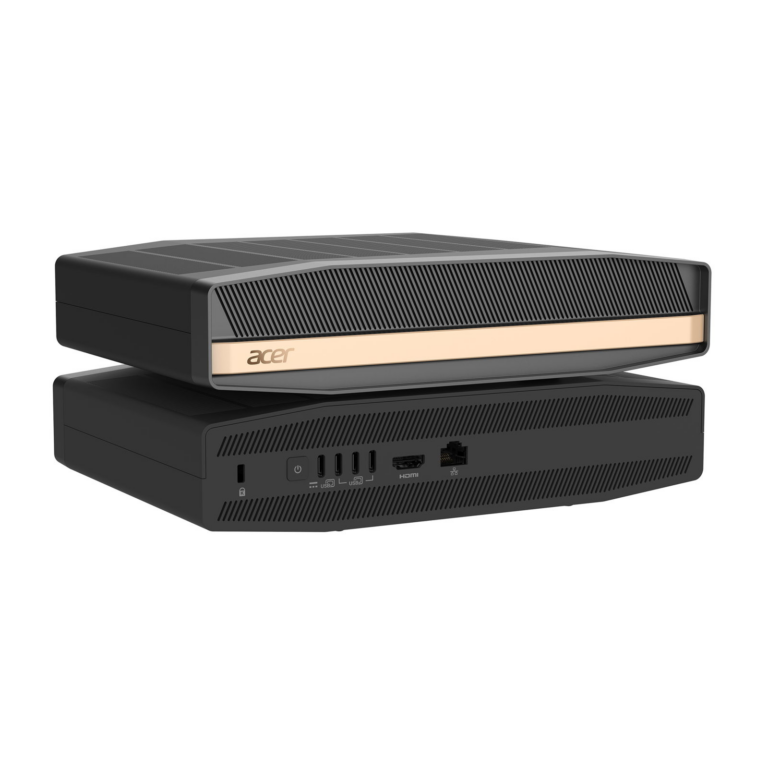
The Veriton RI110 is the concrete product. It fits an Intel Core Ultra X7 processor 358H and Intel Arc B390 graphics into a chassis measuring 138.5 × 131.3 × 52.1 millimeters (5.45 × 5.17 × 2.05 inches) and weighing approximately 0.63 kilograms (1.39 pounds) — a box light enough to mount behind a monitor. The system supports up to 96 GB LPDDR5X and up to 4 TB of PCIe Gen 4 SSD storage, and Acer says it handles AI models with up to 120 billion parameters for local inference, design work, and content creation. An OCuLink port delivering up to 64 gigabits per second gives buyers an external GPU expansion path post-purchase — meaning the Veriton RI110 is not a fixed-spec product but a platform that can be upgraded as workloads grow. It ships with Windows 11 Pro and includes Acer Qubi Claw, an agentic AI assistant that runs local workflows inside an isolated sandbox, keeping data off external servers.
The SFF RTX Spark is the concept. Its chassis — a vertical enclosure on a fold-out stand, closer in aesthetic to high-end audio equipment than a traditional workstation — houses NVIDIA’s RTX Spark Superchip: up to a 20-core NVIDIA Grace ARM CPU paired with up to a 6,144-core Blackwell RTX GPU and up to 128 GB of unified LPDDR5X memory in a single coherent pool. Acer also confirmed OCuLink on the SFF RTX Spark design, offering up to 64 Gbps for external GPU or storage expansion. At the press conference, Acer pitched the machine at creators, AI developers, and gamers. Pricing and availability have not been announced; the company stated those details will be confirmed at a future date.
What NVLink-C2C Unified Memory Actually Does: Why It Matters
The SFF RTX Spark’s architectural claim rests on NVIDIA’s NVLink-C2C chip-to-chip interconnect, a technology originally developed for data center superchips. Understanding what it does — and what it does not do — is the essential context for evaluating the 1-petaflop headline.
In a conventional desktop workstation, the CPU communicates with system RAM through one bus and the GPU communicates with its own dedicated video memory (VRAM) through another. When an AI workload — say, running a large language model — exceeds the GPU’s VRAM, the system must page data between the two pools, creating a bandwidth bottleneck and latency penalty. This ceiling is the reason desktop RTX 5090 cards with 32 GB of VRAM cannot run 70-billion-parameter models without quantization tricks: the model simply does not fit.
The RTX Spark Superchip eliminates that boundary. The Grace CPU and Blackwell GPU sit in a single package — a 2.5D chiplet design fabricated on TSMC’s 3-nanometer process — connected by NVLink-C2C. Both CPU and GPU share a single 128 GB unified pool as their native memory, with the LPDDR5X delivering approximately 300 gigabytes per second of memory bandwidth — roughly five times the bandwidth of PCIe Gen 4 and meaningfully faster than PCIe Gen 5 (~128 GB/s peak for x16). The NVLink-C2C interconnect itself runs at a higher chip-to-chip bandwidth internally, while remaining substantially below the 900 GB/s NVLink-C2C found in NVIDIA’s data center Grace-Hopper systems.
The practical result: NVIDIA says the RTX Spark runs 120B-parameter models with up to 1 million tokens of context entirely in local memory. That is a workload that would require a $4,699 NVIDIA DGX Spark or a dedicated data center GPU to run under conventional architecture. The RTX Spark’s Blackwell GPU implements NVIDIA’s NVFP4 format — 4-bit floating-point precision — which is what produces the 1-petaflop figure. At the more familiar FP32 (full) precision, the same silicon delivers approximately 31 teraflops — still competitive for a compact desktop, but a useful calibration for buyers comparing this number against competitors citing higher-precision figures.
What the CUDA Performance Claim Actually Means Right Now
Before the SFF RTX Spark’s AI performance claim becomes a purchase factor, a critical data point belongs in this article: as of today, NVIDIA’s 1-petaflop CUDA AI inference capability has not been independently validated on any shipping RTX Spark hardware.
In July 2026, a tech reviewer who obtained a pre-production Surface Laptop Ultra with the top-tier RTX Spark N1X configuration published benchmark data from more than a month of hands-on testing. The finding most relevant to AI buyers: CUDA-based AI workloads failed to complete on both driver versions tested — the original 591.33 drivers that shipped with the engineering sample and the newer 616.00 developer preview that includes CUDA Toolkit 13.4 support. The reviewer was forced to fall back to CPU and Vulkan Compute paths, which are substantially slower alternatives. Tom’s Hardware, TechSpot, VideoCardz, and Notebookcheck independently corroborated those results.
This does not mean the hardware cannot deliver on the AI claim at retail — driver development for a new platform architecture is iterative, and engineering samples run pre-production software specifically not intended to represent final performance. What it does mean is that the 1-petaflop figure remains an architectural target backed by NVIDIA’s own demonstrations, not yet a number that an independent buyer can verify on a machine they can purchase. NVIDIA has also released CUDA 13.4 for Windows ARM64 as a Developer Preview, marking real progress in the software stack, but that progress is not yet confirmed as working in practice on the platform.
For anyone evaluating the SFF RTX Spark for local AI workloads — which is the primary use case Acer is marketing — the responsible summary is: trust the architecture, verify the claim with independent benchmarks when retail units arrive.
Acer Is in the Second Wave, Not the First
The SFF RTX Spark’s timeline context matters for buyers planning a purchase. NVIDIA confirmed at SIGGRAPH 2026 that ASUS and MSI will lead the initial fall 2026 launch of RTX Spark devices, with Acer and GIGABYTE following in a second wave. The first wave also includes Dell, HP, Lenovo, and Microsoft Surface — more than 30 laptop designs and approximately 10 compact desktops across the first and second waves combined, per NVIDIA’s original Computex announcement.
What Acer’s IFA 2026 showcase established is the company’s design direction for both waves: a vertical SFF chassis with a fold-out stand for the RTX Spark desktop, and the Intel-based Veriton RI110 as the immediately available offering for enterprise and SMB buyers who cannot wait for NVIDIA silicon.
Morgan Stanley analysts placed N1X-class configurations at approximately $2,899 and lower N1 configurations near $1,799 — though NVIDIA has not officially announced pricing for any RTX Spark device. The Veriton RI110’s pricing has not been announced either, but the machine’s Intel Core Ultra positioning suggests it will fall meaningfully below the RTX Spark’s estimated entry point.
Windows on ARM: What Works and What Still Requires Confirmation
The SFF RTX Spark runs Windows 11 on ARM, which means the platform’s software compatibility deserves specific attention before gaming and legacy application compatibility are assumed.
Acer and NVIDIA have confirmed that the SFF RTX Spark supports a specific set of games natively: Fortnite, Valorant, League of Legends, and PUBG — all titles that have been ported to ARM64. The platform also supports Adobe, Blender, CapCut, and ComfyUI for creative workflows. These are confirmed-working applications, not representative of the full library. Games that rely on kernel-mode anti-cheat systems — a category that includes many competitive multiplayer titles — require native ARM64 ports from individual developers before they work on this platform; Microsoft’s Prism x86 emulation layer cannot bridge kernel-mode driver dependencies. Pre-production testing showed meaningful gaming performance under compatible titles (Kingdom Come: Deliverance II ran correctly in prototype testing), and GPU performance at retail with production drivers is expected to improve substantially over what pre-production units demonstrated.
For creative and development workloads — Blender rendering, ComfyUI image generation, local LLM inference — the unified memory architecture is the relevant capability, and that architecture is confirmed as technically sound regardless of the CUDA validation gap (which is a driver-maturity issue, not a hardware deficiency).
How to Compare These Two Machines Today
Veriton RI110
SFF RTX Spark
Availability
North America Q4 2026
Date not announced
Price
Not announced
Not announced (est. $1,799–$2,899+)
Processor
Intel Core Ultra X7 358H
NVIDIA Grace ARM (20 cores)
GPU
Intel Arc B390
Blackwell RTX (6,144 CUDA cores)
Max memory
96 GB LPDDR5X
128 GB LPDDR5X (unified)
Max AI model
120B parameters
120B parameters (CUDA unvalidated at retail)
Storage
Up to 4 TB SSD
Not announced
AI assistant
Qubi Claw (included)
Not announced
OS
Windows 11 Pro
Windows 11 (ARM)
OCuLink
Yes, up to 64 Gbps
Yes, up to 64 Gbps
The most consequential difference is not the memory ceiling or the compute specification — it is the timeline and the CUDA validation status. If you need a compact AI workstation in Q4 2026, the Veriton RI110 is the product Acer has committed to shipping. If you want NVIDIA’s petaflop-class unified memory architecture, you are waiting for hardware whose AI capability will need independent confirmation when retail units arrive.
Frequently Asked Questions
What is the difference between the Acer SFF RTX Spark and the Veriton RI110?
The Veriton RI110 is a confirmed shipping product, arriving in North America in Q4 2026, built on Intel’s Core Ultra X7 358H processor and Intel Arc B390 graphics with up to 96 GB LPDDR5X memory and up to 4 TB of SSD storage. The SFF RTX Spark is a design concept built on NVIDIA’s RTX Spark Superchip — it has petaflop-class compute and 128 GB of unified memory on paper, but Acer has not announced a price or ship date. The RTX Spark’s CUDA AI performance has also not been independently verified on shipping hardware as of today. If you need a compact AI workstation now, the Veriton RI110 is the product Acer has committed to; the SFF RTX Spark is worth tracking for when retail hardware ships and independent benchmarks can confirm its claimed capabilities.
Can the Acer SFF RTX Spark actually run 120-billion-parameter AI models locally?
Architecturally, yes — the RTX Spark’s 128 GB unified pool, accessed at approximately 300 gigabytes per second via the LPDDR5X memory bus, is designed to run inference on models at that scale without data-transfer bottlenecks. However, CUDA workloads failed on pre-production hardware tested independently in July 2026, under both available driver versions at that time. Driver development continues, and NVIDIA has released a CUDA 13.4 Developer Preview for Windows ARM64, but retail hardware and independent benchmarks are needed before this claim can be verified as working in practice.
What does NVLink-C2C unified memory mean for AI workloads, and how does it differ from a standard gaming PC?
In a conventional desktop, the CPU and GPU maintain separate memory pools — system RAM and video RAM (VRAM). When an AI model is too large to fit in the GPU’s VRAM, the system must shuffle data between pools, introducing latency and throttling throughput. NVLink-C2C eliminates that split: the RTX Spark’s CPU and GPU share a single 128 GB LPDDR5X pool, so a 120-billion-parameter model that would not fit on any consumer GPU’s VRAM can reside entirely in the unified pool. The practical result is that workloads that previously required a $4,699 DGX Spark or a data center GPU can theoretically run on a palm-sized desktop — pending validation on shipping hardware.
When will Acer’s RTX Spark desktop be available, and how much will it cost?
Acer has not announced a ship date or price for the SFF RTX Spark. ASUS and MSI launch first in fall 2026; Acer is in the second wave, which means its timeline will likely follow those initial launches. Analyst estimates from Morgan Stanley place N1X-class configurations at approximately $2,899 and lower N1 configurations near $1,799, but those are channel-check estimates, not official prices.