September 2, 2026:


With one month to go before launch, Ace Combat 8: Wings of Theve has pulled back the curtain on its online component — and what Bandai Namco revealed on September 1 is more than a multiplayer feature set. It is a second, separately-monetized game attached to the $69.99 purchase price: a 100-player persistent hub, six distinct mode types, cross-play across PS5, Xbox Series X|S, and PC, a progression system that never touches your campaign save, and an ACE PASS with free and premium tiers, loot boxes, and a standalone in-game store. Prospective buyers who pre-order before October 2 should understand this structure clearly, because the box price is the floor, not the ceiling, of what engagement with Ace Combat Online will cost.
Ace Combat Online is a standalone game mode with its own save data and progression track, entirely separate from the campaign. Players enter it not as the campaign’s protagonist — an FCU pilot operating under the legend of “Wings of Theve” during Sotoa’s 2029 invasion — but as a custom mercenary pilot with a personalizable avatar. The two identities share nothing; your aircraft unlocked in the campaign do not carry over, and your online rank does not affect your story progress. This architecture is a deliberate live-service design choice: it keeps the multiplayer mode extensible and monetizable independently of the narrative, in the same structural pattern used by games like Destiny 2 and GTA Online.
The mode launches with full cross-play enabled from day one across PlayStation 5, Xbox Series X|S, and PC via Steam. Sony opened cross-play to all developers in October 2019; AC8 is the first numbered Ace Combat entry to take full advantage of unified cross-platform matchmaking. The practical consequence is significant: specialist modes like Emergency Sortie — which requires eight pilots simultaneously — and Scramble, which requires four, depend on a large enough active player population to fill lobbies at any given hour. A game with three platform pools is harder to keep populated than a game with one unified pool. Cross-play is less a convenience feature here than a structural prerequisite for the mode’s more demanding co-op configurations.
The entry point for every online session is the Air Base, a persistent virtual lobby that can house up to 100 players simultaneously. Rather than a loading-screen-dressed-as-a-lobby, the Air Base functions as a social space: pilots can meet, communicate via in-game chat, visit the supply shop and the ACE COMBAT STORE, browse the in-game jukebox stocked with music from prior series entries, or play Bandai Namco arcade classics including Pac-Man in a virtual arcade. A military training mode for up to four players also runs within the hub between sorties.
As players progress through Ace Combat Online, they unlock gates that open additional Air Bases — alternative lobby environments that also serve as a light progression indicator within the social layer itself.
The online suite is built around two permanent core modes, two recurring limited-time modes, and a rotation of PvP events — a structure that distinguishes it sharply from Ace Combat 7: Skies Unknown‘s two strictly PvP-only modes — Team Deathmatch and Battle Royale — which offered no shared hub, no persistent progression, and no co-op.
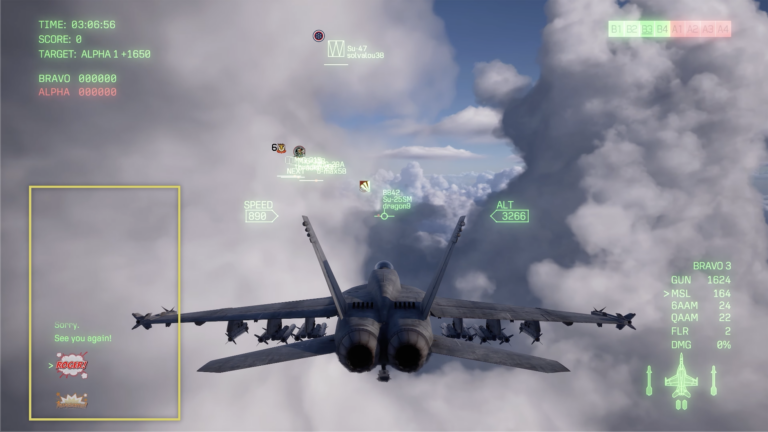
Co-Op Assault is the more accessible of the two core modes — a competitive PvE format pitting two squadrons of four players each against AI-controlled enemy forces across missions with varied objectives: air, sea, and ground targets requiring aircraft selection strategy. Both teams race for the highest score rather than fighting each other, but their competition is indirect and score-based. This is the mode designed to onboard players unfamiliar with online competitive formats.
Co-Op Warfare introduces the PvPvE architecture that gives AC8’s online its distinct strategic texture. Two teams of four face each other while NPC units engage both sides simultaneously. As players destroy enemies and accumulate points, they earn up to three stars of notoriety — a threat-level system that makes them higher-value targets for the opposing team. The more points you score, the more points the enemy team earns by shooting you down — a risk-reward feedback loop borrowed structurally from games like GTA Online’s Wanted Level system, but applied to dogfighting at supersonic speeds. The team with the highest total score at the session’s end wins.
Scramble missions are four-player sorties against a formidable NPC rival air squad — the closest equivalent to a traditional cooperative survival mode.
Emergency Sortie missions are the mode series veterans will watch most closely: eight pilots operating together against one of the franchise’s iconic colossal weapons — the superweapons that have defined the series’ scale since Ace Combat 04. The Online 101 trailer specifically showed the Chandelier and Arsenal Bird — from Ace Combat 6 and Ace Combat 7 respectively — as raid targets, signaling that these missions will draw directly from the franchise’s 30-year history of outsized opponents. Co-op boss raids of this scale are a structural first for a numbered Ace Combat entry.
Rounding out the offering are limited-time PvP events: 4v4 team deathmatches and eight-player free-for-all battles, sometimes with aircraft-class restrictions applied.
Here is the structural cost reality the trailer does not foreground: the $69.99 standard launch price admits you to a game with ongoing monetization layers.
The ACE PASS operates on the now-familiar battle-pass model: a free tier offering baseline progression rewards, and a premium tier with more substantial content including aircraft. Bandai Namco has not publicly disclosed the premium ACE PASS price as of this writing. Crucially, any aircraft made available through the premium ACE PASS will eventually become separate purchasable DLC — meaning non-pass buyers are not permanently locked out of pass-exclusive aircraft, but will wait longer and pay separately for them.
Beyond the ACE PASS, Ace Combat Online contains loot boxes and a standalone ACE COMBAT STORE stocked with aircraft, cosmetics, and progression-related items purchasable with in-game currency earned through missions. According to Bandai Namco’s official FAQ, there are currently no plans to include consumables in the store, and real-money purchases are associated with the premium ACE PASS rather than the store directly.
Platform costs compound this further. PS5 players require a PlayStation Plus subscription to access online multiplayer — PS Plus Essential costs $79.99 per year as of the May 2026 price revision. Xbox players require Xbox Game Pass Essential (formerly Xbox Game Pass Core) at $9.99 per month. PC players on Steam pay no additional subscription. A PS5 buyer engaging with Ace Combat Online at launch should budget accordingly: the game price plus a year of PS Plus totals $149.98 before any ACE PASS or store spending.
AC8 is a hybrid: a premium purchase with live-service economics grafted onto its online component. That is not automatically a negative — Destiny 2 built seven-plus years of content from a similar structure — but it is a structure buyers deserve to enter with open eyes.
The architectural gap between AC7 and AC8 online is not incremental. Ace Combat 7: Skies Unknown sold over 7 million units by January 2026. Its online component consisted of two strictly PvP modes — Team Deathmatch (two to four players per team) and Battle Royale (free-for-all) — with Military Result Points earned in those matches spent to unlock aircraft through a tech tree. There was no persistent social hub, no co-op mode, no boss-raid structure, no cross-play, no battle pass, and no in-game store. Players paid for the game once and that was the complete financial interaction with multiplayer.
AC8 replaces that architecture entirely. It treats multiplayer as a separate product — one that happens to be included in the box — with its own independent economy, its own social space, and a progression system built to sustain ongoing engagement over an extended post-launch period. Bandai Namco describes Ace Combat Online as the online endgame of AC8: a mode players return to after finishing the campaign, not a feature they try once and set down.
AC8 is also the first numbered entry developed as a joint project between Bandai Namco Aces (formerly Project Aces) and ILCA — the studio behind Pokémon Brilliant Diamond and Shining Pearl — and is built on Unreal Engine 5, an upgrade from AC7’s Unreal Engine 4 base. The shift to UE5’s Nanite and Lumen rendering systems is the technical foundation for the stated claim that online mode visuals match the campaign in fidelity, something AC7’s online never explicitly promised.
Yes. Cross-play across PlayStation 5, Xbox Series X|S, and PC via Steam is confirmed from launch. Players on all three platforms share unified matchmaking pools for all online modes including Co-Op Assault, Co-Op Warfare, Scramble missions, Emergency Sortie raids, and limited-time PvP events. No cross-progression between platforms has been announced — your Ace Combat Online pilot is tied to the platform account you use.
Bandai Namco confirmed that Ace Combat 8: Wings of Theve will headline its playable booth at TGS 2026, scheduled for September 17-21 in Tokyo, where hands-on demos will be available alongside pre-order campaigns and commemorative freebies for attendees.
The Deluxe Edition grants early access beginning September 28, giving those buyers a four-day head start in the Air Base before the full player population arrives. Both Standard and Deluxe Editions are available for pre-order now. The full game launches October 2, 2026, for PlayStation 5, Xbox Series X|S, and PC via Steam.
Yes, platform subscriptions are required for console online play. PS5 players need PlayStation Plus (Essential tier and above) to access Ace Combat Online — PS Plus Essential costs $79.99 per year as of May 2026. Xbox Series X|S players require Xbox Game Pass Essential (formerly Xbox Game Pass Core) at $9.99 per month. PC players on Steam do not need an additional subscription to access multiplayer. The game itself costs $69.99 for the Standard Edition. A PS5 player who subscribes annually to PS Plus Essential is budgeting $149.98 for the combination before any ACE PASS or in-game store spending.
The ACE PASS is Ace Combat Online’s battle-pass system — it operates in two tiers: a free tier included with the game, and a premium tier (price not yet disclosed by Bandai Namco) with more substantial rewards, including aircraft. The Ace Pass is not required to play any of the game’s six online mode types; it governs cosmetic and aircraft rewards. Any aircraft made available through the premium ACE PASS will later become available as separate purchasable DLC, so non-pass buyers are not permanently excluded from those aircraft — they will pay separately at a later date.
Ace Combat 7: Skies Unknown offered two strictly competitive PvP modes — Team Deathmatch and Battle Royale — with no social hub, no co-op content, no cross-play, and no ongoing monetization beyond the game’s DLC season pass. Ace Combat 8 replaces that architecture entirely with a 100-player persistent Air Base hub, two core hybrid modes (competitive PvE and PvPvE), co-op boss raids against the series’ iconic superweapons (Emergency Sortie), cross-play across all three platforms, and a live-service structure with a battle pass, loot boxes, and a separate in-game store. This is not an iteration on AC7’s multiplayer — it is a structural rebuild.
Emergency Sortie missions are eight-player cooperative raids against one of the Ace Combat series’ iconic colossal superweapons — the large-scale boss encounters the franchise has featured since Ace Combat 04: Shattered Skies. Bandai Namco’s Online 101 trailer showed the Chandelier from Ace Combat 6 and the Arsenal Bird from Ace Combat 7 as examples. These missions represent a structural first for numbered Ace Combat online play: a full-scale PvE co-op format built explicitly around the franchise’s most recognizable enemy archetypes.