HomeAuto A Talent for Murder Opens at TIFF: Neuroscience Validates Highsmith’s Theory of Criminal Imagination
A Talent for Murder Opens at TIFF: Neuroscience Validates Highsmith’s Theory of Criminal Imagination
September 8, 2026:
Tiff.net
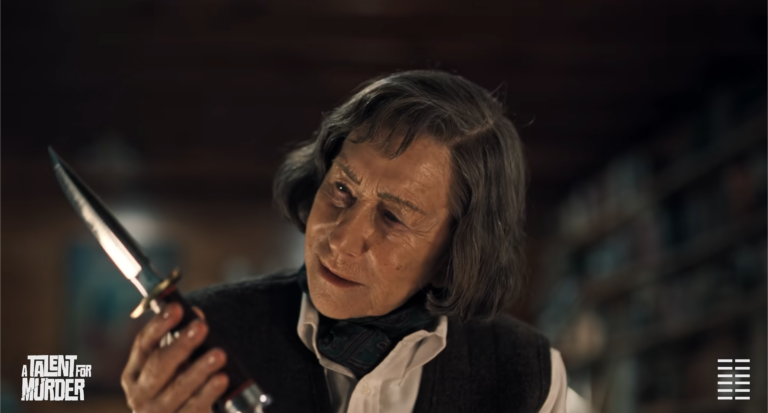
Before A Talent for Murder makes its world premiere at the Toronto International Film Festival on September 10, cognitive science already has a partial answer to the question the film is asking: when crime fiction readers imaginatively inhabit a killer’s mind, they are not merely pretending. They are running a form of threat simulation — a cognitive process that uses many of the same neural mechanisms as planning and responding to real danger. Patricia Highsmith knew this intuitively her entire career, and the new film starring Helen Mirren dramatizes what it costs to know it. TIFF confirmed the film as a world premiere in its 2026 Gala and Special Presentations lineup.
Anton Corbijn’s A Talent for Murder — his first narrative feature in 11 years, rated R and running 1 hour 46 minutes — is set to open in US theaters October 23, 2026, after its TIFF debut. Bleecker Street and LD Entertainment acquired the film for US distribution in July 2026. It is based on Australian playwright Joanna Murray-Smith’s 2014 stage work Switzerland — Corbijn changed the title because the original felt, in his words, “a bit like it was going to be about nice flowers in the meadows. It didn’t feel dark enough,” as he told Vanity Fair. The film poses a question that crime fiction has always lived inside but rarely named: if fully inhabiting a murderer’s perspective is something the genre asks of its readers every time, what happens when a real person is asked to do it for real?
The Story the Film Is Telling — and What It Refuses to Tell You
A young literary agent named Edward Ridgeway (Alden Ehrenreich, a recent Tony Award winner) travels from New York to Highsmith’s isolated Swiss retreat in 1995 with a mission: persuade the reclusive novelist to write one final installment of her Ripley series, after the last man the publisher sent disappeared. She agrees — but only on a condition. He must prove he has the mind of a killer.
What begins as a collaborative writing exercise — Highsmith and Ridgeway developing a plot in which Tom Ripley seduces an heiress named Clementine Balfour (Olivia Cooke, of House of the Dragon) and plots to murder her wealthy great-aunt — gradually stops feeling like fiction. The line between the story they are constructing and the room in which they are constructing it begins to dissolve. Juliet Stevenson also stars as Peggy. The full cast and release details are confirmed on Wikipedia’s film page.
The film’s central dramatic question — whether Ridgeway crosses from fictional complicity into something worse, or whether Highsmith is setting a trap for reasons of her own — is the thing A Talent for Murder is building toward, and it is not answered here. What is answerable, and what makes the film worth entering with more than a passing curiosity, is the intellectual landscape the premise opens up. There are three questions embedded in it, each backed by real research, each illuminated by Highsmith’s documented biography.
Ripley as Clinical Case Study: What Does “the Mind of a Killer” Actually Mean?
Tom Ripley — the charming murderer at the center of Highsmith’s five-novel Ripliad sequence — is among the most discussed potential psychopaths in all of literary fiction. His “talent,” as both the original novel and the film’s title declare, is fundamentally a talent for mimicry. He forges signatures, impersonates his victims after killing them, and wears other people’s identities the way most people wear borrowed clothes.
Contemporary clinical psychology distinguishes between psychopathy and antisocial personality disorder, and the distinction matters for understanding what Highsmith built. Psychopathy — which does not exist as a standalone DSM-5 diagnosis but is formally assessed through Robert D. Hare’s Psychopathy Checklist-Revised (PCL-R) — involves what the triarchic model describes as three components: Boldness (low fear, high social confidence), Disinhibition (poor impulse control), and Meanness (lack of empathy, exploitative tendencies). Ripley scores high on all three. His meticulous planning and emotional flatness after killing align with Boldness and Meanness. His occasional eruptions of jealous rage — killing Dickie Greenleaf not from cold calculation but from envious rupture — suggest the Disinhibition factor.
What neuroimaging research has established about people with high psychopathy scores is that they show reduced activity in the amygdala and prefrontal cortex regions associated with empathy and impulse control — a difference that is neurological, not merely behavioral. Antonio Damasio’s research at the University of Southern California found that subjects with damage to the ventromedial prefrontal cortex reached decisions in moral dilemmas without the emotional anguish that typically accompanies them — not because they were less intelligent, but because a specific emotional-regulatory circuit was absent.
This matters for the film’s premise in a specific way. When Highsmith demands that Ridgeway prove he has the mind of a killer, she may be demanding something structurally impossible: genuine access to a subjective state whose defining feature is the absence of circuits that Ridgeway has. The philosopher Thomas Nagel argued in his landmark 1974 paper in The Philosophical Review “What Is It Like to Be a Bat?” that each conscious experience is tied to a “single point of view,” making it structurally inaccessible to outside observers — not because those observers are insufficiently imaginative, but because subjective experience is definitionally private. What Ridgeway might achieve is a formal model of Ripley’s reasoning — externally coherent, internally hollow.
The Neuroscience of Criminal Imagination: What Crime Readers Are Actually Doing
Highsmith was not the first crime writer to understand that the genre requires something stranger than sympathy. She was among the few willing to say so explicitly. In a 1991 ICA talk, she said she chose to live alone because “my imagination functions better when I don’t have to speak with people.” Her imaginative practice was, by her own account, a form of sustained entry into psychological states that unsettled almost everyone she described them to.
What cognitive science now calls “threat simulation” is the mechanism she was exploiting. Mathias Clasen, an associate professor at Aarhus University and co-director of the Recreational Fear Lab, argued in his 2017 book Why Horror Seduces (Oxford University Press) that humans engage with frightening and violent fictional content “because we have an adaptive tendency to find pleasure in make-believe that allows us to experience negative emotions at high levels of intensity within a safe context.” The mechanism is not mere escapism. It is functional — a form of cognitive rehearsal that trains threat-recognition and emotional regulation using the same neural pathways as the real thing.
A 2021 study by Coltan Scrivner, John A. Johnson, Jens Kjeldgaard-Christiansen, and Clasen, published in Personality and Individual Differences, found that fans of horror films exhibited greater psychological resilience during the COVID-19 pandemic than non-fans, and that “prepper genre” fans (apocalyptic, alien-invasion, and zombie films) showed both greater resilience and preparedness. Trait morbid curiosity — defined as a disposition to seek out information about dangerous or threatening phenomena — independently correlated with positive resilience. The study’s interpretation: fictional engagement with threat scenarios appears to function as genuine preparation for real-world crises.
This is the research context in which Highsmith’s demand of Ridgeway lands differently than it would without it. She is not asking him to perform a party trick or pretend to be someone he is not. She is asking him to do, deliberately and consciously, what crime readers do instinctively every time they open a Ripley novel: run a sustained cognitive simulation of a perspective defined by the absence of remorse, the strategic use of deception, and the instrumental treatment of other people.
The Metafictional Architecture: Three Levels, One House
A Talent for Murder operates on three simultaneous narrative levels, and the formal instability between them is not incidental — it is the film’s structural argument.
At the outermost level is the real historical Patricia Highsmith (1921–1995), born Mary Patricia Plangman in Fort Worth, Texas, who moved to Switzerland in 1982 and died there on February 4, 1995, of aplastic anemia and lung cancer. At the age of nine — not eight, as is sometimes reported — she became fascinated by case histories of abnormal psychology in The Human Mind by Karl Menninger, a popularizer of Freudian analysis. The biography confirms that the book’s vivid case studies of pyromaniacs, sadists, and kleptomaniacs shaped what would become, 46 years later, Tom Ripley.
Graham Greene described her — in the foreword to her 1970 short story collection Eleven — as “the poet of apprehension rather than fear,” and characterized her fictional universe as a world “claustrophobic and irrational which we enter each time with a sense of personal danger.”
At the middle level sits the fictional film-Highsmith, played by Mirren — a fabricated version of the historical author, placed inside a fictional encounter that never occurred. At the innermost level is the fictional Ripley novel Highsmith and Ridgeway are co-writing — a nested murder plot in which Ripley seduces Clementine Balfour with the goal of eliminating her great-aunt.
What the film constructs, formally, is a specific variant of what literary theorist Patricia Waugh described in Metafiction: The Theory and Practice of Self-Conscious Fiction (Methuen, 1984) as the postmodern recognition that “reality or history are provisional: no longer a world of external verities but a series of constructions, artifices, impermanent structures.” The term “metafiction” itself was coined in 1970 by William H. Gass in Fiction and the Figures of Life (Knopf). What distinguishes A Talent for Murder‘s formal architecture from standard postmodern self-reference is that the self-referentiality here is not playful: it carries weight, because the nested fiction involves a detailed plan for killing a real person.
The film’s deepest formal question — implicit in every scene where the collaborative draft bleeds into the Swiss house — is whether the detailed architectural plan for a murder retains moral innocence because of the intent behind its construction. Highsmith’s own fiction consistently refused to let that question rest. As literary critic Anthony Hilfer observed, Ripley is an exemplar of “the protean or perpetually self-inventing man” — a figure who demonstrates that identity is not a possession but a performance. When Ridgeway inhabits Ripley in order to write him, the film asks what it means to perform a performance that involves planning to kill.
Why Corbijn for This Material
Anton Corbijn is the Dutch filmmaker and photographer who built his career at the edge where darkness and art do not separate cleanly. His debut feature, Control (2007), examined Joy Division singer Ian Curtis through an aesthetic that refused both glorification and condemnation — an exhausted, beautiful portrayal of a man collapsing inward. The American (2010) centered a professional assassin in an almost meditative stillness. A Most Wanted Man (2014) placed Philip Seymour Hoffman’s CIA operative inside a Le Carré moral fog that never lifted. In each case, Corbijn built an environment of moral pressure without moral verdict — a frame that watches rather than judges. His complete filmography is documented on Wikipedia.
That sensibility maps directly onto what A Talent for Murder requires. A director who flinched from the material — who rushed toward the resolution that Highsmith knew better than to provide — would collapse the ambiguity that makes the premise work. Corbijn has spent a filmmaking career demonstrating that he does not flinch. His decision to pursue this project — first recognizing its cinematic potential in 2014 and pursuing it for 12 years until the financing and cast aligned — is itself an act of commitment to material that requires patience.
The Reclusion in Switzerland Was Never Simply Withdrawal
That the film is set inside Highsmith’s Swiss retreat is not atmosphere — it is argument. She moved to Switzerland permanently in 1982, initially to the village of Aurigeno, later to Tegna, after French tax authorities fined her for fiscal irregularities she called, with characteristic dryness, “How appropriate — I was bleeding in two places.” She lived there until 1995, increasingly private, selling more books in Germany and France than in the United States, where her publishers could not quite categorize her.
What Europe recognized that America dismissed was precisely the thing that makes A Talent for Murder possible: Highsmith was not writing crime fiction. She was writing psychological literature that happened to involve crime. The genre label protected her from both the appreciation and the accountability her work deserved. Graham Greene understood this. Brigid Brophy, writing in the New Statesman, called her crime novels works that transcended genre limits entirely, “staying strictly inside its rules,” and compared her achievement to what “Sophocles did for the tragedy of fate.”
The Swiss retreat was not refuge. It was laboratory. A woman who read clinical case studies of abnormal psychology at age nine and spent five decades building fictional models of consciousnesses she found more interesting than her own had finally arranged for herself the ideal conditions: silence, distance, and no obligation to perform normality for an audience that would have misunderstood the work anyway.
The film that arrives at TIFF on September 10 enters that laboratory and refuses to leave quietly.
Frequently Asked Questions
What is A Talent for Murder actually about, and is it based on a true story?
The film is based on Joanna Murray-Smith’s 2014 stage play Switzerland (the production was originally developed under that title before being retitled). It is not based on a true story — it is a work of fiction imagining an encounter between the real historical author Patricia Highsmith and a fictional literary agent. Patricia Highsmith was a real person (1921–1995) who did live in Switzerland in her later years and did create Tom Ripley. Edward Ridgeway, the literary agent played by Alden Ehrenreich, is entirely fictional.
Is Patricia Highsmith’s portrayal in the film historically accurate?
The film takes significant creative liberties — it invents the entire central encounter. However, the biographical elements it draws on are grounded in documented history. Highsmith did move to Switzerland permanently in 1982 and died there in 1995. She was notoriously private and reclusive, preferring animals to most people and solitude to social performance. She did claim her imagination functioned best when she was alone, and her attraction to abnormal psychology began in childhood — she read Karl Menninger’s The Human Mind at the age of nine. The film’s premise that she would demand a collaborator demonstrate the capacity for criminal thinking is consistent with her documented biography: she wrote that she was showing “the unequivocal triumph of evil over good and rejoicing in it.”
Can you actually simulate a psychopath’s mind, or does Highsmith’s demand make something impossible?
This is the deepest question the film embeds, and cognitive science now offers a partial answer. Mathias Clasen’s threat simulation theory (supported by peer-reviewed research published in Evolutionary Behavioral Sciences, 2018) confirms that imaginative engagement with criminal and threatening content does activate real cognitive mechanisms — it is not merely metaphorical rehearsal. The Scrivner et al. (2021) study in Personality and Individual Differences found that horror fans exhibited genuine psychological resilience benefits from that engagement. But Nagel’s 1974 philosophy argument complicates the picture: if psychopathic consciousness involves the neurological absence of empathy-processing circuits — a structural difference confirmed by fMRI research showing reduced amygdala and prefrontal cortex activity in people with high psychopathy scores — then what a neurotypical person can produce is a formal external model of that reasoning, not genuine access to the subjective experience. Highsmith’s demand, in other words, may be asking for something achievable in simulation but unavailable in fact. The film’s power lies partly in not resolving which version is true.
Who else is in the film, and where can I see it?
A Talent for Murder stars Helen Mirren as Highsmith, Alden Ehrenreich as literary agent Edward Ridgeway, and Olivia Cooke as Clementine Balfour — the fictional heiress who appears in the Ripley novel they co-create. Juliet Stevenson also stars as Peggy. The film will have its world premiere at the Toronto International Film Festival (September 10–20, 2026) in the Special Presentations section. Bleecker Street and LD Entertainment will release it in US theaters on October 23, 2026. Full cast and production details are available on Wikipedia.