October 12, 2026:


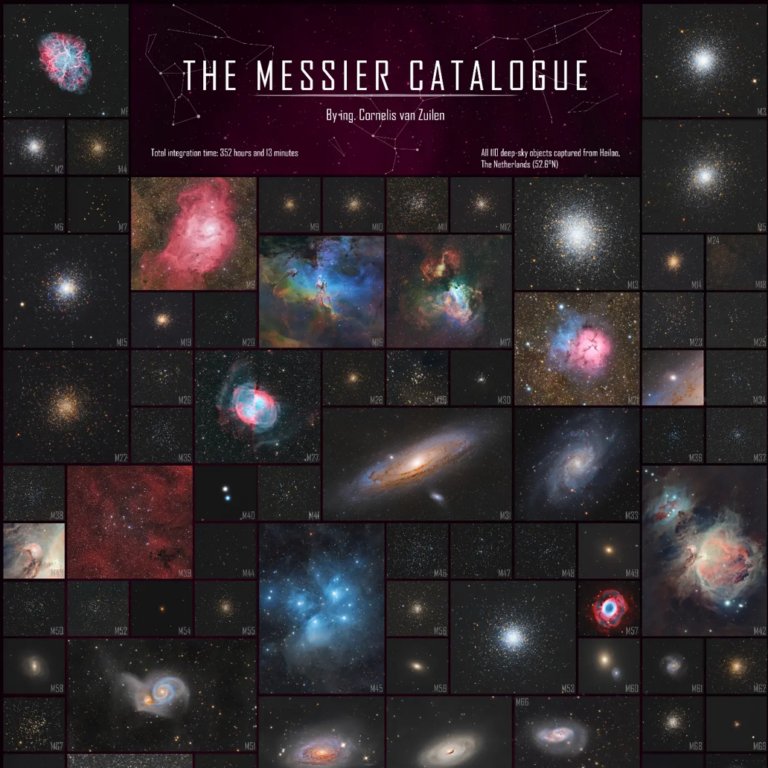
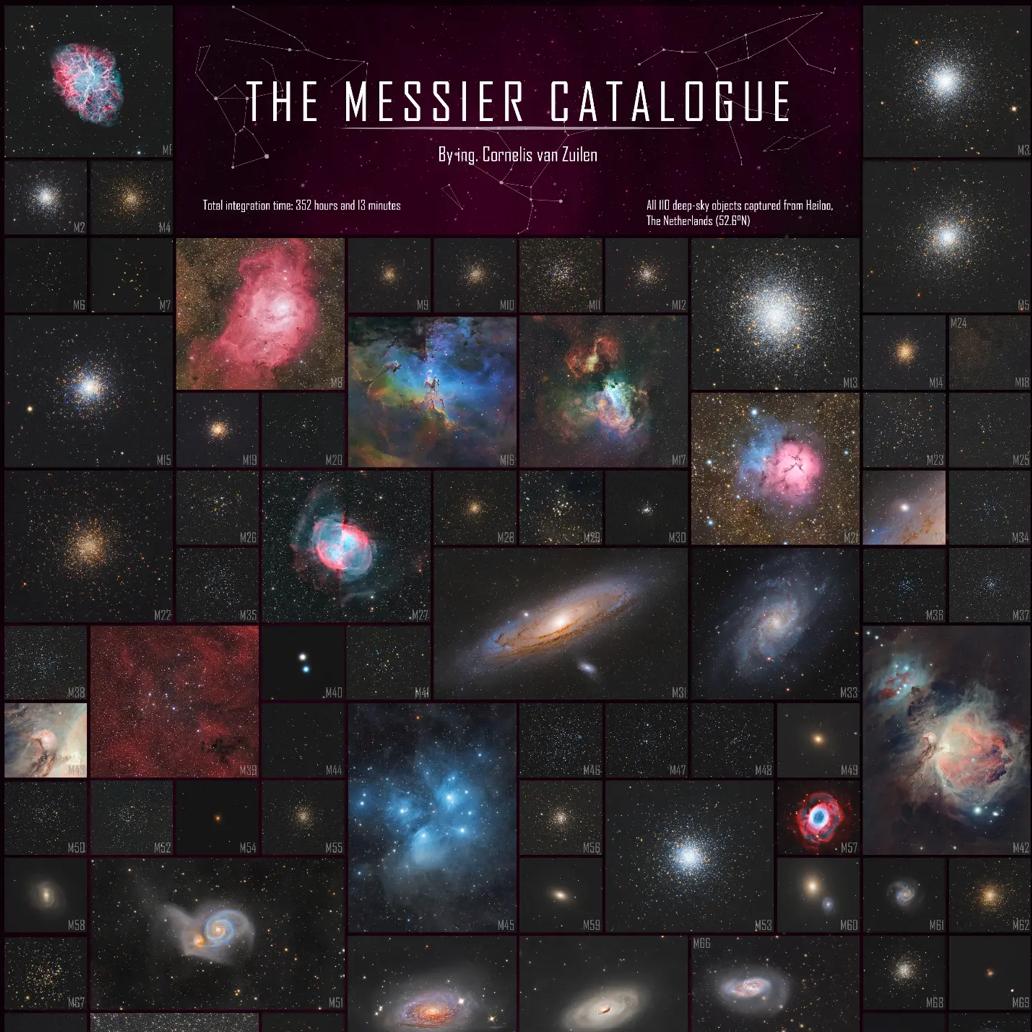
An ambitious astrophotography project has brought together 110 remarkable celestial objects in a single cosmic mosaic, showcasing the galaxies, star clusters, and nebulae cataloged by 18th-century astronomer Charles Messier. Created by Dutch amateur astrophotographer Cornelis van Zuilen, the collection represents hundreds of hours of imaging, extensive post-processing, and numerous nights spent observing the sky from different locations across the Netherlands.
The project required a total of 352 hours and 13 minutes of imaging time. Using specialized telescopes, astronomical cameras, and filters, van Zuilen captured the distant objects before combining and processing the images with astronomy software and Photoshop. The finished mosaic offers a broad view of some of the most recognizable deep-sky targets visible to observers from the Northern Hemisphere.
Beyond its visual appeal, the project demonstrates the patience, technical knowledge, and planning involved in deep-sky astrophotography
Van Zuilen began his deep-sky astrophotography journey in 2024 after purchasing a cooled astronomical camera. One of the first objects he photographed was Messier 45, better known as the Pleiades, a prominent open star cluster in the constellation Taurus.
The experience eventually inspired a larger undertaking: photographing the entire Messier catalog. According to van Zuilen, the decision to capture all 110 objects developed roughly a year and a half before he completed the project.
The scale of the work extended well beyond simply pointing a telescope at each target. Every object required suitable observing conditions, image acquisition, and processing. Some celestial targets could be photographed from his balcony, while others demanded trips to locations with clearer views of the horizon.
The final collection represents 352 hours and 13 minutes of imaging. That figure reflects the time spent gathering astronomical images rather than the entire duration of the project, which also involved travel, equipment setup, image processing, and planning.
The Messier catalog is a collection of deep-sky objects first compiled by French astronomer Charles Messier during the 18th century. Its original purpose was practical: Messier was searching for comets and wanted to distinguish them from other objects that appeared as fuzzy patches of light in the night sky.
Galaxies, nebulae, and star clusters could resemble comets when observed through the telescopes available at the time. By documenting these objects, Messier created a reference list that helped him avoid confusing them with potential comet discoveries.
The catalog has since become one of the most familiar observing lists in amateur astronomy. Its 110 commonly recognized entries include some of the best-known objects beyond the solar system, from nearby star clusters to distant galaxies.
Each entry is identified by the letter M followed by a number. For example, M31 refers to the Andromeda Galaxy, M42 identifies the Orion Nebula, and M45 represents the Pleiades.
Although the catalog was not originally intended as a comprehensive inventory of the universe, it remains a popular introduction to deep-sky observation. Many of its objects can be located with modest backyard telescopes under sufficiently dark skies.
One reason the Messier catalog remains popular is its variety. Its entries showcase different stages of stellar evolution, large-scale galactic structures, and clouds of gas and dust where stars form.
The Andromeda Galaxy, designated M31, is among the most recognizable objects on the list. Located approximately 2.5 million light-years from Earth, it is a neighboring major galaxy in the Local Group. Under dark conditions, it can appear as a faint, elongated patch of light to observers using the unaided eye.
The Orion Nebula, or M42, offers a different view of the universe. Located in the constellation Orion, it is a star-forming region containing gas and dust illuminated by young stars. Its complex structure makes it a particularly rewarding target for astrophotography.
The Pleiades, known as M45, presents a striking contrast. Rather than a distant galaxy or glowing nebula, it is an open cluster of relatively young stars. Its brightest members are surrounded by blue reflection nebulosity, which becomes more apparent in long-exposure photographs.
Together with globular clusters, planetary nebulae, and other galaxies, these objects illustrate the range of celestial structures represented in the Messier catalog.
Capturing the entire catalog presented practical challenges because of the Netherlands’ observing conditions. Artificial lighting, buildings, trees, and the position of celestial objects can all affect astronomical photography.
Van Zuilen photographed many targets from his balcony in Heiloo, a town in the Netherlands. However, some objects required a wider view of the sky than his home location could provide.
To overcome these limitations, he traveled to a nearby semi-dark field where the horizon was less obstructed. These trips sometimes involved sleeping in his car during observing sessions.
Rather than viewing the overnight trips as a burden, van Zuilen described the experience as something similar to camping. The process became part of the personal story behind the mosaic, connecting the final images with the locations and conditions in which they were captured.
Van Zuilen used two telescopes for the project: an Askar 103APO and a William Optics Redcat 51 MK2.5. These instruments provided different optical capabilities for photographing a range of deep-sky targets.
A telescope’s focal length and field of view influence how much of an object fits within a frame and how its details are recorded. Larger objects may require wider-field equipment, while smaller targets can benefit from longer focal lengths and more detailed imaging.
The project also relied on a selection of ZWO astronomical cameras and filters. Cooled astronomy cameras are designed to reduce sensor temperature, helping control thermal noise during long exposures. Filters can isolate particular wavelengths of light or improve contrast under certain observing conditions.
These tools are especially useful in deep-sky astrophotography, where targets may be extremely faint. Collecting sufficient light often requires multiple exposures that are later combined during processing.
The resulting photographs are not simple snapshots. They are carefully assembled records of light gathered over time, revealing structures that may be difficult or impossible to distinguish through a telescope’s eyepiece alone.
Capturing the light is only one part of the process. Deep-sky images typically require substantial post-processing to bring out faint details, control noise, and balance the appearance of celestial objects.
Van Zuilen used PixInsight and Adobe Photoshop to process the images in his mosaic. PixInsight is specialized astronomy software designed for tasks such as calibrating, aligning, stacking, and enhancing astronomical photographs. Photoshop provides additional tools for adjusting color, contrast, and composition.
Image stacking is particularly important in astrophotography. By combining multiple exposures of the same target, photographers can improve the signal-to-noise ratio and reveal details that are difficult to extract from individual frames.
Processing also requires care, according to Space.com. Excessive sharpening, saturation, or contrast adjustments can obscure subtle structures or make an image appear less representative of the captured data. A successful result balances visibility with the preservation of meaningful detail.
For a project covering 110 objects, consistency presents another challenge. Each target has different brightness levels, colors, and apparent sizes, so individual images may require different adjustments before being assembled into a coherent collection.
Although the project was designed to cover the entire Messier catalog, not every object received the same amount of visual space in the final composition.
Van Zuilen explained that some images appear larger because they are among his personal favorites. Many also have individual stories associated with the circumstances in which they were photographed.
Instead of presenting all 110 objects as equally sized entries in a reference chart, the arrangement reflects the photographer’s experiences and preferences.
Such choices are common in astronomical image collections. Some targets offer especially intricate structures, while others become memorable because of difficult observing conditions, successful technical experiments, or the time invested in capturing them.
The finished mosaic therefore serves two purposes: it documents the Messier catalog and records the experiences of an amateur astronomer working through an extensive observational challenge.
The commonly used Messier catalog contains 110 objects. These include galaxies, nebulae, globular clusters, and open star clusters, many of which are popular targets for amateur astronomers.
French astronomer Charles Messier compiled the original catalog during the 18th century. He created the list to distinguish fixed deep-sky objects from comets while searching for new comet discoveries.
Van Zuilen spent 352 hours and 13 minutes imaging the 110 objects. The overall project also required planning, travel, equipment setup, and extensive image processing.
He used an Askar 103APO telescope and a William Optics Redcat 51 MK2.5. He also used ZWO astronomical cameras and filters to collect images of the deep-sky objects.
Notable examples include the Andromeda Galaxy (M31), the Orion Nebula (M42), and the Pleiades star cluster (M45). These objects represent different types of celestial structures and are popular targets for observation and astrophotography.
Yes. Many Messier objects can be observed with binoculars or small backyard telescopes under suitable conditions. Dark skies, clear weather, and familiarity with locating constellations can improve the experience.
PixInsight is commonly used for astronomical image calibration, stacking, and processing. General image-editing software such as Adobe Photoshop can also help refine color, contrast, and composition.