November 28, 2026:


A rust-covered rock that a mushroom hunter picked up in eastern Finland in 2017 was cracked by impacts at least twice, with a period of heating in between, according to the paper’s listed abstract for a Geochimica et Cosmochimica Acta study listed as available online Nov. 27. The same abstract reports that oxygen isotopes in the rock’s olivine fall between those of main-group pallasites and IIIAB iron meteorites, which the authors read as the fingerprint of a previously unknown parent body that no other known meteorite samples.
The “unsampled parent body” part is not the new part. A 2023 University of Maryland study already placed the meteorite on a previously unsampled parent body, and Åbo Akademi University said the same in a November 2025 press release. What the 2026 abstract adds is the oxygen-isotope position and the impact-and-heating sequence.
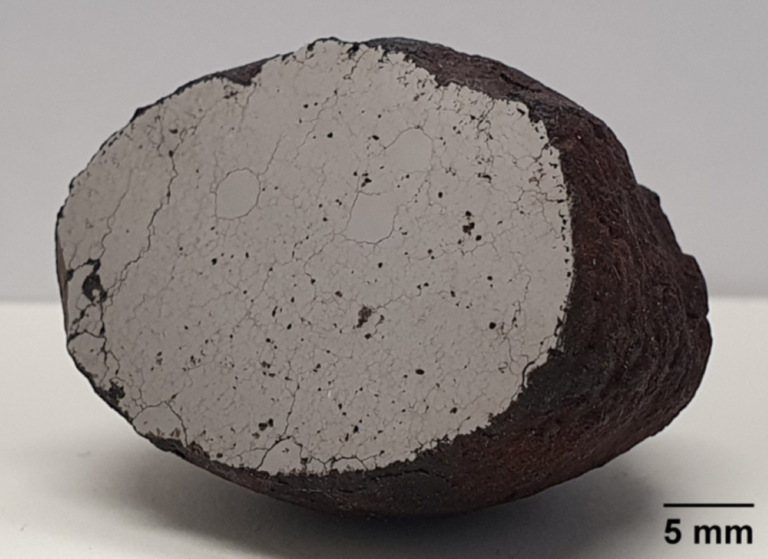
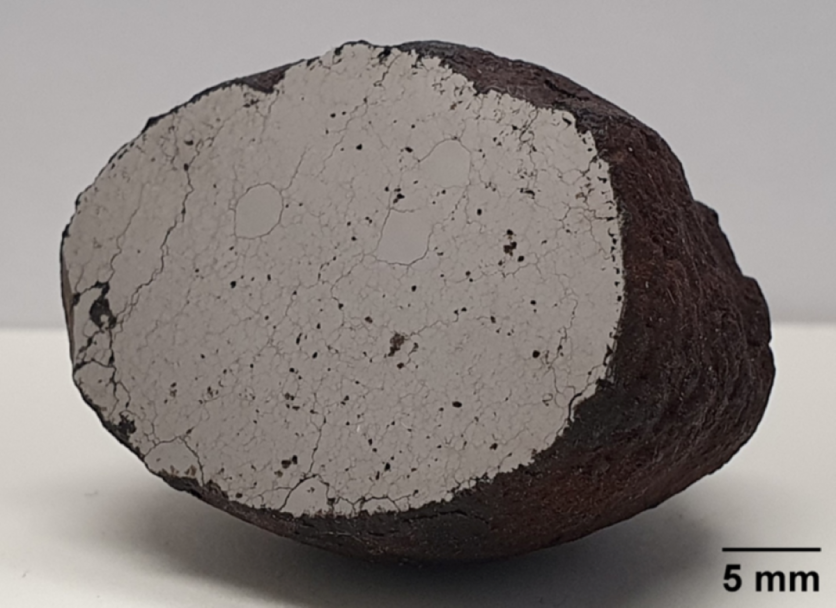
Lieksa is a pallasite, a stony-iron meteorite made of olivine crystals set in nickel-iron metal. This one is classed as “ungrouped,” meaning its olivine and bulk chemistry differ from known pallasite groups and from the known iron meteorite groups.
Pekka Vallimies found the heavy rock on May 30, 2017, at Löpönvaara, about 10 km (6.2 miles) northeast of the town of Lieksa, while searching for false morel mushrooms. He picked it up as a possible ore specimen and later removed the rust with a wire brush.
The rock weighed 280 g as found, or 9.9 oz, and 238.30 g (8.4 oz) once the rust was gone. The Finnish Museum of Natural History took it into the national collection in May 2018. By volume it is about 80% nickel-iron metal and 20% silicate and oxide inclusions, mostly iron-rich olivine.
Oxygen isotopes work as a parent-body fingerprint. A 2022 PNAS Nexus study states that each parent body has a distinct oxygen-isotope value, which is why it could read a mismatch between two minerals as evidence of two bodies.
According to the summary on the karmaka.de listing, Lieksa olivine falls between main-group pallasites and IIIAB irons, and the authors conclude the rock comes from a previously unknown parent body with a unique isotopic fingerprint. IIIAB is a chemical group of medium-octahedrite iron meteorites carrying 7.1% to 10.5% nickel.
The placement lands in a live argument. Whether main-group pallasites and IIIAB irons share a parent body is a long-standing question, and a Meteoritics & Planetary Science paper by R. J. Windmill and colleagues, online July 28, 2026, compared IIIAB oxygen isotope data with main-group pallasite data and concluded the two groups do not share a parent body. A Lieksa composition between the two groups fits the authors’ conclusion of a separate parent body. The listing summary does not say whether the Lieksa authors tie their result to the Windmill paper.
The listing also leaves out the numbers: it reports no oxygen values, no analytical method and no cooling rates, so how far Lieksa sits from either group cannot be judged yet. A Meteoritical Society conference abstract for the 2026 meeting, held Aug. 9–14 in Frankfurt, says Lieksa’s oxygen composition suggests a parent body formed from material similar to the IIIAB irons, while its core crystallization and metal-silicate separation ages differ between Lieksa and IIIAB.
The 2023 study, led by Emily Chiappe at the University of Maryland, reported Lieksa olivine at Fa23, a measure of iron content, against Fa11 to Fa13 in main-group pallasites and Fa19 to Fa20 in Eagle Station pallasites. Its germanium-to-gallium ratio is 28, while main-group pallasites and most magmatic iron groups sit below 5.
Molybdenum, ruthenium and tungsten isotopes placed the metal in the non-carbonaceous group, an isotopic family that likely formed inside Jupiter’s orbit, and a tungsten-based model dated the metal-silicate separation to 1.5 ± 0.8 million years after the first solids in the solar system formed. The authors described the parent body’s oxidation state as closer to carbonaceous planetesimals.
In November 2025, Åbo Akademi University reported that the Lieksa pallasite appears to come from a parent body not previously known from other meteorite discoveries. A new parent body is not unprecedented on its own. Iron meteorites alone indicate a minimum of about 50 parent bodies.
The abstract describes small, rounded olivine grains, 1 to 5 mm (0.04 to 0.2 inches) across, whose boundaries meet at roughly 120° at triple junctions. Petrologists have read that geometry as a sign of annealing for decades: a 1969 Mineralogical Magazine study tied straight 120° boundaries to grain-boundary migration during recrystallization, which moves crystals toward lower interfacial energy.
The texture alone does not say how long the heating lasted. A 2008 laboratory study of olivine found that powder held at 1,350 to 1,550 °C (2,462 to 2,822°F) for 100 hours developed granoblastic texture with 120° triple junctions. The listing also calls the olivine homogeneous and gives no heating duration or temperature.
The metal carries the other half of the record. The nickel-iron matrix, at about 10 wt% nickel, shows micro-Widmanstätten and duplex plessite textures, and the authors propose that the metal cooled rapidly after the final stage of the sequence. Classic Widmanstätten patterns are products of very slow cooling, roughly 100 to 10,000 °C per million years (180 to 18,000°F per million years), and plessite is the fine kamacite-taenite mixture that fills gaps between lamellae. The listing gives no cooling rate, so whether “rapid” falls inside or outside that range is not stated. Silicate and oxide textures also point to rapid cooling from high temperature, according to the conference abstract.
Read together, the proposed sequence is at least two rounds of impact fracturing with annealing between them, then rapid cooling of the metal after the final stage. No dates for the impacts appear in the listing.
Pallasites have long been described as samples from the core-mantle boundary of a differentiated asteroid. Two explanations compete: the older one favors a core-mantle boundary setting, while a newer hypothesis proposes impacts mixed core and mantle material. An oxygen-isotope mismatch between olivine and chromite in main-group pallasites, reported in 2022, supported the impact-mixing side.
Lieksa’s reported history is about fracturing and annealing, not about how its olivine and metal first came together. The listing summary does not address that question.
A second odd meteorite turned up in the same patch of forest about six weeks later, on July 10, 2017. Löpönvaara, a phosphorus-rich iron of about 164 g (5.8 oz), was described in a 2025 paper as an ungrouped iron. The 2025 paper puts it about 350 m (1,148 ft) from the Lieksa find site in its introduction and about 200 m (656 ft) in its discussion, without reconciling the two figures. Its authors wrote that the link between the two meteorites “has yet to be studied” and that shared traits are not enough to tie them together.
More than 100 suspected iron-bearing meteorites have been found in the area since 2017, and only these two are classified. Ten additional finds from the Löpönvaara area went to Åbo Akademi University for research, and the authors suggest the smaller finds may share a heterogeneous parent body, which is a hypothesis, not a finding.
For readers, the takeaway is what kind of claim this is. A rock picked up by a mushroom hunter now carries a proposed record of impact, heat, impact and fast metal cooling on a parent body whose oxygen fingerprint sits between two known groups. The oxygen values, cooling rates and dates that would let others test it have to come from the paper itself.
A pallasite is a rare stony-iron meteorite made of olivine crystals in an iron-nickel metal matrix, split into the main group, the Eagle Station group, a two-specimen pyroxene grouplet and ungrouped members such as Lieksa.
No. The 2023 Maryland study and the November 2025 Åbo Akademi release already reached that conclusion; the 2026 paper’s abstract adds the oxygen-isotope placement between main-group pallasites and IIIAB irons and the two-round impact history.
Yes. Gem-quality peridot has been identified in multiple pallasites; peridot is the gem form of olivine. The Lieksa listing describes its olivine as small rounded grains only 1 to 5 mm (0.04 to 0.2 inches) across.
Not on the evidence reported. The July 2026 Windmill paper concluded the two groups do not share a parent body, and Lieksa’s abstract places its oxygen isotopes between them as a distinct source.