Grado Signature S150 Headphones Go on Sale in Japan December 4 With Plastic Housing, Smaller Driver

November 28, 2026:

Grado Signature S150 Headphones Go on Sale in Japan December 4 With Plastic Housing, Smaller Driver
Grado Signature S150 Headphones Grado Signature S150 Headphones
Gradolabs.com

Knicom (ナイコム), Grado’s distributor in Japan, will put the Signature S150 on sale on Friday, Dec. 4, at ¥49,500 including tax (approximately $310 USD). That is less than one-third of the ¥154,000 Japanese price (approximately $966 USD) of the next-cheapest Signature model, the S550, and the savings come with three specific changes: a one-piece plastic housing, a 44 mm (1.7 in) driver in place of the 52 mm (2.05 in) S driver in pricier Signature models, and cable connectors that differ from earlier Signature models. PHILE WEB reported the release plan at 6:08 a.m. ET on Nov. 27 (8:08 p.m. in Japan). A version with a 4.4 mm (0.17 in) balanced cable will cost ¥57,200 (approximately $359 USD), which is ¥7,700 (approximately $48 USD) more, and an XLR version planned for 2027 has no price or month given. The Japanese retailer Fujiya Avic already lists both versions at those prices with a Dec. 4 release date, shows the standard model as open for preorder with a demo unit on display, and marks the 4.4 mm (0.17 in) version sold out.

Grado announced the S150 on Oct. 22 as the “most accessible entry” into its Signature Line, at $295 in the U.S. and £295 (approximately $387 USD) in the U.K. audioXpress reported that U.S. shipping was expected early November, while What Hi-Fi reported late-November availability. U.S. retailers now carry it: Audio46 lists the headphones at $295, and Turntable Lab lists them too.

Japan Price Sits Under One-Third of Next-Cheapest Signature Model and Below U.S. Price Before Tax

Knicom put the flagship HP100 SE on sale in Japan in December 2024. Japanese prices for the five Signature models, all including tax:

The S150 costs about 32% of the S550’s Japanese price. Japan’s standard consumption tax is 10%, and the prices above include it. Taking the tax out leaves ¥45,000 (approximately $282 USD) for the standard S150, a little under its $295 U.S. price, which typically excludes sales tax. Japanese buyers are therefore not paying a markup over U.S. buyers, as a straight conversion of ¥49,500 (approximately $310 USD) might suggest, although exchange rates move daily and the comparison ignores U.S. state sales tax.

Smaller Paper-Composite Driver Scales Down Flagship Signature Design

The S150 is built around a new 44 mm (1.7 in) S driver with a paper-composite diaphragm, scaled down using technology from larger S drivers measuring 52 mm (2.05 in) in pricier Signature models. Grado describes the tuning goal as detail and clarity with enough low-frequency presence to keep the sound full. By simple geometry, a 44 mm (1.7 in) diaphragm has about 72% of the surface area of a 52 mm (2.05 in) one.

Diaphragm material is a tradeoff rather than a ranking. Wikipedia’s overview of loudspeakers says an ideal cone is stiff, light and well damped, that no single material delivers all three, and that paper is light and well damped but not stiff. No source reviewed gives the composition of the S150’s composite or independent data on how it behaves, so the diaphragm’s real-world performance is unconfirmed.

Why Does Grado Use ABS Plastic Instead of Wood or Aluminum?

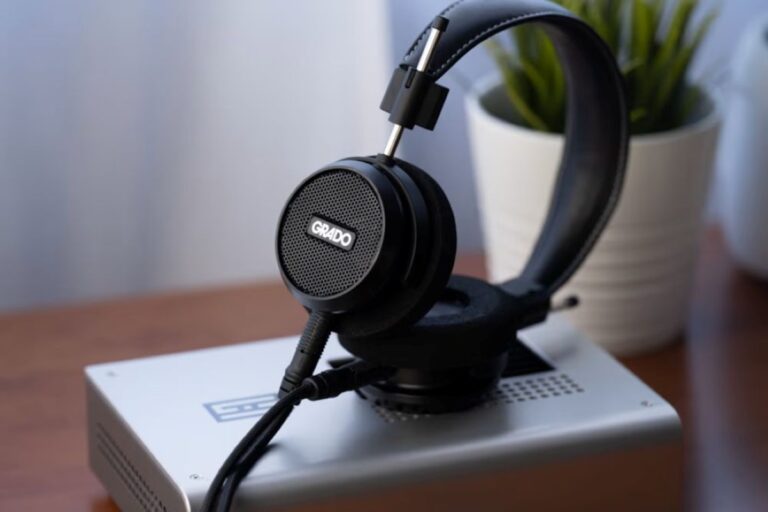
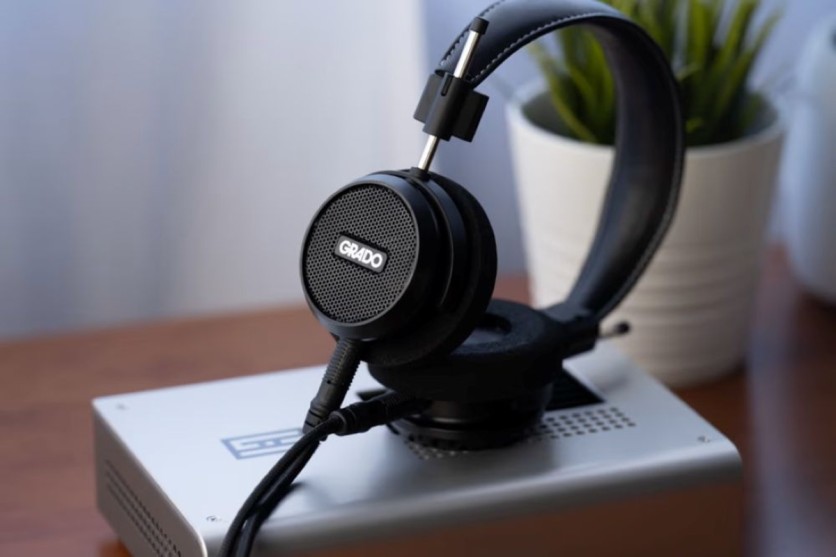
The S150 housing is a single-piece, matte-black acoustic chamber molded from engineered ABS polymer. Pricier Signature models use machined aluminum on the HP100 SE, Brazilian walnut on the S950 and walnut on the S550, and eCoustics contrasted ABS with wood or metal in its launch coverage.

ABS is a lightweight thermoplastic that can be injection molded and extruded. Knicom says the chamber improves driver control and clarity while keeping the housing light and durable, a company claim for which no test data has been published. Knicom’s housing explanation, as reported, cites weight, durability and precision rather than cost.

The S150 weighs about 220 g (7.8 oz), compared with 335 g (11.8 oz) for the S550, a difference of 115 g (4.1 oz), or 34%. Housing material is not the only variable, because the S550 pairs a walnut housing with a 50 mm (1.97 in) S2 driver, and no source reviewed breaks down where the weight difference comes from. The Japanese retailer e-earphone lists the S150 at about 270 g (9.5 oz) with its cable attached.

Different Earcup Connectors Split Signature Line Into Two Cable Systems

The S150 connects to its cable through dual 3.5 mm (0.14 in) sockets, one on each earcup, while the preceding Signature models use four-pin mini-XLR connectors. The included Signature Bronze cable measures about 1.85 m (6.1 ft), ends in a 3.5 mm (0.14 in) plug at the source, and comes with a 6.3 mm (0.25 in) adapter. Because the two connector types are physically different, cables built for the earlier Signature models would not plug directly into the S150, which matters to anyone who owns a Signature headphone and hopes to share cables.

Balanced Version Carries Surcharge, Breaking Pattern on Four Pricier Signature Models

The 4.4 mm (0.17 in) balanced-cable S150 costs ¥57,200 (approximately $359 USD), and the ¥7,700 (approximately $48 USD) difference is ¥7,000 (approximately $44 USD) before tax. Knicom lists S750 balanced cables, same price, S550 balanced models, same price, and HP100 SE and S950 balanced models at prices that match the standard versions, which makes the S150 the only one of the five Signature models in Japan so far with a balanced-cable surcharge.

Balanced audio is an interconnection method that rejects noise picked up along a cable. No source reviewed for this article reports an audible difference between the S150’s standard and balanced versions, so the surcharge buys a different cable termination rather than a documented sound upgrade. Knicom’s announcement, as reported by PHILE WEB, does not explain the surcharge.

Impedance of 38 Ω and 104 dB Sensitivity Set Modest Drive Demands

Grado’s published specifications for the S150, as listed on Audio46’s product page and by audioXpress’s launch report:

Spec Value (Grado’s figures)

Frequency response

16 Hz to 34 kHz

Sensitivity

104 dB SPL at 1 mW

Impedance

38 Ω

Total harmonic distortion

Below 0.3% at 100 dB

Driver matching

0.05 dB

Wikipedia’s headphone overview classes 16 to 32 Ω as low impedance and 100 to 600 Ω as high, and says high-impedance headphones need more voltage for the same loudness. At 38 Ω, the S150 sits just above the low range. Using Grado’s figures, the S150 needs about 0.12 volts RMS to reach 100 dB sound pressure and about 0.39 volts RMS to reach 110 dB, a calculation from the published ratings rather than a measured result. Wikipedia also advises that an amplifier’s output impedance stay below one-eighth of the headphone’s impedance, which is about 4.8 Ω here, to avoid added distortion.

The ratings carry limits. Grado quotes distortion at a single level, 100 dB, and Wikipedia notes that total harmonic distortion is not standardized, which makes figures hard to compare across manufacturers. The S150 is also an open-back design, which leaks more sound out and lets more ambient sound in than a closed-back headphone, and Wikipedia says closed-back designs usually produce stronger low frequencies.

Sound Quality Remains Unverified Without Independent Measurements

Hands-on coverage so far includes a listening review published by Audio46, a U.S. retailer that sells the headphones. Early pieces from eCoustics’ launch product page and TechRadar’s launch coverage were written at launch and report no listening tests. SoundMavericks’ November write-up says the site has not tested the S150. eCoustics also cautioned that it would be premature to assume the S150 matches the refinement of the HP100 SE or S950, because it shares only some engineering ideas with them.

XLR Price, Balanced Premium Reason and Cost Rationale Remain Unreported

Knicom has given no price or month for the XLR-cable version planned for 2027. PHILE WEB states ¥49,500 (approximately $310 USD) as a price rather than describing it as open pricing, and e-earphone lists ¥49,500 tax included, but the Knicom release itself was not retrieved for this article. Knicom says the model was developed for a more accessible price range, but no source reviewed breaks down how the smaller driver, the ABS housing or the 3.5 mm (0.14 in) connectors contribute to the price.

For buyers weighing the S150, the trade is specific. It keeps the Signature name, an open-back dynamic design and a driver scaled down from the flagship models, at under one-third of the next-cheapest Signature price in Japan and below the U.S. price once Japanese tax is removed. It gives up the 52 mm (2.05 in) driver, the wood or machined-metal housing and the earlier cable connectors, it adds a surcharge for the 4.4 mm (0.17 in) balanced option, and its sound quality still awaits independent measurements.

Currency conversions are approximate, use mid-market rates from Nov. 27, 2026 (about 159.5 yen per U.S. dollar and $1.31 per British pound), and shift as exchange rates move.


Frequently Asked Questions

What is the difference between the Grado S150 and the S550?

The S550 uses a 50 mm S2 driver, a Brazilian walnut housing and weighs 335 g (11.8 oz), while the S150 uses a 44 mm (1.7 in) S driver, an ABS housing and weighs 220 g (7.8 oz). In the U.S., Grado lists the S550 at $995, the next-cheapest Signature model, against $295 for the S150.

Is the Japanese price higher than the U.S. price?

Not after tax. Japan’s 10% consumption tax is included in ¥49,500 (approximately $310 USD), and removing it leaves ¥45,000 (approximately $282 USD), compared with $295 in the U.S. before sales tax. Exchange-rate changes can shift the gap.

Can I use cables from other Grado Signature headphones with the S150?

Not directly. Earlier Signature models connect through four-pin mini-XLR plugs at each earcup, while the S150 uses dual 3.5 mm (0.14 in) connections and ships with its own Signature Bronze cable. Check with Grado or a retailer before buying a cable for a mixed setup.

Does the Grado S150 need a headphone amplifier?

Grado’s ratings of 38 Ω and 104 dB per milliwatt are modest next to the 100 to 600 Ω headphones Wikipedia describes as needing more voltage. How it sounds from a phone, a dongle or a desktop amplifier has not been independently measured, and as an open-back headphone it will not isolate the listener from surrounding noise.

Source link