HomeAuto South Korea Flu Hospitalizations Hit 926: Seniors Already Top Last Season’s Peak Level
South Korea Flu Hospitalizations Hit 926: Seniors Already Top Last Season’s Peak Level
November 21, 2026:
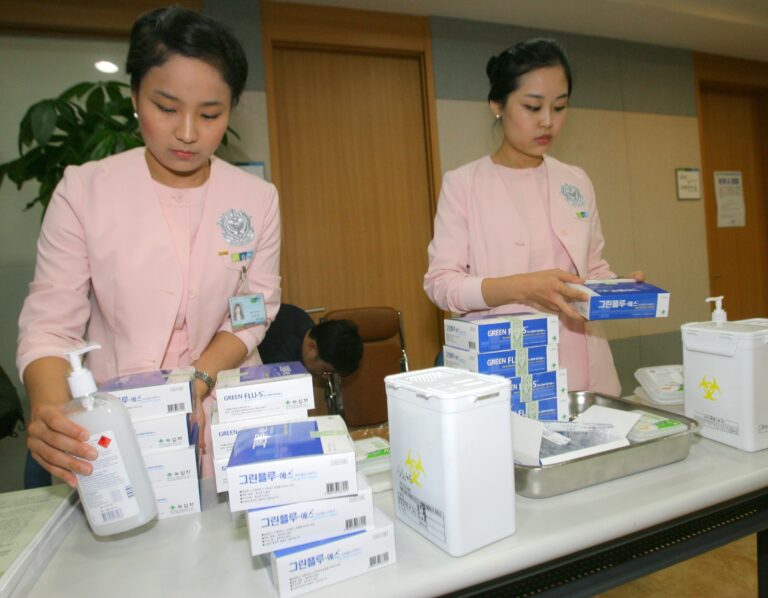
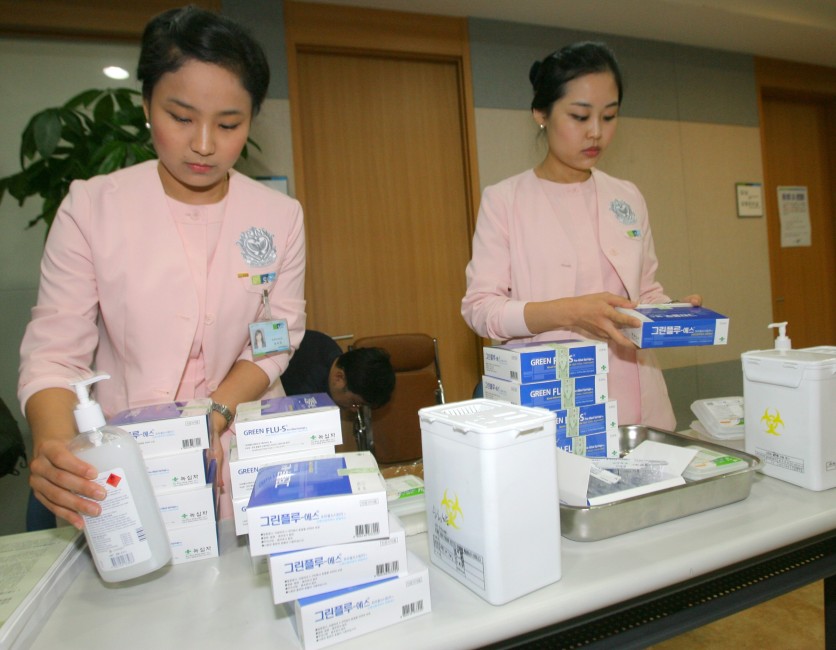
South Korean nurses handle boxes of swine flu vaccines in a hospital on October 27, 2009. South Korea has begun distributing a large amount of vaccines to stop the spread of the H1N1 virus. AFP PHOTO / WON DAI-YEON WON DAI-YEON/AFP via Getty Images
South Korea’s Korea Disease Control and Prevention Agency (KDCA) reported on Nov. 20 that 223 sentinel hospitals recorded 926 influenza hospitalizations in epidemiological week 46 (Nov. 8–14), up about 45% from 639 a week earlier and nearly double the 490 logged in the same week last year.
Adults 65 and older accounted for 606 of those admissions, or 65.4%, already beyond the 329 this age group recorded at last season’s peak in week 48 of 2025. The stakes are practical for older adults and their families: KDCA’s clinic-based flu count requires a fever, and the hospital data suggest that count may understate how hard this season is hitting seniors, about one in four of whom have not had a flu shot, based on 74.8% vaccination coverage.
Week 46 Hospital Data: Admissions Climb 45%, Seniors Make Up 65.4%
Indicator (week 46, Nov. 8–14)
This season
Comparison
Flu hospitalizations, 223 sentinel hospitals
926
639 prior week; 490 same week last year
Hospitalizations, adults 65+
606 (65.4% of total)
329 at last season’s peak (week 48, 2025)
Deaths among flu-positive patients (provisional)
44
24 prior week
Influenza-like illness (ILI) per 1,000 clinic visits
37.0
28.9 prior week; 66.3 same week last year
Flu positivity, clinic patients with respiratory symptoms
33.1%
Reported by KDCA for week 46
Reported deaths rose about 83% in a week, from 24 to 44. KDCA’s count is provisional and covers patients who tested positive within 30 days before death, so influenza may not be the cause of every death counted. For scale, Korea’s deaths directly attributed to influenza run about 200 a year, while KDCA and academic researchers estimate 2,000 to 3,000 a year once indirectly linked excess deaths are counted, so the weekly figure is not a like-for-like comparison with either number.
Why Are Clinic Flu Counts Lower Than Last Year When Hospital Admissions Are Higher?
Outpatient surveillance has climbed four straight weeks, from 17.7 per 1,000 clinic visits in week 42 to 37.0 per 1,000 clinic visits in week 46. That is still well below last year’s 66.3 in the same week and 69.4 in week 48, during an early wave of the A(H3N2) subtype. This season’s circulating virus is A(H1N1)pdm09, which KDCA says matches this season’s vaccine strain, with no mutations linked to antiviral resistance found.
The age mix explains part of the difference. Children aged 7–12 had the highest clinic rate this week at 98.9 per 1,000 visits, followed by ages 13–18 (64.5), 1–6 (46.6) and 19–49 (39.5). In the same week last year, children aged 7–12 stood at 170.4 per 1,000 visits, and ages 13–18 at 112.6. This year’s school-age wave is smaller, and the hospital burden has shifted toward older adults. For adults 50 and older, KDCA said clinic rates are already comparable to last season’s peaks, though it gave no exact figure. The Nov. 20 coverage reviewed for this article includes no KDCA explanation for the divergence between its clinic and hospital streams.
Clinic Flu Counts Require Fever, and Older Adults With Flu Can Lack One
KDCA defines influenza-like illness as a fever of 38°C (100.4°F) or higher plus cough or sore throat. Under that definition, adults 65 and older posted the lowest clinic rate of any age group in KDCA’s week 44 age breakdown: 10.1 per 1,000 visits, against 60.9 for children aged 7–12. In that same week, adults 65 and older made up 64.9% of hospital admissions. Last season showed the same structural gap: in week 48 of 2025, adults 65 and older registered 11.9 per 1,000 visits while children aged 7–12 registered 175.9.
Fever may be one reason. The U.S. Centers for Disease Control and Prevention (CDC) says many people sick with influenza do not have a fever, especially those who are older or immunosuppressed, and that frail older adults in long-term care can show atypical signs such as mental status changes, behavior changes or loss of appetite. The American Geriatrics Society’s Health in Aging site says up to half of frail older adults do not develop a fever even with a serious infection. KDCA has not said that fever-based counting accounts for South Korea’s gap. The shift from last year’s H3N2 virus to H1N1, and differences between clinic and hospital networks, may also contribute.
Is This Flu Season Worse Than Last Year in South Korea?
On several measures it started earlier and has hit hospitals harder, but it has not yet matched the worst recent season. KDCA issued its 2026–27 influenza epidemic advisory on Sept. 11, about a month ahead of the Oct. 17 advisory last year. Last year’s advisory was itself earlier than the previous season’s December advisory.
The Seoul Institute of Health and Environment, testing patient and sewage samples, found case counts were rising at the end of August, three weeks ahead of last year, and detected the virus in sewage at the end of July, six weeks ahead of last year. Jung Jae-hun, a professor at Korea University College of Medicine, told the Korea Herald that since the COVID-19 pandemic the cycle of respiratory virus spread has changed.
Among adults 65 and older, hospital admissions are already above last season’s peak, with 606 admissions in week 46 against 329 at that peak. But the 2024–25 season set a higher bar overall: sentinel hospitals logged a peak of 1,632 admissions in week 2 of 2025, and adults 65 and older made up 52.4% of that season’s admissions. This week’s 926 is roughly 57% of that record. Admissions have risen each of the last three reported weeks, from 389 in week 43 to about 460 in week 44, 639 in week 45 and 926 in week 46.
Seniors’ Flu Shot Coverage Hits 74.8%, but About One in Four Remain Unvaccinated
The national free program covers adults 65 and older, pregnant women and children from 6 months through 14 years. Eligibility for children was extended this season to include 14-year-olds. Shots for children and pregnant women began Sept. 21. Seniors started in stages: those 75 and older on Oct. 6, ages 70–74 on Oct. 12 and ages 65–69 on Oct. 15, each moved up three to six days from earlier planned dates because of the early season. The vaccine is a trivalent vaccine with WHO-recommended strains, and the program runs through April 30, 2027.
As of 4 a.m. ET on Nov. 19 (6 p.m. in Seoul), about 8.57 million adults 65 and older had been vaccinated, a coverage rate of 74.8%, and about 2.96 million eligible children had received a dose, or 59.8%. KDCA’s week 46 summary does not break out vaccination status for the 606 hospitalized seniors, so it cannot show how many of them were vaccinated. The government secured 12.33 million doses for the program plus 370,000 for the private sector, and total supply is about 4 million doses lower than last season.
Vaccination protects older adults more against severe outcomes than against infection itself. In its first joint annual flu report with the National Health Insurance Service, published April 17, KDCA estimated death prevention in older adults of up to 81.1% (a range of 38.1% to 81.1% across study designs and age groups) for the 2024–25 season, while the estimated effect against infection in older adults was less than 20%. KDCA Commissioner Lim Seung-kwan said hospitalizations are nearing 1,000 and that severe cases are unusually high compared with prior years, and he urged unvaccinated older adults, children and pregnant women to get vaccinated promptly. Eligible people can be vaccinated at roughly 23,000 contracted medical institutions or public health centers, regardless of where they live.
Korea University Experts Push Broader Eligibility and Stronger Senior Shots; KDCA Weighs Adjuvanted Vaccine
Two Korea University physicians have argued that the current program design falls short, from different directions. Kim Woo-joo, an infectious diseases professor at Korea University Guro Hospital, wrote in an October 2025 column for the Seoul city government that low vaccination among active young and middle-aged adults keeps flu spreading, and recommended vaccination for everyone aged 6 months and older. His comments predate this season.
Choi Min-ju, an infectious diseases professor at Korea University Guro Hospital, argued in July that the debate should move beyond coverage rates to the quality of protection. She said that, because of immunosenescence, the age-related decline of immune function, older adults’ antibody formation reaches about 40–80% of that in healthy adults, and noted that the United States, United Kingdom and Australia already prioritize enhanced or high-dose vaccines for those 65 and older. Choi has also led a cost-effectiveness study of an adjuvanted vaccine for older adults, a product type relevant to the policy she describes.
KDCA’s own data credit the current program: its annual report estimated vaccination averted 3,506 deaths in 2024–25. The agency is also looking ahead. KDCA has designated a high-immunogenicity flu vaccine for older adults a priority review item for the national program. A KDCA official told FN News in September that the agency is weighing a phased rollout starting with adults 75 and older, with the target group depending on budget talks with finance authorities and the National Assembly. Shim Eunha, a mathematics professor at Soongsil University, presented a model estimating that switching adults 65 and older to an adjuvanted vaccine would prevent 125,240 symptomatic infections and 15,696 hospitalizations per season. That is a modeled estimate, not observed data. The vaccine in the current program is the trivalent formulation described above, not a high-immunogenicity product.
KDCA Chief Lim Seung-kwan Promised Data-Driven Forecasting and More Sentinel Sites Last Year
Lim, an infectious diseases specialist who took office as KDCA commissioner on July 14, 2025, told reporters on Sept. 9, 2025, that the agency would focus on data-based disease prediction and greatly expand its sentinel surveillance institutions. Sentinel surveillance, which tracks disease through a selected network of clinics and hospitals rather than counting every case, is the system behind both the clinic and hospital numbers in this report. KDCA later said it would expand its clinic-based respiratory sentinel sites from 300 to 800 sites in 2026. The April 17 annual report also showed KDCA linking vaccination records with insurance claims to estimate vaccine effectiveness, a data-linkage approach that goes beyond the weekly sentinel counts.
Week 47 Data Will Show Whether Admissions Keep Climbing Toward 2024-25 Record
Week 47 runs Nov. 15–21, and KDCA’s next weekly figures will show how the hospital and clinic streams move relative to each other.
Admissions. Whether hospitalizations keep rising from 926 will show how close the surge is to a peak, and whether it approaches the 2024–25 record of 1,632.
Deaths. Whether the provisional count continues to rise from 44, and whether later reviews link the deaths to influenza.
Clinic rates. Whether outpatient ILI, now at 37.0, accelerates toward last year’s levels or hospital strain stays ahead of it.
Child vaccination. Whether coverage among eligible children, now 59.8%, rises given that children have the highest clinic ILI rates.
For seniors and the people who care for them, the Nov. 20 data suggest that hospital admissions, more than clinic fever counts, show where this season is hurting most, and a free shot remains available through April 30, 2027. KDCA’s Nov. 6 advisory urges anyone with fever, cough or sore throat to seek prompt diagnosis and treatment, and the CDC notes that older adults can fall ill with flu without a fever, so a sudden change in an older person’s mental state or appetite is worth raising with a clinician, given the atypical signs in older adults it describes.
Frequently Asked Questions
Do older adults always get a fever with the flu?
No. The CDC says many people sick with influenza do not have a fever, especially those who are older or immunosuppressed. Because KDCA’s clinic counts requires a fever of 38°C (100.4°F) or higher plus cough or sore throat, seniors without a fever would not appear in that count, though KDCA has not published an estimate of how many are missed.
Who can get a free flu shot in South Korea?
Adults 65 and older, pregnant women, and children from 6 months through 14 years, at contracted medical institutions and public health centers regardless of home address, through April 30, 2027. Children under 9 with no prior flu vaccination, or only one prior dose, receive two doses.
Does the weekly death count mean flu killed 44 people?
Not necessarily. The figure is provisional, counts flu-positive patients who tested positive within 30 days before death, and may include deaths from other causes. KDCA says influenza may not be the cause of every death counted.
How did Seoul detect this season’s flu before clinics saw a surge?
The Seoul Institute of Health and Environment tested sewage as well as patient samples. It detected the virus in sewage at the end of July, six weeks ahead of last year, while clinic case counts began rising at the end of August.