November 21, 2026:


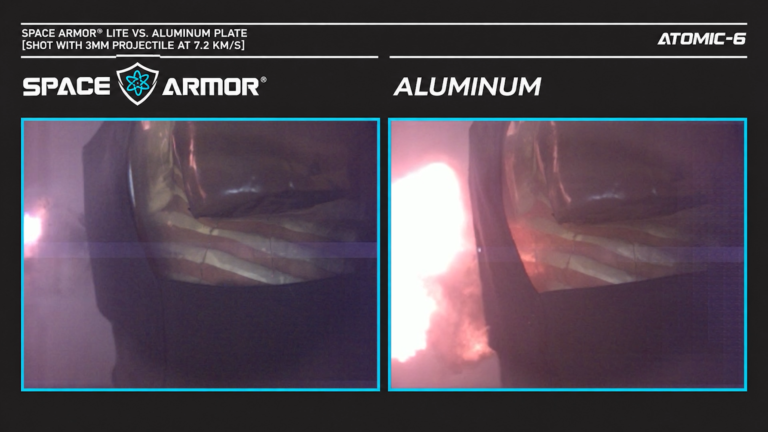
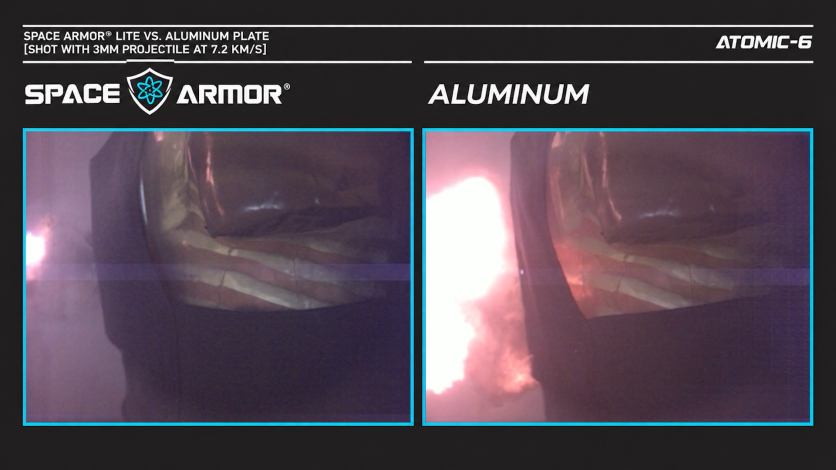
Atomic-6, a Marietta, Georgia, composites maker, said Friday that a Space Armor Lite tile, a debris shield built for satellites, left a transparent torso dummy with no visible damage after a 3-mm (0.12 in) aluminum sphere struck it at about 7.2 km/s (4.5 miles per second), or roughly 16,100 mph, at Texas A&M University’s Hypervelocity Impact Laboratory. A 4-mm (0.16 in) solid aluminum plate, which Atomic-6 used to represent current spacesuit protection, did not hold up the same way: fragments lodged in the torso behind it.
The comparison is narrower than the headline speed suggests. Atomic-6 tested one tile and one plate against a stationary dummy with no spacesuit, pressure garment or life-support hardware, and the company says the results do not establish injury outcomes, pressure retention or readiness for use in space. By TechTimes’ arithmetic, the tile is about 30% heavier per unit area than the aluminum control, and the release does not say whether the two shields were matched by weight.
Atomic-6 released the results at 9 a.m. ET Friday, a month after a Space Armor tile first reached orbit on Portal Space Systems’ Starburst-1 spacecraft. For anyone following spacewalk safety, the result raises a question that the release leaves open: how much protection a tile adds once weight, mobility and a pressurized suit enter the picture.
Atomic-6 fired a 3-mm aluminum sphere at a hexagonal Space Armor Lite tile and, separately, at a 4-mm solid aluminum plate, with a ballistic torso behind each. The torso, supplied by Georgia company Ballistic Dummy Lab, is transparent and contains simulated soft tissue and skeletal structures. Atomic-6 says impact angle, spacing between shield and torso, and mounting were identical in both shots.
Behind the tile, the company reports no visible marks or penetration in the torso and no bulging, cracking or material leaving the tile’s back surface. Atomic-6 chose the plate’s thickness using NASA ballistic-limit equations; the release credits NASA only as the source of those equations and does not say the agency reviewed the results. Atomic-6 supplied a photo of the dummy after the aluminum shot.
The release describes one composite test and one aluminum comparison, gives no test date and calls the work a proof of concept.
Aluminum has a density of about 2,700 kg per cubic meter (169 lb per cubic foot), so by TechTimes’ calculation a 4-mm solid plate weighs about 10.8 kg per square meter (2.2 lb per square foot). Space Armor Lite is listed at 14 kg per square meter (2.9 lb per square foot), about 30% more. That is not a flaw in the tile, but it means the result shows a heavier composite outperforming a lighter plate, not a like-for-like weight trade.
Weight matters because a spacewalker carries it. The International Space Station version of NASA’s spacesuit has a listed suit weight of 122 lb (55.3 kg). At 2.9 lb per square foot, every square foot of tile coverage would add that much before attachment hardware, and Atomic-6 has not said how much of a suit it would cover.
Hypervelocity impacts happen at roughly 3 km/s (6,700 mph) or faster, where a material’s strength matters little compared with the inertia of the impact. TechTimes’ calculation puts the 3-mm sphere at about 0.04 g and its energy at about 990 joules (730 foot-pounds of force) at 7.2 km/s.
The release says the test focused on rear-face spalling, in which material breaks off the back of a shield. In metal armor, a shock wave can reflect as a tensile wave off the free back surface, tearing fragments loose from inside, and many armored vehicles carry spall liners to catch them. In orbit, that distinction matters because a shield can stop a particle yet still throw fragments at whatever sits behind it.
Spaced shields attack the problem differently. A Whipple shield places a thin bumper some distance from the main wall so the particle shatters and spreads its energy over a larger area, but it needs a gap, and NASA says such designs are intended for debris up to about 1 cm (0.4 in). Atomic-6 CEO Trevor Smith has said metal Whipple shields need 4 to 6 inches of standoff, while Space Armor is under an inch thick.
What the tile is made of remains largely undisclosed. Atomic-6 describes a proprietary fiber-to-resin process that tunes the ratio and cuts porosity, and Space.com’s Space Armor report does not name the fibers or resins. Smith says the armor starts working around Mach 10, and neither the release nor Payload’s report gives the tile’s layup.
Relative speeds in Earth orbit can reach about 18 km/s (about 11 miles per second), which is why very small particles can do damage. Kinetic energy rises with the square of speed, so TechTimes estimates the same 3-mm sphere would carry about 6,200 joules (4,600 foot-pounds of force) at 18 km/s, roughly 6.25 times the test energy.
The test speed is comparable to past NASA suit testing. NASA used a light-gas gun at about 7 km/s (4.3 miles per second) in its own spacesuit-garment tests, and the light-gas guns at its White Sands hypervelocity laboratory fire at up to 8.5 km/s (5.3 miles per second).
Particle size is the other limit. Atomic-6 has said Space Armor Lite withstands debris up to 3 mm, the same size as the test sphere, so the shot sat at the tile’s stated limit. The company says its Max version targets objects up to 12.5 mm (0.49 in) and is meant for human-rated spacecraft and habitats. The European Space Agency’s model puts about 68,000 objects larger than 10 cm (3.9 in) and about 1.5 million between 1 and 10 cm (0.4 and 4 in) in orbit, according to ESA’s DISCOS debris statistics for February 2026.
NASA’s spacesuit outer layer is a white Ortho-Fabric blend of Gore-Tex, Kevlar and Nomex over seven layers of aluminized Mylar. The 4-mm aluminum plate is therefore a stand-in for current spacesuit protection chosen through ballistic-limit equations, not a section of suit.
A 2007 NASA assessment found the suit’s outer garment had a 0.94 probability of no penetration against a requirement above 0.91 over 2,700 projected hours of two-person spacewalks, and that tested enhancements would improve that figure only slightly.
Yes, though NASA’s estimate puts the odds low. Dana Weigel said in November 2021 that the baseline chance of debris puncturing a suit is about 1 in 2,700 during a standard six-and-a-half-hour spacewalk, and that a Russian anti-satellite test raised it by about 7%. Weigel added that a penetration would not necessarily be catastrophic.
Today’s government tracking can follow debris only when it is larger than about 10 cm (3.9 in), which leaves the fragments Atomic-6’s tile targets effectively invisible. In November 2025, China’s Shenzhou-20 crew found a crack in their return capsule’s window that a Shenzhou spacecraft designer attributed to debris smaller than 1 mm (0.04 in); the crack extended more than 1 cm (0.4 in). The crew returned on Nov. 14, 2025, aboard a different capsule, Shenzhou-21.
Atomic-6, founded in 2018, developed Space Armor with a $1.2 million SBIR Phase 2 award from the Small Business Innovation Research program and a $3.8 million Tactical Funding Increase agreement, funded by the U.S. Air Force and Space Force. Portal chose the tiles in January as its primary micrometeoroid and orbital debris protection.
Starburst-1 lifted off Oct. 20 aboard a SpaceX Falcon 9 on the Bandwagon-5 rideshare mission and is planned for a one-year mission in sun-synchronous orbit. In August, Smith told the Atlanta Journal-Constitution that Atomic-6 hoped to attach a camera to capture debris impacts. No in-orbit impact data from the tile has been reported yet.
Former International Space Station commander Chris Hadfield, who sits on Atomic-6’s advisory board, calls the early results “very encouraging” and says further testing will show whether the material could add a layer of safety for astronauts, according to the release quoting Hadfield. He joined the board in connection with the company’s Light Wing solar array program. He also sits on Virgin Galactic’s advisory board and advises Kepler Communications. Neither the release nor the coverage reviewed discloses the terms of his Atomic-6 role.
The release does not claim independent verification of the results, and Payload quotes no independent expert on the results.
Atomic-6 says next steps include curved shielding and different impact angles to better match chest or shoulder geometry, and that any spacesuit use would require evaluating attachment points, mobility, pressure retention and thermal-vacuum performance. The company is in early talks with suit makers about where armor could fit without restricting movement and has named no partner.
The decision framework for readers is short. The result is one vendor-reported shot in which a heavier tile outperformed a lighter plate at a speed comparable to past NASA suit testing, against a debris size at the tile’s rated limit. It is not a suit test, not independently verified and silent on pressure and mobility. The evidence that would change that picture is a weight-matched comparison, tests against real suit fabric layups, higher-speed and larger-particle shots, and impact data from Starburst-1.
At 14 kg per square meter (2.9 lb per square foot), it is about 30% heavier per unit area than the 4-mm solid aluminum plate used as the control, by TechTimes’ calculation. Atomic-6 has not said how it would limit weight on a suit.
No. Relative speeds in orbit can reach about 18 km/s (about 40,000 mph), well above the test speed. NASA used about 7 km/s (4.3 miles per second) in its own spacesuit-garment tests, so the Atomic-6 shot is comparable to past suit testing, not to the fastest real-world impacts.
Not yet. Atomic-6 says the results do not establish injury outcomes, pressure retention or readiness for use in space.
The release describes no independent verification, and the testing was done at a university lab using a torso from an outside supplier.