
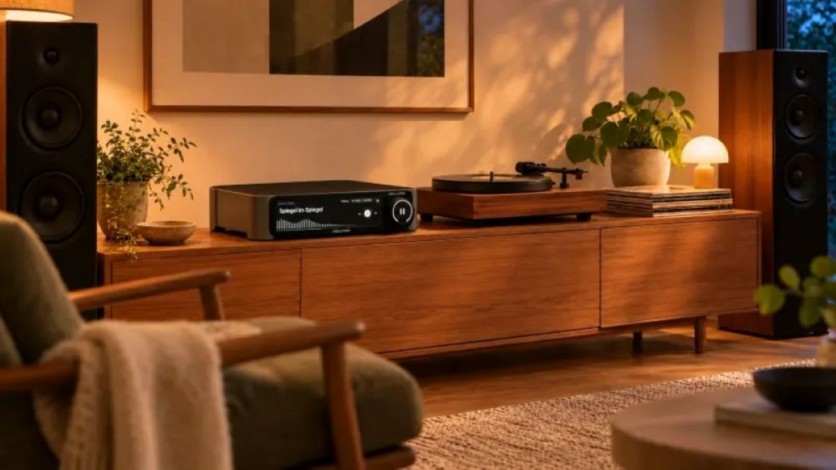
Volumio Rivo Ultra Streamer Pre-Order Costs $4,999 With No DAC and Unmeasured Clock Claims

November 20, 2026:

Volumio Rivo Ultra Streamer Pre-Order Costs $4,999 With No DAC and Unmeasured Clock Claims
Volumio Rivo Ultra Streamer
Volumio.com

Volumio’s Rivo Ultra streaming transport is available to pre-order at $4,999 and is due to ship from Nov. 30, per Volumio, but buyers still need to supply their own digital-to-analog converter (DAC). The headline spec, a clock rated at 54-femtosecond RMS phase noise, comes from Volumio alone, with no stated measurement band and no independent test published yet.

The Florence-based company lists the unit at £3,499 (approximately $4,608) in the UK and about AU$6,900 (approximately $4,645) in Australia, according to What Hi-Fi? pricing coverage.

Rivo Ultra Costs $4,999 With No DAC Included, Triple Rivo Plus Price

Volumio’s U.S. shop page lists $4,999.00 including shipping, import duties and sales taxes, with an estimated ship date of Nov. 30 and a 30-day return window. The page states no warranty terms. Volumio says the price includes Volumio Premium features with no subscription.

The Rivo Ultra sits above the Rivo Plus, which Volumio’s U.S. shop lists at $1,599. That makes the Ultra 3.13 times the Rivo Plus price, a $3,400 gap. Some earlier reviews cited a $1,399 U.S. list price, as in Audiophilia’s Rivo Plus review, so buyers comparing models should check the current shop listing.

For outside context, What Hi-Fi? has reviewed the Lumin U2 Mini, another network streamer, at $2,400, so the Ultra costs about 2.08 times as much. What Hi-Fi? says the Ultra lands above that five-star competitor.

Seven Outputs Replace Four, and I2S Ceiling Doubles to DSD1024

Volumio says the Ultra has more digital outputs than any other Rivo model: seven jacks, against four on the Rivo Plus. Volumio’s own pages for both models give these figures:

Feature Rivo Plus Rivo Ultra
U.S. price (Volumio shop) $1,599 $4,999
USB output PCM 1536 kHz/32-bit, DSD1024 PCM 1536 kHz/32-bit, DSD1024
I2S over HDMI PCM 768 kHz/32-bit, DSD512 PCM 768 kHz/32-bit, DSD1024
AES/EBU, coaxial, optical AES/EBU and RCA coaxial, no optical AES/EBU, RCA and BNC coaxial, two optical
Clocks Improved MEMS clocks Femto clock (54 femtoseconds RMS) plus TCXO on USB
Power External 5 V/3 A supply Internal dual linear supply, toroidal transformer
Display None 12-inch touchscreen
Weight 1.12 kg (2.5 lbs) 6 kg (13.2 lbs)

The USB maximums are identical on both models, so the Ultra’s gains lie elsewhere: a doubled DSD ceiling on I2S, three extra outputs and different clocking. Volumio says the I2S output has adjustable pin assignment so it can be matched to the connected DAC, which matters because I2S has no standard cable when carried over HDMI. The AES/EBU, coaxial and optical outputs handle up to 192 kHz/24-bit, plus DSD64 via DoP.

Two caps apply when multiroom is on. Volumio’s page says that with multiroom enabled, DSD output drops to DSD256 on both USB and I2S.

Does Femtosecond Clock Change What Your DAC Plays? It Depends on Output Used

Volumio says the Ultra carries a femto clock with extremely low phase noise, 54 femtoseconds RMS, for its integrated outputs, while a temperature-compensated crystal oscillator (TCXO) serves the USB DAC output. The company’s stated goal is an ultra-low noise floor and the most timing-accurate signal possible.

Whether that clock matters depends on how the signal reaches the DAC. Over S/PDIF coaxial or optical, and over AES/EBU, the clock is embedded in the signal, and the DAC’s receiver must recover it, a step Wikipedia notes may produce jitter. I2S carries its clock on a separate line. Over asynchronous USB, the DAC’s own clock governs timing, which Sinkkonen’s 2024 Chalmers thesis says appears preferable for lowest jitter, though not unambiguously. Volumio does not say which output its 54-femtosecond figure applies to, and it gives no TCXO number for USB.

A femtosecond value also needs a measurement band. Phase noise is a frequency-domain measurement, and an RMS jitter figure comes from integrating phase noise over a stated range of offset frequencies, so 54 femtoseconds without that range cannot be compared with another maker’s figure. Volumio’s page states no such range.

Audibility research cited in the Chalmers thesis suggests why the details matter more than the headline number. In listening studies it reports, random jitter on music went undetected at 250 nanoseconds and was detected by 26% of listeners at 500 nanoseconds. Those figures dwarf 54 femtoseconds on paper, so the open questions are the measurement band, the output used and what the DAC does with the incoming signal. Those studies are cited secondhand from the thesis and involved listening tests the thesis itself did not run.

Dual Linear Supply Targets Noise Alpha-Audio Measured on Original Rivo

The Ultra’s internal dual linear supply is built around a custom toroidal transformer, with two separate regulation stages: one for the CPU and peripherals, the other for the clocks and digital outputs. Volumio says the split stops processor load changes from reaching the audio circuitry. A linear regulator wastes excess voltage as heat, though Wikipedia says it causes less electromagnetic interference than a switching design.

Dutch site Alpha-Audio measured a related effect on the original Rivo. Its Wavecrest jitter measurements found the stock supply averaged 37.3 picoseconds of jitter, against 33.8 picoseconds with an Sbooster linear supply attached. That test concerned the original Rivo and an add-on supply, not the Ultra.

The front panel has a 12-inch touchscreen and a rotary knob with its own small display, and the chassis measures 44 × 34 × 9 cm (17.3 × 13.4 × 3.5 in). Volumio says it is designed and handmade in Florence.

Roon Ready Claim Is Missing From Roon’s Partner Page for Rivo Ultra

Volumio’s page describes the Ultra as Roon Ready and certified by Roon Labs, and What Hi-Fi? describes it the same way. As of Nov. 19, Roon’s Volumio partner page lists the Rivo and Rivo Plus but not the Rivo Ultra. Roon buyers should confirm certification before ordering.

Questions to Put to Volumio Before Spending $4,999

The Ultra was shown at High End Vienna 2026, where Volumio also presented a software platform with a discovery layer called CORRD and an OEM program for other audio brands, according to High End Society’s coverage. CEO Michelangelo Guarise framed the aim as reconnecting people with music that matters to them.

Buyers weighing $4,999 face a clear checklist. They need a DAC and should know which input it accepts, since the clock’s role differs on USB, I2S and S/PDIF. They can ask Volumio for the integration band behind 54 femtoseconds and a TCXO figure, wait for independent measurements, confirm Roon certification and compare the Rivo Plus at $1,599. The 30-day return window offers an exit, though the shop page lists no warranty terms.

Exchange rates as of Nov. 19, 2026, based on European Central Bank reference rates published Nov. 18; conversions are approximate.


Frequently Asked Questions

Does the Volumio Rivo Ultra have a built-in DAC?

No. Volumio calls it a network transport that hands music to an external DAC, so a separate converter is required.

Does a femtosecond clock make a streamer sound better?

Volumio claims 54 femtoseconds RMS phase noise but states no measurement band, and no independent measurements are published. How much a transport clock matters also depends on whether the DAC uses USB, I2S, AES/EBU or S/PDIF.

Does the Rivo Ultra work with Roon?

Volumio says it is Roon Ready, but Roon’s partner page did not list it as of Nov. 19.

What is the difference between a network transport and a network streamer?

A streamer usually includes a DAC and outputs analog audio. A transport sends the digital signal to a separate DAC, which is the Rivo family’s approach, as Wikipedia’s DAC entry describes converters.

Source link