November 19, 2026:


At first, Alia Bhatt’s arrival was met with a degree of cynicism. Here was another daughter of Bollywood privilege—her parents are the filmmaker Mahesh Bhatt and the actor Soni Razdan—this time, asserting her magnetic presence in the 2012 film Student of the Year. A turning point arrived just two years later. In Imtiaz Ali’s 2014 film Highway, she played Veera Tripathi, a woman who goes on an unexpected voyage of self-discovery after being abducted.
It was, by all measures, an unorthodox choice.
“I wanted to shatter a preset expectation,” Bhatt says. We meet at her towering abode in Bandra, Mumbai’s version of Beverly Hills, where generations of Bollywood royalty have lived within a few leafy blocks of one another. “The perception about me was: pretty girl, dances well. Not much to offer, acting-wise. So when Highway came, I pounced.”
Bhatt credits Highway with paving her path to the gritty crime drama Udta Punjab, in which she delivered a searing performance as a Bihari migrant worker ensnared in Punjab’s drug trade. The role won her a Filmfare Award for Best Actress.
Fourteen years after her debut, Bhatt has assembled a bouquet of both critically applauded and commercially successful films—from charming crowd-pleasers like 2 States and Gully Boy to more dramatically complex turns in Raazi and Dear Zindagi—won a bevy of top awards, and cultivated a devoted fan base. In January, she’ll be on screens everywhere in the sprawling epic, Love and War, in which she stars alongside her husband Ranbir Kapoor and actor Vicky Kaushal, and her excitement at the prospect of its operatic scale, its elaborate musical pieces, and its heightened drama, is palpable. “I feel we’ve forgotten to make good old relationship dramas,” she says. “I’m dying to watch Love and War as an audience of love stories.”
Industry privilege may have secured Bhatt’s foothold in Bollywood, but it cannot adequately explain the longevity and the force of her ensuing stardom. Bhatt got there by understanding that she didn’t have to choose between artistic credibility and mass appeal. She could lay claim to both.
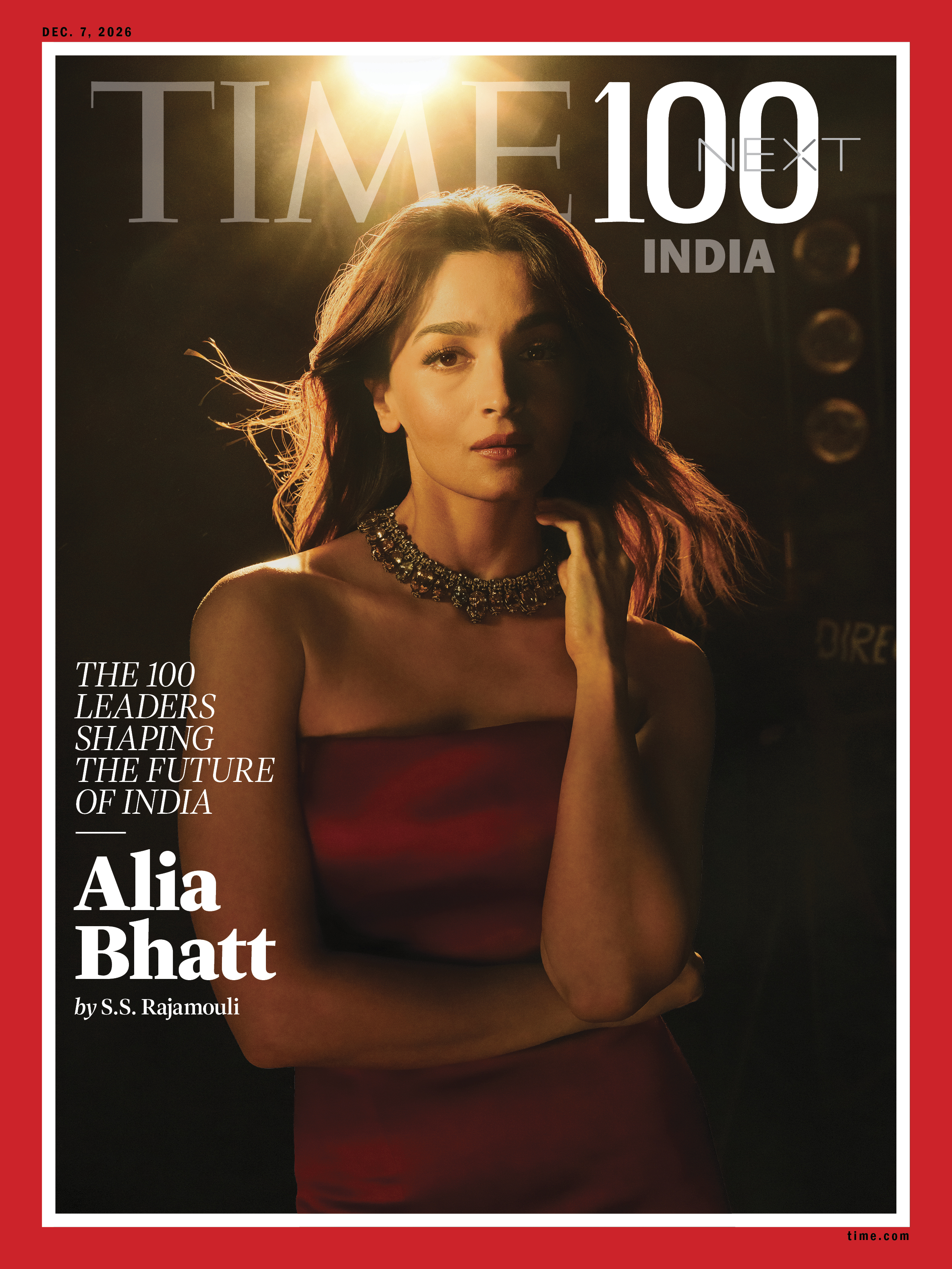
This story is part of the 2026 TIME100 Next India. Read S.S. Rajamouli’s tribute to Alia Bhatt here

Click here to buy your copy of this issue
Bhatt’s ascent coincided with the intersection of two eras: the last years of Bollywood’s old star system and the emergence of a new, unforgiving celebrity culture. The rise of vicious commentary online has sharpened the hostility aimed at female stars like Bhatt. Every choice she makes, from career moves to family life, gets ridiculed, dissected, or explained by a wild conspiracy theory. Among the more presumptuous narratives circulating is the one concerning her marriage to Kapoor.
Drawing on selectively interpreted remarks from the couple, certain corners of the internet have conjured an elaborate theory that Bhatt is an unsuspecting victim in an unequal marriage. Bhatt rejects any suggestion from strangers that she doesn’t have agency. “I am someone who’s always advocating for women to know their mind, to know their heart, so to reduce me to someone who’d suffer through this imagined scenario is offensive,” she says. She believes these narratives endure because her relationship doesn’t fit into deeply entrenched stereotypes about marriage. “The bedrock of any relationship is when you feel seen without putting any effort, and feel heard without saying anything—that’s Ranbir for me, and that’s our reality.”
Bhatt says marriage and becoming a parent in 2022 have changed how she looks at her work. “It’s quality over quantity now,” she says. She stands firmly with Deepika Padukone, who recently sparked a debate over Bollywood’s culture of punishing working hours, arguing that the industry’s norm of 15-to-18-hour shoots needs a serious overhaul. “I’ve been lucky that all my producers have been extremely accommodating but this needs a rethink,” she says. Bhatt is quick to acknowledge that her ability to demand better working hours is a privilege of her professional standing, but she aims to use her influence as producer to make such protections less dependent on individual clout. “It cannot be arbitrary. Fair working hours make the work more efficient, and people shouldn’t be afraid of losing employment when they set those boundaries.”
There’s another more elementary reform she wants to bring to her sets: toilets. “It’s not really asking for the sun and the moon but something so basic, so essential. A woman being able to use a clean bathroom on a film set should not be a conversation in 2026,” she says of her push for better conditions. “I want to ensure—on a systemic level—that this becomes a norm for the entire crew and not just the top talent.”
Bhatt is also unequivocal about her refusal to work with men accused of sexual misconduct. During Bollywood’s short-lived #MeToo reckoning in 2018, the movement threatened to upend the industry’s existing power structures, but few powerful men accused of misconduct faced any real consequences. Bhatt sees this reality as symptomatic of a larger issue. “Bollywood doesn’t exist in isolation—look all around us. Violence against women has become so much more normalized,” she says. “When rapists go unpunished, are released from prison, and go on to hold political office, one feels very helpless. I have to remind myself that I can only focus on what I can control—make better decisions where I can.”
Over a decade after Highway, Bhatt continues to push boundaries of her craft through her choice of roles. In the 2024 thriller Jigra, she played a struggling young woman trying to rescue her imprisoned brother; in Alpha, the first female-led film in the YRF Spy Universe, a trained assassin. The films may have had a modest box-office showing, but Bhatt navigated their high-voltage action sequences and emotionally-charged moments with a natural ease, revealing a performer invested in expanding her range rather than simply sticking to the formulaic. Her appetite for taking risks remains undiminished, regardless of the outcome. “When a male-led film flops, nobody says that we shouldn’t be making ‘male-centric’ films. So I am not going to stop choosing films that are women-led,” Bhatt says. “When you take these gambles, there’s always the risk that you’ll fall flat on your face. But there’s an equally good chance that you might fly.”
Correction, Nov. 18
The original version of this story misstated the name of the film franchise Bhatt starred in. It is the YRF Spy Universe, not the YSF Spy Universe.
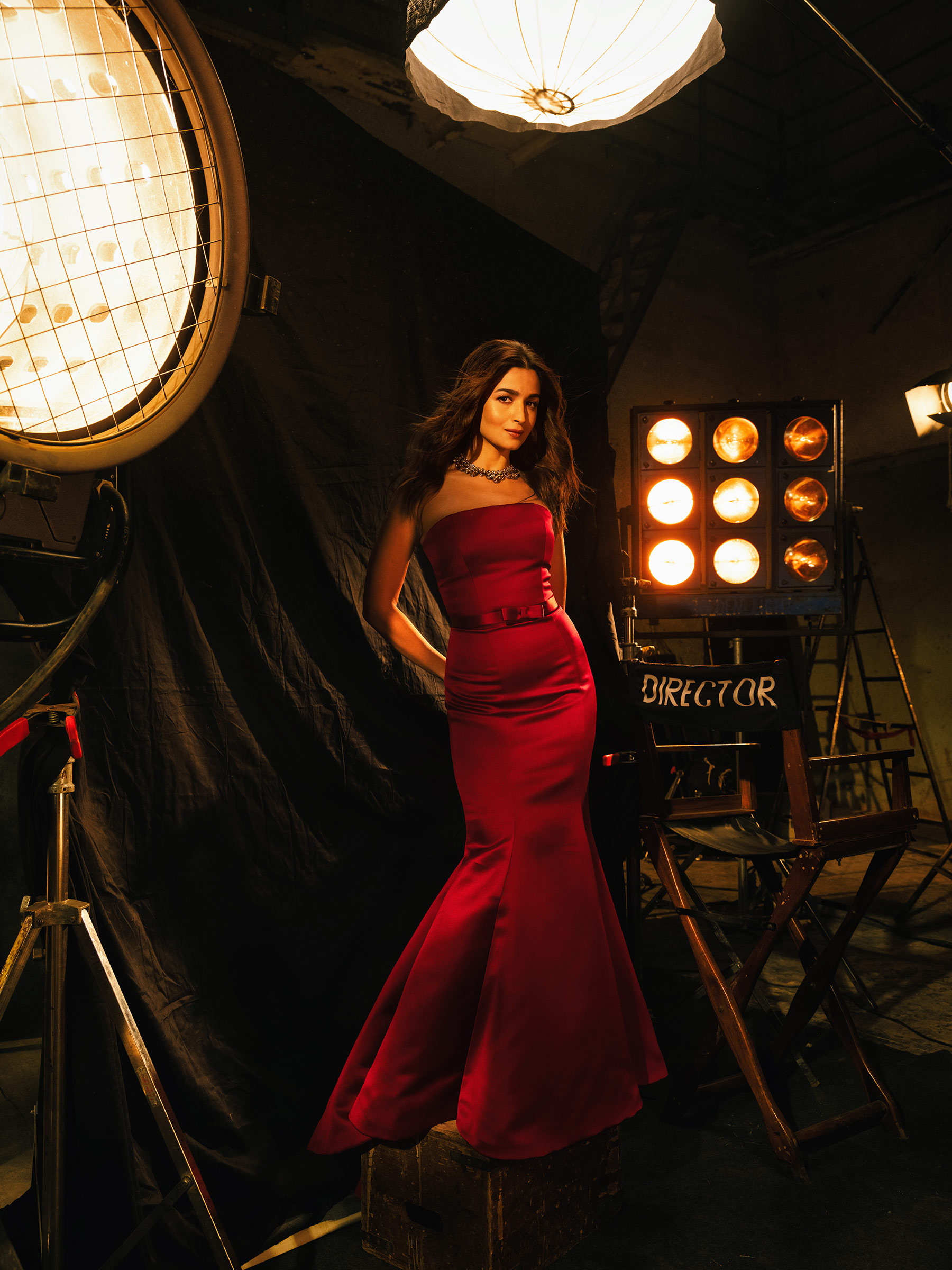
Styling by Priyanka Kapadia, Iram Halai; Make-up by Mickey Contractor, Shamu Kandara (Assistant); Hair by Flavien Heldt at Faze Management; Wardrobe by Sabyasachi