November 19, 2026:


Jeff Parsons, U.K. editor-in-chief of Tom’s Guide, published his two-week iPhone Duo verdict on November 18, and his sharpest criticism comes from handedness: as a lefty, he finds the Touch ID sensor in the side button awkward. He still calls split-screen multitasking a major productivity win on a phone Apple prices at $1,999.
The timing matters for buyers. Apple’s second iOS 27.3 developer beta, released November 16, added Unlock with Front Camera, a face-based option that works only while Duo is closed. That leaves an unfolded Duo to Touch ID, which is where Parsons’ complaint applies. Parsons mentions the beta workaround in his piece but says Face ID cannot arrive soon enough.
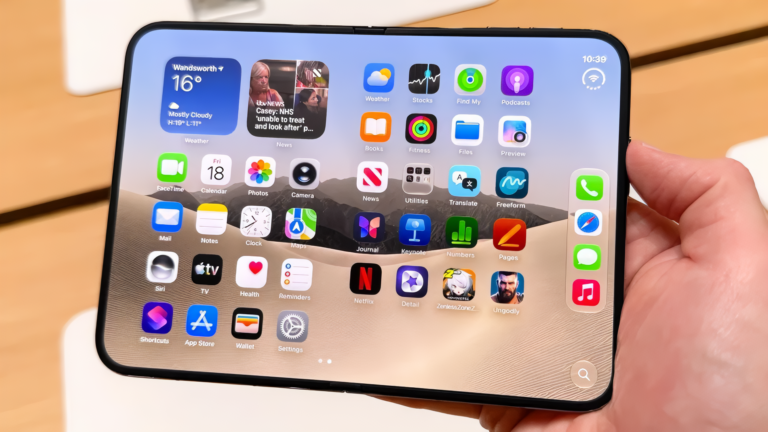
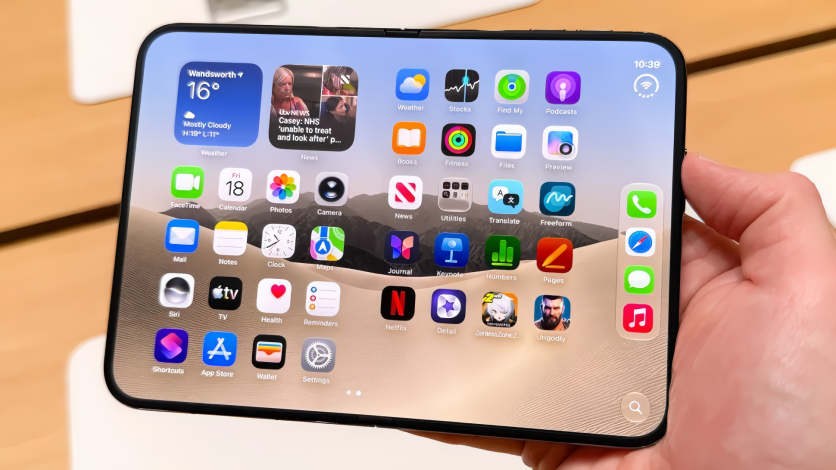
Parsons says the two displays changed how he works. He keeps Slack beside a livestream for live events, and he runs Photos next to Google Drive to drag and drop images, which he calls a huge time-saver.
He also props Duo up in Tent Mode, where the outer display shows his calendar, a photo slideshow or his music. Based in London and working with colleagues in New York and Los Angeles, he uses it to show several time zones at a glance, though he notes a regular iPhone on a MagSafe stand can do something similar. Apple says StandBy works on either display even when Duo is not charging.
Parsons also singles out Kid Cue, which plays Snoopy clips on the outer screen to grab children’s attention while the phone is unfolded; the drawback is that kids look slightly off-camera because the lens sits to the side. He wishes more apps were optimized for Duo’s displays. Apple said on November 16 that more than 200,000 apps are now optimized, up from 100,000 earlier this month.
Duo doesn’t have Face ID hardware. It is 5.2 mm thick when open (0.20 in) and 11.3 mm (0.44 in) closed.
Apple has not given an engineering explanation in the sources reviewed for this article. The thin open body is the obvious constraint, but that is an inference rather than an Apple statement.
The security trade-off is real. Apple says the chance that a random person could unlock a device with Face ID is less than 1 in 1,000,000. Apple’s own setup screen for the beta camera unlock says the feature isn’t as secure as Touch ID or Face ID.
Parsons says he curls his index finger around the back of the phone to reach the power button, which he finds slower and more awkward than Face ID. Roughly 10% of people are left-handed, according to studies that include a 2020 meta-analysis led by Papadatou-Pastou.
Face ID removes handedness from the equation because a face can be scanned from either grip. A fixed side-button sensor does not. Apple says Touch ID works open or closed, and an Apple Watch can also unlock the phone. Daring Fireball’s John Gruber registered extra left-hand fingerprints to solve the side-button problem, but still found Duo uncomfortable to hold left-handed because it is so wide.
Apple’s settings text says Unlock with Front Camera is for use when Duo is closed, and it requires a recent Touch ID or passcode entry. It stops working after 45 minutes of inactivity, and it does not work on the inner display or when Duo is unfolded.
Engadget found it was not fooled by a photo and unlocked faster than Touch ID. PetaPixel found it works in poor lighting but had not tested total darkness, and MacRumors noted it relies on the standard front camera, so a dark room is a problem. Apple Pay, passwords and app sign-ins still ask for Touch ID or a passcode.
The first iOS 27.3 beta, released November 3, added a Reachability mode that shifts content left or right on the closed outer display after a short swipe from the edge. Tom’s Guide called it a step in the right direction for left-handed users.
It does nothing for the sensor’s position. Apple has said iOS 27.3 will reach everyone next month, which points to December.
Parsons’ complaint is that his second-generation Apple Pencil does not work with Duo, so he needs the USB-C model. Apple added support for that model in iOS 27.2 on October 26, and it is the only Pencil Duo supports.
Apple lists the USB-C Pencil at $79, while Parsons puts it nearer $75. Apple’s listing names Duo as the only compatible iPhone and says hover is not supported.
Parsons says Duo’s weight is noticeable when folded but feels balanced when open, and he does not mind it. Duo weighs 254 g (8.96 oz), against 201 g Galaxy Z Fold 8 (7.09 oz), a gap of 53 g (1.87 oz). The 249-gram iPhone 18 Pro Max (8.78 oz) is only 5 g (0.18 oz) lighter than Duo.
Parsons’ piece does not cover battery life, the crease or durability. Those questions are not settled. On October 26, Apple acknowledged an inner-display issue affecting a small number of Duo units and told owners to contact AppleCare for a replacement. Apple has not disclosed a cause.
iFixit gave Duo a provisional repairability score of 5 out of 10 after its teardown.
Parsons notes that Apple is reportedly working on Face ID and an Action Button for Duo 2. Bloomberg’s Mark Gurman reported on November 15 that Duo 2 prototypes with Face ID exist and engineers are still integrating it, so the feature could slip to a third-generation Duo in 2028. Duo 2 itself is expected next fall.
Parsons’ verdict is largely positive: he calls his two weeks mostly smooth sailing and says the novelty has not faded. Split View, Tent Mode and StandBy on either display deliver daily value, and the first-generation compromise is the biometric.
For left-handed buyers, the practical test is to hold Duo open and press the sensor with the dominant hand. The beta camera unlock covers only the closed posture, Reachability does not move the sensor, and Face ID is reported but not confirmed for Duo 2. Display durability is also unresolved after Apple’s October 26 acknowledgment, so the decision rests on workflow value against ergonomics, security and a possible hardware revision.
It stops working after about 45 minutes of inactivity, after which a Touch ID or passcode entry is needed again.
Yes. Apple says users can unlock iPhone Duo using Apple Watch, in addition to Touch ID.
It can be. Parsons, who is left-handed, finds Touch ID awkward. Gruber found Duo not comfortable left-handed because of its width, though extra fingerprints fixed the sensor problem for him. Hardware placement is the root issue, and software workarounds only partly address it.
Not confirmed. Prototypes reportedly exist, but Gurman says the feature may not arrive until a 2028 model.