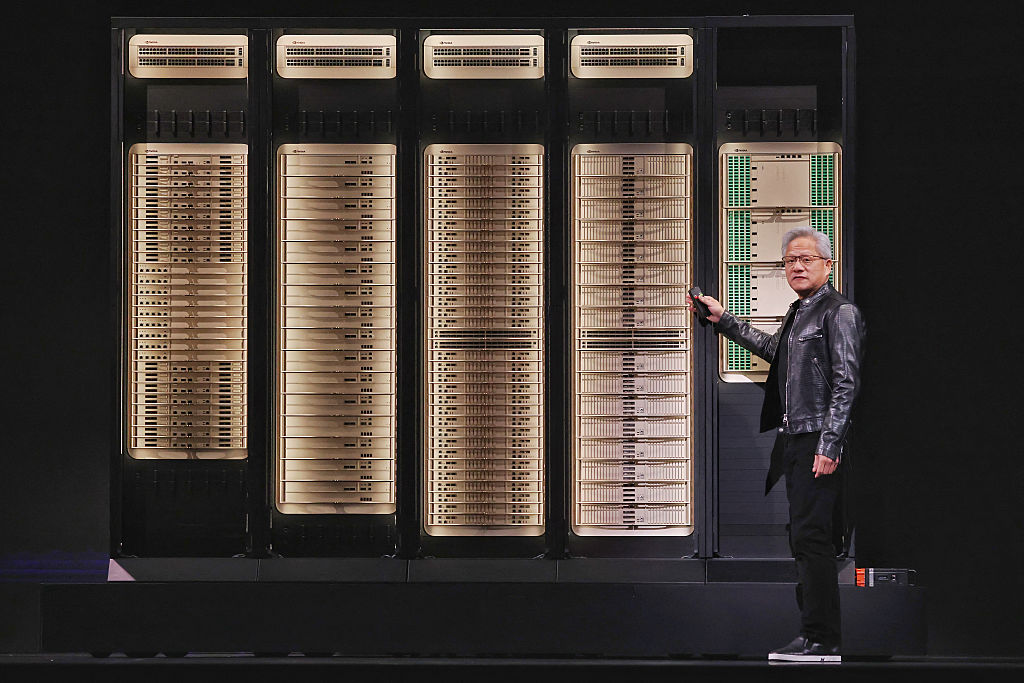
November 18, 2026:


Penguin Solutions (Nasdaq: PENG), the Fremont, Calif., company, announced on Tuesday, Nov. 17, at 9:05 a.m. ET that its ComputeAI NML72-VR200, a liquid-cooled rack built on Nvidia’s Vera Rubin NVL72, is available now, but the release gives no rack power draw, coolant requirements or price. Those are the numbers a data center has to be built around, and rival builders already publish them: Lenovo lists a rack thermal design power of up to 227 kilowatts (kW) in its highest mode, and reseller World Wide Technology says Supermicro’s planning guidance sizes cooling near 227 kW per rack.
Lenovo’s guide also puts about 4% of the rack’s heat into air, so a liquid-cooled rack doesn’t eliminate a room’s airflow needs. Penguin’s release lists direct liquid cooling and stops there.
Anyone weighing the rack, including the AI cloud providers, enterprises, and sovereign AI programs Penguin names as targets, needs three answers before a purchase order: which operating mode the rack ships in, whether a coolant distribution unit (CDU) is included, and how much heat the room must still handle.
Penguin’s release lists 72 Nvidia Rubin GPUs, 36 Nvidia Vera CPUs, sixth-generation NVLink, ConnectX-9 networking, BlueField-4 data processing units (DPUs), high-capacity memory and storage, rack-level power and direct liquid cooling. Nvidia is the only partner named. No customers, delivery schedule, or price appear.
Penguin’s product page adds memory figures: 20.7 terabytes (TB) of HBM4 GPU memory and 54 TB of LPDDR5X host memory. It lists pricing as available on request and offers a downloadable datasheet that may carry more detail. The page itself carries no rack power specification.
Ranjeet Sudan, Penguin’s vice president of product management, said in the release that organizations need infrastructure that moves quickly from deployment to production. The rack belongs to Penguin’s Full-Stack AI Factory Platform, which bundles infrastructure software, memory, compute systems and services, but the release does not say which software ships with this rack.
Performance figures come from Nvidia, not Penguin. Nvidia’s reference design lists 3,600 petaflops (3.6 exaflops) of NVFP4 inference and 20.7 TB of HBM4, both vendor figures.
| Builder | Rack power published | Cooling-loop detail published |
|---|---|---|
| Lenovo | Rack TDP up to 227 kW (MaxP) and 187 kW (MaxQ) | Four 110 kW power shelves; coolant inlet up to 45°C (113°F); in-rack or in-row CDU, capacity not given |
| Supermicro | Cooling sized near 227 kW per rack, per World Wide Technology | In-row CDUs rated 1.8 megawatts (MW) each with N+1 redundancy |
| Gigabyte | Up to 240 kW per rack | In-row CDU rated 1,800 kW; four 110 kW power shelves |
| Cisco (built by Supermicro) | Four 110 kW power shelves; final operating power confirmed at configuration | Ships without CDU; in-row CDUs, manifolds and facility water loop quoted separately |
| Penguin Solutions | None in release or product page | None in release or product page |
Lenovo’s Vera Rubin product guide, Gigabyte’s GIGAPOD product page and Cisco’s AI Rack data sheet are each company’s own documents, and Supermicro’s release says it is now shipping Vera Rubin NVL72 racks with in-row CDUs rated at 1.8 MW each. Cisco’s page lists orderability starting October 2026, with hardware availability dates still unannounced.
These figures are not interchangeable. Thermal design power (TDP) is the heat a cooling system is built to remove, not a measured electrical draw, and vendors define it differently. A quote that does not name its operating mode cannot be compared with any of these numbers.
Direct liquid cooling puts metal cold plates on the chips and circulates coolant through them in a closed loop. Nvidia calls the Rubin generation its first to liquid-cool every chip and networking component with no fans. Its coolant is 75% water and 25% propylene glycol, and it can enter at up to 45°C (113°F) and leave at roughly 55°C (131°F). A CDU sits between that rack loop and the facility’s water system, which is why Cisco quotes it as separate equipment.
Warm coolant is the economic tradeoff. At 45°C, Nvidia says a site can use dry coolers instead of chillers in favorable climates, and it projects near-zero facility water use. Those savings are projections in Nvidia’s own marketing post, which also allows that chillers may still be needed in some climates.
Full liquid cooling describes the chips and boards, not the whole rack. Lenovo’s guide calls the architecture hybrid, with a nominal heat-capture ratio of about 96% to liquid and 4% to air, and says “some fans are required.” At 227 kW, 4% works out to roughly 9 kW of heat in the room, a TechTimes calculation from Lenovo’s nominal ratio. That is small next to the rack’s total load, but it is not zero.
Penguin’s release does not say who services the coolant loop. Lenovo’s guide says service kit equipment is customer-supplied, including a flow meter and pressure gauge.
Lenovo’s guide describes the rack’s NVLink fabric as letting all 72 GPUs communicate as one unified compute domain. Penguin markets its ComputeAI pre-validated advanced compute systems portfolio, but its release for this rack defines no tests, benchmarks or burn-in hours. Buyers will want to know whether pre-validation covers that domain, the liquid loop and the DPUs together.
Penguin is not first to sell these racks. Supermicro announced on Sept. 23 that it is now shipping Vera Rubin NVL72 racks, and Lenovo said on Oct. 12 that it is now shipping Vera Rubin NVL72 globally. Penguin lists pricing as available on request.
Penguin’s track record is in GPU systems rather than this rack. Its website says it has deployed and managed roughly 100,000 GPUs, and it became an NVIDIA AI Factory Specialized Partner on June 23. The release identifies no customer for this rack.
Published figures run from 187 kW to 240 kW per rack, and they vary by operating mode. A buyer comparing quotes should put these questions to Penguin:
Penguin lists booth #1723 at SC26 in Chicago, which runs Nov. 15 through Nov. 20, where buyers can ask these questions in person.
The announcement is confirmed by Penguin’s own release and product page, and the platform specifications are Nvidia’s. What a data center team can plan around today is what Lenovo, Gigabyte and Cisco publish: racks sized near 227 kW to 240 kW, a CDU that may or may not be in the box, and a small but real air-cooling load. Until Penguin publishes the same numbers for NML72-VR200, the price quote, not the press release, is where those decisions will be settled.
Published figures depend on operating mode. Lenovo gives a rack TDP of up to 227 kW at MaxP and 187 kW at MaxQ, Gigabyte lists up to 240 kW, and reseller World Wide Technology says Supermicro’s guidance sizes cooling near 227 kW.
Yes, a small amount. Nvidia describes the Rubin generation as liquid-cooling every chip and networking component with no fans, but Lenovo’s guide for the full rack documents 4% of heat going to air and fans in hybrid cooling. Operators should ask any builder, Penguin included, for the residual air load in kilowatts.
Penguin describes ComputeAI as pre-validated, but its release for this rack does not say which tests were run, for how long or against what benchmarks. Buyers can ask for the validation report, firmware versions and burn-in duration.
TDP is the heat a cooling system is designed to remove, not measured electrical draw, and vendors define it differently. Lenovo cites TDP at two operating modes, and Cisco says final operating power is confirmed at configuration time.