Webb Telescope Images NGC 7129: Young Star Carved Golden Cavity as Newborn Stars Fire Jets

November 17, 2026:

Webb Telescope Images NGC 7129: Young Star Carved Golden Cavity as Newborn Stars Fire Jets
NGC 7129: Star Formation with Jets from Webb
Nasa.gov

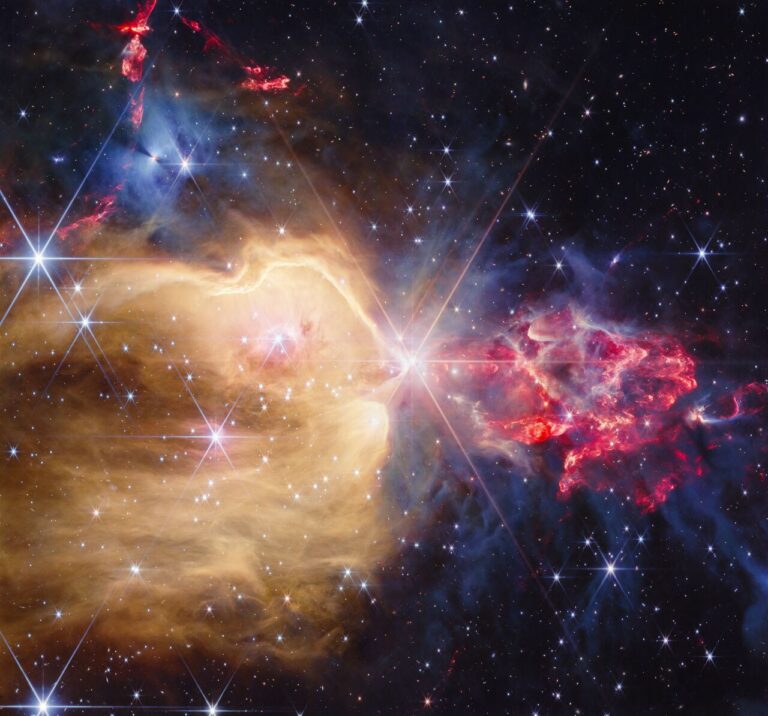
NASA selected a James Webb Space Telescope image of the star-forming region NGC 7129 as its Astronomy Picture of the Day for November 16, 2026. The nebula sits in the constellation Cepheus, about 3,300 light-years from Earth, and Webb’s infrared view places stars at several stages of development inside one cluster: a luminous central star, dusty protostars driving red jets, and gas that outflows and winds have shaped into filaments.

Webb’s Near Infrared Camera collected data on December 17, 2025, and NASA released the image on October 6, 2026. Image processing by Alyssa Pagan of the Space Telescope Science Institute turned the raw data into the final color composite, with credit to NASA, the European Space Agency and the Canadian Space Agency.

What makes the frame useful is the range of stages it shows. NASA says the stars in this cluster are at different stages of development because more massive stars form and evolve fastest, and the most massive, most mature star is LkHα 234 near the center. Because mass sets the pace, the differences between the two sides of the image reflect mass as well as age, so the picture is a side-by-side comparison of stages rather than a clean test of age alone.

Why NIRCam Can See Through Dust at NGC 7129

Young stars are often wrapped in dusty cocoons that hide them from telescopes unable to capture infrared light, and NASA says Webb’s infrared sensitivity lets astronomers peer through that dust. The physics comes down to size. Dust grains absorb and scatter light most effectively at wavelengths comparable to their size, and grains at least about a tenth of a micron across are needed to explain the dimming of starlight at visible and near-infrared wavelengths.

Longer wavelengths slip through more easily. NIRCam is Webb’s primary imager from 0.6 to 5 microns, and measurements of interstellar extinction in the infrared find that dimming follows a power law in wavelength, with an index near 1.8, from the near-infrared out to at least 5 microns. In practice, infrared light from buried protostars gets through the same dust that blocks visible light.

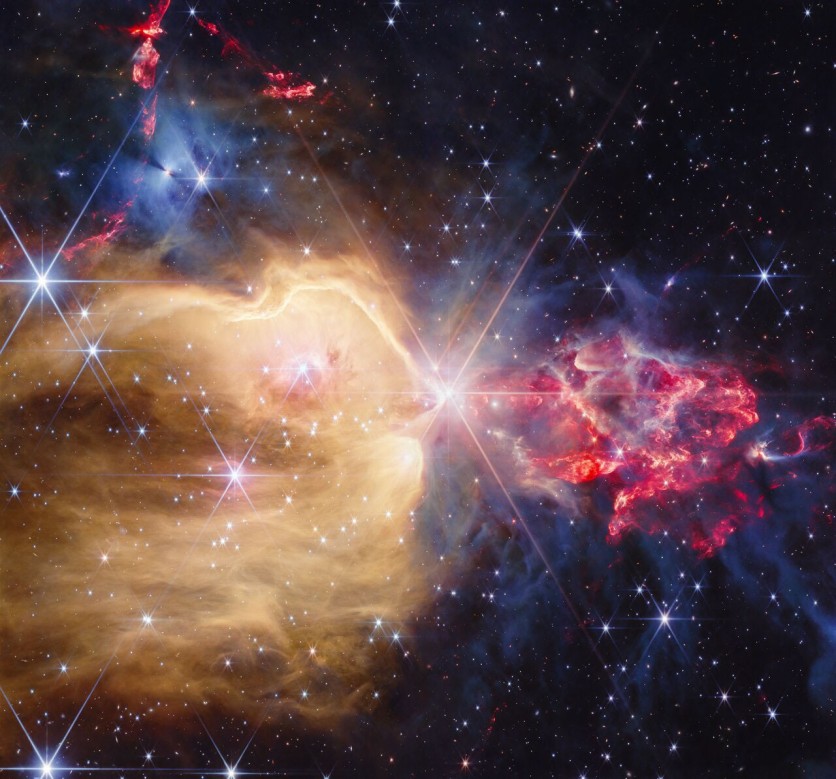
The colors in the image encode physical conditions. In NASA’s caption, hot atomic hydrogen gas appears gold, while cooler molecular hydrogen gas shocked by embedded protostars appears red. Gas near bright protostars in the upper left looks blue because those stars illuminate it, and dense gray gas wraps the youngest objects. Stars carry Webb’s eight-pronged diffraction pattern: six large and two small spikes produced by the hexagonal mirror segments and the secondary-mirror struts.

LkHα 234 and the Golden Cavity It Shaped

At the center, LkHα 234 is a pre-main-sequence star weighing 5 to 8 times the mass of the Sun. NASA says such stars have mostly finished gathering mass and are contracting under gravity, which raises their temperatures, and that this one will eventually fuse hydrogen as the Sun does. Stars in that mass range are called Herbig Ae/Be stars, a class of pre-main-sequence objects spanning 2 to 8 solar masses.

The gold cavity to its left spans about 3.5 light-years and is the largest demonstration of the star’s impact, according to NASA. Outflows from an earlier stage of the star’s life carved into the dense molecular cloud, and both those outflows and the star’s light energize the gas and make it glow. Much of the hydrogen was blown away, but a large amount was compressed, which NASA says creates conditions for more stars to form. NASA’s side-by-side view also shows bow shocks, stars and protostars inside the cavity.

In the upper-left blue region, a protostar sits at the center of a donut-shaped disk of material. That disk casts a shadow against the surrounding nebula, which NASA says is reminiscent of the Bat Shadow that the Hubble Space Telescope observed in a similar structure.

The Red Jets: Younger Stars Still Driving Outflows

To the right of the central star, a clumpy, flame-like red plume of dust and gas hides protostars that emit a soft white light. NASA says the plume is about one third the size of the gold region and sits inside dense gray gas. Outflows from these protostars hit the translucent gray matter around them, creating shocks that give the plume its textured look and its red glow. Because outflows from several stars overlap along our line of sight, the scene looks chaotic.

Jets like these have a long research history. Herbig-Haro objects are bright patches that form when narrow gas jets strike nearby gas at several hundred kilometers per second; the HH 46/47 jet, for example, hits its surroundings at about 300 kilometers per second (roughly 190 miles per second). Jets also carry away the excess angular momentum that accretion deposits on a growing star, which would otherwise spin it fast enough to risk disintegrating. Sherburne Burnham recorded the first such object in 1890, and Herbig and Haro studied them independently in the 1940s.

Where Molecules Break Apart: The Photodissociation Region

A sharp ridge at the top of the gold cavity marks a photodissociation region. NASA explains that light from the central star and the embedded stars heats the colder, denser molecular gas outside the cavity, and at that boundary hydrogen molecules break apart into atoms. NASA says the collection of stars offers insight into how such clouds will gradually erode over millions of years.

What Webb Adds Beyond Spitzer

NASA’s side-by-side comparison with the retired Spitzer Space Telescope shows what changed. Spitzer’s infrared camera identified numerous protostars in the dense material but struggled to resolve their effects on their surroundings. Webb’s higher resolution shows the outflows’ effects in the red clouds, and its sensitivity reveals cold gray gas where stars have not yet formed, along with many distant background galaxies.


Frequently Asked Questions

What is NGC 7129 and how far away is it?

NGC 7129 is a star-forming region about 3,300 light-years from Earth in the constellation Cepheus. Webb’s Near Infrared Camera observed it on December 17, 2025, and NASA released the image on October 6, 2026, before featuring it as the Astronomy Picture of the Day on November 16, 2026.

How does Webb’s NIRCam see through the dust in NGC 7129?

Dust grains absorb and scatter light most effectively at wavelengths close to their size, which is why dense clouds block visible light. NIRCam works at 0.6 to 5 microns, where infrared dimming falls off steeply with wavelength, so far more light from buried stars gets through. NASA says Webb’s infrared sensitivity lets astronomers peer through the dust to study the beginning of the star life cycle.

What are the red jets in NGC 7129?

In NASA’s color scheme, red marks cooler molecular hydrogen gas that outflows from embedded protostars have shocked. The protostars hidden in the red plume are at an earlier stage than the stars in the gold cavity. Jets matter because they carry away angular momentum that accretion adds to a young star, and Herbig-Haro jets are known to travel at several hundred kilometers per second.

Why does NGC 7129 show stars at different stages of development?

NASA says the stars in this cluster are in different stages of development because more massive stars form and evolve fastest. The protostars on the right are earlier-stage objects, while LkHα 234 and the other pre-main-sequence stars are more developed. Since mass affects the pace, the differences reflect both mass and age.

What is the Bat Shadow in the NGC 7129 image?

NASA describes a donut-shaped disk around a protostar in the upper-left blue region that casts a shadow against the surrounding nebula. NASA calls the feature reminiscent of the Bat Shadow, a similar structure that the Hubble Space Telescope observed, rather than the same object.

Source link