Webb Rocky Worlds Workshop Tests Planet Atmosphere Verdicts After Polynomial Fit Moved Depth 90 ppm

November 17, 2026:

Webb Rocky Worlds Workshop Tests Planet Atmosphere Verdicts After Polynomial Fit Moved Depth 90 ppm
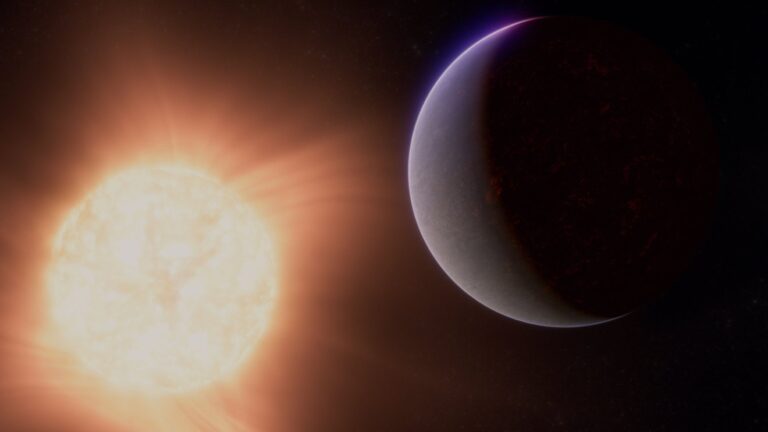
artist’s concept shows what exoplanet 55 Cancri e could look like
This artist’s concept shows what the exoplanet 55 Cancri e could look like. Observations by NASA’s Webb telescope suggest it may be surrounded by an atmosphere rich in carbon dioxide or carbon monoxide, which could have bubbled up from of an ocean of magma on the planet’s surface. Credit: NASA, ESA, CSA, Ralf Crawford
jpl.nasa.gov/

A three-day workshop at the Space Telescope Science Institute (STScI) in Baltimore, scheduled for November 16 to 18, will test whether independent analysis pipelines agree on the faint 15-micron (about 0.0006 inch) signals that Webb’s Rocky Worlds program uses to judge whether rocky planets around red dwarf stars hold atmospheres. The early-career school opens the program on Monday morning, and STScI has not published session times for the days that follow.

The test matters for anyone reading “bare rock” verdicts on distant planets, because the program’s first complete data set shows how far a single analysis choice can move the answer. For the Earth-sized planet GJ 3929 b, a polynomial detrending method shifted the measured eclipse depth by 90 ppm (parts per million) as researchers widened the photometry aperture from 5 to 10 pixels, about four times the 22 ppm uncertainty on the combined measurement, while a second method moved it by only 18 ppm over the same range.

Polynomial Detrending Moved GJ 3929 b’s Depth 90 ppm Across Apertures

Nicholas Connors and colleagues compared frame-normalized principal component analysis (FN-PCA), implemented in the Erebus pipeline, against a third-degree polynomial baseline across seven aperture radii from 4 to 10 pixels. With the polynomial method, the joint eclipse depth fell roughly linearly from 150 ppm at a 5-pixel radius to 60 ppm at 10 pixels. With FN-PCA, the depth fell from 118 ppm to 100 ppm over the same range, and results from 5 pixels outward agree within one standard deviation. FN-PCA’s 4-pixel result, 177 ppm, is an outlier that the authors attribute to detector settling, and the 5-pixel FN-PCA fit is their fiducial result. The authors write that aperture choice can have a significant effect on inferred depth and scientific conclusions.

The program’s own analysis team saw the same sensitivity early. After reducing the first two GJ 3929 b eclipses, its Checkpoint 1 report found that detecting the eclipse at 3 sigma depends strongly on the systematic model used. One fit of the first observation without a Gaussian process returned about 300 ppm, more than double the roughly 134 ppm maximum expected for a planet with zero albedo and no heat redistribution. The team left the scheduling of eclipses 3 and 4 unchanged.

Individual visits scatter as well. FN-PCA gave 190, 155, 60 and 97 ppm for the four eclipses, with uncertainties from 34 to 78 ppm, and the authors report visit-to-visit differences up to 2.5 sigma that they could not attribute to a specific cause. The combined four-eclipse result is 118 ± 22 ppm and a dayside brightness temperature of 641 K (about 694°F), marginally lower than the 160 ppm reported from the first two eclipses alone.

How Does Mid-Infrared Eclipse Photometry Reveal Planetary Atmospheres?

The method measures how much total light drops when the planet passes behind its star. Webb’s MIRI instrument records that drop at about 15 microns (0.0006 inch), which gives the brightness of the planet’s sunlit side. A deeper eclipse points to a hot dayside with little heat carried to the night side. A shallower one points to an atmosphere moving heat around, and the survey also probes for carbon dioxide absorption near 15 microns (0.0006 inch), which reduces the planet’s measured flux further.

For GJ 3929 b, the zero-albedo, no-redistribution ceiling on dayside brightness temperature is 737 K (about 867°F). The detrending step has to model detector behavior before any depth can be read off. In the four-eclipse analysis, the authors found a detector-settling slope FN-PCA could not fit in the first visit, and in the fourth they found a possible tilt event that required trimming 1,500 integrations instead of the standard 500. The earlier two-eclipse analysis likewise found a ramp term strongly favored for the first visit.

Interpretation adds a second uncertainty. In a separate analysis, stellar models alone differ by about 60 ppm for M8 stars and 20 ppm for M5 stars at 15 microns (0.0006 inch).

Data Challenge Pairs Real GJ 3929 b Data With Simulated LHS 1140 b Eclipses

The workshop culminates the Rocky Worlds Data Challenge, which asked the community to analyze two MIRI data sets: four real eclipse observations of GJ 3929 b from Webb program JWST-DDT-9235, and nine simulated eclipse observations of the planet LHS 1140 b modeled on the planned strategy for program JWST-DDT-12498. STScI released the challenge on May 20, opened it to anyone through a Kaggle competition page, and closed it at 5 p.m. ET on August 28.

The simulated half is what makes a benchmark possible. Participants analyzed LHS 1140 b data without a published answer, and the workshop is set to unveil the data-generating process so teams can compare their approaches directly against it. The workshop will also include talks on simulated-data production, and top-performing teams that submitted all requested information may be invited to present. Taylor Bell of STScI is the Data Challenge technical lead.

Scale raises the stakes. STScI describes the Rocky Worlds program as a joint 250-orbit Hubble and 500-hour Webb project, and its data become accessible right after download from the telescope. STScI says it is building systems for open collaboration aimed at reducing duplicated effort across the field.

Hackathon, Talks and Posters Fill Three Days, but No Agenda Is Public

STScI has named the components of the program but not placed most of them on a day. The announced pieces are:

  • Early-career school: an introductory school for early career researchers on Monday morning, with hands-on activities using data products from the program’s Core Implementation Team. Applications have closed. An earlier STScI notice called it a one-day school, while an ESA/Hubble announcement called it a half-day school.
  • Data Challenge sessions and a hackathon: sessions centered on the challenge, including a hackathon-style component that an earlier announcement described as a mini hackathon to test algorithms and compare pipelines.
  • Invited and contributed talks: on Rocky Worlds science, analysis methods and interpretation. Abstracts were accepted from May 18 to July 17. The accepted list has not been published.
  • Posters: covering Rocky Worlds science, according to the event page.
  • Possible community papers: STScI has said one or more publications may come out of the effort, with no scope or timing announced.

Hannah Diamond-Lowe and Néstor Espinoza, both of STScI, chair the workshop. Espinoza is the program lead and Diamond-Lowe is the program’s deputy lead.

Lower Eclipse Depth Leaves Room for Thin Atmospheres on GJ 3929 b

The four-eclipse analysis reads the data as consistent with a bare rock while leaving more room for thin atmospheres than the first two eclipses did. Only thick carbon dioxide atmospheres without a thermal inversion remain ruled out at greater than 3 sigma. The earlier two-eclipse paper by Qiao Xue and colleagues ruled out a 100-millibar (about 1.5 psi) carbon dioxide atmosphere at greater than 3 sigma and a 50-millibar (about 0.7 psi) pure carbon dioxide atmosphere at 3.3 sigma, but did not rule out thin atmospheres where water vapor is the only longwave absorber, and its models did not include clouds.

That bears on the program’s larger question. Rocky Worlds was designed to investigate the cosmic shoreline, the empirical boundary between bodies that keep atmospheres and those that do not, which Kevin Zahnle and David Catling described in a 2017 paper. Xue and colleagues place GJ 3929 b well beyond the shoreline, where retaining a carbon dioxide atmosphere is unlikely. Every planet the program adds to that census arrives with an eclipse depth, so agreement between pipelines decides how much weight each point can carry. STScI frames the workshop around that question: what level of agreement between analyses is needed for robust conclusions.

Registration Is Closed, but STScI Plans YouTube Stream

Registration ran online from August 10 to October 16 and is closed. The Rocky Worlds program site states that the workshop will be streamed on the STScI YouTube channel, while the STScI event page does not mention streaming. The venue is STScI at 3700 San Martin Drive in Baltimore, and a shuttle schedule is to be posted closer to the event. Questions go to RockyWorldsDDTWorkshop@stsci.edu; earlier announcements listed RockyWorldsDDT@stsci.edu.

Session Times, Speakers and Day Assignments Remain Unpublished

The NASA, STScI and Rocky Worlds program pages carry no day-by-day agenda, session times, talk titles or speaker list. NASA’s listing sits under a “Save the Date” heading with the meeting link marked to be determined and a last-updated date of May 12, 2026. The program site’s banner gives November 16 to 18, but its meetings table lists the workshop only under November 16. Apart from the Monday-morning school, no component is placed on a specific day, and the program’s community page lists no released Data Challenge results.


Frequently Asked Questions

Can the Rocky Worlds workshop be watched online?

The program site says the November 16 to 18 workshop will be streamed on YouTube. The STScI event page does not mention streaming, and no stream link for individual days is published.

Does GJ 3929 b have an atmosphere?

The data so far fit a bare rock best, but the measured eclipse depth changes with analysis choices, and thin atmospheres are not excluded. Only thick carbon dioxide atmospheres without a thermal inversion are ruled out above 3 sigma.

Why does comparing analysis pipelines matter for finding rocky-planet atmospheres?

Atmosphere verdicts rest on eclipse depths tens of parts per million wide, and one aperture choice moved a polynomial-fit depth by 90 ppm against a 22 ppm combined uncertainty. A shared benchmark shows which methods recover a known simulated answer.

Can researchers still join the Rocky Worlds analysis effort?

The Data Challenge submission window closed on August 28, but program data carry no proprietary period, and STScI runs a Community Involvement Initiative for sharing analysis techniques and publication plans, plus a mailing list for program news.

Source link