A Black Mom Fled the U.S. to Protect Her Kids. Her New Book Explains What Drove Them Out.

November 16, 2026:

A Black Mom Fled the U.S. to Protect Her Kids. Her New Book Explains What Drove Them Out.

In “The Fleeing Season,” Jamie Brooks rebukes the injustices of modern American childhood: “I didn’t grow up with gun violence in that way.”

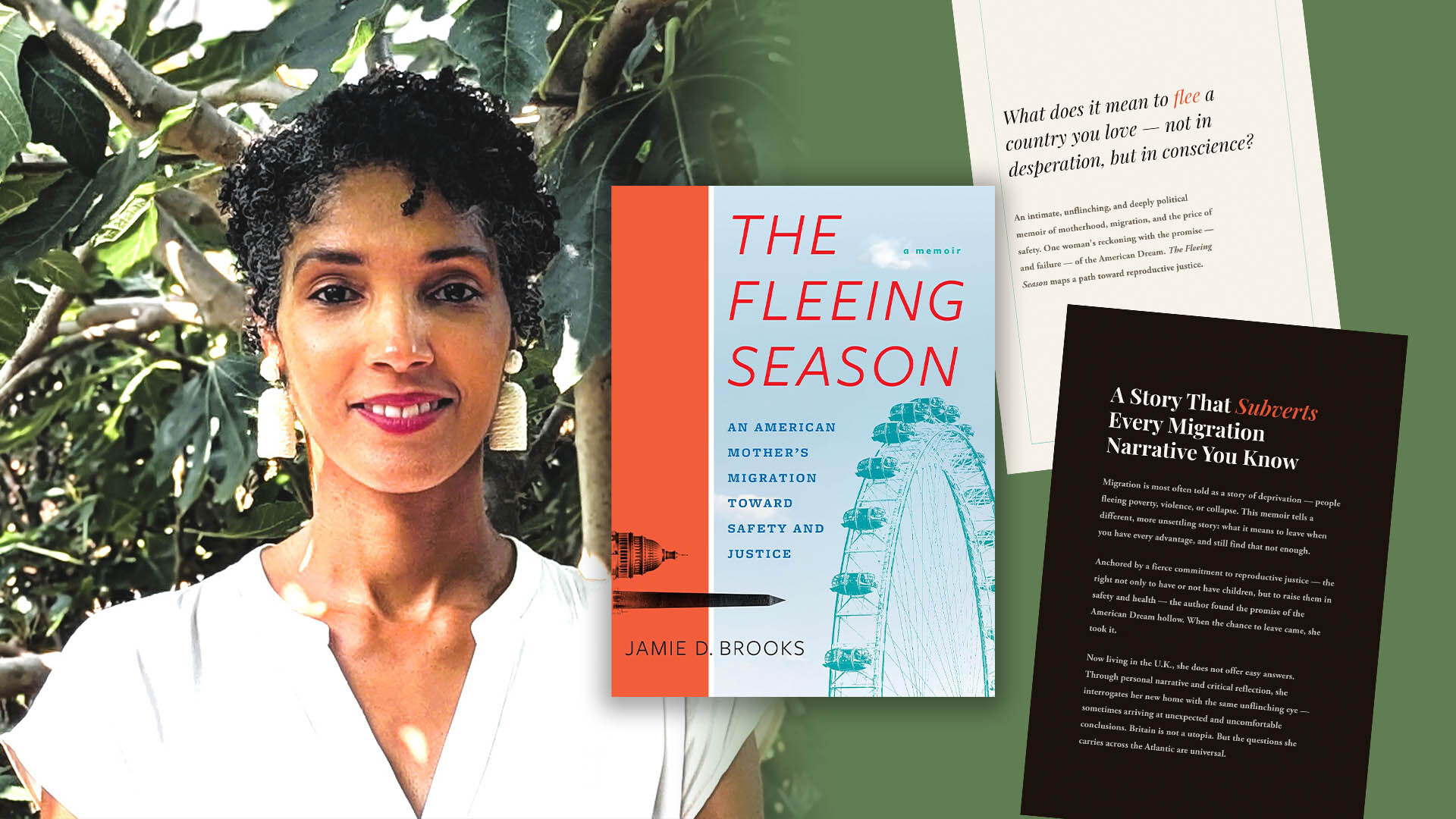
The Fleeing Season Jamie D Brooks

Jamie Brooks considers herself a reproductive justice migrant.

In 2021, she and her husband uprooted their family from a Maryland suburb outside D.C. and moved to England. Officially, the move was a professional one: Brooks’ husband is a journalist at Bloomberg, and he was offered a position in the London bureau.

But, for Brooks—a Black woman with three small children—the decision was profoundly and painfully personal. 

When Brooks began thinking about leaving the United States, the COVID-19 pandemic was raging, and she worked as a health-care attorney at a hospital. George Floyd had been murdered by police. The Trump administration was separating migrant families and teargassing protesters. The drumbeat of mass shootings, which had slowed in the early, isolated months of the pandemic, was resuming its steady tempo. 

She couldn’t escape the conclusion that in the U.S., she couldn’t keep her kids safe. 

Americans “are not living in freedom. They’re living in fear,” she said in an interview with Rewire News Group. 

Brooks’ new memoir, The Fleeing Season (out Nov. 17, 2026), traces her family’s decision to leave the country for safer shores, and examines whether they’ve found it in the United Kingdom, a country that presents its own challenges for a mixed-race immigrant family. 

I interviewed Brooks about the primal fears of motherhood and her complicated relationship with the U.S.—one that’s now tinged with an unfamiliar shade: political hope.

This interview has been edited and condensed for length and clarity.

Your story is, in some respects, a familiar one: A mother flees her homeland to give her kids a better future. But it complicates that narrative. For one thing, you left a country that many immigrants are still literally dying to reach. You write that your migration journey was shaped by your race and gender. 

I had a very privileged life in the U.S., even as a Black female. On paper, I had all of the trappings of what would look like a stable, successful life. 

But I would have these moments, when you get hit with racism or colorism. That’s always jarring. 

That’s just the nature of these shells we grow up in. [Race and gender define] how you get treated, and what you get exposed to, and how the world treats you. 

It’s a lens that I can’t strip away. I will always see the world [as a Black woman] because I am seen as that. As soon as I step out anywhere, that’s how people see me.

Your story is also different from another popular media portrayal of modern migration—that of the “digital nomad.” These are white-collar, remote workers, often young and single, who move abroad for a more flexible, affordable lifestyle. That’s not why you moved your family to England. What were you looking for? 

Safety, safety, safety, safety. 

When you come into parenthood, there’s a biological freakout. Your mind gets rewired. There’s this matrescence thing that happens, and everything’s about safety and protecting these kids. 

[Over time] for a lot of us, it starts to soften a bit. [Yet] as my kids were getting older, and I was watching what was happening with the treatment of people at the border and gun violence, that fear wasn’t subsiding. I just couldn’t shake that perpetual state of anxiety. …

Inequity was growing. Access to health care was becoming more difficult … And I didn’t grow up with gun violence in that way—the mass gun violence. … I wasn’t afraid of being shot and killed going to high school.

Motherhood, gun violence, racism, and abortion may seem like separate issues to many people. Can you tease out the relationship you see between them?

It was an evolution in thought. [At first], I don’t think I was thinking about these issues as reproductive justice issues. If you’re parenting [small children], it really is day to day—just get this kid … to put their shoe on, let’s get out the door. 

The physical nature of parenting eases up a little bit as they get older. And having conversations with friends about what was happening politically, socially—it all started to come into that third realm of reproductive justice: I should have a right to raise my kids in a safe environment. … The gun violence [was] bananas to me. 

And then abortion: … It clicked for me once I started working for Planned Parenthood. 

I’d never done enterprise risk for a health organization or hospital where I had to worry about the safety of each and every single employee. … Are they safe coming to and from work? Are they safe going home? 

Wherever you fall on the spectrum [of reproductive health care], I can disagree with you. You can disagree with me. But that terrorism and violence is accepted as part of this [political debate] is unacceptable to me. It’s inexcusable. 

It all seems connected to me. Whether you’re going to parent or not parent … we should be able to do [it] without the threat of violence and terror and killing people. 

You call yourself a “reproductive justice migrant.” Why do you think that’s a helpful term?

We talk often about the right to have a child [and] the right not to have a child. … I don’t feel like we talk often [enough about] the right to parent the children we have in safe and healthy environments. 

If you’re scared to go to school because somebody might bring a gun one day, or somebody recently brought a gun to school and shot other kids three states away, this is not a safe and healthy environment. 

We have to lift this [truth] up. I think this is how we make change. 

Do you try to explain that to Brits who ask why you came there? 

I do. And people are really shocked. They say, Well, there’s not that much gun violence, is there? 

And no, it’s not like every time you step out your door, there’s bullets flying. But it’s the anxiety of you never know where, you never know when. It’s always a possibility. … [That’s] not freedom. We call it freedom, but people are not living in freedom. They’re living in fear that’s constricting so much of what we naturally do, which is unfair. 

It doesn’t have to be that way. 

Do you have hard conversations with your kids about your decision to move abroad?

We are very honest with them. 

We weren’t when we came; they were 3, 5, and 7 [years old] … But as they’ve gotten older, particularly when we make these trips back across the ocean, we started to be honest with them, [especially] about gun violence. 

We wanted them to look at the extent that mass gun violence is still happening in the U.S. …  and go, “That’s so crazy. I don’t understand it.” Rather than [feel] this is just part of who we are, and it’s unfair. I want them to not understand it. … 

[We aim for] balance: [The United States is]  this wonderful, amazing place. We have people we love. We need to go [visit]—and yeah, they are tearing people off the streets and kidnapping them. They see all that. They read the news, so it’s hard. 

I’m hearing you talk more about gun violence than about abortion bans, but you write in the book that your mother was skeptical about your move abroad—until the Dobbs v. Jackson Women’s Health Organization decision that ended federal abortion protections in 2022. What did that ruling change in her?

It was such a moving moment for me. I’d spent all this time working in reproductive justice, and … she never was like, “I’m so glad you’re working on that.” … There was no commentary. 

But then [after Dobbs], it [became] very clear that this was something she felt passionately about. … There was this fear that this right, this bodily autonomy had been taken away from so many people. 

That must have been the straw that broke the camel’s back. … to see something so tangible potentially taken away from so many people. 

I think she was terrified. I mean, I know she was: I could see it in her face. She kept saying, “It’s like the Handmaid’s Tale. This is where we are headed.” 

She only has daughters and granddaughters … the reality of being women and birthing people that, I think, terrified her.

Working in hospitals, you’ve seen other reproductive injustices up close: gunshot wounds, birth complications, sexual abuse survivors, trafficked teens. How did that professional experience inform your personal perspective?

Seeing these pockets of extreme injustice—whether it’s people not having access to care, being a victim of trafficking, or being a victim of sexual violence or exploitation—I don’t feel like I was having a lot of conversations [at the time] about how this is all a reproductive injustice.

[But] if you peel back the layers on it, all these things are part of the onion. I just don’t think they can be separated. I think it’s all linked. I think it’s the way that we view individual freedoms and who we fight for, who we advocate for, who’s it’s okay that they’re victims, what bodies we don’t value. I think it’s all part of it.

Do you feel that you’ve achieved what you were looking for as a mother, as a Black woman, by taking your family to England?

Yes and no. 

We have a better baseline [here]. … We believe in universal health-care coverage. It’s shabby. It’s threadbare. It’s being sold off piecemeal and privatized. But in general, most people think that we should have that. 

In general, most people think that we shouldn’t have unfettered access to guns. 

…[We have] paid maternity leave and paternity leave. … If my kids or their partners decide to pursue parenthood, there’s still that mechanism in place. 

So yeah, there’s a better baseline. … It feels like we jumped to a lily pad that feels a little bit bigger and safer.

… It’s not Valhalla. It feels safer, but it all feels tenuous. … There’s still the rise of the far right. There’s still large anti-immigrant sentiment all over this country.

I’m in a mixed race marriage. My husband’s white. I think people perceive him as an expat.  He’s American; he came with his job. But I think just on sight I’m viewed as a migrant. … When you look on the ground, at what’s happening here and where the anti-immigrant sentiment is focused, it is not on Ukrainian refugees [or] American expats. … 

The focus is on people who look like me. I feel that for sure. It’s very palpable.

We are speaking just days after the 2026 midterm election. How are you feeling about U.S. politics and Texas, where you have deep ties?

I’m super excited. It’s one of those moments where you’re like, Oh, I wish I was there to celebrate and live in the glory of it. 

I’m so grateful for young people in Texas right now. … I feel like that’s going to give the youth there what so many of them haven’t had. We’ve had these highs and lows. [Kids] really haven’t. 

I know that they’re going to be busy working—the other side. We’ve got to roll up our sleeves and get to work. It’s still not going to be easy. But I’m hopeful. Hopeful!

Source

Source link