Autonomous Weapons Treaty at Stake as CCW Review Conference Opens Monday; US Wants Nonbinding Text

November 16, 2026:

Autonomous Weapons Treaty at Stake as CCW Review Conference Opens Monday; US Wants Nonbinding Text

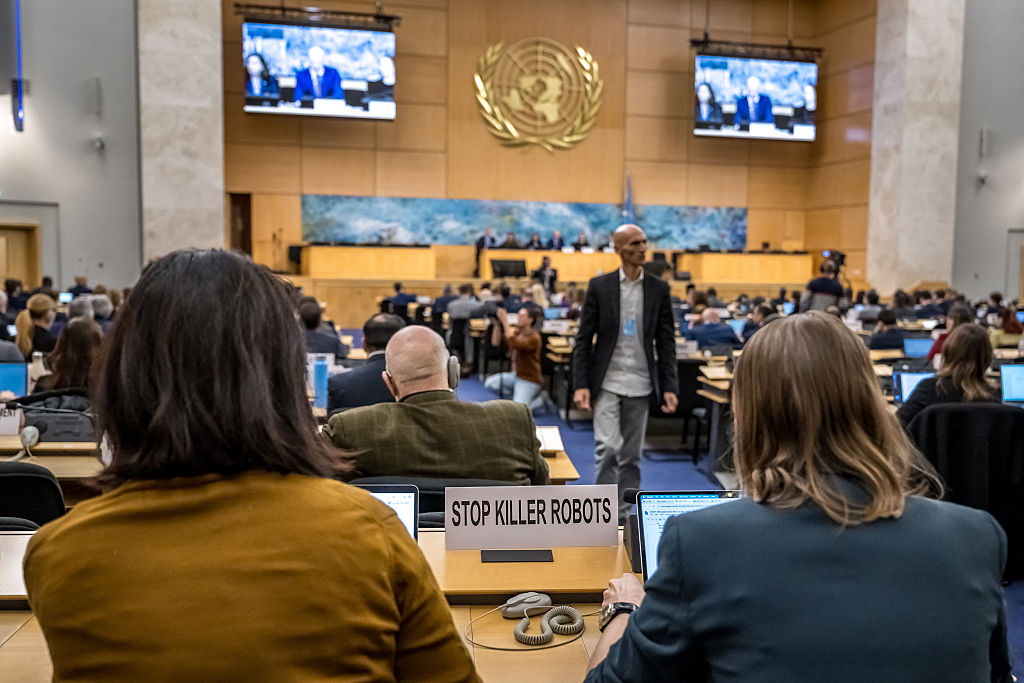
Delegates from the 128 states parties to the Convention on Certain Conventional Weapons (CCW) will open the Seventh Review Conference in Geneva at 10 a.m. Geneva time on Monday (4 a.m. ET), and the week’s central decision comes down to three competing texts: a draft mandate with 30 negotiating days and a 2028 target for a draft protocol, a seven-country proposal with 25 days in 2027, and a US paper that rejects a protocol altogether.

The outcome will decide whether anyone who builds or fields AI-enabled targeting systems faces a legally binding international text, or only voluntary guidance. Civilians in active conflict zones carry the risk if no binding rule emerges, and engineers at defense contractors will have no treaty standard to design against.

The conference will run through Friday, Nov. 20, under President Julien Thöni, Switzerland’s ambassador to the Conference on Disarmament. Delegations will get five minutes each in the general exchange of views and three minutes on other agenda items, with no advance speaker list, according to the UN Office for Disarmament Affairs.

Three Competing Mandates Offer 25 Days, 30 Days and Five Years

A cross-regional group of seven countries has proposed an open-ended expert group meeting for three sessions totaling 25 days in 2027, with a draft protocol submitted that year. Peru’s ambassador, Elmer Schialer, the chair-designate of Main Committee II, circulated a draft on Oct. 23 that would provide 15 negotiating days each in 2027 and 2028 and aim for a draft protocol by 2028.

The United States took the opposite direction on Nov. 4, submitting working paper CCW/CONF.VII/WP.2. It rejects a protocol and recommends five more years of consensus-based work toward a nonbinding instrument that clarifies how existing rules apply and sets out compliance-support measures, with an initial version ideally by 2029, according to Spoiler Alert’s coverage. France wants a new negotiating mandate and an instrument that bans completely autonomous systems and regulates systems with autonomous functions. The International Committee of the Red Cross (ICRC) wants a mandate to negotiate a legally binding instrument in 2027.

Support for binding rules is broad but not unanimous. Human Rights Watch counts 76 states, 70 of them CCW parties, that back negotiations, against 128 parties in total.

Why Can One Objector Block a Treaty Twice Under CCW Consensus?

The CCW decides by consensus, so opponents have two chances to stop a protocol. Mei Ching Liu of the S. Rajaratnam School of International Studies wrote in Opinio Juris on Aug. 31 that states could accept a mandate and still block later adoption of the resulting protocol. Russia said in October 2025 that the CCW expert group is the best forum for discussing military AI, while China has said it supports a binding instrument only when conditions are ripe.

The Guardian reported that a group led by Russia and the United States is moving to block binding rules at the Geneva conference, and that Israel is also pushing against a timetable, according to a secondary summary. That account does not include those governments’ reasoning, and this article has not independently confirmed it.

US Paper Argues Autonomy Is a Capability, Not a Weapon Type

The US paper’s core technical claim is that autonomy is a capability that can sit inside many systems, not a “certain” type of conventional weapon, which would put it outside what a CCW protocol is built to regulate.

Defense-industry voices make a related argument from the other side. Benjamin Tallis of Helsing said at the Internet Governance Forum in 2025 that “we are in an AI arms race” and described autonomous weapons as the continued evolution of military command and control.

Human Judgment Replaced Meaningful Human Control in Final Expert Report

The expert group (GGE) finished its report in the early hours of Sept. 5, and the text will anchor the week’s talks. Paragraph 25 offers the first agreed characterization of a lethal autonomous weapon: a combination of weapons and integrated technological components that can identify, select, and engage a target without intervention by a human operating the system. Paragraph 36 says human judgment and control are needed but does not imply constant direct human control.

Jeroen van den Boogaard, an adviser to the Dutch foreign ministry who supported the chair and wrote in a personal capacity, said in Opinio Juris that the text dropped “meaningful human control” in favor of “context-appropriate human judgement and control.” Human Rights Watch reported removals of references to design and development, ethics, and predictability, reliability, explainability and traceability, and said Russia and the US were behind the weakening, including narrowing the scope from international law to international humanitarian law.

Zaporizhzhia Gas Station Strike Gives Delegates a Documented Civilian Toll

A Russian Molniya drone carrying an Nvidia Jetson Orin module killed three civilians at a gas station in Zaporizhzhia, according to a New York Times investigation: Tetiana Bubynets, 19, Oleksiy Svirin, 41, and Roman Karpiy, 48. The Times reported that human operators set the route but the drone chose its own target, most likely propane tanks. Advocates are likely to cite the case in Geneva.

Does Article 8 Give Treaty Supporters a Route Around Consensus?

Campaigners point to Article 8(2) of the CCW as a fallback. It lets any party propose an additional protocol, and if a majority of parties, “not less than eighteen,” agree, the Depositary convenes a conference to which all states are invited. Stop Killer Robots lists Article 8 and a UN General Assembly route as alternatives if the Review Conference offers only a discussion mandate. The cluster munitions precedent shows the path: after the third Review Conference blocked a mandate, 46 states launched a separate process and the Dublin convention was adopted by 107 states. The limit is that a breakaway treaty binds only the states that join it, and major military powers have stayed outside such treaties, including the Ottawa landmine convention.

General Assembly Vote of 164 to 6 Sets Backdrop for Geneva Talks

The General Assembly’s resolution 80/57 on autonomous weapons passed 164 to 6 with 7 abstentions on Dec. 1, 2025, a margin that treaty supporters will invoke. Belarus, Burundi, North Korea, Israel, Russia and the United States voted against. A side event on incendiary weapons and white phosphorus is scheduled alongside the plenary on Monday afternoon.

Schialer was Peru’s foreign minister from September 2024 to October 2025 and served as deputy permanent representative in Geneva from 2007 to 2011, covering disarmament and humanitarian law. He became Peru’s permanent representative in Geneva in February.

For readers, the practical test arrives Friday. A mandate with dated negotiating days and a protocol deadline means a binding text is possible by 2028 and would bind only ratifying states. A five-year consensus track toward nonbinding guidance means no enforceable limit before 2029 at the earliest.


Frequently Asked Questions

What is the CCW Review Conference deciding this week?

Delegates will decide what work the CCW does on autonomous weapons next: whether to negotiate a legally binding protocol, continue discussions, or pursue a nonbinding instrument.

Can a few countries really block a treaty on killer robots?

Within the CCW, yes, because decisions require consensus, and opponents could accept a mandate yet still block the protocol later.

What would a binding protocol change compared with nonbinding guidance?

A binding protocol can create legal obligations for states that ratify it, while a nonbinding instrument cannot create obligations or sanctions.

Which countries are on each side?

Seventy-six states, 70 of them CCW parties, back negotiations, while Russia, the US and Israel are reported by the Guardian to oppose a timetable.

Source link