HomeAuto Russia Launches Private KOEN and Kinosputnik Satellites, but State Sets Imagery Purchase Rules
Russia Launches Private KOEN and Kinosputnik Satellites, but State Sets Imagery Purchase Rules
November 15, 2026:
Roscosmos.ru
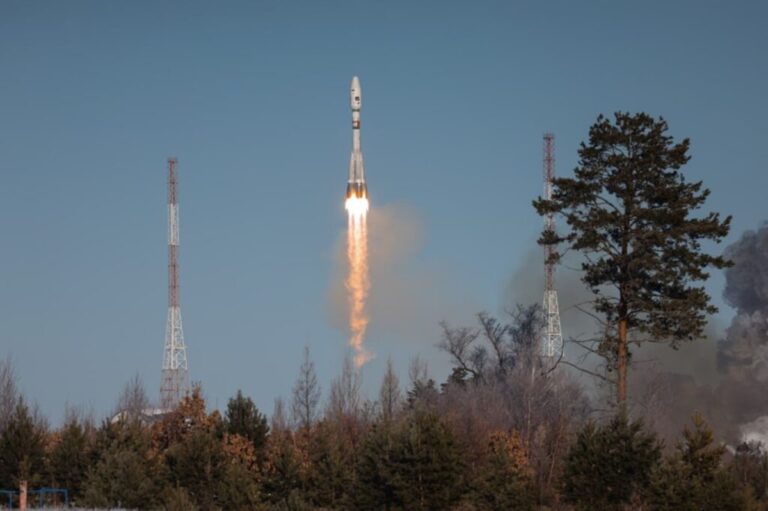
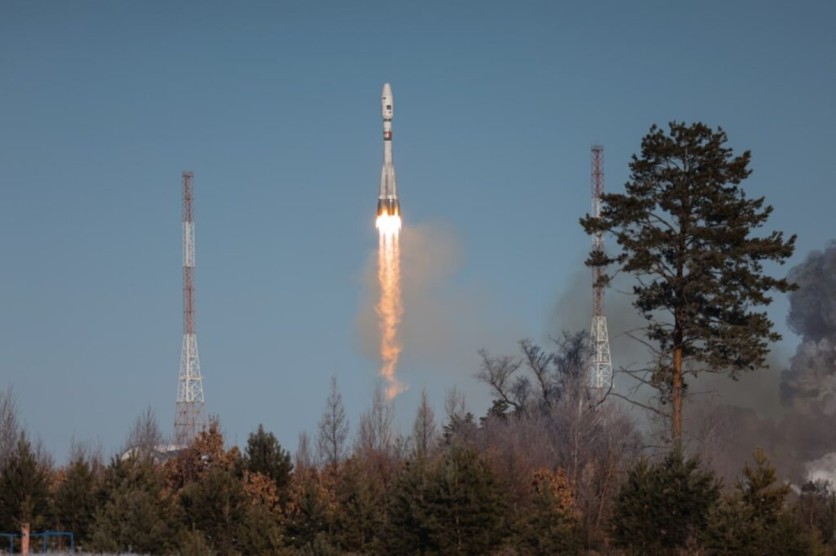
A Soyuz-2.1b rocket carrying two privately built Earth-imaging satellites, KOEN and Kinosputnik, lifted off from Russia’s Vostochny Cosmodrome at 04:16 Moscow time on Saturday, Nov. 14 (8:16 p.m. ET on Friday, Nov. 13), according to TASS’s launch report. Roscosmos describes it as the first launch of private satellites subsidized under the “Kosmos” national project. Buyers weighing the half-meter imagery these spacecraft promise should know that the state sets the purchase rules: since this summer, Roscosmos has assessed how much a private satellite depends on foreign components, and how secure its data is, before government customers buy from it. This article covers what the satellites can do, how the optics work and what stays unverified. It also covers the legal and supply-chain conditions that readers outside Russia need to understand before treating “private” Russian imagery as independent of the state.
Roscosmos Reports Both Satellites in Orbit and Under Ground Control
Roscosmos said on Saturday that both spacecraft reached orbit and were accepted for control. MT-LAB, KOEN’s developer, reported normal telemetry from KOEN, according to Defense News. The same report says SPUTNIX’s mission control center in Skolkovo received signals from Kinosputnik and that its systems were operating normally.
The rocket was a Soyuz-2.1b built by RKTs Progress, a Roscosmos subsidiary, topped by a Fregat upper stage. Fregat is a restartable stage, which lets it fire more than once to place payloads in the right orbit, as it did in a 2018 launch where Fregat fired seven times, including a final firing to deorbit itself. The Japanese space outlet Sorae reported that Fregat separated on schedule, and none of the reports reviewed gives precise orbital parameters.
How Much Did Roscosmos Pay for This Launch?
The reports reviewed do not say. Defense News reports that Roscosmos partially funded the launch, and Sorae describes it as Russia’s first launch of private satellites with a partial state subsidy. Neither gives a ruble figure.
Roscosmos lists intended uses that include monitoring land use, detecting illegal structures, watching natural areas and assessing the effects of fires and floods, according to Expert’s launch report. Sorae adds infrastructure, agriculture and construction monitoring to the list. Sorae also describes the two satellites as the mission’s main payloads rather than secondary passengers.
What Does Half-Meter Resolution Actually Show From Orbit?
Profile, a Russian news outlet, reports that KOEN images the ground at 0.5 meters per pixel, or 1.6 feet, across a swath 12 kilometers (7.5 miles) wide. The same report gives an annual capacity of 15 million square kilometers (5.8 million square miles), against a Russian land area of more than 17 million square kilometers (6.6 million square miles). The satellite is designed to operate at roughly 500 kilometers (311 miles) for at least five years, and Profile calls it the first Russian civilian spacecraft able to image at this detail. That last claim is the outlet’s own and has not been independently checked.
Kinosputnik, from the SPUTNIX group, carries a multispectral camera with 0.8-meter (2.6-foot) resolution and is built on SPUTNIX’s new Pallada platform. ComNews reported in September that its planned orbit is about 600 kilometers (373 miles). SPUTNIX says Pallada covers 80 to 200 kilograms (176 to 441 pounds), carries up to 100 kilograms (220 pounds) of payload and sends data down in the X-band at 800 to 1,500 megabits per second. The company says a planned 0.5-meter successor would let a car be seen from orbit and its dimensions estimated. Commercial imagery from Kinosputnik is expected in 2027.
Orbit Altitude, Pixel Size and Swath Width Set What Each Satellite Can Cover
Ground sample distance, the figure behind “0.5 meters per pixel,” is the distance between pixel centers measured on the ground. It depends on altitude, pixel size and focal length, growing with height and shrinking as the telescope’s focal length increases. A half-meter camera at about 500 kilometers (311 miles) therefore needs a long focal length, and a long focal length narrows the field of view. That is why KOEN’s swath is about 12 kilometers (7.5 miles) rather than the 150 kilometers (93 miles) of a wide-swath satellite such as China’s Kuanfu-02A.
Two caveats matter for buyers. First, ground sample distance describes sampling, not the finest feature an image can truly resolve, because it is only one limit on resolution. Second, a narrow swath means a satellite must point and slew to cover a target region, so the 15-million-square-kilometer annual figure is a ceiling reported by Russian media, not a measured result. Neither figure has been confirmed by an independent source in the reports reviewed.
Roscosmos Now Audits Foreign-Component Dependence Before Buying Imagery
The stated purpose of Russia’s new rules is to build a private market. The operative burden falls on the private operators themselves. In April, the State Duma passed amendments in a third and final reading that let Roscosmos approve a methodology for pricing data from the federal Earth remote sensing data fund, keep the payments in its own budget and set purchase conditions for state bodies buying from non-governmental spacecraft. Bakanov also told President Vladimir Putin in April that Federal Law 540, passed in 2025, had made access to remote sensing data a paid service. A separate law that took effect Jan. 1, 2026 requires launch reports to Roscosmos from Russian citizens and organizations that plan or complete launches of privately owned spacecraft.
Since this summer, the state checks whose technology a private satellite runs on before buying imagery, according to Russian business outlet www1.ru. Roscosmos assesses the spacecraft’s dependence on foreign components and the security of the data it collects. Data from satellites that have not passed the assessment can still be purchased, but only when the needed information cannot be obtained from verified ones. Reports differ on the exact effective date of the order, and this article could not fetch the full text of the underlying report.
The largest consequence follows from these pieces together: a state-subsidized launch, state-set pricing and purchase rules, a state supply-chain audit and an agreement under which private data flows to a state-run federal fund add up to infrastructure that is private in ownership but state-directed in use. SPUTNIX’s parent, AFK Sistema, signed a September 2025 agreement with Roscosmos under which Bakanov said satellites would be built and their data passed to the federal remote sensing fund for distribution to users. Interfax attributes the construction role to Sputnix, an AFK Sistema subsidiary.
KOEN’s half-meter class is competitive but not leading. Planet’s Pelican Gen 1 offers 50-centimeter (19.7-inch) class imagery over an 8-kilometer (5-mile) swath, and a Gen 2 with 30-centimeter (11.8-inch) class imagery is planned. BlackSky’s Gen-3 satellites deliver 35-centimeter (13.8-inch) imagery, according to the company’s own product page. China’s Jilin-1 constellation had 117 satellites by 2024, and one newer spacecraft, Gaofen-05B-01, was reported at better than 0.5-meter resolution. Its Kuanfu-02A covers a 150-kilometer (93-mile) swath at 0.5 meters.
By comparison, KOEN has a 12-kilometer (7.5-mile) swath, and SPUTNIX says it plans to move to 0.5-meter imaging after Kinosputnik. KOEN’s swath is wider than Pelican Gen 1’s but about one-twelfth of Kuanfu-02A’s.
Neither Satellite Has Delivered Customer Imagery Yet
No customer imagery has come from either spacecraft. SPUTNIX has described resolution as its main constraint: its subscription service for Earth-observation data receives thousands of requests monthly but only dozens of clients buy images, with the main customers in forestry, agriculture and oil and gas. SPUTNIX CEO Georgy Alyoshkin has described pilot projects with AFK Sistema enterprises in forestry and telecom, along with AI models for recognizing objects in imagery.
Whether the stated resolutions hold up on orbit and whether demand covers costs without subsidy will only become clear over the coming months.
Resolution and Origin Claims Rest on Company Statements, Not Independent Audits
Every performance figure in this article comes from MT-LAB, SPUTNIX, Roscosmos or outlets repeating them. None has been confirmed by an independent third party in the sources reviewed.
The launch schedule was also soft. Profile reported that MT-LAB had earlier given Sept. 2 as a launch date for KOEN, and in September SPUTNIX deputy director Vsevolod Shevtsov said late November for Kinosputnik, according to ComNews.
Hendrickx Reports KOEN Matches Design of Stilsat, Raising Supply-Chain Questions
Independent space analyst Bart Hendrickx wrote in The Space Review that a satellite looking exactly like Stilsat has surfaced under the name KOEN. He described it as one of three types of high-resolution optical satellites to receive grants under Russia’s National Technological Initiative, and said KOEN weighs 500 kilograms (1,103 pounds). In the same analysis he wrote that Russia may also receive high-resolution imagery from two Chinese MinoSpace satellites, Taijing-3-01 and Taijing-3-04, which are likely controlled from China.
That does not show that the KOEN flying now contains Chinese parts, and none of the reports reviewed lists MT-LAB’s suppliers. It does explain why the Roscosmos foreign-component assessment matters. In a separate investigation, Hendrickx found that Novyy Kosmos’s Okulus-1, marketed as homegrown, is actually China’s Taijing-4-03, white-labeled for Russian customers. This article has not independently verified that finding.
The sanctions context adds a second constraint. The European Union added AFK Sistema, SPUTNIX’s parent, to its sanctions list on July 24, 2026, and the company called the decision unlawful, unfounded and profoundly unjust. A UN Panel of Experts report published March 22, 2024, citing South Korean media, alleged Lazarus Group stole satellite blueprints from the Russian company Sputnix in 2022. Moscow told the panel there was no clear evidence that North Korean cybercriminals had sought weapons data from Russian defense companies.
SORM and Yarovaya Law Define Russia’s Security-Service Access to Online Data
Any buyer of Russian-made satellite imagery operates under a fixed legal condition, whatever a company’s privacy policy says. SORM, the System for Operative Investigative Activities, dates to 1995 and requires telecom operators to install equipment that gives security services, led by the Federal Security Service (FSB), access to communications. A court warrant is generally required for communications content but not for metadata. The 2016 Yarovaya laws, Federal Laws 374-FZ and 375-FZ, require data retention and FSB access: telecom operators must store call and message content for six months and metadata for three years. Internet and telecom companies must also hand communications, metadata and other requested information to authorities on request without a court order, and encrypted online services must let the FSB read their traffic.
The reports reviewed do not establish whether those laws bind MT-LAB’s or SPUTNIX’s imagery platforms specifically, and no independent audit of either platform’s data handling has been published. What is established is that Russian internet and telecom companies operate under these access rules, and that ordering platforms collect something sensitive: which locations a customer asks to see. Readers who order imagery of sensitive sites can limit exposure by avoiding Russian-hosted accounts and by assuming order metadata is accessible to Russian authorities. No mitigation addresses the structural legal risk.
Bakanov Courts Private Capital While Keeping Roscosmos as Data Gatekeeper
Dmitry Bakanov, whom Putin appointed to lead Roscosmos on Feb. 6, 2025, was tasked with addressing procurement inefficiencies and making the state corporation more attractive to private investors, according to the Jamestown Foundation. On Sept. 22, Interfax reported, he told Prime Minister Mikhail Mishustin that Russia had launched about 60 satellites in 2026, that the total constellation was nearing 400 and that drawing in the private sector was crucial to the Kosmos national project, adding that two private optical-electronic satellites had passed every test.
On Nov. 10, Mishustin led a strategy session at which, according to Roscosmos Media’s report, more than 4 trillion rubles (approximately $48 billion) are planned for the Kosmos national project over 11 years. The report puts the orbital group at nearly 400 satellites, about 30 of them in the Rassvet internet system, and says regional satellite-production capacity is expected to cut costs by roughly a third. The cost reduction is a projection, not a reported result.
Secondary Payloads Remain Unconfirmed
Pre-launch listings named two NPO Kaisant cubesats, 6U and 16U, as planned secondary payloads, a point RussianSpaceWeb raised as cited by Sorae. Sorae describes them as planned secondary payloads and does not confirm they were deployed. Sorae lists the vehicle as a Soyuz 2.1b with a Fregat-M upper stage, while Roscosmos and TASS refer to a Soyuz-2.1b.
Private Label, State Control: Decision Framework for Imagery Buyers
For anyone deciding whether KOEN or Kinosputnik imagery is worth using, the picture has four parts. The performance case is real but unproven: half-meter and 0.8-meter imagery from one satellite each, with a narrow swath and no customer deliveries yet. The benchmark case rests on company and state claims that no independent party has confirmed. The ecosystem case carries open questions about foreign hardware, EU sanctions on SPUTNIX’s parent and an alleged past theft of SPUTNIX blueprints. The legal case is fixed: Russian security-service access rules such as SORM and the Yarovaya laws apply to internet and telecom operators in Russia, and the Roscosmos purchase rules put the state in the buyer’s seat. A subsidized launch makes the satellites privately owned and state-directed, and readers should weigh that before treating the imagery as independent.
Currency conversions in this article are approximate and based on exchange rates as of Nov. 14, 2026.
Frequently Asked Questions
What does “0.5 meters per pixel” mean for what KOEN can see?
It means adjacent pixels sit 0.5 meters (1.6 feet) apart on the ground, enough to make vehicles and buildings distinguishable but not fine detail. The figure measures sampling, not the smallest feature the optics can truly resolve, and the operator-reported figure has not been confirmed by any independent party. See how GSD measures sampling, not resolution.
Are KOEN and Kinosputnik really independent of the Russian state?
They are privately developed, but the state subsidized the launch, sets pricing and purchase rules for government buyers, and audits foreign-component dependence before buying. AFK Sistema’s September 2025 agreement also routes data to the federal fund for distribution to users.
Can someone outside Russia buy this imagery?
Neither company has published international availability terms in the reports reviewed. SPUTNIX runs a subscription service for Earth-observation data, but the EU sanctioned SPUTNIX’s parent, AFK Sistema, on July 24, 2026, which makes any transaction a compliance question. This is a reporting observation, not legal advice.
Do these satellites contain Chinese hardware?
Not established. Analyst Hendrickx reports that KOEN resembles Stilsat and that Russia may receive Chinese imagery, but no source reviewed lists KOEN’s components, and the Roscosmos assessment of foreign-component dependence is the mechanism meant to answer the question for state buyers.