November 11, 2026:


Path Robotics, the Ohio company that builds AI to let robots weld, announced a $300 million Series E on Tuesday at a $2.45 billion post-money valuation. The Navy work that anchors the story is a shared ceiling, not booked revenue: HII’s agreements with Path and GrayMatter Robotics total up to $900 million over seven years, HII does not state each company’s share, and awards depend on technology, manufacturing-readiness and performance milestones.
A reader weighing the round can sort it into what Path has shown, which is adaptive welding inside fixed factory cells, and what it has not yet shown, which is milestone-gated shipyard production and its walking welder, Rove. One open question sits under the Navy deal: the Navy qualifies robotic welding by fixed settings, while Path’s pitch is a model that changes those settings in real time. The industry brief describing the rules does not say how they apply to a learned, adaptive controller.
Georgian, an AI-focused growth equity firm, led the round. Existing investors Addition, Drive Capital, IronArc Ventures, Tiger Global and Yamaha Motor Ventures participated, and D. E. Shaw Ventures and NAVER Ventures joined as new backers. Georgian partner Emily Walsh will join Path’s board.
Pulse 2.0 and The Next Web put Path’s total funding at more than $610 million. The Next Web, citing Bloomberg, reports the valuation nearly quadruples the company’s previous level.
Path says the capital will go toward deploying its platform in industries it considers critical, expanding into other manufacturing tasks and robot form factors, and spending more on AI model training and compute. CEO and co-founder Andy Lonsberry told The Next Web, “Our goal isn’t to automate one step, but to automate the entire factory.”
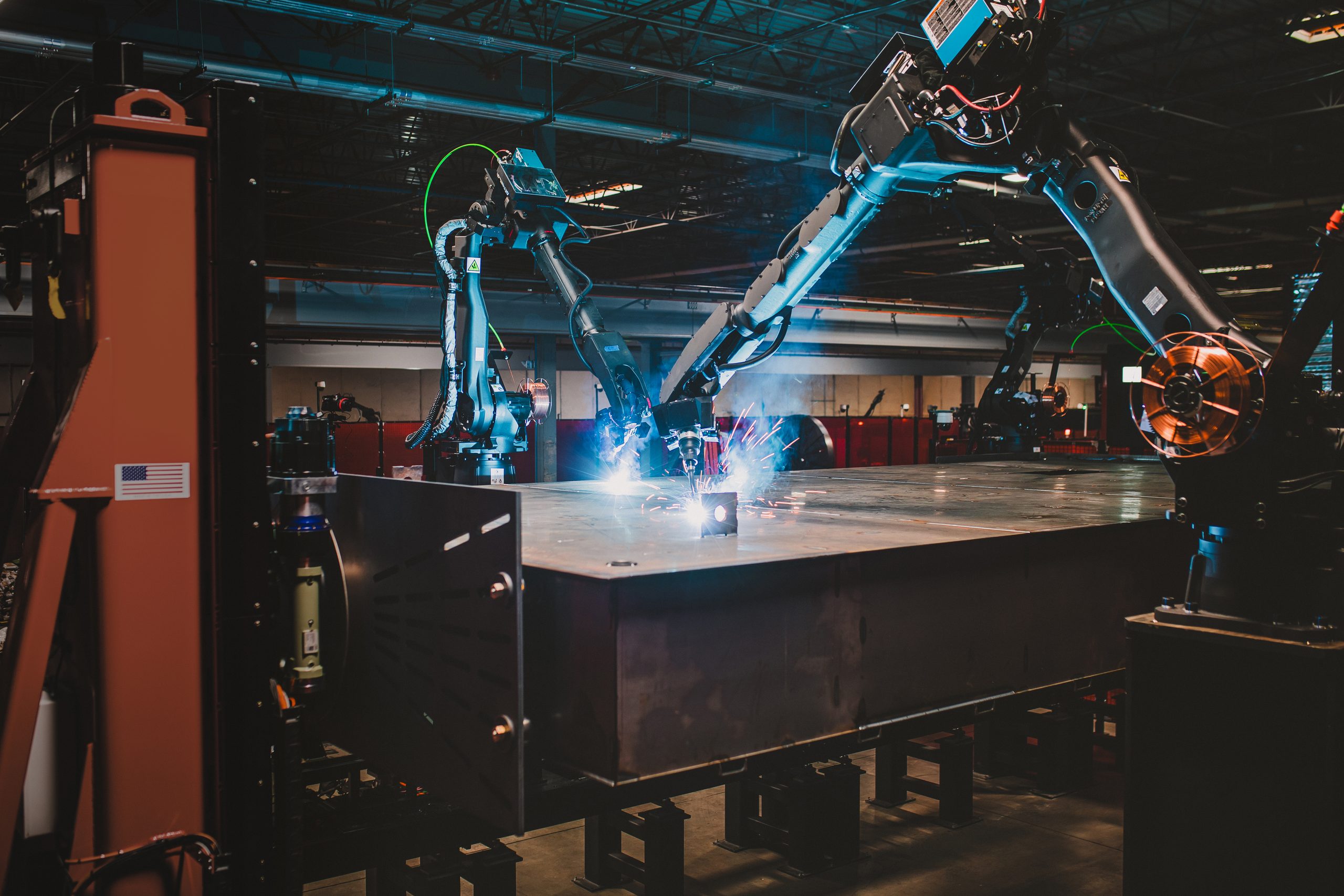
Path’s core product is Obsidian, a reinforcement-learning agent trained inside what the company calls its Weld World Model, a neural network built from what Path’s Obsidian page describes as tens of millions of welded inches collected over eight years from deployed robots and an internal data farm. Path says Obsidian runs at the edge, on the robot, and uses real-time sensor data to make decisions on each seam.
Reinforcement learning trains an agent to maximize a reward signal, and the method is known for needing very many interactions and for struggling to generalize to unfamiliar scenarios. Training inside a learned simulator substitutes simulated experience for costly physical trials, which makes the simulator’s fidelity to real welds the assumption that matters most. Path’s Obsidian page offers no third-party validation of its accuracy claims.
The sensing hardware uses two cameras and four lasers for 360-degree awareness around the torch, generates sub-millimeter point clouds, and uses a neural network to filter false reflections, according to Path.
The difference Path claims over older systems is tolerance for imperfect parts. Robot welders traditionally follow pre-programmed positions, machine vision or both, and a robot keeps its torch on the work about 90% of the time versus about 30% for a human welder, according to a dated 1982 estimate in Wikipedia’s robot welding entry. Acceptance still comes down to code and inspection: weld defects include cracks, porosity, lack of fusion and incomplete penetration.
HII, the largest U.S. military shipbuilder, signed a memorandum of understanding with Path in February to explore AI welding for naval work. On Aug. 6, HII announced performance-based agreements with Path and GrayMatter under which it may award up to $900 million in work over seven years, contingent on both companies meeting technology, manufacturing-readiness and performance milestones. The scope spans welding, grinding, blasting, painting, assembly and inspection, starting with small steel structures and growing to units and modules.
Path’s Series E announcement describes a $600 million HII agreement. HII’s own release gives only the combined $900 million ceiling and does not break out each company’s share. AI2Work reports Path’s portion as up to $600 million, attributing the figure to Ohio Tech News rather than HII. Either way, the figure is a ceiling on potential work, not booked revenue.
HII’s incentive is throughput. Executive Vice President Eric Chewning said HII raised throughput 14% in 2025 and wants 15% more in 2026.
According to a July 28 National Shipbuilding Research Program brief, Navy robotic welding follows NAVSEA Technical Publication S9074-AQ-GIB-010/248. Its Revision 1, dated Nov. 12, 2019, moved Level 1 qualification of robotic welding machines from each serial number to each make and model, tied to essential variables: amps, volts, gas type, material, grade and filler. Additional machines of a qualified make and model need only a Level 2 visual qualification.
The same brief calls implementing cobots on Navy work time consuming and difficult because of training and qualification requirements.
Path’s Rove page says Obsidian adjusts welding parameters in real time after scanning the seam. The brief describes fixed essential variables and does not address how an adaptive, learned controller is qualified, so what the technology milestone in HII’s agreements is measured against is an open question.
Path launched Rove in April. Rove pairs Obsidian with a quadruped robot so the welder can walk to large or immovable workpieces instead of the work moving into a fixed cell. It moves to a set location, locates seams, scans seam geometry, then welds while Obsidian adjusts parameters.
WorkBoat reports the quadruped is Boston Dynamics’ Spot, and Boston Dynamics chief strategy officer Marc Theermann praised the combination on social media. The Next Web separately reports a Boston Dynamics quadruped. Business Wire’s launch release and Path’s Rove page do not name the supplier.
Lonsberry told WorkBoat that Rove is slower than Path’s fixed cells and “designed for flexibility over speed.” The welding power supply and computer ride on a separate autonomous mobile robot wired to Rove. Path has published no Rove payload, battery or weld-process specifications.
Path’s Rove page says “Only 50 units shipping in 2027,” and WorkBoat reports the first 50 units go to early adopters that year. The Next Web describes the 50 as preorders. Saronic Technologies, which builds autonomous vessels, was named as an early adopter planning to integrate Rove at its Franklin, Louisiana, shipbuilding site. Lonsberry said Rove’s cost is similar to hiring humans; Path declined to share pricing.
On July 28, the Federal Communications Commission added foreign-produced advanced robotic devices to its Covered List. The definition covers mobile devices capable of locomotion, including quadrupeds and humanoids, that weigh more than 4.4 pounds and contain an environment-perceiving sensor and at least 200 kbps of connectivity. It excludes fixed, stationary industrial robots, which places Path’s fixed welding cells outside the rule.
A device escapes the list if it is a domestic end product, which requires U.S. manufacture and U.S. components above 65% of cost, rising to 75% in 2029. Foreign-produced devices can seek a Conditional Approval from the Department of War, with applications due by Jan. 1, 2028, and previously authorized robots keep their authorizations.
Boston Dynamics is controlled by Hyundai Motor Group, which bought a controlling stake in a deal valued at about $880 million. In July, Hyundai said it would acquire SoftBank’s remaining stake, a deal that had not closed when reported. Boston Dynamics policy chief Brendan Schulman publicly endorsed the ban. The sources reviewed do not state where Spot is manufactured or whether it qualifies as a domestic end product, and Path’s launch materials do not say how Rove is classified under the rule.
Lonsberry has pitched automation as the way to fill a welder gap. An American Welding Society publication says projections suggest 320,500 new welders will be needed by 2029. A video on Path’s site is headed “America Is 600,000 Welders Short,” a larger figure than the AWS projection.
Heather Carroll of Path Robotics spoke at the Dec. 10, 2025, relaunch of the Congressional Robotics Caucus about AI-enabled robots for labor-intensive tasks such as welding. Lonsberry is also an angel investor in Enact Intelligence, which raised $30 million in October. On jobs, he told Bloomberg, as reported by The Next Web, that none of Path’s customers has fired a welder because of a task robot. Path has published no independent labor data on its deployments.
Path says annual recurring revenue grew 17-fold over 18 months and headcount rose 97% year over year, with a target of 400 employees by the end of 2026. Both figures are company-reported, and Path has not disclosed absolute revenue. Annual recurring revenue also excludes one-time payments such as hardware and implementation fees. Path’s named customers include HII, Lockheed Martin and Saronic, plus mid-sized manufacturers EK Machine, Millerbernd Manufacturing, TransAmerican Power Products and TYCROP.
The round is a large late-stage bet that learned models can run robots in messy factories. At a CES research summit preview in January, Google DeepMind robotics head Carolina Parada said physical AI will not become commercially viable all at once, and General Motors robotics strategy head Mikell Taylor said reliability separates demos from systems that survive daily use.
For a reader, the decision framework is plain. Proven: adaptive welding in fixed cells for commercial customers, company-reported growth from an undisclosed base, and a funded round. Unproven: independent weld-quality validation, Navy qualification of an adaptive controller, Rove production, and each company’s share of HII’s $900 million ceiling.
HII’s release gives only a combined ceiling of up to $900 million over seven years for Path and GrayMatter and does not state a split. Path’s Series E announcement cites $600 million, and AI2Work reports up to $600 million for Path, all contingent on milestones.
An industry brief describes the Navy’s robotic welding rules as qualifying machines by make and model against fixed essential variables. It does not say how an adaptive, learned controller such as Obsidian is treated, so that question is open.
Rove launched in April, and Path’s Rove page says only 50 units will ship in 2027. Path has not disclosed pricing or payload specifications.
The rule excludes fixed, stationary industrial robots, which covers Path’s fixed cells. Rove is a mobile quadruped, and Path’s launch materials do not state how it is classified.