November 11, 2026:


Ring built its reputation on a simple idea: a doorbell with a camera that lets you see who is at your front door.
More than a decade later, the company is making a move that takes that original concept to a place nobody quite expected. Its latest products do not just watch; they move.
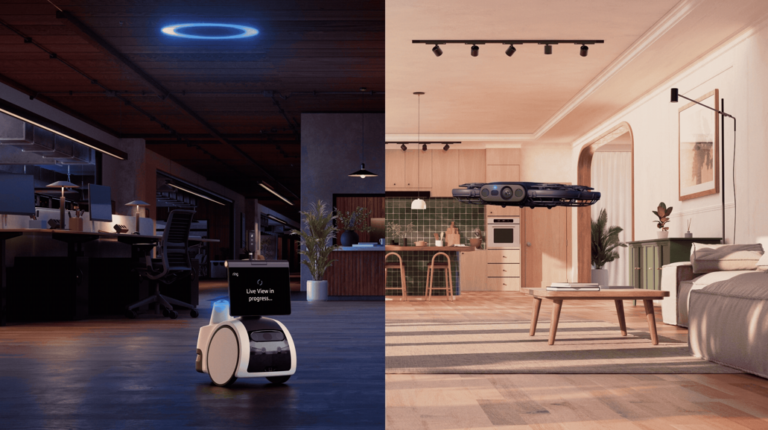
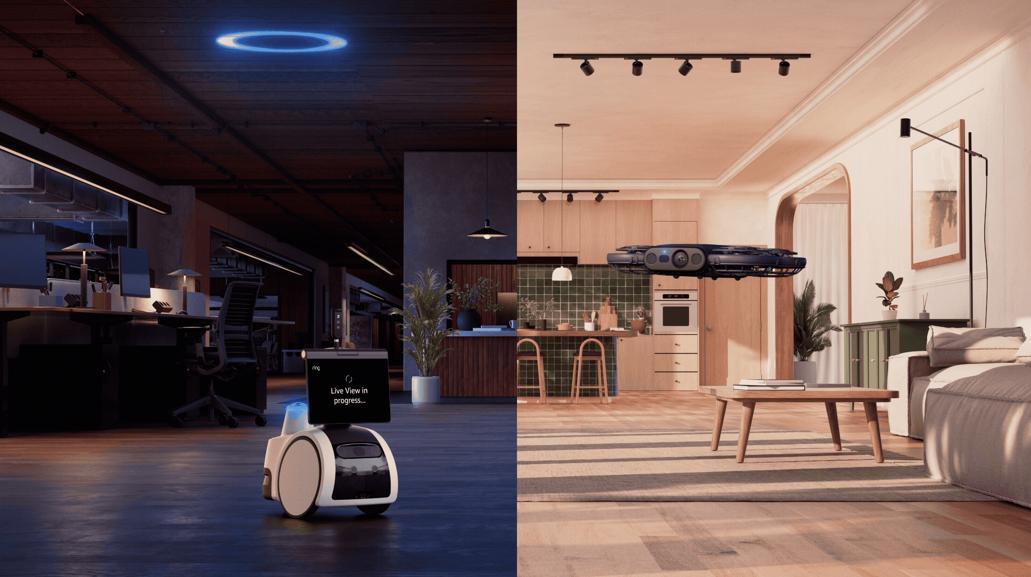
Amazon announced Ring Robotics earlier today, offering an entirely new category of Ring security products that brings autonomous, mobile devices to the home and business security market for the first time. The initial launch covers two products: Ring Drone Cam, a flying indoor security camera, and Ring Rover Cam, an autonomous ground-based robot built specifically for businesses.
Ring Drone Cam is a first-of-its-kind Ring camera that flies custom routes inside a home, patrols on a set schedule, and deploys automatically when another Ring device triggers an alert. It can be sent to investigate an alarm or simply launched on demand from the Ring app at any time, giving homeowners a way to check in on specific rooms without installing cameras throughout the entire house.
The drone delivers a 148-degree field of view with 360-degree rotation, capturing footage in 2K video. Two built-in LED lights activate automatically in low-light conditions so the camera remains useful after dark. When not in use, Ring Drone Cam returns to its dock and powers down with its camera off, with no recording taking place while it is docked.
“For years, customers told us they wanted eyes in the places a fixed camera could not reach, and peace of mind in the spots they would never want one,” said Jamie Siminoff, founder and chief inventor of Ring. “The honest answer was not more cameras; it meant reimagining what a security device could be.”
Ring Rover Cam takes the mobile security concept to the business environment, targeting any commercial space where full camera coverage of every corner would otherwise be cost-prohibitive or logistically difficult to wire up. The robot patrols autonomously, streams in up to 4K video whenever it is in motion or on patrol, and can be deployed to any saved patrol point with a single tap from the Ring app.
An adjustable periscope camera mast allows Ring Rover Cam to see over counters, shelves, and obstacles, with the height saved per stop so each patrol automatically raises or lowers to the right position for that location. When a connected Ring sensor or alarm triggers, the Rover automatically heads to its programmed patrol points to investigate without any manual input required.
Built-in deterrence features include a siren and a bright light tower designed to make it unmistakably clear to anyone present that the space is monitored and protected. Two-way audio allows a manager or business owner to speak directly through the device in real time from anywhere. Person motion detection continues even when the Rover is docked, and it begins recording and alerting the moment someone enters its field of view.
Ring Rover Cam is a direct descendant of Amazon’s Astro home robot. The Ring team drew on feedback from Astro customers who identified roving security as the feature they valued most and built the Rover as a purpose-built security robot rather than a general home assistant that also handled security as a secondary function.
Both Ring Drone Cam and Ring Rover Cam are powered by AI Pilot, a custom-built system that handles navigation, mapping, and autonomous decision-making for both devices. AI Pilot uses the devices’ cameras, specialized vision models, on-device sensors, and cloud processing to build an understanding of the space they are deployed in.
The setup process is designed to be simple. For Ring Drone Cam, a user carries it through the home once, and AI Pilot builds a floor plan from what the drone observes. For Ring Rover Cam, the robot explores autonomously during the initial setup period. After mapping, AI Pilot identifies rooms and suggests patrol points based on what it has learned about the layout, such as side doors, windows, storage areas, long corridors, and registers in a business setting.
Privacy is a core part of the design. Ring Drone Cam does not record while docked, and its propellers are audible when in flight, making it easy to know when the device is active. Ring Rover Cam includes a Sleep Mode that retracts the periscope and turns off the microphone with a single tap, and an LED indicator on the device signals recording status at all times. All video from both devices is protected by Ring’s Throw Away the Key encryption, which Amazon describes as the company’s strongest default encryption standard to date.
Both devices are fully integrated into the existing Ring ecosystem and are manageable through the Ring app alongside any other Ring cameras, doorbells, sensors, and alarms a customer already uses. Ring Rover Cam can also be controlled through the new Alexa Home Map, Amazon’s recently announced 3D smart home interface.
Ring is a smart home security company known for its video doorbells, security cameras, and alarm systems. It was founded by Jamie Siminoff in 2013, initially launching as a Kickstarter project called Doorbot before growing into one of the most widely used home security brands in the United States and globally.
The company’s product lineup has expanded significantly over the years to include outdoor and indoor cameras, motion-triggered floodlights, alarm systems, solar-powered cameras, and now autonomous robotic devices through Ring Robotics.
Amazon acquired Ring in April 2018 for approximately $1 billion, making it a subsidiary of the company. Since the acquisition, Ring’s product development has accelerated substantially and its integration with Amazon’s Alexa ecosystem has deepened. Amazon uses Ring’s security platform as a cornerstone of its broader smart home strategy, with Ring devices working natively with Alexa-powered Echo speakers, displays, and Amazon’s Sidewalk network.
Both Ring Robotics products are designed to fill specific gaps that fixed camera installations leave behind. Ring Drone Cam addresses the problem of needing visibility in rooms or areas where a permanent camera would be impractical or unwanted, letting homeowners deploy on demand rather than committing to a permanent installation.
Ring Rover Cam addresses the business challenge of covering a large floor space without wiring cameras to every corner of the building, providing a mobile alternative that patrols scheduled routes, investigates alarms automatically, and streams everything in high-definition video. Both devices integrate fully with existing Ring systems, so they add to what a customer already has rather than requiring a separate app or account.
Ring Rover Cam is the first to arrive, with preorders open now and shipping beginning December 16, 2026, in the United States at a price of $999.99. Ring Drone Cam follows later, with shipping beginning January 27, 2027, at a price of $249.99.
Both devices require a compatible Ring Protect plan for access to features such as scheduled patrols and video history. Ring Drone Cam has not yet been authorized by the Federal Communications Commission as required, meaning it cannot be formally offered for sale until that authorization is obtained ahead of its January 2027 ship date.