
November 11, 2026:


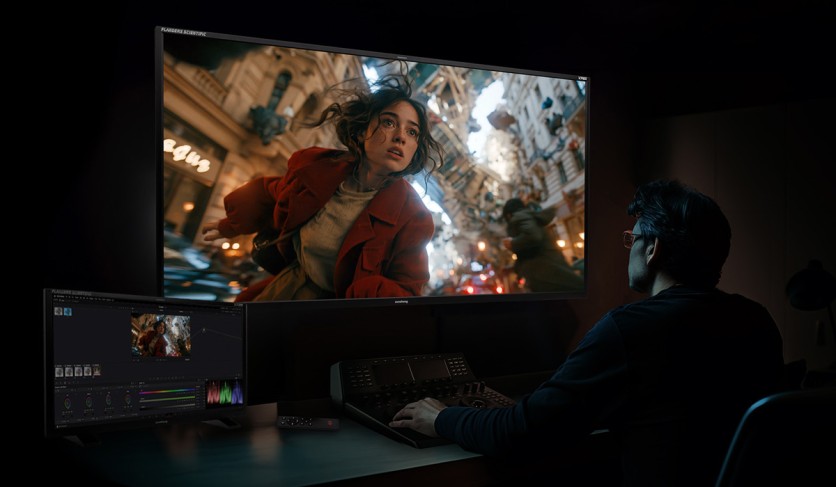
Flanders Scientific has launched two new professional reference monitor lines — the VP Series and V Series — adding seven models to its display lineup. The November 10, 2026, release extends the company’s QD-OLED range downward in price from its existing XMP Series, with the V270 at $5,995 representing the lowest price point FSI has offered for a Dolby Vision mastering-qualified display. The VP Series spans four models with 12G-SDI connectivity ranging from $9,995 to $17,495; the V Series spans three models without SDI ranging from $5,995 to $12,495. All seven monitors use QD-OLED panels from Samsung Display.
The underlying case for QD-OLED in professional monitoring comes down to color volume at peak brightness. QD-OLED technology combines a blue OLED light source with a quantum dot color-conversion layer, producing distinct red, green, and blue subpixels that maintain color saturation at high luminance. White OLED designs, by contrast, add a fourth white subpixel to boost brightness but dilute color saturation in the process. As detailed in a technical overview of QD-OLED color science published by Definition Magazine, QD-OLED reaches roughly 73 percent of the BT.2020 color space at peak output, compared to roughly 34 percent for WOLED. That gap matters for HDR mastering, where staying within grade requires accurate color at the high-luminance values HDR content actually uses.
Flanders Scientific introduced QD-OLED to professional monitoring in June 2023 with the XMP550, the first professional mastering display to use the technology. The VP and V Series share that foundational approach while targeting facilities and colorists who do not need the full broadcast toolset of the XMP line.
FSI’s decision to split the launch into VP and V Series maps directly onto a single connectivity question: does your facility use 12G-SDI infrastructure?
The VP Series retains the SDI connectivity that characterizes the XMP line. Each VP model includes four 12G-SDI inputs with clean SDI output, following the SMPTE ST 2082 standard, which carries 4K UHD at up to 60 frames per second over a single BNC coaxial cable without packetization latency. Post-production facilities with SDI-based routing, tape decks, or broadcast infrastructure will find VP connectivity compatible with their existing signal chain. The VP Series omits the XMP’s onboard waveform scopes, Look LUT storage, and Pomfort Livegrade integration — but it retains SDI at a significantly lower price.
The V Series uses HDMI 2.1 and DisplayPort 1.4 only, with no SDI inputs. It targets independent colorists and smaller facilities that work from a computer workstation without SDI infrastructure. For this workflow, HDMI 2.1 supports 4K at 120Hz with HDR, and DisplayPort 1.4 supports 4K at up to 144Hz. The absence of SDI drops the V270’s entry price to $5,995 — $4,000 less than the equivalent VP270 at $9,995.
One feature neither the VP nor the V Series carries over from XMP is Pomfort Livegrade 7.2 integration. The July 2026 Livegrade update added four-channel LUT control specifically for XMP monitors, requiring both SDI connectivity and XMP firmware 3.2.10 or later, which applies only to XMP hardware. Neither the VP Series nor the V Series appears in Livegrade’s current compatibility list. Facilities that rely on Livegrade for set monitoring, dailies, or on-set grading workflows should use the XMP Series for Livegrade-integrated positions.
The VP Series offers QD-OLED panel technology with 12G-SDI connectivity at prices below the XMP line, trading away onboard scopes and broadcast toolset features in exchange for a lower price point. For post-production facilities that need SDI monitoring but do not use the XMP’s waveform display or Look LUT functions, the VP Series represents a meaningful cost reduction.
| Model | Size | Panel | Inputs | Price |
|---|---|---|---|---|
| VP270 | 27 in. | 2,000 nit QD-OLED | 4× 12G-SDI, HDMI 2.1, DP 1.4 | $9,995 |
| VP310 | 31.1 in. | 2,000 nit QD-OLED | 4× 12G-SDI, HDMI 2.1, DP 1.4 | $12,495 |
| VP551 | 55 in. | 4,000 nit QD-OLED | 4× 12G-SDI, HDMI 2.1, DP 1.4 | $15,495 |
| VP651 | 65 in. | 4,000 nit QD-OLED | 4× 12G-SDI, HDMI 2.1, DP 1.4 | $17,495 |
The VP551 and VP651 use the same Samsung 4,000-nit fourth-generation panel found in the XMP551 and XMP651, with an 8,000,000:1 contrast ratio and 4,000-nit peak luminance. The VP270 and VP310 use the same 2,000-nit QD-OLED panel as their XMP counterparts in the 27-inch and 31.1-inch sizes.
All four VP models include GaiaColor AutoCal, GaiaColor Analyzer, Dolby Vision mastering qualification, HDR/SDR LUM Coloring false-color analysis, custom markers, and RGB-only monitoring modes.
The V Series shares the same calibration tools and Dolby Vision mastering qualification as the VP Series, with HDMI 2.1 and DisplayPort 1.4 connectivity and no SDI inputs. The price reduction relative to VP reflects the absence of SDI hardware: $4,000 at the 27-inch size, with proportional savings across the line.
| Model | Size | Panel | Inputs | Price |
|---|---|---|---|---|
| V270 | 27 in. | 2,000 nit QD-OLED | HDMI 2.1, DP 1.4 | $5,995 |
| V310 | 31.1 in. | 2,000 nit QD-OLED | HDMI 2.1, DP 1.4 | $7,995 |
| V550 | 55 in. | 2,000 nit QD-OLED | HDMI 2.1, DP 1.4 | $12,495 |
One important distinction within the V Series: the V550 uses a 2,000-nit panel rather than the 4,000-nit fourth-generation panel found in the VP551, VP651, XMP551, and XMP651. Buyers who need 4,000-nit peak luminance for specular highlight work will need to step to the VP551 at $15,495 or the XMP551 at $20,995.
All three V Series models include GaiaColor AutoCal, GaiaColor Analyzer, Dolby Vision mastering qualification, HDR/SDR LUM Coloring false-color, custom markers, and RGB-only monitoring modes — the same calibration and monitoring feature set as the VP Series, with SDI connectivity as the sole functional difference.
Buyers evaluating VP against their existing XMP monitors, or evaluating V against VP, should focus on three capability categories: connectivity, calibration tools, and broadcast toolset.
VP Series versus XMP Series
| Feature | XMP Series | VP Series |
|---|---|---|
| QD-OLED panel (same spec per size) | Yes | Yes |
| 12G-SDI inputs | Yes | Yes |
| GaiaColor AutoCal | Yes | Yes |
| GaiaColor Analyzer | Yes | Yes |
| Dolby Vision mastering qualification | Yes | Yes |
| Onboard waveform scopes | Yes | No |
| Look LUT storage | Yes | No |
| Pomfort Livegrade compatibility | Yes | No |
V Series versus VP Series
| Feature | VP Series | V Series |
|---|---|---|
| QD-OLED panel (same spec per size) | Yes | Yes |
| GaiaColor AutoCal | Yes | Yes |
| GaiaColor Analyzer | Yes | Yes |
| Dolby Vision mastering qualification | Yes | Yes |
| HDR/SDR LUM Coloring | Yes | Yes |
| 12G-SDI inputs | Yes | No |
The key point for buyers considering V Series: GaiaColor Analyzer support — which allows probe-based calibration verification using an attached colorimeter or spectrophotometer — is present on both VP and V Series. The V Series sacrifice is SDI connectivity, not calibration capability.
Professional colorists evaluating QD-OLED for full-time, logo-heavy, or static-element-heavy workflows will want to review burn-in data before committing. Independent long-term burn-in testing on current-generation QD-OLED panels indicates these displays can support professional color grading use when operators follow manufacturer-recommended pixel-shift, logo-dimming, and automatic screen-saver protocols. Under worst-case static-use conditions, testing on a comparable QD-OLED panel found it might require replacement for color-sensitive professional use as early as nine months after visible burn-in first appears — a scenario the researchers considered representative of extreme, unmanaged use rather than typical grading workflows.
Flanders Scientific addresses this with standard OLED care features built into the VP and V Series lineup, including pixel-shift and automatic screen-saver policies.
The VP and V Series launch into a professional display market where QD-OLED adoption is accelerating but not yet universal. EIZO’s CG3200X QD-OLED reference monitor, a 31.5-inch display shipping in winter 2026 and described as aimed directly at SDR and HDR grading, signals that professional QD-OLED adoption is extending beyond FSI’s XMP lineup to include other major display manufacturers.
The broader context is a shift toward higher color volume in professional displays, driven by HDR mastering requirements that WOLED technology cannot reliably meet at peak luminance. As QD-OLED supply has expanded and panel costs have decreased, the technology is reaching price points accessible to independent colorists rather than only to large post-production facilities. The V270’s $5,995 entry point represents a meaningful step in that direction.
A Dell’s UltraSharp U3226Q QD-OLED review in ITPro noted that the shift toward QD-OLED in professional displays reflects broader industry demand for color precision and HDR performance, as more studios adopt the technology for color-critical work. Peter Barber, CEO of Atomos, the parent company that acquired Flanders Scientific earlier in 2026, said the goal was to extend professional QD-OLED monitoring to a wider range of video professionals while preserving the core reference-grade features that matter most for color work.
All VP and V Series monitors are available through the Flanders Scientific website.
| Model | Size | SDI | Price |
|---|---|---|---|
| V270 | 27 in. | No | $5,995 |
| V310 | 31.1 in. | No | $7,995 |
| V550 | 55 in. | No | $12,495 |
| VP270 | 27 in. | Yes | $9,995 |
| VP310 | 31.1 in. | Yes | $12,495 |
| VP551 | 55 in. | Yes | $15,495 |
| VP651 | 65 in. | Yes | $17,495 |
The VP Series includes four 12G-SDI inputs per model and is designed for facilities with SDI-based signal infrastructure. The V Series uses only HDMI 2.1 and DisplayPort 1.4 inputs, with no SDI, and is designed for independent colorists and smaller facilities working from a computer workstation. Both series share the same QD-OLED panels (by size), GaiaColor AutoCal, GaiaColor Analyzer, Dolby Vision mastering qualification, and other core monitoring features. The SDI capability is the primary functional distinction and accounts for approximately $4,000 of the price difference between equivalent-size models.
Yes. GaiaColor Analyzer support is present on both the VP and V Series. GaiaColor Analyzer allows probe-based calibration verification using an attached colorimeter or spectrophotometer. Both series include it. The V Series omits 12G-SDI inputs relative to the VP Series — not calibration tools.
No. Pomfort Livegrade 7.2 added four-channel LUT control for FSI XMP monitors, but this integration requires both 12G-SDI connectivity and XMP firmware 3.2.10 or later, which applies only to XMP hardware. Neither the VP Series nor the V Series appears in Livegrade’s current compatibility list. Facilities requiring Livegrade integration should use the XMP Series for Livegrade-compatible monitoring positions.
Current evidence from long-term testing supports using QD-OLED monitors for full-time professional color grading when manufacturers’ OLED care features are enabled. These include pixel-shift, logo-dimming, and automatic screen-saver protocols. The risk of burn-in is real under worst-case static-image conditions, and colorists should enable all available OLED care functions and avoid displaying high-contrast static graphics for extended periods. Flanders Scientific includes these protective features across the VP and V Series lineup.
The V550 is priced at $12,495, compared to $20,995 for the XMP551. These are not equivalent monitors: the V550 uses a 2,000-nit panel and has no SDI inputs, while the XMP551 uses a 4,000-nit fourth-generation panel with four 12G-SDI inputs, onboard scopes, Look LUT storage, and Pomfort Livegrade compatibility. The VP551 at $15,495 is a closer functional comparison to the XMP551, sharing the same 4,000-nit panel and SDI connectivity while omitting the XMP’s broadcast toolset.