HomeAuto Stopping Statins Clears 2-Year Safety Bar for Adults 70+; 1 in 40 Face Extra Heart Event
Stopping Statins Clears 2-Year Safety Bar for Adults 70+; 1 in 40 Face Extra Heart Event
November 9, 2026:
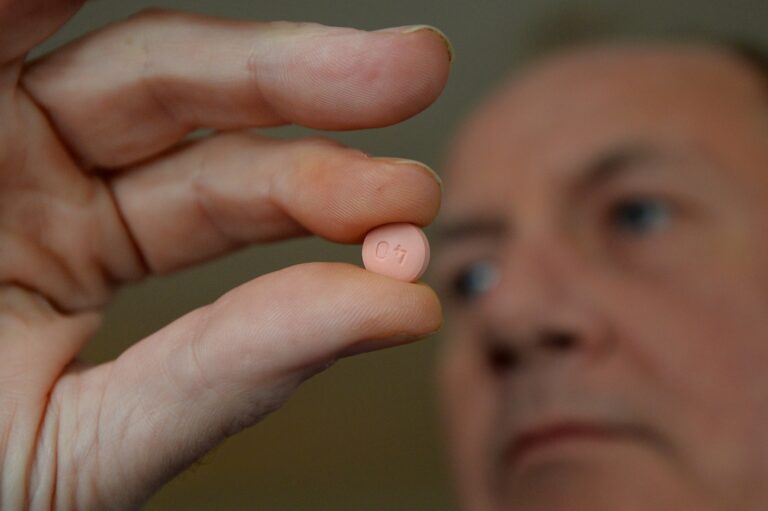
British man, Alwyn Daniel poses with a tablet of the anti-cholesterol drug Statins in London on March 21, 2014. As the home of cooked breakfasts and pints of beer, it is perhaps no surprise that Britain is the European king of anti-cholesterol drugs with some seven million users. But recommendations to widen the use of “statins” — the class of drugs used to battle cholesterol — has sparked a national debate about their merits and whether they are really a silver bullet to stave off heart attacks.AFP PHOTO / BEN STANSALL BEN STANSALL/AFP via Getty Images
For the tens of millions of older Americans juggling five or more prescriptions for multiple conditions, a landmark study published Thursday in The New England Journal of Medicine provides the most rigorous answer yet to a question their doctors have long struggled to answer with data: is it safe to stop taking a cholesterol-lowering statin if you have never had a heart attack or stroke?
The short answer is: generally yes, over two years — but with a catch that the trial’s investigators, the American Heart Association, and the independent safety panel that monitored the data all believe is too significant to dismiss.
The STREAM trial (STatin discontinuation as pRevention among the Elderly And Multimorbid), presented November 7 at the AHA’s Scientific Sessions 2026 in Chicago and simultaneously published in The New England Journal of Medicine, enrolled 1,880 adults at 24 clinical sites across Switzerland, the Netherlands, and France. All were aged 70 or older, had been taking statins for primary prevention — meaning no prior heart attack, stroke, or other cardiovascular event — and lived with at least two additional chronic conditions such as diabetes, cancer, or pulmonary disease.
Stopping statins cleared the trial’s prespecified non-inferiority hurdle at two years. Over the full study follow-up, it did not.
What STREAM Actually Found — And Why Both Numbers Are Right
STREAM randomized 938 participants to discontinue their statin and 942 to continue it, then tracked them for a median of 103 weeks — roughly two years.
The trial’s primary endpoint was two-year restricted mean event-free survival: how many weeks, on average, participants spent free of a nonfatal heart attack, nonfatal ischemic stroke, or death from any cause in the first two years. Those who stopped statins accumulated an average of 96.5 event-free weeks over that period; those who continued accumulated 98.5 weeks. The difference was −2.0 weeks (95% CI, −3.7 to −0.3; P
That is the headline finding the deprescribing community has been waiting for: randomized evidence that stopping statins in multimorbid older adults without heart disease does not unacceptably worsen outcomes over two years.
But STREAM also reported event rates over the full 103-week follow-up, and those numbers tell a different story. The primary outcome occurred in 12.7% of the discontinuation group versus 9.2% of the continuation group — a hazard ratio of 1.38 (95% CI, 1.05–1.81). That translates to roughly one extra cardiovascular event or death for every 40 patients who stop statins over approximately two years.
These two findings are not contradictory. They measure different things. The two-year restricted mean survival time summarizes the average area under the survival curve across the full study population through 104 weeks — a statistical snapshot designed to capture whether the overall experience differed by an amount that would be clinically meaningful to patients. The hazard ratio captures how the event rate evolved over the full follow-up period: a signal that the cardiovascular benefit of continuing statins accumulates with time, as LDL-driven plaque progression diverges between the two groups over months and years.
Principal co-author Rita F. Redberg, MD, MSc, FAHA, professor of cardiology and the Araxe Vilensky Endowed Chair in Cardiology at the University of California, San Francisco, was careful to frame the results as nuanced rather than a blanket endorsement of stopping statins.
“This small, increased risk of cardiovascular events means that one cannot make a general recommendation about stopping statins in this patient population,” Redberg said in an AHA statement. “There should be shared decision-making between the patient and the healthcare professional to know if it is appropriate for an individual to discontinue the medication. In general, however, discontinuation is safe for most people who are in this age group and without a previous CVD event.”
Why LDL Cholesterol Surges After Stopping — And Why That Matters
Understanding what happened to LDL cholesterol in STREAM is key to understanding why the full follow-up risk signal appeared.
Statins work by blocking HMG-CoA reductase, the rate-limiting enzyme in the mevalonate pathway — the biochemical route liver cells use to manufacture cholesterol. When this enzyme is inhibited, the liver compensates by increasing the number of LDL receptors on its surface, pulling more low-density lipoprotein out of the bloodstream. The result is lower plasma LDL cholesterol.
When statins are stopped, the inhibition lifts. Hepatic cholesterol synthesis resumes, LDL receptor expression decreases, and plasma LDL rises back toward its pre-treatment level. In a subset of 235 STREAM participants, this reversal was stark: mean LDL cholesterol at 12 months was 176.0 mg/dL in the discontinuation group versus 99.4 mg/dL in the continuation group — a difference of roughly 76.6 mg/dL.
That matters because LDL cholesterol is causally linked to atherosclerotic plaque buildup. Each meaningful reduction in LDL reduces cardiovascular events; reversing that reduction gradually re-exposes patients to a higher underlying risk — a process that takes months to years to manifest as measurable differences in event rates. The divergence seen in STREAM’s full follow-up HR is consistent with this biology.
Who Was in This Trial — And Who Was Not
STREAM’s population was deliberately specific — and that specificity is essential for understanding who the results apply to.
Included: Adults aged 70 and older (mean age 77.5 years, 46.9% women) who had been taking statins for primary prevention — meaning no prior atherosclerotic cardiovascular disease, no prior heart attack, no prior stroke, no known coronary artery disease. All participants had at least two additional chronic conditions (multimorbidity). More than half (53.5%) were recruited through general practitioners rather than hospital specialists.
Excluded: Anyone with a prior cardiovascular event. These patients are on statins for secondary prevention — to prevent recurrence of an established disease — and the evidence for continuing statins in this group is substantially stronger. STREAM’s findings do not apply to them.
This distinction is not a footnote. It is the entire basis for the trial’s clinical relevance. The ~40% of U.S. adults over age 75 who take statins include both primary and secondary prevention patients; the conversation about stopping is appropriate only for the primary prevention subset who have never had a cardiovascular event.
The trial’s design also reflects the population where statin evidence has historically been thinnest. As lead investigator Nicolas Rodondi, MD, MAS, professor at the University of Bern and head of the ambulatory care department there, noted: most landmark statin trials enrolled predominantly younger, healthier adults — leaving clinicians without randomized data for the oldest, most medically complex patients.
One notable subgroup signal: participants recruited through general practitioners showed a 3.4-week shorter event-free survival after stopping statins, compared to just 1.1 weeks shorter among hospital-recruited participants. Investigators did not establish a definitive explanation, but it may reflect differences in underlying health complexity, monitoring intensity, or access to follow-up care between primary care and specialty settings.
Safety Board’s Signal: Restart the Conversation
After STREAM concluded, the trial’s Data and Safety Monitoring Board — the independent panel charged with watching for emerging harms during a clinical trial — recommended that participants who had been in the discontinuation arm be advised to discuss restarting statin therapy with their physicians.
That recommendation is not a formal withdrawal of the trial’s non-inferiority finding. But it is a meaningful institutional signal: the same people who reviewed the full unblinded data as the trial progressed believed the HR 1.38 finding warranted at least a clinical conversation about resumption. The DSMB’s recommendation is noted in the NEJM publication and was presented as part of the AHA abstract.
For patients: if you participated in a trial where you stopped statins, or have recently stopped statins on the basis of STREAM’s headline finding, this is exactly the kind of conversation to have with your clinician — not a reason to panic, but a reason to revisit the decision with fresh data.
No Quality-of-Life Windfall
One of the most common expectations attached to statin deprescribing is that removing statins from an elderly patient’s daily regimen will produce measurable quality-of-life benefits — fewer side effects, less pill burden, better muscle function, reduced risk of falls.
STREAM did not find that.
The two groups showed no significant difference in quality of life at 24 months, pain at three months, falls at 12 months, or sarcopenia (muscle-wasting) risk at 24 months. Serious adverse events occurred in 43.0% of the discontinuation group and 39.8% of the continuation group — a small numerical difference that was not a focus of the primary analysis.
For the deprescribing movement, this null finding is clinically important. The rationale for stopping statins in multimorbid elderly patients has often leaned on expected symptom relief or improved wellbeing as a partial offset to any residual cardiovascular risk. STREAM provides the strongest evidence yet that those quality-of-life benefits may not reliably materialize — leaving the decision primarily as a risk tradeoff, not a risk-plus-benefit tradeoff on the stopping side.
How STREAM Fits Into Growing Body of Evidence
STREAM enters a scientific conversation that has been building for more than a decade — and complements, rather than settles, the question of statins in elderly adults.
The SAGA/SITE trial (Lancet Healthy Longevity 2026): A French randomized trial of 1,160 adults aged 75 and older found statin discontinuation non-inferior for all-cause mortality at three years (7.9% vs. 7.2%). Notably, however, the SAGA/SITE population was substantially healthier than STREAM’s: its three-year mortality was approximately 7.5%, compared to 15.1% in STREAM — a stark difference that underscores how much sicker STREAM’s multimorbid participants were. The survival benefit from continuing statins may be greater in higher-risk populations, which STREAM’s HR 1.38 supports.
The STAREE trial (STAREE findings in NEJM): An Australian randomized trial of 9,971 statin-naive adults aged 70 and older tested whether starting atorvastatin 40 mg reduced major cardiovascular events. It did — by 30% (6.0% vs. 8.3%; HR 0.70). But atorvastatin did not improve disability-free survival (12.8% vs. 13.6%). The STREAM investigators explicitly noted that STAREE’s findings on initiating therapy in a different population should not be used to guide decisions about discontinuing statins in those already taking them. These are distinct clinical questions.
The two trials together sketch the emerging picture: statins do something meaningful for older adults’ cardiovascular outcomes (STAREE), but that benefit can be traded off against polypharmacy burden and life goals under carefully individualized circumstances (STREAM) — not population-wide.
Context: The Polypharmacy Problem That Made This Trial Necessary
Approximately 50.9% of U.S. adults aged 65 and older take five or more medications daily, the standard threshold for polypharmacy — and in adults over 75, the proportion is higher. Each additional medication adds risks: drug-drug interactions, adverse reactions, falls, and the cognitive burden of managing a complex regimen. Statins are among the most commonly prescribed medications in this group, with roughly 40% of Americans over age 75 estimated to be on them — often as part of regimens that already include blood pressure drugs, diabetes medications, blood thinners, and more.
The clinical deprescribing movement has been pressing for randomized evidence on which medications can be safely reduced or stopped as patients age, comorbidity accumulates, and the balance of benefit versus burden shifts. Until STREAM, the statin evidence base was thin for the primary prevention population over 70: the original trials that established statins’ cardiovascular benefits enrolled predominantly middle-aged, healthier adults.
STREAM fills that gap — imperfectly but meaningfully. It is the largest RCT ever designed to test this specific clinical question, and its simultaneous NEJM publication and AHA presentation give it the scientific platform it warrants.
What Clinicians and Patients Should Take Away
STREAM does not support a population-wide policy of stopping statins in multimorbid older adults without heart disease. It supports something more nuanced: individualized shared decision-making, grounded in data.
The trial provides what clinicians have lacked — randomized evidence to bring to a conversation that too often relied on intuition, habit, or concern about causing harm by stopping a medication with decades of prescribing behind it. That evidence says: for the two-year window, stopping is generally safe. Over a longer horizon, stopping carries a risk signal that amounts to one extra cardiovascular event or death per 40 patients — a number that, depending on a patient’s absolute cardiovascular risk, life expectancy, comorbidity burden, and preferences, may or may not tip the decision.
The DSMB’s recommendation to discuss restarting underlines that the trial’s authors are not advocating for universal deprescribing. They are advocating for the conversation — and for the first time in this population, they have an RCT to bring to it.
The trial was funded by the Swiss National Science Foundation. Full results are published in The New England Journal of Medicine (doi: 10.1056/NEJMoa2606634).
Frequently Asked Questions
Does this study mean I should stop taking my statin?
Not on its own. STREAM enrolled adults aged 70 and older who were taking statins for primary prevention — meaning they had never had a heart attack, stroke, or other cardiovascular event. If you have had a cardiovascular event, your statin is prescribed for secondary prevention, and this study does not apply to your situation. If you are in the primary prevention group, STREAM provides evidence that stopping may be safe over two years — but the full follow-up data show a hazard ratio of 1.38, meaning your absolute risk of a cardiovascular event or death increases by about 38% if you stop, relative to continuing. What that means for you individually depends on your overall cardiovascular risk, life expectancy, number of other medications, and your own priorities. This is exactly the conversation to have with your clinician — not a decision to make based on a headline.
If stopping statins is “non-inferior,” why is there still a risk signal?
This is the methodological heart of the study, and it is worth understanding. The trial’s primary endpoint measured average event-free time over exactly two years using a statistical method called restricted mean survival time (RMST). It found a difference of −2.0 weeks — small enough to fall within the prespecified “non-inferiority margin” of −5.2 weeks, meaning stopping was not unacceptably worse by this measure. The hazard ratio of 1.38, by contrast, was derived from the full survival curve over the entire 103-week follow-up. These two statistics are compatible: the RMST says the two-year snapshot difference is within an acceptable range; the HR says the event rate diverges meaningfully when you watch longer. Both are right. The HR 1.38 reflects the biology of LDL-driven plaque progression: as the statin group maintains lower LDL (~99 mg/dL) and the discontinuation group’s LDL rises back toward ~176 mg/dL, the cardiovascular risk gap widens over time.
What happened to LDL cholesterol in patients who stopped statins?
It rose substantially. In a subset of 235 participants measured at 12 months, mean LDL was 176.0 mg/dL in the discontinuation group versus 99.4 mg/dL in the continuation group — a rise of approximately 76.6 mg/dL. This is the biochemical mechanism behind the risk signal: statins keep LDL low by blocking HMG-CoA reductase (the rate-limiting enzyme in cholesterol synthesis) and thereby upregulating LDL receptors. Remove the statin, and LDL drifts back toward its natural baseline.
Did stopping statins improve quality of life or reduce side effects?
STREAM did not find meaningful quality-of-life benefits from stopping statins. The two groups showed no significant differences in overall quality of life at 24 months, pain at three months, falls at 12 months, or sarcopenia (muscle-wasting) risk at 24 months. Serious adverse events were 43.0% in the discontinuation group versus 39.8% in the continuation group — a small numerical difference that was not a primary focus of the trial. This null finding matters because a common expectation in the deprescribing field is that removing statins will produce measurable wellbeing improvements; STREAM provides the best evidence yet that this expectation is not reliably met.
How does this study compare to other recent trials of statins in older adults?
Two other major trials provide important context. The SAGA/SITE trial (Lancet Healthy Longevity 2026) found statin discontinuation non-inferior for 3-year all-cause mortality in 1,160 adults aged 75+, but its population was notably healthier (3-year mortality ~7.5% vs. STREAM’s ~15.1%), suggesting STREAM’s findings may be more applicable to higher-risk multimorbid patients. The STAREE trial (NEJM 2026) tested whether starting atorvastatin in statin-naive adults aged 70+ reduced cardiovascular events — and found a 30% reduction in major cardiovascular events, with no improvement in disability-free survival. STAREE tested starting statins in a different population; STREAM tested stopping statins in patients already on them for at least a year. These findings are complementary, not contradictory.
Does the trial’s monitoring board recommendation to restart statins change the conclusion?
It is a signal worth taking seriously. After STREAM concluded, the Data and Safety Monitoring Board — the independent safety panel that reviewed unblinded data throughout the trial — recommended that participants in the discontinuation arm be advised to discuss restarting statin therapy with their physicians. This does not overturn the non-inferiority finding, but it reflects the monitoring board’s clinical judgment that the HR 1.38 finding is meaningful enough to warrant revisiting the decision. For patients and clinicians, the DSMB’s signal reinforces the shared decision-making framework: stopping statins is not reckless, but it is not consequence-free either, and the conversation should continue.