HomeAuto Nikon Camera Sales Slide to Three-Year Low; AI Memory Demand Lifts Semiconductor Revenue
Nikon Camera Sales Slide to Three-Year Low; AI Memory Demand Lifts Semiconductor Revenue
November 7, 2026:
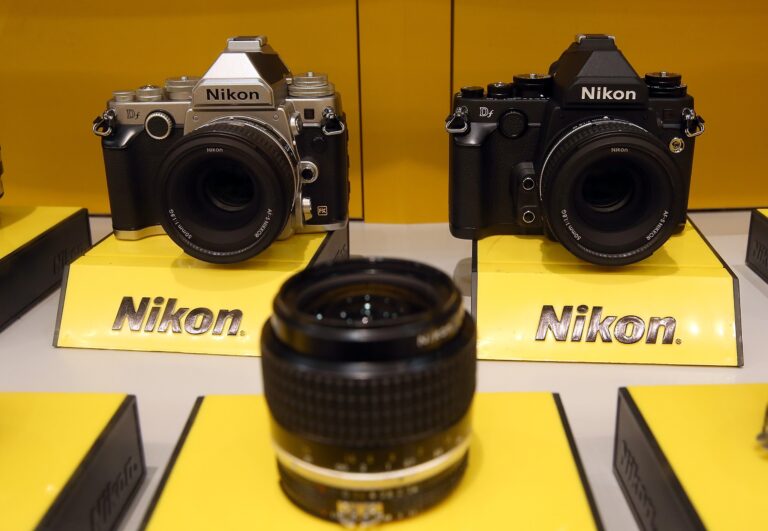
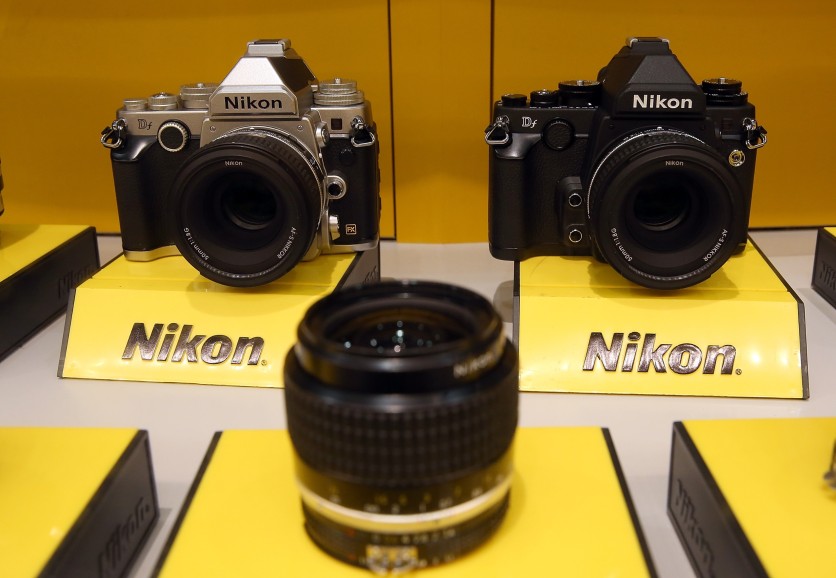
LAS VEGAS, NV – JANUARY 08: The Nikon DF is displayed in the Nikon booth at the 2014 International CES at the Las Vegas Convention Center on January 8, 2014 in Las Vegas, Nevada. CES, the world’s largest annual consumer technology trade show, runs through January 10 and is expected to feature 3,200 exhibitors showing off their latest products and services to about 150,000 attendees. Justin Sullivan/Getty Images
Nikon sold just 150,000 camera bodies in Q2 FY2027 (July–September 2026), the lowest single-quarter figure in at least three years, down 28.6% from 210,000 units in the same quarter a year earlier
The Z5IIC is the only new Nikon camera body launched in all of 2026, targeting smartphone upgraders with a compact, viewfinder-free full-frame design priced at $1,399.95
AI-driven demand for NAND flash and DRAM memory is raising input costs for camera manufacturers across the industry — Fujifilm, Sony, and Canon have all flagged the same pressure in 2026
Nikon’s Precision Equipment (semiconductor lithography) segment grew nearly 30% in H1 FY2027, driven by the same AI infrastructure buildout that is squeezing camera component budgets — the identical macroeconomic force operating in opposite directions on Nikon’s two main businesses
Nikon raised its full-year operating profit forecast by 50% to ¥16.5 billion (approximately $104.4 million USD) while simultaneously cutting its full-year revenue forecast by ¥10 billion (approximately $63.3 million USD) and its camera unit target from 850,000 to 800,000 bodies
Nikon’s Quarterly Camera Sales Just Hit a Three-Year Low
Nikon filed its Q2 FY2027 financial results on November 5, 2026, and the camera number buried in the supplementary investor tables tells a story the headline figures don’t. The company sold 150,000 interchangeable-lens camera bodies in the July–September 2026 quarter — the lowest single-quarter total in at least three years, and down nearly 29% from the 210,000 units shipped in Q2 FY2026.
For the first half of fiscal 2027 combined, Nikon shipped 360,000 camera bodies on revenue of ¥129.3 billion (approximately $818.4 million USD), a 10.8% revenue decline from the same period a year earlier. Lens volumes followed: 530,000 interchangeable lenses shipped in H1, down 140,000 from the 670,000 shipped in H1 FY2026.
None of that stopped Nikon’s overall financial performance from improving substantially. Consolidated H1 revenue reached ¥334.5 billion (approximately $2.12 billion USD), up 7% year-over-year. Q2 operating profit came in at ¥9.9 billion (approximately $62.7 million USD), and H1 operating profit finished at ¥9.0 billion (approximately $57.0 million USD) — a dramatic reversal from the ¥5.5 billion (approximately $34.8 million USD) operating loss the company had projected for the same period just three months ago.
That gap between a thriving corporate balance sheet and a camera division under structural pressure is not an accident. It is a product of AI.
The AI Memory Factor: Why Your Next Camera Costs More Than Your Last
The connection between artificial intelligence and mirrorless camera prices is not obvious. It runs through a supply chain most camera buyers never think about.
Modern mirrorless cameras depend on two categories of semiconductor memory: NAND flash (used for image buffers, write queues, and onboard media standards like CFexpress) and DRAM (used for the image-processing pipeline, pre-capture buffers, and the computational functions that power features like real-time subject detection). These are commodity components, sourced from the same pool of supply that feeds smartphones, laptops, and servers.
In 2026, that supply pool has been substantially redirected toward AI infrastructure. Cloud providers expanding their AI inference capacity — the hardware that runs large language models at scale — have committed the majority of enterprise SSD and high-bandwidth DRAM output well in advance. Market research firm TrendForce projected Q4 2026 NAND prices would rise 15–20% quarter-over-quarter as AI cloud providers absorbed memory supply, with conventional DRAM prices projected to climb 10–15% in the same period. Enterprise SSD bit demand was forecast to grow more than 80% year-over-year in 2026 as cloud providers scale AI workloads.
Camera manufacturers have no leverage in that market. Sony, Nikon, Canon, and Fujifilm each order memory at volumes dwarfed by a single smartphone OEM’s quarterly purchase. When AI demand pulls memory prices up, camera makers can absorb the increase (compressing already-thin margins) or pass it through (raising retail prices). In 2026, they have been doing both.
Fujifilm disclosed that its DRAM costs rose from ¥11 billion to ¥25 billion, with ¥14 billion (approximately $89 million USD) of that increase hitting its Imaging division specifically. The company raised camera prices in Germany by €100 to €500 (approximately $110 to $550 USD at mid-market rates). Sony flagged approximately ¥30 billion in memory-related costs across its camera and imaging businesses. Canon cited ¥6–7 billion (approximately $38–44 million USD) in DRAM exposure. Nikon described “elevated memory component costs” as a factor in its Imaging Products segment performance without quantifying the specific amount.
What this means for buyers: the price floors for cameras are rising on a structural basis, not because manufacturers have improved their products enough to command premium pricing, but because the input costs are higher. The Z5IIC’s $1,399.95 price tag reflects a component cost environment that did not exist when the Z5 II launched in spring 2025 at a comparable entry point.
One Camera for All of 2026: The Nikon Z5IIC
Nikon launched exactly one new camera body in calendar year 2026: the Z5IIC announced September 24, available from mid-October in black and silver.
The Z5IIC is a compact, full-frame mirrorless camera with a distinctive flat-top profile — no electronic viewfinder, no mode dial hump, a silhouette closer to a point-and-shoot than to a conventional DSLR replacement. It uses a 24.5-megapixel full-frame backside-illuminated CMOS sensor and Nikon’s EXPEED 7 image processor — the same chip found in the flagship Z9 and Z8 bodies — which enables real-time AI subject detection across 10 categories. The camera adds “Fish” to Nikon’s subject-detection roster for the first time in any of its bodies, alongside the existing People, Animal, Vehicle, and other recognition modes.
The Z5IIC also becomes the first Nikon full-frame camera to include a Scene dial — 15 scene modes accessible from a physical selector on the top plate — alongside in-body stabilization rated at 7.5 stops at the center of the frame and 6.0 stops at the periphery under CIPA 2024 test conditions with a compatible lens. It records 4K 60fps video without crop. Body-only retail price is $1,399.95; a kit with the NIKKOR Z 24-50mm f/4-6.3 lens is $1,699.95.
The design philosophy targets a specific population: existing smartphone users who have never owned an interchangeable-lens camera and do not come to full-frame photography with strong priors about what an enthusiast camera should look like. The absence of an EVF (which adds cost, complexity, and a learning curve for newcomers) is not a cost-cut; it is a deliberate removal that keeps the form factor familiar. The Z5IIC does not replace the Z5 II in Nikon’s lineup — the Z5 II, with its traditional eye-level viewfinder, remains available. The two cameras address different entry points and different buyer psychologies.
The thin 2026 launch calendar — one body versus two in FY2026 (the Z5 II and the ZR cinema camera), two in FY2025 (Z6 III and Z50 II), and two in FY2024 (Z8 and Zf) — has contributed directly to the volume shortfall heading into the holiday quarter. With no second body to offer alongside the Z5IIC, Nikon’s holiday sales funnel narrows to whatever portion of the November–December camera-buying market decides a compact no-EVF full-frame camera is what they want. Nikon has trimmed its full-year camera unit target from the August forecast of 850,000 to a revised 800,000 — against FY2026’s actual result of 910,000.
China and the Geographic Demand Problem
Nikon’s Q2 results call out China demand contraction as a specific pressure on Imaging Products. This follows a pattern visible across Japanese consumer electronics companies in 2026: the Chinese market, which had been a growth engine for premium mirrorless cameras through FY2024, has pulled back sharply.
The reasons are structural rather than cyclical. Domestic Chinese camera brands (most prominently building on existing OEM partnerships and emerging manufacturing capability) have expanded their presence in the entry-to-mid-range segment. Simultaneously, economic headwinds in China’s property and consumer spending sectors have compressed discretionary purchases of premium imported hardware. For Nikon, which does not break out China-specific revenue in its quarterly supplementary materials, the description of “weaker demand, particularly in China” in its October 30 forecast revision tracks with the narrative from Canon and Sony, both of which flagged similar China headwinds in their own second-quarter statements.
The Semiconductor Paradox: Same AI, Opposite Effects
Nikon’s Q2 results contain a corporate paradox worth examining closely, because it illustrates how the same macroeconomic force can operate on two halves of the same business in opposite directions.
The Precision Equipment segment — which manufactures ArF and ArFi (argon fluoride and argon fluoride immersion) photolithography scanners used in semiconductor fabrication — posted H1 FY2027 revenue of ¥90.6 billion (approximately $573.4 million USD), up ¥20.8 billion, or +29.8%, year-over-year. Operating profit reached ¥7.2 billion (approximately $45.6 million USD) for the half. This is the same segment that was in the red a year earlier, losing ¥2.6 billion in Q1 FY2026 alone.
What changed? Semiconductor fab investment. Cloud providers and chip manufacturers are building out fabrication capacity to supply the AI hardware supply chain — the GPUs, AI accelerators, and high-bandwidth memory chips that power the infrastructure described above. Building those fabs requires lithography equipment. Nikon sells lithography equipment. The AI buildout that is absorbing NAND and DRAM supply and raising camera component costs is simultaneously funding the capital expenditure cycles that generate Precision Equipment orders.
Nikon’s raised full-year operating profit forecast — up 50% to ¥16.5 billion (approximately $104.4 million USD) from the prior ¥11.0 billion (approximately $69.6 million USD) guidance — is overwhelmingly a Precision Equipment and Healthcare story. Imaging Products’ full-year operating profit forecast holds at ¥13.0 billion (approximately $82.3 million USD) on ¥280.0 billion (approximately $1.77 billion USD) in revenue — an operating margin of approximately 4.6%, the lowest in the company’s modern era of full-frame mirrorless. For context: Nikon’s Imaging segment operated at a 14.0% margin in FY2025 and an 18.6% margin at its FY2023 peak.
Five Years of Margin Compression
The five-year history of Nikon’s Imaging Products operating margin reads like a case study in structural market change:
This is not a company in crisis — Nikon’s overall financial position is improving, and the Precision Equipment recovery is real and significant. But the Imaging segment, which was generating margins that would be the envy of most hardware businesses three years ago, is now operating at margins that cannot sustain heavy R&D investment without trade-offs. The implications for future camera development cycles — how many bodies Nikon can afford to develop in parallel, at what feature tier — are worth watching.
What the Industry Is Saying
Nikon is not alone in describing a difficult 2026 for the camera market. The Camera and Imaging Products Association (CIPA), the Tokyo-based trade body that tracks Japanese camera shipments globally, projected 6.82 million mirrorless bodies would ship in 2026, a 2.6% decline year-over-year from roughly 7 million in 2025.
Monthly CIPA data through August 2026 showed mirrorless shipments running below prior-year pace, while the compact camera category — lower-end fixed-lens cameras — posted a rare revival driven by social media content creators seeking alternatives to smartphone cameras. The two trends are not unrelated: memory costs that hurt mirrorless camera margins also affect compacts, but the compact camera’s simpler hardware architecture means the per-unit cost impact is proportionally smaller.
Fujifilm, Canon, and Sony have all issued formal guidance revisions attributing partial margin compression to the same NAND/DRAM cost environment that Nikon describes. The industry-wide nature of the pressure means camera buyers cannot shop their way around it by switching brands — the memory cost environment is uniform.
What’s Coming Next: Z70 and the Full-Year Outlook
Also on November 5, 2026 — the same day Nikon filed its Q2 results — camera watchers confirmed the upcoming Nikon Z70 through N2416 FCC documents, an APS-C camera filling the gap in Nikon’s lineup between the Z50 II and Z30.
Nikon has not formally announced the Z70 or provided a launch timeline. If it ships in Q4 FY2027 (January–March 2027), it would arrive outside the holiday shopping window but would meaningfully expand Nikon’s 2027 lineup range. Combined with potential 2027 refreshes in the mid- and upper-tier full-frame range, the company has a credible path to recovering some of the volume lost in the thin-launch FY2027.
For the full fiscal year (ending March 31, 2027), Nikon now guides:
Consolidated revenue: ¥722.0 billion (approximately $4.57 billion USD), down from prior guidance of ¥732.0 billion (approximately $4.63 billion USD)
Consolidated operating profit: ¥16.5 billion (approximately $104.4 million USD), up from ¥11.0 billion (approximately $69.6 million USD)
Camera body volume: 800,000 units, down from 850,000 previously guided and from 910,000 actual in FY2026
FX assumption for Q3 onward: ¥155/USD, ¥180/EUR
What This Means for Camera Buyers
Should you buy now or wait? If the Z5IIC matches your needs — a compact entry-level full-frame with no EVF and strong AI-assisted shooting — there is no technical reason to delay. But if you are considering the broader Nikon full-frame ecosystem, the first half of 2027 may bring additional choices, including potential mid-range full-frame and Z70 APS-C announcements.
Are prices going to keep rising? Memory cost pressures are real and industry-wide, but the rate of increase shows signs of moderating. TrendForce projected Q4 2026 as another period of elevated prices before potential H1 2027 stabilization as AI memory supply capacity is built out. Camera prices set in fall 2026 — including the Z5IIC — reflect current input costs. Future models will reflect future costs.
Is Nikon’s camera business in trouble? Not imminently, but the margin trend is concerning over a multi-year horizon. The company’s overall profitability is recovering thanks to Precision Equipment, and that provides runway for continued camera R&D. But an Imaging segment operating at approximately 4.6% margins has limited capacity to fund the simultaneous development of multiple new bodies at different price tiers.
What does the Z5IIC actually offer at $1,399.95? For a first-time mirrorless buyer coming from a smartphone: a full-frame sensor, 10-category AI subject detection, 7.5-stop IBIS, and 4K 60fps video in a compact body that is easier to pick up than a traditional SLR-style camera. For an existing mirrorless photographer who already owns an EVF-equipped body: limited incremental value. The Z5IIC is designed for the former group, not the latter.
Currency conversions in this article are approximate, based on an exchange rate of ¥158 per USD as of November 6, 2026.
Frequently Asked Questions
Why are Nikon camera sales declining in 2026?
Three factors are converging: a thin launch calendar (one new body in all of 2026, versus two or more in prior years); geographic demand weakness, particularly in China, where discretionary spending on premium imported hardware has contracted; and industry-wide memory component cost inflation driven by AI server infrastructure buildout, which compresses margins and limits competitive pricing flexibility.
What is the Nikon Z5IIC and who is it for?
The Z5IIC is a compact full-frame mirrorless camera announced September 24, 2026, priced at $1,399.95 body-only. It lacks an electronic viewfinder — a deliberate design choice that makes it more approachable for smartphone upgraders who are unfamiliar with traditional camera interfaces. It includes Nikon’s latest EXPEED 7 processor with 10-category AI subject detection (including “Fish,” a first for Nikon), 7.5-stop in-body stabilization, and 4K 60fps video.
How is AI making cameras more expensive?
AI server infrastructure requires large volumes of NAND flash and DRAM memory — the same components used in cameras. When cloud providers commit bulk orders of memory for AI infrastructure, they absorb supply that would otherwise be available to consumer electronics manufacturers. With less supply available at lower prices, camera makers face higher input costs that flow through to retail prices or compress margins. All four major camera manufacturers — Nikon, Sony, Canon, and Fujifilm — cited this pressure in their 2026 financial reporting.
When will Nikon release its next camera?
An upcoming Nikon product designated N2416 was confirmed by regulators as the Nikon Z70, an APS-C camera filling the gap between the Z50 II and Z30 in Nikon’s lineup. No official announcement or launch date has been provided. The Z70 may arrive in calendar 2027.