HomeAuto France Hits 9 Million HIV Tests as New Diagnoses Drop — but New Infections Hold Steady
France Hits 9 Million HIV Tests as New Diagnoses Drop — but New Infections Hold Steady
November 7, 2026:
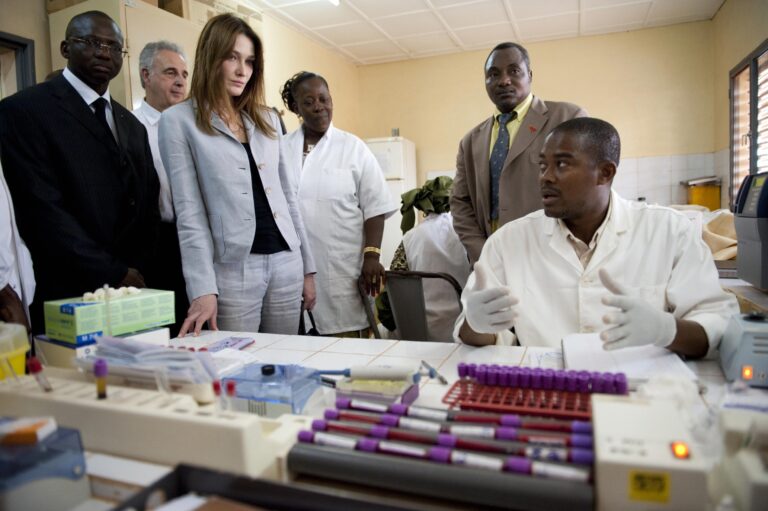
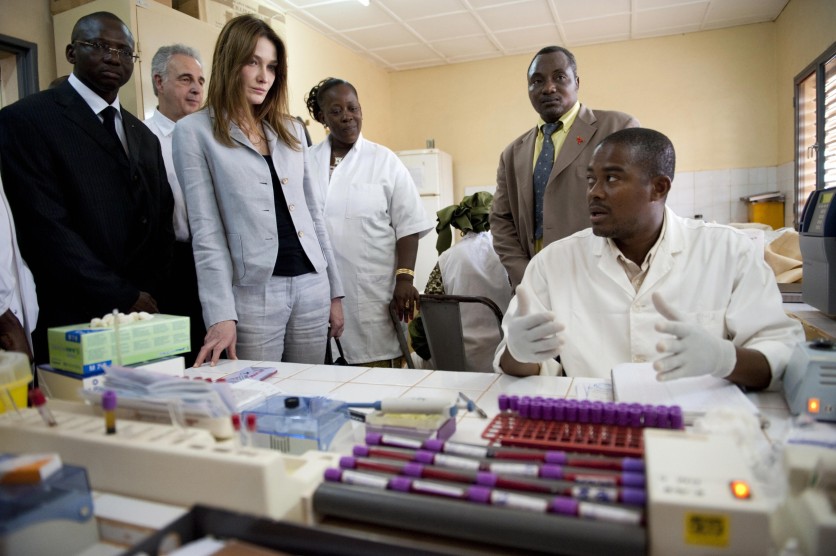
France’s first lady Carla Bruni-Sarkozy (3rd L) and Global Fund to fight Aids Executive Director Michel Kazatchkine (2nd L), visit an HIV virus blood testing laboratory at the Pissy medical center in Ouagadougou in Burkina-Faso on February 11, 2009. The medical center offers treatment for various diseases and at the same time the detection of the HIV virus. Bruni, who married Sarkozy a year ago, expressed an interest in work to battle HIV following a visit to South Africa, which has one of the world’s largest AIDS caseloads. The supermodel-turned-singer has said she hoped her status as French first lady could be used to advance a worthy global cause. AFP Photo / Pool / Philippe Wojazer PHILIPPE WOJAZER/AFP via Getty Images
France logged nearly 9 million HIV tests in 2025, a 7 percent jump from the previous year and the highest annual total in the country’s recorded public health history, national health agency Santé publique France (SPF) annual HIV surveillance report announced on Thursday, weeks before the December 1 World AIDS Day observance that this year carries unusual urgency per the UNAIDS 2025 World AIDS Day report. The surge in testing drove the number of newly discovered HIV diagnoses down to 4,983 — roughly 6 percent below the 5,318 cases recorded in 2023 and the lowest annual total in six years.
But the headline numbers obscure a more complicated epidemiological picture. The rate at which people are newly acquiring HIV in France — the incidence, as distinct from diagnoses — has remained essentially flat since 2023, holding at approximately 50 new infections per million people (roughly 3,464 total). That divergence, between a diagnosis count falling and an infection rate not following, is the central tension in France’s 2025 HIV data, and understanding it is key to assessing how much progress the country has actually made.
What Changed in September 2024: The Mon test IST Program
The testing surge is directly traceable to a structural change in how France delivers HIV screening. In September 2024, France expanded its “VIH Test” predecessor program into a broader initiative called Mon test IST program — translating roughly as “My STI Test” — which eliminated the requirement for a prescription before getting tested for HIV and four other sexually transmitted infections.
Under the new system, any person in France can walk into a participating medical laboratory, request testing for HIV, gonorrhea, chlamydia, syphilis, and hepatitis B, and receive results without first seeing a physician. For people under 26, all five tests are reimbursed at 100 percent by France’s national health insurance system (Assurance Maladie), making them effectively free with no upfront cost. For adults 26 and older, the standard 60 percent reimbursement rate applies — still far below the financial and administrative barrier of obtaining a physician referral.
The program’s impact on the under-26 demographic has been measurable and fast. By the end of 2025, Mon test IST accounted for approximately 2.3 million of France’s 9 million HIV tests — roughly 25 percent of the national total. Among participants, young adults aged 18 to 25 represented between 44 and 50 percent of Mon test IST users. Monthly HIV tests among people under 25 doubled compared to the period before the program launched.
“The year 2025 shows concrete progress: 9 million HIV tests conducted and an 18 percent drop in newly discovered seropositive cases,” said Dr. Etienne Pot, Director General of Santé publique France. “The momentum is there. Our shared goal is clear: to eradicate HIV. Expanding testing, strengthening prevention, and combating stigma are the key priorities guiding our efforts.”
Why Diagnoses Falling Does Not Mean Infections Falling
The distinction between HIV diagnoses and HIV incidence is not a statistical technicality. It is the difference between measuring how well a country is finding existing infections and measuring how well it is stopping new ones.
When a country expands testing access, diagnosis counts can rise — because previously undiagnosed people are now getting tested and learning their status for the first time. Those are not new infections; they may have occurred years earlier. Conversely, as that backlog of undiagnosed cases is cleared, annual diagnosis counts can fall even if the underlying transmission rate hasn’t changed, simply because fewer previously undiagnosed people remain to be found.
France’s modelling suggests exactly this dynamic is at work. SPF estimates that roughly 8,463 people in France currently live with HIV without knowing their status — a figure that has fallen dramatically from estimates exceeding 29,000 as recently as 2014, but which still represents a residual pool of undiagnosed infections capable of onward transmission. Meanwhile, the estimated incidence of approximately 3,464 new infections per year has not declined meaningfully since 2023, suggesting the structural drivers of transmission — incomplete PrEP access, geographic inequity, persistent stigma — remain largely unaddressed.
This matters because of a well-established but still under-communicated fact in HIV prevention: an HIV-positive person who is diagnosed, initiated on antiretroviral treatment, and achieves an undetectable viral load cannot sexually transmit the virus to a partner. This principle — Treatment as Prevention, or TasP, formally confirmed by the PARTNER and PARTNER2 studies — means that the entire residual transmission pool in France consists of people who are either undiagnosed or diagnosed but not yet on suppressive treatment. The 8,463 undiagnosed people are, in public health terms, the only remaining source of new sexual transmissions among people who would have been reached by better testing access.
The implication is both hopeful and demanding: falling diagnoses are genuinely good news in that they reflect fewer undiagnosed people. But stable incidence means that for every person newly finding their status and entering treatment, another person is becoming newly infected — often without knowing it.
Who Is Being Diagnosed and Who Isn’t
France’s 2025 diagnosis breakdown reveals persistent structural inequalities across population groups and geography.
Men who have sex with men (MSM) continue to account for the largest share of diagnoses among people born in France, though their numbers have plateaued since approximately 2022. Encouragingly, early-stage diagnoses among MSM reached 48 percent in 2025 — meaning nearly half of MSM diagnosed received their positive result before the virus had significantly damaged their immune system, enabling faster treatment initiation and better long-term outcomes.
People born outside France — predominantly from sub-Saharan Africa and the Caribbean — account for a substantial share of diagnoses, with new diagnoses in this group falling approximately 11 percent since 2023. SPF attributes part of this decline to improved testing access and part to changes in migration patterns.
Late-stage diagnoses remain a stubborn problem across all groups. Approximately 39 percent of people diagnosed in 2025 met the clinical definition of late diagnosis (a CD4 count below 350 cells per cubic millimeter at first HIV-positive test), and 24 percent were at an advanced stage — meaning their immune systems had already sustained significant damage. The European Late Presenter Consensus Working Group defines advanced disease as a CD4 count below 200 cells per cubic millimeter. Late diagnosis is both a treatment challenge — antiretroviral therapy is less effective at restoring immune function when initiated at very low CD4 counts — and a transmission risk factor, since viral loads are highest in the early and late stages of untreated infection.
The Overseas Territories Gap: 13 Times the National Rate
France’s headline statistics — 50 new diagnoses per million people nationally — become unrecognizable when disaggregated by geography.
French Guiana, France’s overseas department on the northeastern coast of South America, recorded approximately 672 HIV diagnoses per million people in 2025 — roughly 13 times the metropolitan French rate. The epidemic in French Guiana is predominantly heterosexual in transmission pattern and is structurally linked to the high-prevalence environment of neighboring Suriname; the department of Saint-Laurent-du-Maroni, on the border, carries the heaviest burden. Healthcare infrastructure in French Guiana remains significantly under-resourced relative to metropolitan France, and access to both testing and PrEP is constrained by geography and staffing shortages.
Mayotte, France’s Indian Ocean department off the coast of Madagascar, recorded approximately 306 diagnoses per million — roughly 6 times the national rate. The epidemic in Mayotte has been rising since 2022, driven in part by limited healthcare capacity and significant migration from the Comoros Islands. Mayotte became a French department in 2011 but its health infrastructure has not yet reached the level of mainland France, creating a gap in both testing access and treatment coverage.
Both territories are covered by French national health insurance in principle, but geographic, logistical, and linguistic barriers substantially limit effective access in practice. Mon test IST’s expansion to these regions has been slower than in metropolitan France, where the dense network of urban medical laboratories made rollout straightforward.
PrEP, U=U, and the Prevention Stack
France’s public health response to HIV rests on what epidemiologists call “combined prevention” — the integration of multiple tools, used simultaneously across the population, rather than reliance on any single intervention.
Pre-exposure prophylaxis (PrEP) — a daily oral medication (tenofovir/emtricitabine, marketed as Truvada or generic equivalents) that is 97-plus percent effective at preventing HIV acquisition when taken consistently — has been fully reimbursed by French national health insurance since 2017, with PrEP reimbursement in France confirmed by the Haute Autorité de Santé, making France one of the first countries globally to remove financial barriers to PrEP access. PrEP prescriptions have grown year over year, with an estimated 60,000-plus people currently on PrEP in France. However, uptake remains concentrated among MSM in major urban centers; heterosexual women and people in overseas territories — the populations with the fastest-growing incidence in several risk categories — remain significantly underrepresented in PrEP programs.
Treatment as Prevention (TasP), also expressed as “Undetectable = Untransmittable” (U=U), is the cornerstone of SPF’s December 2026 World AIDS Day campaign: “Vivre avec le VIH, c’est d’abord vivre” — Living with HIV is, above all, living. The campaign is designed to address two simultaneous goals: reducing stigma around HIV by emphasizing that diagnosed, treated individuals have normal life expectancy and cannot transmit the virus to partners, while encouraging at-risk populations to know their status precisely because treatment makes diagnosis a beginning rather than an end.
Condoms remain part of the combined prevention framework, particularly for populations not yet reached by PrEP, and France’s national health strategy includes free condom distribution programs for people under 26 at pharmacies.
The Global Context: A Funding Crisis France Cannot Ignore
France’s 2025 progress report lands against a global backdrop of mounting concern about the HIV response’s long-term trajectory.
The UNAIDS 2025 World AIDS Day report described the global HIV response as experiencing its “most significant setback in decades” — a consequence of funding cuts to international HIV programs, including PEPFAR (the US President’s Emergency Plan for AIDS Relief), which has historically provided the backbone of HIV treatment and prevention in sub-Saharan Africa. UNAIDS warned that if 2030 targets are missed, an additional 3.3 million HIV infections could occur globally between 2025 and 2030 beyond current projections — with the burden falling disproportionately on the countries least equipped to absorb it.
France’s domestic progress, however real, exists within this larger system: French Guiana’s epidemic is inseparable from the epidemic in Suriname; HIV treatment chains that reach Martinique pass through global supply systems that PEPFAR shortfalls could disrupt. No country’s national gains are fully decoupled from the global response architecture.
The Global AIDS Strategy 2026-2031, adopted earlier this year, sets out a framework for reaching UNAIDS’ 95-95-95 targets globally — meaning 95 percent of all people living with HIV diagnosed, 95 percent of diagnosed people on treatment, and 95 percent of those on treatment achieving viral suppression. France has largely met or exceeded these targets domestically. The gap between French domestic performance and the overseas territories’ performance is itself a preview, at smaller scale, of the global challenge.
What the Numbers Mean for Americans in France
For American travelers, expatriates, and study-abroad students in France, the Mon test IST program represents a genuinely unusual public health infrastructure relative to the United States, where no-cost, no-appointment, no-prescription HIV testing varies widely by state and insurance status.
Any person physically in France — regardless of nationality or insurance status — can access the Mon test IST screening through participating medical laboratories. For US citizens under 26, the testing is fully covered. For those 26 and older, out-of-pocket costs for a full five-STI panel are modest compared to US laboratory pricing (the lab fee for the full panel in France typically runs €40–80 (approximately $43–86 USD) before reimbursement, compared to $200–500 out of pocket in the US without insurance). A list of participating laboratories is available through the Assurance Maladie laboratory finder.
PrEP is available in France by prescription through any general practitioner or infectious disease specialist; for US citizens on extended stays, obtaining a French prescription through the universal health system (or as a paying patient at a private clinic) is straightforward.
Frequently Asked Questions
What is Mon test IST?
Mon test IST is France’s no-prescription, no-appointment STI testing program, launched in September 2024. It allows anyone in France to walk into a participating medical laboratory and be tested for HIV, gonorrhea, chlamydia, syphilis, and hepatitis B without first obtaining a physician’s referral. For people under 26, all tests are free. It is accessible from France’s overseas departments and territories in principle, though laboratory availability varies.
Why did HIV diagnoses fall in France in 2025?
Primarily because more people are getting tested and finding their status earlier — clearing a backlog of previously undiagnosed infections. France estimates that approximately 8,463 people currently live with HIV without knowing their status, down from roughly 29,000 in 2014. As that number falls, the annual diagnosis count falls with it. This is good news in that it means more people are in treatment; it does not necessarily mean the rate of new infections has fallen, which remains stable.
What does “undetectable = untransmittable” (U=U) mean?
An HIV-positive person who takes antiretroviral treatment consistently and achieves a viral load below 200 copies per milliliter of blood — classified as “undetectable” — cannot sexually transmit HIV to a partner. This was confirmed with zero observed transmissions in over 1,593 serodifferent couples in the PARTNER and PARTNER2 clinical studies. It means that treatment is, literally, prevention: getting diagnosed and treated is not just about personal health but about breaking transmission chains.
Why are France’s overseas territories so much worse off?
French Guiana (672 diagnoses per million, 13 times the national rate) and Mayotte (306 per million) face a combination of geographic isolation from laboratory networks, healthcare staffing shortages, economic disadvantage, and proximity to high-prevalence neighboring populations (Suriname for French Guiana; the Comoros for Mayotte). Despite being legally part of France and covered by French national health insurance, effective healthcare access in both territories lags substantially behind metropolitan France.
Is France’s progress replicable elsewhere?
The Mon test IST model — removing prescription requirements and financial barriers while routing screening through existing laboratory infrastructure rather than building new specialty clinics — is relatively low-cost and logistically tractable for countries with existing universal laboratory networks. The United States, which has no equivalent at national scale, has seen similar impacts at the state level from programs like California’s free STI testing expansion. The model’s key dependency is a dense network of participating laboratories; it functions well in France’s urban centers and less well in its less-resourced territories.