HomeAuto Heart Valve Disease Deaths Among Older Americans Climbed 5% Since 2018: Millions Are Never Diagnosed
Heart Valve Disease Deaths Among Older Americans Climbed 5% Since 2018: Millions Are Never Diagnosed
November 7, 2026:
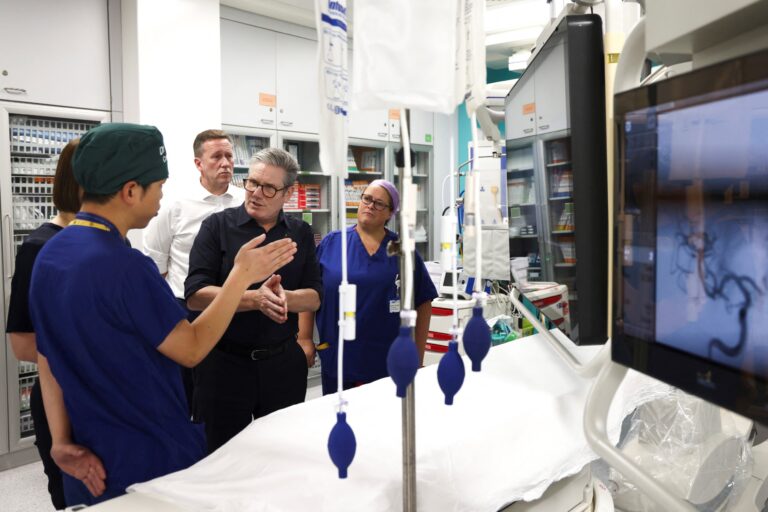
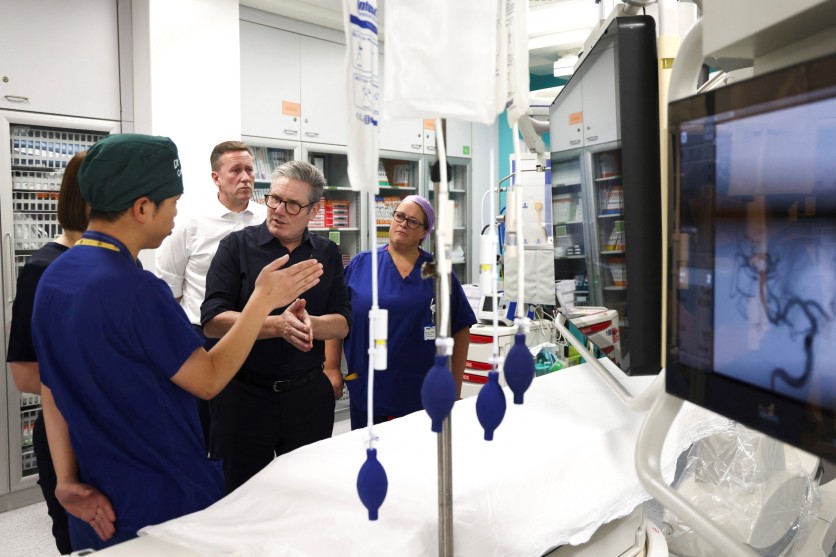
Britain’s Prime Minister Keir Starmer and Britain’s Chancellor of the Exchequer Rachel Reeves speak with members of staff as they look at catheterisation laboratory, where they saw how the team use technology in the treatment of patients who have suffered a stroke or have structural heart valve disease, during a visit to University Hospital Coventry and Warwickshire, in Coventry, central England, on October 31, 2024. (Photo by Darren Staples / POOL / AFP) DARREN STAPLES/POOL/AFP via Getty Images
For roughly 20 years, medicine was slowly winning against heart valve disease in older Americans. Death rates fell steadily. Minimally invasive procedures expanded access to treatment that once required open-heart surgery. The trend lines looked like a success story in progress.
That story ended around 2018 — and may not resume for another 14 years.
Landmark research presented Friday at the American Heart Association’s Scientific Sessions 2026 in Chicago found that age-adjusted death rates from valvular heart disease (VHD) among U.S. adults aged 65 and older climbed from roughly 104 to more than 109 per 100,000 between 2018 and 2023 — a nearly 5% increase that shows no signs of reversing. Statistical models project the death rate will remain near that elevated level all the way through 2040, rather than resuming the downward trajectory observed before the COVID-19 pandemic. And crucially: the reversal preceded the pandemic.
The finding, presented as Abstract 17023 by lead author Dr. Hritvik Jain, an internal medicine resident at Allegheny General Hospital in Pittsburgh, draws on 25 years of death records from the CDC’s Wide-ranging Online Data for Epidemiologic Research (WONDER) database — covering more than 1.2 million heart valve disease-related deaths among Americans 65 and older from 1999 through 2023.
Note: This research is a preliminary abstract presented at a scientific meeting. It has not been peer-reviewed or published in a full-length journal article, and findings should be treated as early-stage evidence until that process is complete.
The Gap Between Innovation and Outcomes
The timing makes the finding harder to dismiss. The last 15 years have seen some of the most significant advances in cardiovascular medicine in decades. Transcatheter aortic valve replacement (TAVR) — a catheter-based procedure that delivers a new valve without open-heart surgery — was approved by the FDA for high-risk patients in 2011, expanded to intermediate-risk patients in 2016, and extended to low-risk patients in 2019. What was once a last resort for patients deemed too sick for surgery is now first-line treatment across the surgical risk spectrum.
And yet mortality is rising, not falling.
Dr. Sreekanth Vemulapalli, an associate professor of medicine at Duke University and a volunteer member of the AHA’s Target: Aortic Stenosis Scientific Advisory Group, called the disconnect alarming: “The recent reversal of progress in valvular heart disease mortality is especially alarming in light of the substantial advances in treatment achieved over the past decade and a half. This disconnect between therapeutic innovation and population-level outcomes highlights the critical need for the American Heart Association’s quality improvement and educational initiatives to improve awareness, care delivery and patient outcomes.”
The gap is not a treatment problem. It is a detection and access problem.
How TAVR Works — and Why It Isn’t Reaching Everyone
To understand why the technology hasn’t bent the mortality curve, it helps to understand what the technology requires.
TAVR works by threading a collapsed bioprosthetic valve — typically made from bovine or porcine tissue mounted on a metal stent frame — through the femoral artery via catheter. Under fluoroscopic and echocardiographic guidance, the collapsed valve is advanced to the native aortic valve location, then expanded, pushing the calcified native leaflets aside while the new valve seats itself. Blood flow through the replacement valve begins immediately. No cardiopulmonary bypass is required. Recovery time is typically days, not weeks.
That procedure, however, can only help patients who reach it. Getting there requires a cascade: a clinician who detects a heart murmur or orders an echocardiogram; a referral to a cardiologist; an evaluation at a center with a structural heart program; and a determination that intervention is appropriate and timely.
Patients who arrive at that cascade late — after symptoms have appeared, after the heart muscle has begun compensating and failing, after valve disease has become severe — face higher procedural risk and derive less benefit than patients identified earlier.
The core problem is that most people who have heart valve disease don’t know it. The PREVUE-VALVE study at TCT 2025, which recruited more than 3,000 adults aged 65 to 85 from pharmacies across all 50 states, found that more than 10.6 million older Americans have clinically significant VHD — and many of them are unaware of their condition. At least 4.7 million have moderate or greater disease. Lead investigator David J. Cohen, MD, MSc, noted that most affected individuals have not been diagnosed.
Valve disease frequently progresses silently until classic symptoms — shortness of breath, chest pain, fainting — appear. By then, treatment risk is already elevated. Without systematic screening in primary care, patients are often not referred for echocardiography until they are already past the point of optimal intervention.
Who Is Being Left Behind
The mortality burden is distributed sharply — and the distribution maps almost exactly onto documented gaps in access to specialized valve care.
Men vs. women: Men died from VHD at a rate of 124.7 per 100,000, compared to 103.1 for women — a gap of more than 20%.
By race and ethnicity: Non-Hispanic white adults carried the highest VHD death rate among all racial and ethnic groups examined, at 122.4 per 100,000. This is consistent with aortic stenosis’s known higher prevalence in white adults, a pattern also confirmed by PREVUE-VALVE, which found 21% lower VHD prevalence in Black participants after age and sex adjustment.
By geography: Adults living in nonmetropolitan (rural) areas faced a death rate of 120.5 per 100,000, versus 110.1 in metropolitan areas. That 10-point rural penalty almost certainly reflects what researchers have independently documented about the geography of TAVR programs.
A 2021 SCAI TAVR access analysis found that of the 554 hospitals that opened new TAVR programs between 2012 and 2018, 98% were in metropolitan areas. Only 11 new programs opened in nonmetropolitan areas. What’s more, more than half of new programs opened in metro areas that already had a TAVR program — clustering expertise rather than expanding access.
“The increased number of TAVR programs over the last 10 years has not necessarily translated to increased access,” said Ashwin Nathan, the study’s lead author. Senior author Jay Giri was more direct: “Market forces overwhelmingly seemed to drive the development of new TAVR programs over access to care considerations.”
By age: Adults aged 85 and older bear the most extreme burden. At the 1999 mortality peak, their VHD death rate was more than 15 times that of adults aged 65 to 69. They remain the highest-risk group.
A Generational Warning Signal
One of the study’s most consequential findings involves what researchers call an age-period-cohort effect — a statistical approach that separates the influence of aging from the influence of when someone was born.
The team found an unsettling generational pattern: adults in newer birth cohorts show improved VHD outcomes in their late 60s compared to prior generations at the same age — suggesting that better management of cardiovascular risk factors (blood pressure, cholesterol, diabetes) in midlife is producing a healthier-at-65 population. But those gains do not carry forward.
By the time members of newer generations reach 85 and older, they are actually dying from VHD at higher rates than adults of previous generations did at the same age.
“While death rates improved for newer generations in their late 60s, those gains did not continue into very old age. At age 85 and older, newer generations had higher death rates than earlier generations at the same age,” said Dr. Jain.
That paradox points to something specific happening at extreme old age — and the research literature offers a likely culprit. Studies on valve intervention in very elderly patients have documented a clinical tendency toward undertreatment based on perceived frailty, comorbidity, or shortened life expectancy. A patient who arrives at 88 with aortic stenosis may never be referred to a structural heart program at all, even when TAVR would likely improve both survival and quality of life. If newer generations are surviving longer to extreme old age — with more complex comorbidity profiles — but are still being triaged away from intervention at that age, the APC paradox could reflect a systematic undertreatment bias against the oldest patients rather than any biological change in how late-stage valve disease progresses.
The Underlying Driver: Calcific Aortic Stenosis
Across all subgroups in the study, nonrheumatic aortic valve disease — the category that encompasses calcific, age-related aortic stenosis — accounted for the majority of deaths.
Calcific aortic stenosis is not primarily an infectious disease. It is a degenerative process: lipid infiltration of the valve leaflets, followed by inflammation, calcification, and progressive stiffening that restricts the valve’s ability to open. The process shares risk factors with atherosclerosis — age, male sex, hypertension, high cholesterol, diabetes, smoking — but unlike coronary artery disease, there is no proven drug to slow its progression. Intervention is currently the only effective treatment.
That means the population living longer — with controlled cardiovascular risk factors — is not necessarily accumulating less aortic stenosis. They may simply be developing it later, arriving at the same calcification endpoint at an older age and in a more vulnerable physiological state.
A Rising Tide With No Ebbing in Sight
The scale of the problem ahead is stark. The AHA 2026 heart disease statistics puts the global VHD burden at more than 80 million people, a number growing as populations age worldwide. In the United States, heart valve disease contributes to more than 57,000 deaths each year.
The demographic math is unforgiving. The U.S. population 65 and older is the largest it has ever been, as the Baby Boomer generation continues moving through its eighth and ninth decades. PREVUE-VALVE projects the number of older Americans with moderate or greater VHD will rise by approximately 1.8 million in the coming years, with the largest increases in the 80–85 age group.
The statistical models in the new research — using ARIMA time-series forecasting — project that absent policy or practice changes, the VHD death rate will remain near 109.2 per 100,000 through 2040. That projection is not a prediction that nothing will change. It is a projection of what happens if current trends continue. The researchers use a standard statistical method (ARIMA), which fits the existing trend forward rather than modeling future policy interventions. Any successful effort to close the detection gap, expand rural access to valve programs, or address the undertreatment of the very elderly would, in principle, alter that trajectory.
The question is whether those efforts arrive in time.
What the AHA Is Doing About It
The American Heart Association has recognized the access-to-care gap and launched several initiatives aimed at closing it.
In 2020, the AHA introduced the Target: Aortic Stenosis program (Target: AS), a quality improvement program providing hospital care teams with resources to deliver consistent, evidence-based care for aortic stenosis patients — from early diagnosis through treatment and long-term management.
In November 2025, the organization launched the Heart Valve Initiative, expanding its ambition to cover all four valve diseases. The initiative aims to grow its network of enrolled program sites from roughly 80 to around 200, reaching communities that the current specialist infrastructure does not serve.
And in April 2026, the AHA announced $15 million in research awards to study heart valve disease. The four-year awards went to teams at Mass General Brigham, Cincinnati Children’s Hospital, and the University of Pittsburgh, focused specifically on early detection and delaying disease progression — research that targets the detection-pipeline gap the new mortality data exposes.
“Heart valve disease is an increasingly important health concern as the U.S. population ages, but information has been limited on just how much specific populations are currently impacted and what trends are expected for the future,” said Dr. Jain. “Our study found that the decades-long decline in deaths from heart valve disease has stopped. As the U.S. population continues to age, we need to focus on earlier detection, timely treatment and equitable access to specialized valve care, particularly for the oldest adults and those living in rural communities.”
What This Means for Older Americans Right Now
For the tens of millions of older Americans who may be living with undetected valve disease, the gap between medical capability and medical access is not abstract.
If you are 65 or older, particularly if you are male, live in a rural area, or have cardiovascular risk factors (high blood pressure, high cholesterol, diabetes, a history of smoking), the most important protective action is early detection: asking your primary care physician to listen to your heart at routine visits, and requesting an echocardiogram if a murmur is heard or if any of the warning signs of aortic stenosis appear — unexplained shortness of breath with exertion, chest discomfort, or episodes of lightheadedness or fainting.
Patients referred to certified valve centers — including those enrolled in the AHA’s Target: AS network — have access to multidisciplinary teams experienced in valve assessment and treatment planning. TAVR, when performed in patients identified at the right stage of disease, carries low procedural risk and can dramatically improve survival and quality of life.
The technology works. The pipeline that gets patients to it, increasingly, does not.
Study Methods and Limitations
The analysis used death records from the CDC WONDER Multiple Cause of Death database, covering 1999 to 2023. VHD-related deaths were identified using ICD-10 codes listed as either the underlying or contributing cause of death. The study population comprised 1,204,490 deaths among adults 65 and older — 42.9% men and 57.1% women.
Age-adjusted death rates were calculated using the 2000 U.S. Standard Population. The team used Joinpoint regression software (developed by the National Cancer Institute) to identify where the downward trend significantly changed direction — pinpointing the reversal around 2018 — and ARIMA models to project mortality rates through 2040. Age-period-cohort analysis separated the contributions of aging, historical era, and birth generation to the observed trends.
Limitations the authors note include the inherent imprecision of death-certificate coding, which cannot capture disease severity, echocardiographic findings, or individual treatment histories. The study is observational and cannot establish causality. The COVID-19 pandemic may have influenced trends in the final years of the study period — through delayed care, deferred procedures, and pandemic-related mortality — though the reversal appears to have preceded the pandemic.
The research is a preliminary abstract presented at a scientific meeting and has not been peer-reviewed. Findings should be treated as early-stage evidence until publication in a peer-reviewed journal.