HomeAuto Indonesia’s Free Health Screenings Are Finding a Hidden Epidemic: Only 11% of Those Diagnosed Are Getting Treatment
Indonesia’s Free Health Screenings Are Finding a Hidden Epidemic: Only 11% of Those Diagnosed Are Getting Treatment
November 5, 2026:
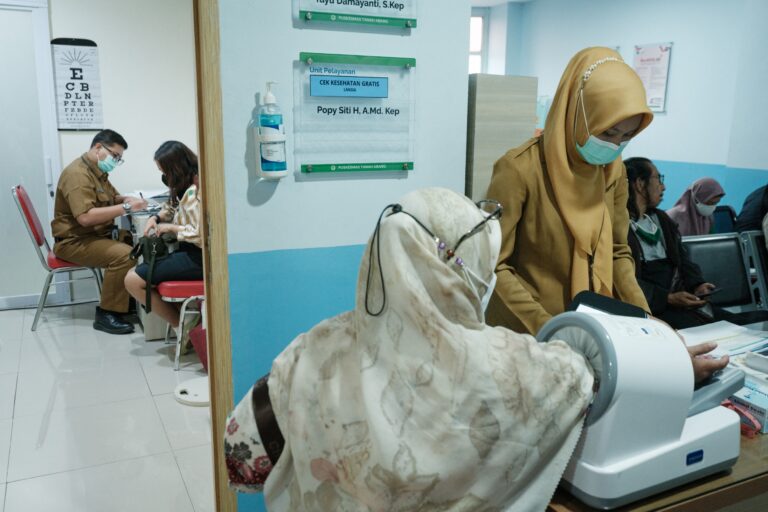
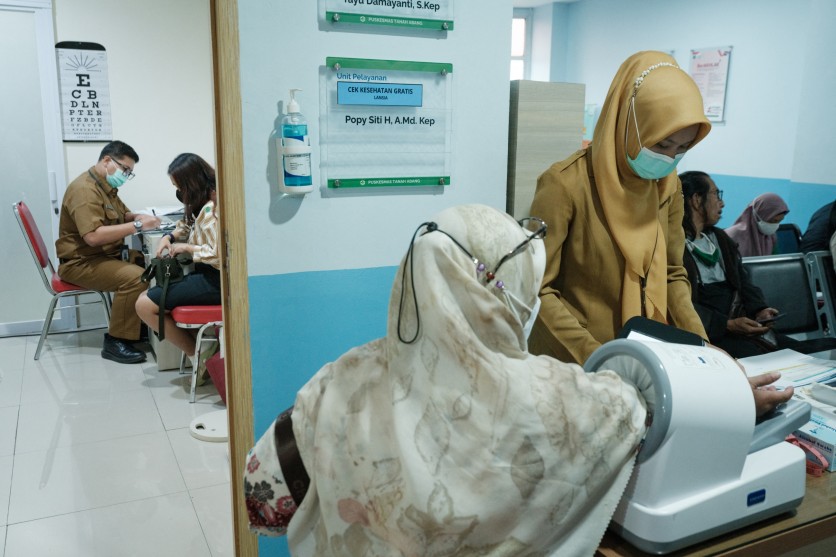
Patients are tended to at a 24-hour community health centre on the opening day of the nationwide free health check-up (PKG) programme in Jakarta on February 10, 2025. (Photo by YASUYOSHI CHIBA / AFP) YASUYOSHI CHIBA/AFP via Getty Images
A free preventive-screening program reaching 109 million Indonesians has uncovered the largest documented trove of undetected chronic disease in Southeast Asian history. What the data reveals about why detection without infrastructure is only half the answer.
Indonesia’s official life expectancy climbed to 74.68 years in 2026, up from 74.47 the year before, according to figures released Wednesday by Badan Pusat Statistik (BPS), the national statistics agency. The country’s Human Development Index reached a record 76.59 — up 0.69 points from 75.90 in 2025 — driven in large part by gains in infant and toddler survival rates.
BPS Deputy Moh. Edy Mahmud attributed the improvement primarily to the government’s Cek Kesehatan Gratis (CKG) program — a free preventive health screening initiative that, since its launch on February 10, 2025, has become the largest population-scale medical screening effort in Southeast Asian history. As of November 2026, 109 million Indonesians have been screened, with 116 million registered. The program’s 2026 target is 130 million — roughly 46 percent of the country’s population.
What those 109 million screenings have produced is a dataset with no precedent in the region: a near-complete picture of the hidden chronic-disease burden in a lower-middle-income nation of 280 million people — and a stark illustration of the gap between finding disease and treating it.
CKG measures four primary indicators: blood pressure, blood glucose, cholesterol, and anthropometric data (height, weight, body mass index). The results, fed into the national SATUSEHAT digital health platform in near real time, have produced a population-level epidemiological profile that Indonesia has never had before.
The numbers are striking. Of CKG participants screened so far, 72.7 percent have dyslipidemia — abnormal cholesterol levels that significantly raise the risk of heart attack and stroke. Some 32.5 percent have dental caries. Obesity affects 18.2 percent, pre-hypertension 9.9 percent, and full hypertension 9.7 percent. Pre-diabetes affects 4.5 percent; diabetes, 2.2 percent.
Nationally, officials estimate 65 million Indonesians have hypertension and 30 million have diabetes. CKG has detected 8.3 million cases of hypertension or diabetes among participants. Of those 8.3 million people with confirmed diagnoses, just 907,000 — approximately 11 percent — are currently receiving treatment.
The government’s target is 80 percent.
That gap — between 11 percent treatment coverage and an 80 percent benchmark, against a backdrop of tens of millions of newly detected cases — is the central story inside Indonesia’s headline life-expectancy improvement. An Antara parliamentary review identified 16.8 million patients needing follow-up care; only 1.4 million, roughly 8 percent, received continued treatment. Among Indonesians with hypertension, only about one-third consistently take medication. Fewer than 10 percent of diabetes patients achieve controlled blood sugar.
“Our 2026 target is not just health checks,” Health Minister Budi Gunadi Sadikin said, “but ensuring people are genuinely healthy.” The minister has repeatedly framed the treatment gap as the program’s defining challenge for its second year.
The numbers carry a fiscal shadow. BPJS Kesehatan, Indonesia’s national health insurance scheme, spent Rp22.8 trillion (approximately $1.26 billion USD) on hypertension-linked cardiovascular disease alone in 2023 — out of Rp34.8 trillion (approximately $1.92 billion USD) on non-communicable diseases overall. Each hypertension or diabetes case that goes unmanaged in the community today becomes a hospitalization cost tomorrow.
The Infrastructure Behind the Numbers
CKG’s reach would not be possible without the SATUSEHAT health platform — Indonesia’s national health data interoperability system, which now connects more than 10,000 primary healthcare centers (puskesmas) across all 514 districts and cities. As of 2026, 99 percent of Indonesia’s community health centers use digital recording through SATUSEHAT’s health worker application (called IndonesiaKu, or ASIK), making Indonesia one of the few lower-middle-income nations with near-universal primary care digitization.
The platform uses HL7 FHIR (Fast Healthcare Interoperability Resources), an international data exchange standard that allows disparate hospital information systems to share patient records in a common format. When a health worker at a puskesmas records a CKG screening, the data flows automatically to the patient’s personal SATUSEHAT Mobile app account, where they receive a digital health record card and a color-coded risk notification — green for healthy, yellow for borderline, red for a diagnosed condition requiring follow-up.
The system holds more than 100 million patient records. It provides, for the first time, a near-real-time view of NCD prevalence across age groups and geographies — data that until recently existed only in fragmented, years-delayed aggregates, if at all.
“SATUSEHAT enables us to collect health data from communities across the country to map disease patterns in near real-time,” said Aji Muhawarman, Head of the Bureau of Communication and Public Service at the Ministry of Health, in GovInsider’s SATUSEHAT feature. The ministry has begun adding artificial intelligence features to the platform in 2026: a meal-photo calorie analysis tool, activity tracking, and automated medication reminders for patients with active prescriptions — the first step toward an AI-powered health assistant the ministry has described as a “24/7 health companion.”
The CKG registration and scheduling process runs through the app as well, integrating with WhatsApp to lower the access barrier for participants without smartphones.
The 2026 Pivot: From Screening to Treatment
For its first year, CKG was primarily a detection exercise — getting Indonesians screened who had never been screened before. In 2026, the Ministry of Health declared a strategic pivot: the program’s second year would focus on what happens after the screening result arrives.
The most significant operational change: starting in 2026, patients diagnosed with hypertension or diabetes at a puskesmas receive their medication the same day, without a hospital referral. Previously, patients received a diagnosis and a referral slip; now they leave with medicine in hand. Dr. Maria Endang Sumiwi, Director General of Public Health, confirmed the 2026 policy change.
Treatment is free for the first 15 days. After that, care continues under JKN (Jaminan Kesehatan Nasional), Indonesia’s national health insurance program managed by BPJS Kesehatan, which now covers approximately 284.3 million Indonesians — roughly 98 percent of the population. Uninsured CKG participants are directed to enroll in BPJS before their follow-up appointment.
The government’s formal benchmark for the treatment pipeline is what officials call the “triple 80” target — modeled on South Korea’s national health benchmarks: 80 percent of the population screened; 80 percent of those diagnosed beginning treatment; 80 percent of those treated achieving healthy outcomes. Indonesia currently meets the first target (with 109 million screened against a 130 million goal). The second and third targets remain distant.
Beyond Chronic Disease: The Infant Mortality Driver
BPS’s Moh. Edy Mahmud noted that the life-expectancy gain was not driven entirely by adult chronic-disease management; improvements in infant and toddler survival rates played a significant role. That trend connects to a parallel initiative: the Indonesia’s 1000 HPK launch — the 1000 HPK (Thousand First Days of Life) Consortium — launched on April 30, 2026.
The consortium’s targets are ambitious: reduce maternal deaths from 4,000 to 400 per year; reduce infant deaths from 30,000 to 3,000 per year; and bring stunting prevalence below 7 percent. To reach community-level outcomes, the program is deploying 10,000 ultrasound devices to community health centers — giving puskesmas the capacity to monitor high-risk pregnancies locally rather than requiring referrals to city hospitals.
The CKG data underscores why this push matters. Among CKG’s youngest participants, findings are sobering: approximately 6 percent of newborns screened were underweight; one in three toddlers showed dental decay; and roughly one in five adolescents had elevated blood pressure. If CKG’s adult chronic-disease data describes the accumulated health debt of a generation that grew up without preventive infrastructure, the children’s data describes what a preventive system must now protect against in the next generation.
The HDI Gains in Context
Indonesia’s HDI of 76.59 sits in the “high development” tier (70–79.9) under the UNDP’s standard classification framework. The country’s education indicators also improved: expected years of schooling reached 13.34 years; mean years of schooling hit 9.16 years. Per capita expenditure rose to Rp13.37 million ($738 USD) annually, up from Rp12.80 million ($706 USD) the year before — an increase of Rp566,000 (approximately $31 USD).
One methodological note is worth flagging for readers comparing these figures internationally: BPS calculates Indonesia’s life expectancy using national data on vital statistics and population surveys, applying its own methodology. The United Nations World Population Prospects model, which uses a different estimation approach, projects Indonesia’s 2026 life expectancy at 71.6 years — a gap of roughly three years. Neither figure is “wrong”; they measure the same underlying reality with different tools and inputs. For international comparisons, regional peers under UN methodology include Vietnam (75.0 years), Thailand (77.1 years), Malaysia (77.2 years), and Singapore (84.1 years).
The RPJMN Target and What It Will Take
Indonesia’s national medium-term development plan (RPJMN) sets a formal target of raising life expectancy from 72 to 76 years. At the current rate of improvement (+0.21 years in 2026), reaching 76 years would take roughly six years — but that assumes linear progress, and the gains most available from preventive screening tend to diminish as coverage broadens and the remaining unscreened population becomes harder to reach.
The more structural challenge is on the treatment side. SATUSEHAT’s shift from screening data to outcomes tracking — measuring not just who was detected, but whether detected patients are receiving and responding to treatment — is the technological test of whether the platform can function as an active health management system rather than a passive records repository. The Ministry of Health has indicated it expects to have treatment outcomes data by the end of 2026 or early 2027.
Whether that data will show the treatment rate moving from 11 percent toward 80 percent — and whether the puskesmas network can absorb the volume of active disease management that detecting chronic conditions in 109 million people implies — is the question that will determine whether Indonesia’s rising life expectancy is a measurement artifact or the beginning of a durable demographic shift.
(Exchange rate note: All IDR figures in this article are converted at 1 USD = Rp18,123, the mid-market rate as of October 26, 2026; conversions are approximate.)
Frequently Asked Questions
What is the Cek Kesehatan Gratis (CKG) program?
Cek Kesehatan Gratis, or CKG, is a free preventive health screening program launched by the Indonesian government on February 10, 2025. It offers screenings for blood pressure, blood glucose, cholesterol, and anthropometric measurements (height, weight, BMI) at primary healthcare centers (puskesmas) nationwide. As of November 2026, 109 million Indonesians have been screened through the program, making it the largest population-scale medical screening effort in Southeast Asian history.
How many Indonesians have been screened, and what did the screenings find?
As of November 2026, 109 million Indonesians have been screened through CKG, with 116 million registered against a 2026 target of 130 million. The screenings found that 72.7 percent of participants have dyslipidemia (abnormal cholesterol), 9.7 percent have full hypertension, and 2.2 percent have diabetes. Among all participants, CKG detected 8.3 million cases of hypertension or diabetes — but only 907,000 of those people, about 11 percent, are currently receiving treatment.
What is the treatment gap, and why does it matter?
The treatment gap refers to the difference between the number of people diagnosed with a condition and those actually receiving treatment. CKG found 8.3 million cases of hypertension or diabetes, but only 11 percent are being treated against the government’s 80 percent benchmark — leaving nearly 7.4 million diagnosed patients without active care. This gap has direct financial consequences: unmanaged chronic disease leads to more expensive hospitalizations, and BPJS Kesehatan’s spending on hypertension-linked cardiovascular disease alone reached approximately Rp22.8 trillion (about $1.26 billion USD) in 2023.
What is SATUSEHAT, and how does it connect to the screening program?
SATUSEHAT is Indonesia’s national health data interoperability platform, managed by the Ministry of Health. It connects more than 10,000 primary healthcare centers across all 514 of Indonesia’s districts and cities using the HL7 FHIR international data exchange standard. When a CKG screening is conducted at a puskesmas, the results flow automatically into the patient’s personal SATUSEHAT Mobile account, providing a digital health record and a color-coded risk notification. As of 2026, the platform holds over 100 million patient records, giving Indonesia a near-real-time view of disease prevalence across the country for the first time.
Why does BPS report a different life expectancy than the United Nations?
BPS (Badan Pusat Statistik), Indonesia’s national statistics agency, reports a 2026 life expectancy of 74.68 years using national vital statistics and population survey data under its own methodology. The United Nations World Population Prospects model projects Indonesia’s 2026 life expectancy at 71.6 years using a different estimation approach and input data. Neither figure is incorrect — they reflect the same underlying reality measured with different tools. The gap of roughly three years is common for countries at Indonesia’s stage of statistical development, where civil registration systems are still being strengthened. For cross-country comparisons, the UN methodology provides more consistent international benchmarks.
What is Indonesia’s Human Development Index score in 2026?
Indonesia’s Human Development Index (HDI) reached 76.59 in 2026, up 0.69 points from 75.90 in 2025, according to BPS. This places Indonesia in the “high development” tier (70–79.9) under the UNDP’s classification framework. The improvement was attributed primarily to gains in life expectancy (74.68 years), along with improvements in education (expected schooling 13.34 years; mean schooling 9.16 years) and per capita expenditure (Rp13.37 million, or approximately $738 USD annually).