HomeAuto A 31-Year-Old Solar Telescope Is Still Finding New Comets — and You Can Help Discover the Next One
A 31-Year-Old Solar Telescope Is Still Finding New Comets — and You Can Help Discover the Next One
November 5, 2026:
esa.int
The NRL Sungrazer Project has collected more than 5,200 comet discoveries from SOHO’s aging coronagraph. A new Kreutz sungrazer candidate filed today shows the program still has fire left — even as a newer instrument quietly takes over the watch.
By J. Tseng | TechTimes | November 4, 2026
A new comet candidate plunging toward the Sun was reported to the NRL Sungrazer Project this morning, the latest entry in a catalog that now stretches past 5,200 discoveries — the overwhelming majority of them made not by professional astronomers, but by volunteers scanning images at home.
The candidate, flagged in data from SOHO’s LASCO coronagraph with observation frames from 07:00 to 09:00 UTC today, belongs to the Kreutz family of sungrazing comets: fragments of an ancient progenitor body that follow a hairpin orbit carrying them to within roughly 50,000 km (31,069 miles) of the Sun’s surface — through the lower regions of the solar corona itself — before most of them silently evaporate.
It is a routine filing. The Sungrazer Project receives and processes these reports constantly. It is also, depending on how much longer SOHO holds together, a glimpse at something that may be running out of time.
The Sun is approximately one million times brighter than its own outer atmosphere. That disparity means that from Earth — or from any ordinary telescope — anything orbiting within a few solar radii of the Sun’s disk is simply swamped by glare. The corona is invisible. The comets threading through it are invisible. They might as well not exist.
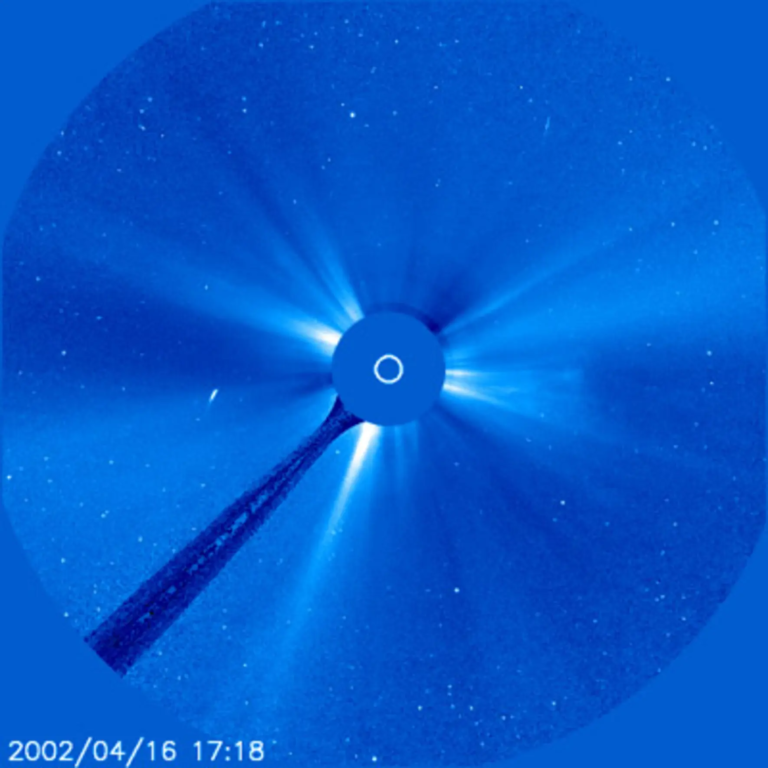
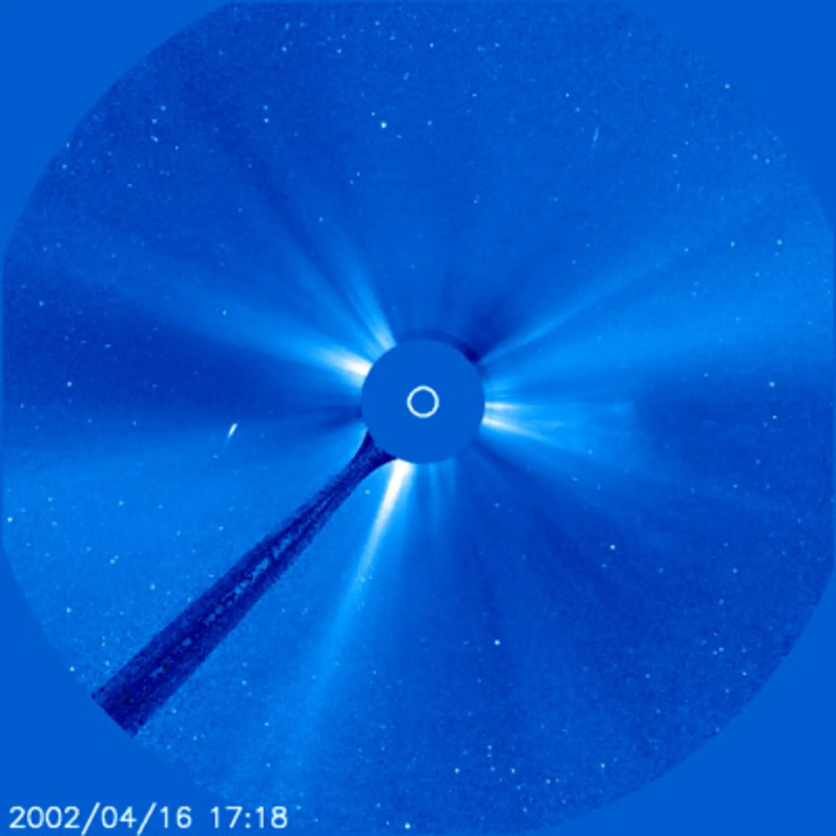
A coronagraph solves this by creating an artificial eclipse. SOHO carries the Large Angle Spectrometric Coronagraph — LASCO — an NRL-built instrument consisting of three nested coronagraphs, two of which (designated C2 and C3) remain in operation today. Both use what is called an externally occulted Lyot design, first conceived by French astronomer Bernard Lyot around 1930: a precisely machined disk positioned in front of the objective lens eclipses the solar disk before any direct sunlight reaches the optics. This is the critical step. By blocking direct sunlight before it enters the instrument, LASCO dramatically reduces the internally scattered light that would otherwise overwhelm the coronal signal — suppressing it to a level roughly ten million times below the solar disk’s brightness at its inner edge.
What remains visible in the resulting images is the corona, coronal mass ejections, solar wind streamers — and comets. LASCO C2 covers a field of view from about 1.5 to 6 solar radii; C3 extends from roughly 3.7 to 30 solar radii. That wide outer field is why SOHO catches Kreutz sungrazers that no ground-based telescope ever could: by the time one of these objects is bright enough to see from Earth, it has already passed perihelion and either survived or burned up. SOHO watches them arrive.
SOHO itself sits not in Earth orbit but at the L1 Lagrange point — a gravitational equilibrium roughly 1.5 million km (932,000 miles) sunward of Earth, where it maintains a continuous, uninterrupted view of the Sun. No orbital day-night cycle, no atmosphere in the way. The coronagraph runs around the clock.
The Program That Turned SOHO’s Side Effect Into a Scientific Legacy
SOHO launched in December 1995 as a solar physics mission — designed to study the Sun’s interior, its atmosphere, and the origin of the solar wind. Nobody expected it to become history’s most prolific comet-discovery platform.
The first hint of what was coming arrived on August 22, 1998, when mission team member S. Stezelberger identified a Kreutz comet in LASCO’s data: C/1996 Q2 (SOHO), the program’s first confirmed discovery. Within years, as the LASCO images became publicly accessible online, amateur astronomers around the world began finding more of them. The pace accelerated. SOHO crossed 1,000 comet discoveries, then 2,000. The NASA-funded Sungrazer Project — operating from NRL, with Karl Battams, Ph.D. as principal investigator since 2003 — formalized the citizen-science pipeline: volunteers register at sungrazer.nrl.navy.mil, access the same LASCO images the professionals use, submit candidate comet sightings through a structured reporting system, and await confirmation from Battams’s team.
No science background is required. What is required, as the program’s own documentation notes, is patience.
“In less than 25 years SOHO has added this huge volume to the archives of our comet knowledge,” Battams said when the program crossed the 4,000-comet threshold in June 2020, “and it comes from a telescope not designed to see comets.”
The program reached 5,000 discoveries on March 25, 2024, with a small Marsden-group comet found by Hanjie Tan, an amateur astronomer from Guangzhou, China, who had been participating since age 13 and is now a Ph.D. student in Prague. The 5,000th comet discovery was confirmed by Battams’s team after Tan submitted his observation through the project’s standard reporting pipeline. The Sungrazer Project website now lists 5,204 total comets discovered.
The Kreutz Family: One Ancient Body, Thousands of Fragments
Of SOHO’s 5,204 comet discoveries, more than 4,400 belong to the Kreutz group — roughly 85 percent of the total catalog.
The Kreutz sungrazers are all believed to be fragments of a single ancient comet that broke apart in one or more catastrophic encounters with the Sun. Some astronomers have proposed a large comet observed around 371 BCE — recorded by Aristotle and the Greek historian Ephorus — as a possible original progenitor, though this identification is not universally accepted; the Great Comet of 1106 is a better-documented fragmentation event within the same lineage. Whatever the origin, the surviving fragments all follow the same general orbital path, one with a perihelion distance of less than 0.01 of an Astronomical Unit — the mean Earth-Sun distance of approximately 150 million km (93 million miles) — meaning 0.01 AU amounts to roughly 1,496,000 km (929,500 miles) from the Sun’s center, or about 50,000 km (31,069 miles) from its surface. At that distance, the ambient temperature is well over a million degrees Celsius (1.8 million°F). The vast majority of Kreutz sungrazers do not survive.
Their orbital periods run to hundreds or thousands of years. They typically arrive without warning from the outer solar system, brighten rapidly as they approach the Sun, and are gone — either evaporated or continuing their elliptical journey back into the deep cold — within days. SOHO can detect them precisely because its coronagraph covers the zone where they spend their final hours.
Citizen Scientists Who Rewrote the Catalog
What the Sungrazer Project’s volunteers have produced is not simply a longer list of known comet types. Two citizen scientists — amateur astronomers Maik Meyer and Rainer Kracht — identified entirely new comet families in the SOHO data: the Meyer group and the Kracht group, both previously unknown comet families whose existence only became apparent because thousands of observations were now being systematically catalogued. The NASA Sungrazer citizen-science profile describes how professional astronomers subsequently confirmed and extended these findings by identifying a third group.
This is the distinction that separates the Sungrazer Project’s citizen-science contribution from mere data collection: participants did not simply add new members to known families. They found new families entirely.
Sebastian Hoenig, who began as a Sungrazer volunteer and went on to become a professional astronomer, identified what was then the second shortest-period comet known — a finding published in Astronomy & Astrophysics in 2006 and later confirmed as the citizen-science community had predicted. The Sungrazer Project has since contributed to dozens of peer-reviewed papers and multiple doctoral theses.
This Year’s Closest Look: C/2026 A1 (MAPS)
The most dramatic Kreutz event of 2026 came in early April, when comet C/2026 A1 (MAPS) — discovered on January 13, 2026, by amateur astronomers Alain Maury, Georges Attard, Daniel Parrott, and Florian Signoret using a telescope in Chile — made its final plunge toward the Sun.
It was the most distant Kreutz sungrazer ever detected before perihelion, spotted at approximately 2 AU (roughly 299 million km / 186 million miles) from the Sun. As it crossed into LASCO’s field of view on April 2, 2026, and then CCOR-1’s field on April 3, it became the first Kreutz sungrazer to be observed simultaneously by both instruments — a dual-coronagraph view that researchers will study for years.
It didn’t survive. C/2026 A1 disintegrated approximately six hours before perihelion on April 4, 2026, at a distance of about 161,000 km (100,041 miles) from the solar surface — roughly twice the distance from Earth to the Moon. Its calculated orbital period: approximately 1,600 years, based on orbital analysis of C/2026 A1. Whatever body produced this comet will not return until the 37th century.
A Generational Transition: CCOR-1 Steps In
SOHO was designed for a two-year mission. It launched in December 1995. It is now operating well into its 32nd year of science, in a formal post-operations phase after ESA’s planned end-of-mission date passed at the close of 2025. The ESA Science Programme Committee extended SOHO along with 12 other missions in June 2026 — confirming that the spacecraft remains scientifically valuable — but the transition to its successor is already underway.
The Compact CORonograph-1 (CCOR-1), built by NRL for NOAA, flew to geostationary orbit aboard GOES-19 in June 2024 and began science operations on September 19, 2024. Unlike SOHO, which sits at the L1 Lagrange point and was designed as a research platform, CCOR-1 is an operational space-weather instrument aboard a geostationary weather satellite. It images every 15 minutes; its field of view runs from 3.7 to 18.7 solar radii — roughly comparable to SOHO’s C3, though with a narrower inner extent. By July 2025, just 10 months into science operations, CCOR-1 had already discovered 70 comets.
The architectural differences are real. SOHO, at L1, sees the Sun from a vantage point 1.5 million km (932,000 miles) ahead of Earth; this geometry has scientific advantages for certain heliophysics measurements. CCOR-1 is in geostationary orbit, fixed relative to Earth’s surface, optimized for continuous operational weather monitoring. LASCO’s C2 coronagraph covers the inner corona down to 1.5 solar radii — a zone CCOR-1 does not observe. That inner zone, where many Kreutz sungrazers make their final approach, will be a gap in CCOR-1’s coverage.
The Sungrazer Project’s pipeline — the reporting infrastructure, the confirmation workflow, the citizen-science interface — is not tied to SOHO specifically. It already incorporates CCOR-1 imagery, as the coronagraph comets 2026 tracking logs confirm. The program will continue. The specific instrument at its center is changing.
How to Get Involved
The Sungrazer Project is open to anyone worldwide. No telescope, no astronomy background, and no paid subscription are required — only a computer, a registration at the project’s website, and enough patience to scan through near-real-time coronagraph images looking for faint moving specks.
Participants who identify a new candidate submit a report through the project’s structured online form. Battams reviews submissions and issues confirmations. Confirmed discoveries carry the discoverer’s name in the official record — permanently.
To register: Visit sungrazer.nrl.navy.mil and follow the registration instructions. SOHO LASCO and CCOR-1 image data are both accessible through the platform.
The candidate filed this morning — today’s new Kreutz comet — will be reviewed and confirmed or rejected in the coming days. Whoever spotted it did so from a screen, in a home or an office somewhere on Earth, scanning the same images that have produced more than 5,200 discoveries since 1996.
One of them, eventually, will be the last one SOHO sees.
Frequently Asked Questions
What is the NRL Sungrazer Project?
The NRL Sungrazer Project is a citizen-science program operated by the U.S. Naval Research Laboratory that allows volunteers worldwide to search for comets in images taken by the LASCO coronagraph aboard the SOHO spacecraft. The project has been running since the late 1990s and has produced more than 5,200 confirmed comet discoveries, making it the most prolific comet-finding program in history. It is funded by NASA and led by principal investigator Karl Battams, Ph.D.
What is a Kreutz sungrazer comet?
A Kreutz sungrazer is a member of a family of comets believed to be fragments of a single ancient progenitor body that broke apart in one or more close encounters with the Sun. All Kreutz sungrazers share a nearly identical orbital path, bringing them to within roughly 50,000 km (31,069 miles) of the Sun’s surface — through the lower solar corona — at perihelion. The vast majority evaporate and do not survive this passage. More than 4,400 of SOHO’s 5,200+ comet discoveries belong to the Kreutz group.
How does SOHO find comets that ground-based telescopes cannot?
SOHO carries the LASCO coronagraph, which uses an external occulting disk to block the Sun’s light before it enters the optics, creating an artificial eclipse. This suppresses scattered light to a level roughly ten million times below the solar disk’s brightness, making the faint corona — and any comets threading through it — visible. Ground-based telescopes cannot observe this zone because the Sun’s glare overwhelms any object within a few solar radii of the solar disk. By the time a Kreutz sungrazer would be detectable from Earth, it has already passed perihelion and either burned up or is heading back into deep space.
Do I need any special equipment or training to participate?
No. The Sungrazer Project requires only a computer with internet access and a free registration at sungrazer.nrl.navy.mil. No telescope, no prior astronomy knowledge, and no subscription fee are required. The program provides access to the same near-real-time LASCO and CCOR-1 images used by professional astronomers. Participants search for faint moving objects in the coronagraph data and submit candidates through a structured online form. Patience is the primary qualification the program’s documentation cites.
What is CCOR-1, and how does it differ from SOHO’s LASCO?
CCOR-1 (Compact CORonograph-1) is an NRL-built coronagraph aboard NOAA’s GOES-19 geostationary weather satellite. It began science operations on September 19, 2024, and had discovered 70 comets within its first 10 months of operation. Unlike SOHO — which orbits the L1 Lagrange point 1.5 million km from Earth and was designed as a research platform — CCOR-1 is an operational space-weather monitoring instrument in geostationary orbit. Its field of view (3.7 to 18.7 solar radii) is comparable to SOHO’s C3 coronagraph but does not cover the innermost corona that SOHO’s C2 observes. The Sungrazer Project already accepts and processes CCOR-1 comet candidates alongside SOHO data.
What happened to comet C/2026 A1 (MAPS)?
C/2026 A1 (MAPS) was discovered on January 13, 2026, by a team of four amateur astronomers using a telescope in Chile. It became notable as the most distant Kreutz sungrazer ever detected before perihelion, spotted at approximately 2 AU from the Sun. It was the first Kreutz comet observed simultaneously by both SOHO’s LASCO and the new CCOR-1 instrument. The comet did not survive its solar encounter: it disintegrated approximately six hours before perihelion on April 4, 2026, at about 161,000 km (100,041 miles) above the solar surface. Its calculated orbital period is approximately 1,600 years, meaning the remnant material will not return until the 37th century.