November 4, 2026:


Uber’s CEO Dara Khosrowshahi just gave the autonomous vehicle industry something it rarely receives: a specific number tied to a specific date. In Uber’s third-quarter 2026 earnings release, the company disclosed it expects approximately 700 fully driverless vehicles on its platform by December 31 — a figure it projects will climb past 2,000 by the close of 2027 and into the tens of thousands by 2028. For an industry that has spent years trading in promises, the precision carries weight.
The language Khosrowshahi chose in the earnings materials represented a deliberate pivot. “Our focus on autonomous is now on commercial execution,” he said — repositioning Uber not as a distributor of pilot programs but as the marketplace every autonomous fleet must connect to in order to reach paying riders at scale. Where previous reports described deals signed and cities studied, the Q3 release talked in units, timelines, and capital structure.
The ecosystem supporting that pivot is unusually broad. Uber’s autonomous vehicle partner count now exceeds 25 developers spanning technology companies, global automakers, and AI software providers. The roster includes Waymo (a subsidiary of Alphabet), Zoox (owned by Amazon), UK-based Wayve, Chinese technology leader Baidu, electric truck and van maker Rivian, and semiconductor powerhouse NVIDIA. Each company brings its own vehicle hardware, geographic footprint, and technology stack. Uber’s role is to consolidate demand and manage the matching, pricing, and insurance infrastructure that makes those trips commercially viable.
Among the deployment milestones Khosrowshahi flagged on the earnings call is Zoox, Amazon’s autonomous subsidiary, which announced a partnership with Uber in March 2026 to place its purpose-built robotaxis on the Uber app in Las Vegas — a launch now set for November 2026, with Los Angeles targeted for mid-2027. The agreement is notable in part because it marks the first time Zoox has shared its vehicles with any third-party ride-hailing platform. The Zoox robotaxi is also structurally distinct from most AV competitors: it was not retrofitted from an existing passenger car but designed from the ground up for commercial ride-hailing, with no steering wheel, no pedals, and a bidirectional cabin built around passenger comfort rather than driver convenience.
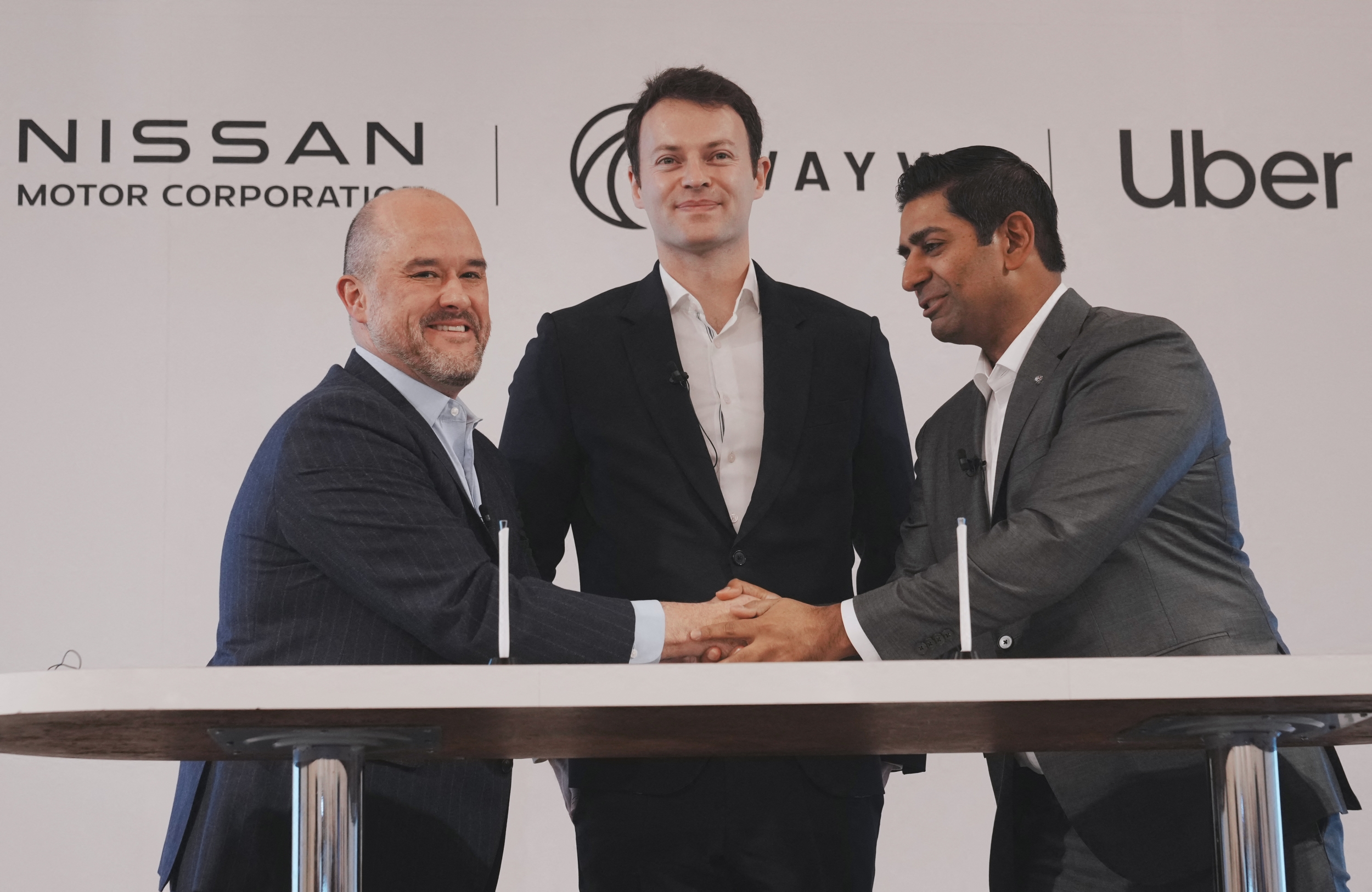
Uber’s international AV footprint is expanding as well. The company, UK-based autonomous driving startup Wayve, and automaker Nissan have signed a memorandum of understanding to pilot robotaxi service in Tokyo, with an initial deployment expected in late 2026 subject to ongoing regulatory discussions. The vehicles will use Nissan Leaf electric cars outfitted with Wayve’s AI Driver system — an end-to-end approach that dispenses with HD mapping in favor of a generalized learning model capable of adapting to new city environments without city-specific re-engineering. The arrangement is Uber’s first autonomous vehicle partnership in Japan, and Tokyo’s dense road grid and demanding safety standards make it one of the more complex environments the platform has targeted.
The scope of Uber’s NVIDIA relationship goes beyond chip supply. In an expansion of their partnership announced in March 2026, the two companies plan to deploy a fleet of vehicles running entirely on NVIDIA’s autonomous software stack — beginning in Los Angeles and San Francisco in the first half of 2027 and scaling to 28 cities across North America, Europe, Australia, and Asia by 2028. The technical foundation is the NVIDIA DRIVE Hyperion platform and Alpamayo, a reasoning-based AI model that uses chain-of-thought logic to handle unpredictable road conditions such as erratic pedestrians and construction-zone disruptions. The arrangement effectively positions NVIDIA as a full-stack Level 4 software provider for commercial robotaxi operations — a role the company has not previously held at this scale.
Waymo, whose driverless rides in Austin and Atlanta have been bookable through the Uber app, remains the platform’s most operationally mature partner. Early data from those markets surfaced a finding that has since become central to Uber’s investor pitch: adding fully autonomous vehicles to a ride-hailing network expands total trip demand rather than shifting rides away from human drivers. That dynamic — if it holds at greater scale — reframes the competitive relationship between driverless cars and the drivers already on the platform.
Uber’s autonomous scale-up is underwritten by a core business outperforming on nearly every margin metric. Third-quarter Gross Bookings reached $59.8 billion, growing 20% on a constant-currency basis — the fifth consecutive quarter clearing that threshold. Non-GAAP Operating Income rose 38% to $2.3 billion, reaching a record 3.9% of Gross Bookings. Adjusted EBITDA climbed 31% to $2.96 billion, with the margin widening to 5.0% from 4.5% in the same period a year earlier.
GAAP net income came in at $512 million, dragged down by a $476 million pre-tax net loss tied to the revaluation of Uber’s equity investments. Non-GAAP EPS of $0.88 represented 35% year-over-year growth. For the fourth quarter, Uber guided for Adjusted EBITDA of $3.13 billion to $3.23 billion, with Non-GAAP EPS of $0.95 to $0.99 — implying earnings growth of 34% to 39% at the midpoint.
Management also noted that autonomous vehicle fleet financing is expected to shift progressively from Uber’s own balance sheet to third-party capital arrangements — a structure it said mirrors fleet financing in adjacent industries, with the caveat that residual values for AV vehicles remain unproven. A $1 billion Santander arrangement was cited as an early template for the model.
Relative to a platform that processes billions of trips annually, 700 fully autonomous vehicles is a rounding error. At Uber’s current quarterly booking run rate of $59.8 billion, even a single percentage point of autonomous trip penetration would represent roughly $600 million in bookings per quarter — which puts the size of the addressable opportunity in context even if the near-term numbers remain small. Fully driverless rides still account for less than 0.5% of Uber’s total volume today.
What the 700-vehicle target signals is not scale — it is a changed relationship with accountability. For the first time, Uber has staked a fleet number to a calendar date, inviting investors and competitors alike to measure progress against a public commitment rather than a directional roadmap. That shift from ambiguity to specificity is, in its own way, the most commercially consequential announcement in this quarter’s earnings release.