November 4, 2026:

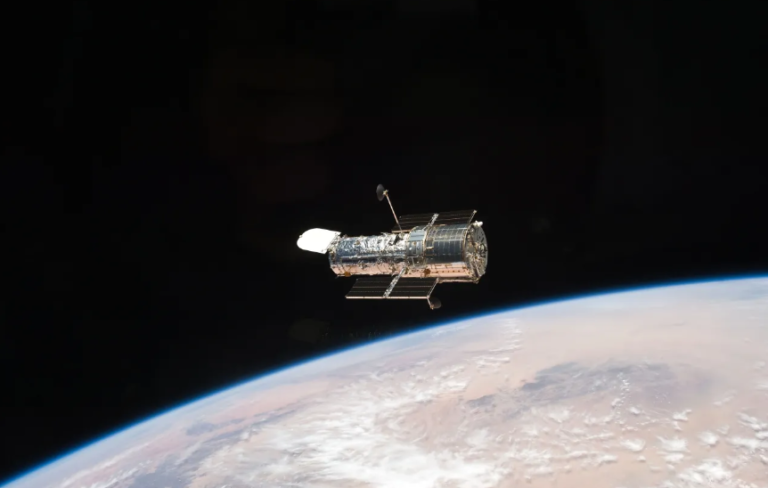
The Hubble Space Telescope has spent more than three decades capturing some of the universe’s most remarkable images, but its time in orbit may be approaching an unexpected turning point.
Although the observatory remains operational and continues to support scientific research, its orbit is gradually deteriorating, putting it on course to reenter Earth’s atmosphere around 2033 or 2034.
NASA is now exploring whether a servicing mission could extend the life of the iconic space telescope. An agency request for information issued on October 29, 2026, invites companies and other organizations to propose ways to service Hubble, raise its orbit, or potentially improve its capabilities.

NASA’s latest move signals renewed interest in extending the operational life of the Hubble Space Telescope.
The agency’s October 29 request for information (RFI) seeks potential in-space servicing solutions. One of the main possibilities involves raising Hubble’s orbit to counteract the gradual loss of altitude caused by atmospheric drag.
Although space is commonly associated with a vacuum, Earth’s upper atmosphere still contains enough particles to create resistance against objects in low Earth orbit. Over time, this drag reduces orbital altitude and eventually leads to atmospheric reentry.
NASA is also considering proposals that could enhance Hubble’s capabilities. However, the agency has not committed to a specific rescue mission or selected a contractor.
The request also considers alternatives for the observatory’s eventual retirement, including a controlled atmospheric reentry or orbital disposal.
The primary concern surrounding Hubble is not that its scientific instruments have suddenly stopped working. Instead, the challenge involves maintaining its orbit.
Hubble operates in low Earth orbit, where atmospheric drag gradually slows spacecraft and causes their altitude to decrease. Without intervention, the telescope is expected to reenter Earth’s atmosphere in 2033 or 2034.
According to NASA’s timeline, a potential servicing mission would need to take place by 2032 to address the problem.
An orbital boost could give Hubble additional time in space, allowing researchers to continue using its instruments and collecting observations.
The proposal is particularly relevant because Hubble remains scientifically productive despite its age. Extending its mission could preserve an existing research platform rather than requiring an entirely new observatory to replace it.
The Hubble Space Telescope was launched in April 1990 through a partnership between NASA and the European Space Agency (ESA).
Unlike many modern space observatories, Hubble was designed with the possibility of astronaut servicing in mind. During the Space Shuttle era, astronauts visited the telescope five times to repair equipment, replace components, and upgrade its scientific instruments.
The last servicing mission took place in 2009.
Those interventions helped keep Hubble operational well beyond its original expected mission duration. Its continued scientific contributions demonstrate the value of maintaining and upgrading spacecraft already in orbit.
However, another servicing mission presents different challenges today. The retirement of NASA’s Space Shuttle program means a new approach would be needed, potentially involving commercial spacecraft and private space companies.
Hubble’s scientific contribution is a major reason NASA is considering ways to extend its lifespan.
The observatory has helped astronomers investigate galaxies, stars, planets, and other distant objects. Among its most significant contributions was providing observations that helped establish that the expansion of the universe is accelerating, a discovery recognized with the Nobel Prize in Physics.
Its scientific influence is also reflected in the volume of research it has supported. NASA figures indicate that Hubble observations have contributed to at least 23,000 scientific papers.
According to Space.com, the demand for telescope observation time remains exceptionally high. In September 2026, NASA reported that astronomers request approximately seven times more observing time than the observatory can provide annually.
Beyond scientific research, Hubble has become an important part of public interest in astronomy. Its photographs, including the famous Pillars of Creation in the Eagle Nebula, have introduced millions of people to the beauty and complexity of the universe.
The idea of rescuing Hubble is not entirely new.
In 2022, technology entrepreneur Jared Isaacman proposed using SpaceX hardware to conduct a servicing mission for the observatory. Isaacman had previously purchased and commanded two crewed SpaceX missions to Earth orbit, flying in September 2021 and September 2024.
NASA declined the earlier proposal, citing potential risks to an observatory that was still functioning well.
However, the situation has since changed. Isaacman, who became NASA administrator in December 2025, expressed renewed interest in examining practical ways to extend Hubble’s operational life.
In an October 30, 2026, agency statement, he emphasized the importance of evaluating reasonable opportunities to preserve the telescope’s scientific contributions, particularly if servicing it would cost less than launching a replacement mission.
Hubble is not the only NASA observatory facing orbital decay.
Earlier in 2026, NASA partnered with Katalyst Space Technologies on a $30 million effort to raise the orbit of the Neil Gehrels Swift Observatory.
The mission was developed in response to increasing atmospheric drag associated with heightened solar activity. As the Sun became more active, Earth’s upper atmosphere expanded, increasing resistance against spacecraft in low Earth orbit.
Katalyst’s LINK spacecraft successfully launched during the summer, but control problems prevented it from completing its planned rendezvous with Swift.
The observatory is expected to reenter Earth’s atmosphere on November 4, 2026, after approximately 22 years of operations. This is considerably longer than its original two-year design lifetime.
NASA’s latest request for information does not focus exclusively on extending Hubble’s mission. It also allows proposals for managing the telescope’s eventual retirement.
One option involves a safe, controlled reentry into Earth’s atmosphere. Another possibility is orbital disposal, depending on the feasibility of available servicing technologies.
If no rescue mission moves forward, Hubble will continue operating under its existing conditions until its systems or orbital limitations prevent further operations.
For astronomers, the loss of Hubble would mean the eventual retirement of an observatory that has shaped modern understanding of the universe. While newer telescopes, including the James Webb Space Telescope, provide complementary capabilities, they do not make Hubble’s scientific role entirely interchangeable.
The coming years will determine whether commercial space technology can provide a practical way to keep the observatory working beyond its projected orbital lifetime.
NASA is exploring servicing options because Hubble’s orbit is gradually declining due to atmospheric drag. Raising its orbit could extend its operational life and allow astronomers to continue using its scientific instruments.
Without intervention, Hubble is expected to reenter Earth’s atmosphere around 2033 or 2034. NASA has indicated that a potential servicing mission would need to take place by 2032.
Yes. Despite being launched in 1990, Hubble remains operational and in high demand among astronomers. Its observations continue to contribute to scientific research across several fields of astronomy.
Yes. Astronauts serviced Hubble five times during Space Shuttle missions. The most recent servicing mission took place in 2009 and included repairs and equipment upgrades.
SpaceX hardware was proposed for a potential Hubble servicing mission in 2022. NASA declined that proposal at the time because of concerns about potential risks. The agency’s latest RFI now invites new servicing concepts, including potential commercial solutions.
The James Webb Space Telescope provides different observational capabilities, particularly in infrared astronomy. However, Hubble continues to make valuable observations, and its retirement would leave a gap in certain areas of astronomical research.