November 4, 2026:


Most in-car AI today lives and dies by its data connection. The moment a vehicle dips into a tunnel, enters a parking garage, or hits a dead zone on a mountain highway, the digital assistant goes quiet. PATEO, one of China’s leading connected-car technology suppliers, has built a direct answer to that problem — and it involves deploying two of the most capable AI models in the consumer market directly inside the vehicle’s cabin.
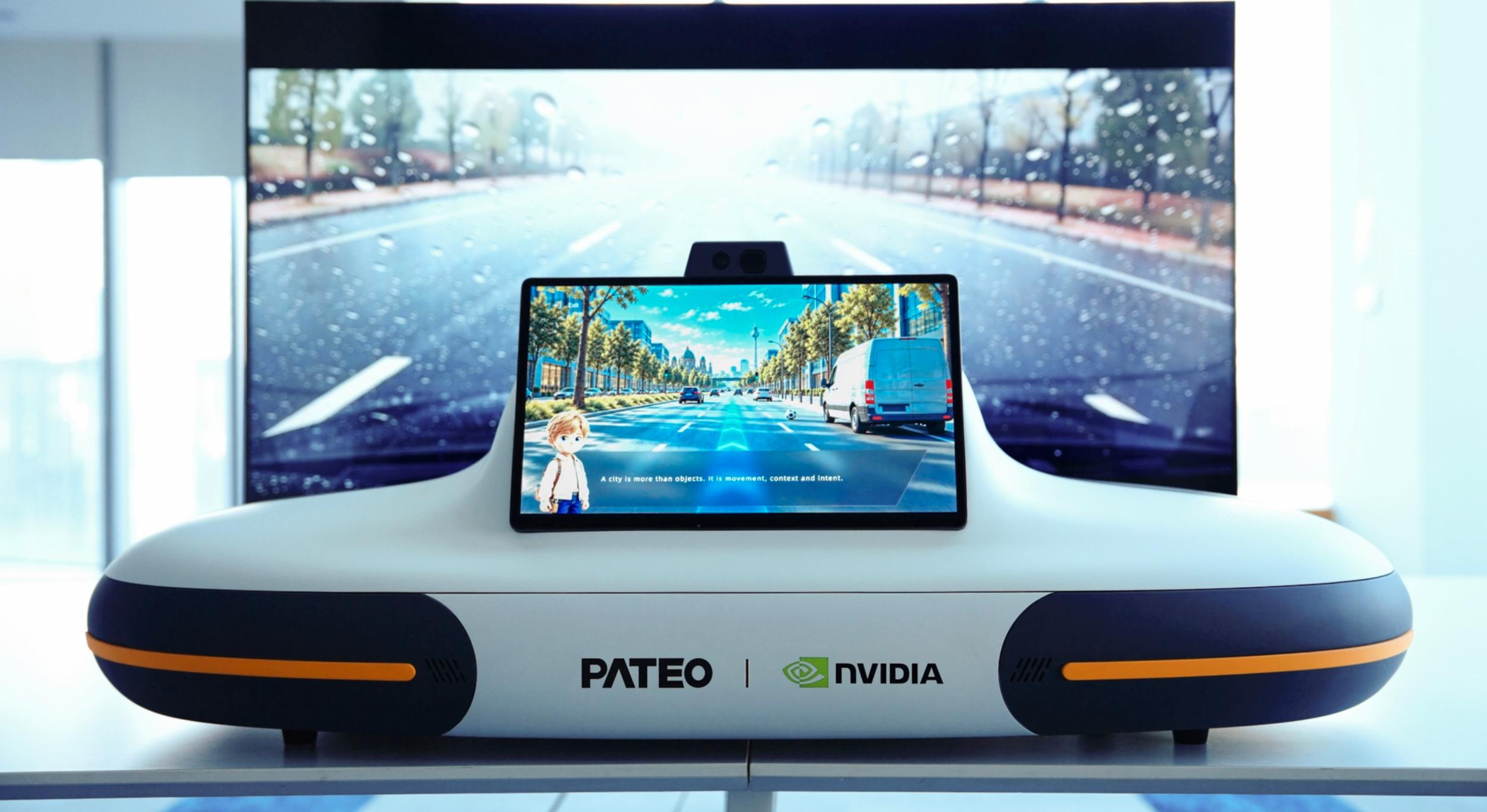
Announced on November 3, 2026, PATEO’s AI Box is a modular add-on compute unit built on the NVIDIA DRIVE AGX Thor platform. Rather than replacing a vehicle’s existing main control chip, the box sits alongside it — a design decision that lets automakers integrate advanced AI without redesigning their entire compute architecture from scratch. Inside that box, PATEO has packed two substantial AI workloads: NVIDIA’s Nemotron 3.5 ASR model for real-time speech recognition, and ByteDance’s Doubao language model, a mixture-of-experts system with 35 billion total parameters, for natural-language understanding and contextual reasoning.
The practical effect is an in-car assistant that can hear, comprehend, and respond to driver requests whether the vehicle has a cellular signal or not. Cloud connectivity remains available as an enhancement layer — for software updates, expanded services, and model iteration — but the system does not require it to function. Core features, from voice-activated cabin controls to real-time hazard awareness, run entirely on the hardware under the hood.
Putting a model of Doubao’s scale into an automotive-grade package is an engineering challenge that goes well beyond raw processing power. NVIDIA DRIVE AGX Thor delivers up to 1,000 INT8 TOPS of AI performance and 273 GB/s of memory bandwidth — specs that PATEO specifically highlights because Doubao’s key-value cache expands as a conversation grows longer, placing increasing pressure on memory bandwidth rather than peak compute alone. A chip that scores well on TOPS but falls short on bandwidth would bottleneck the assistant mid-conversation, producing the kind of lag that erodes driver trust.
Doubao’s mixture-of-experts architecture helps on that front as well. Rather than activating all 35 billion parameters for every request, the model routes each input to a specialized subset of its internal networks — reducing the computational load per query while preserving the depth of response that a dense model of similar size would require server infrastructure to achieve.
PATEO’s AI Agent platform fuses voice input, driver-facing camera footage, and vehicle sensor data into a unified real-time picture of cabin conditions. The system can recognize early signs of driver fatigue through the camera and, without waiting for a voice prompt, offer to adjust ventilation or activate the seat massager. In city driving, an onboard air-quality sensor can trigger automatic window closure and cabin recirculation if the vehicle enters an area with elevated pollution levels.
What PATEO calls the Sentinel AI layer extends that awareness beyond the cabin itself. The system can flag a potential parking violation, alert the owner to nearby flooding conditions, or detect a fire risk in the surrounding area — all without the driver opening a separate app. Users can also authorize the assistant to learn their individual climate and routing habits over time, refining its behavior through a local inference profile rather than uploading behavioral data to a remote server.
The commercial validation for the AI Box comes from a leading new-energy vehicle manufacturer that has issued PATEO a mass-production nomination for a next-generation vehicle program, with production targeting Q2 2027. PATEO announced the joint development agreement publicly at Auto China 2026 in Beijing, alongside its partnership with ByteDance. The identity of the automaker has not been disclosed.
The modular design is central to why the AI Box was able to attract that nomination. Because it coexists with whatever main control chip an automaker has already committed to, it can be incorporated into new vehicle platforms or retrofitted into programs already deep in the development pipeline — a flexibility that significantly lowers the barrier for OEMs considering the upgrade.
PATEO is not positioning this as a conventional parts business. The company is developing what it calls an in-vehicle Tokenomics strategy — a billing architecture that charges for AI compute consumption on an ongoing basis, similar to how cloud providers meter server usage. Under this model, the AI Box becomes the foundation for a recurring-revenue service rather than a one-time hardware sale.
In June 2026, PATEO formalized that direction through partnerships with Mininglamp Technology, Xunce Technology, and Saimo Technology to co-develop a token-based physical AI world model and an operating system called TokenOS, which is intended to underpin the billing and deployment infrastructure. The same platform has also drawn interest from a leading domestic robotics computing provider — a signal that PATEO sees DRIVE AGX Thor as a horizontal compute base with applications well beyond the vehicle cabin.
As automotive AI moves toward widespread on-device deployment, PATEO’s combination of mass-production experience, software-hardware integration, and a novel revenue model positions it as one of the more ambitious bets in China’s rapidly evolving intelligent-vehicle supply chain.