November 2, 2026:


South Carolinians have elected Republican senators in every election cycle in the 21st century. But recent polls indicate that GOP Sen. Darline Graham is facing a tough fight against her Democratic challenger in the race for the seat long held her late brother, Lindsey Graham.
Polling by the New York Times/Siena, released last week, found that likely voters in South Carolina are essentially evenly split over whether they would vote for the Republican nominee, who was appointed by the state governor to finish the remainder of her late brother’s term after he died in July and later announced that she would run for the seat in the midterms, and Dr. Annie Andrews, a pediatrician who won the Democratic primary in June.
In August, the Cook Political Report rated the South Carolina race as “Solid Republican,” indicating that the GOP was widely expected to retain control of the Senate seat. But the election forecaster later shifted the race slightly in Democrats’ favor to “Likely Republican;” then, on Oct. 20, it changed its rating again to “Lean Republican.”
The race is just one example of how Republicans are apparently struggling to maintain voter support in this election cycle. Most generic ballot polls show that voters are more likely to back Democrats than Republicans in this midterm election. Other polling suggests that GOP candidates are even having trouble keeping leads in states that are typically considered strongholds for the party, such as in Texas, where most surveys have found that the Democratic candidate James Talarico is ahead—by a narrow margin—of Republican Ken Paxton in a heated and expensive Senate race heading into Election Day on Tuesday.
This trend is also visible in gubernatorial races, such as the one in Ohio, where Republican candidate Vivek Ramaswamy has launched an aggressive and controversial campaign against his Democratic opponent Dr. Amy Acton. The last time Ohioans elected a Democrat to be their governor was in 2006, but the Cook Political Report recently shifted its rating of the race from “Toss Up” to “Lean Democrat.”
Political experts say the battle for South Carolina’s Senate seat is in line with this national trend. They also say, though, that there are local circumstances that have contributed to how tight the race has become.
According to political experts, part of the reason the race in South Carolina has become so close is because the current national political environment is challenging for Republicans.
Historically speaking, the sitting President’s party tends to lose seats in Congress during midterm elections. And right now, the pressure on Republicans is being compounded by the fact that President Donald Trump’s approval rating has dropped to a new low; the last time a President’s approval rating fell to a comparable level heading into the midterms was in 1946, when Harry Truman was in the Oval Office.
Read More: Trump’s Approval Is at a New Low. Here’s Where Other Presidents’ Stood Before the Midterms—and How Their Parties Fared
Polling shows that the economy and the war in Iran are significant contributors to the public’s dissatisfaction with the President and his Administration.
“That’s hurting Republicans everywhere across the country,” says Joseph Ura, a professor of political science at Clemson University. “You see tight races in places that aren’t usually tight for Republicans, like Texas and in Ohio … so that’s everywhere, including South Carolina.”
On top of that, there are local circumstances at play that were set in motion by Lindsey Graham’s death in July. Before his death, Lindsey Graham, who had held his seat in the upper chamber since 2003 and served in the House before that, was running for re-election and won the Republican primary in June by a nearly 28-point margin. He was widely expected to win the general election in November. But his death “fundamentally changed the race,” says Shannon Bridgmon, a political scientist at the University of South Carolina.
Although Darline Graham is technically running as an incumbent, she has been in the upper chamber for only a few months, so “the race is functioning as an open race within the state,” Bridgmon says. “That—I don’t want to say never happens here, but it’s certainly rare.”
Over the summer, a crowded field of Republican candidates sought the party’s nomination to vie for Lindsey Graham’s seat. But no candidate was able to secure a majority of the vote in the August primary, so the race advanced to a runoff election later that month between Darline Graham and Rep. Ralph Norman. Darline Graham ultimately emerged victorious by a less than 5-point margin.
The primary, Bridgmon says, “created this significant fracture” within the Republican party, as voters were split between Darline Graham and Norman. The divisions within the GOP have become even more apparent as Norman has said that he has no plans to join the Senator’s campaign. He has said, however, that he intends to vote for her.
“There seems to be some sort of dissatisfaction within the party that [Darline Graham] is the nominee,” Bridgmon says. “There were questions about ‘Should she just gracefully finish out the late Sen. Graham’s term and step aside?’ There were some resentments there in some of those camps, and there have even been whispers and, well, rumblings, I would say, about a write-in campaign for Norman among his most ardent supporters.”
Scott Huffmon, a professor of political science at Winthrop University and director of the Center for Public Opinion & Policy Research, says that some Republicans seem to feel that Darline Graham was “ordained” as the party’s candidate. In July, Trump publicly praised her, urging her to run in November even before she had announced her intention to vie for a full term.
Huffmon adds that some of the more conservative members of the Republican Party had not been big supporters of Lindsey Graham because they thought he was “too liberal.”
“Now you have a situation where the most conservative people within the party feel that their voice has been ignored, they’ve had a candidate foisted on them, and that candidate happens to be the sister of the person they had a problem with before,” Huffmon says. “Their internal fight has sort of made this a race that Darline Graham is kind of fighting to win instead of coasting.”
Before she was appointed to finish out the remainder of her brother’s term, Darline Graham had never held an elected office. And her minimal political experience has generated criticism in recent months. She received blowback, including from members of her own party, after a debate against Norman before the runoff in August, in which she said “I’m not that informed on national security” upon being asked a question about Taiwan and the South China Sea.
“She does not have the same public standing in the state as her brother did and does not have the same kind of relationship with the voters in the state that [the late] Sen. Graham had,” Ura says.
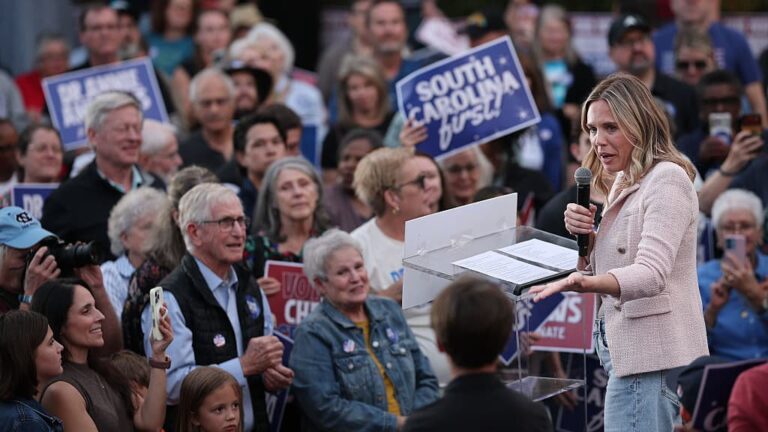
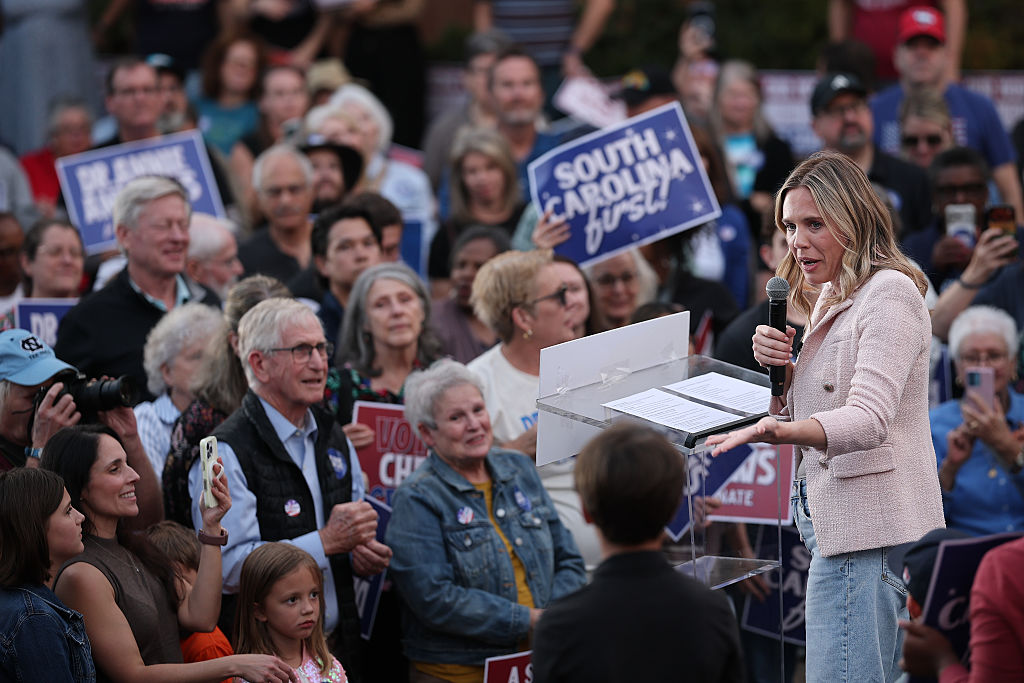
Darline Graham is also up against a strong Democratic candidate, according to Huffmon. Andrews is “a great fundraiser” who has been able to spread strong campaign messaging in the state and “gins up excitement wherever she goes,” Huffmon says. Bridgmon points out that Andrews has even been able to secure bipartisan endorsements; two former South Carolina governors—Republican David Beasley and Democrat Jim Hodges—appeared in an Andrews campaign video in which they both endorsed Andrews in the race.
“Democrats are motivated to go against Trump anyway, but they are excited by Annie Andrews, so there’s a whole lot of excitement on that side,” Huffmon says. “Darline Graham is not an experienced campaigner. She’s not generating the excitement among her base that she needs to, and … the Republicans need it doubly so because of the lack of popularity of Trump, so her inability to generate enthusiasm among the people who should be her base is helping this go down to the wire.”
Bridgmon says that Andrews “still has an uphill climb” to win the Senate seat. A critical question, Bridgmon says, is who will turn out to vote on Election Day: Will Norman’s supporters, for instance, show up to the polls, and if so, will they cast their ballots for Darline Graham, or for someone else?
Ura says that South Carolina is a state that “still leans Republican,” so he would be a little “surprised” if Andrews did end up on top after Election Day. But he notes that this race has taken an unexpected turn, and “will have effects for how Republicans and Democrats both campaign going forward.”
“This race is almost certain to be much, much closer and a much better performance for the Democratic nominee than anybody could have reasonably expected in 2024,” Ura says. “I still think the Republican is more likely than not to win this election, but it’s going to be probably the best performance by a Democrat in a statewide race in South Carolina in a very long time.”