November 2, 2026:


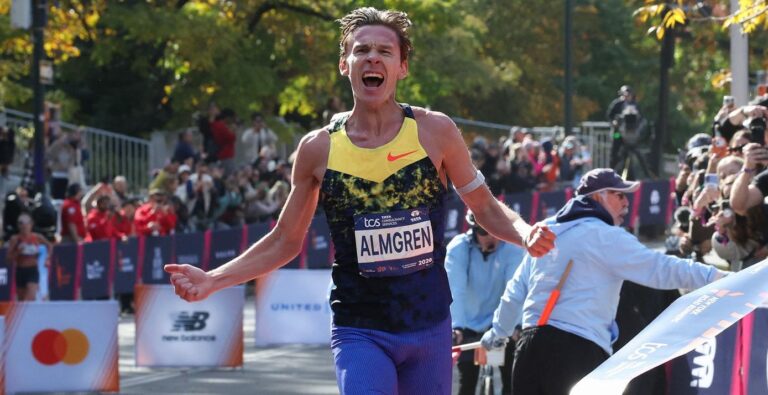
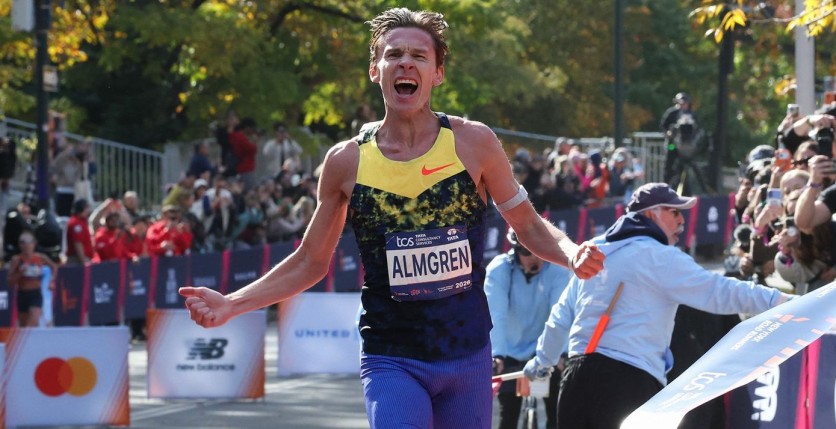
Sweden’s Andreas Almgren became the first Swede in history to win the New York City Marathon on Sunday, crossing the finish line in 2 hours, 6 minutes and 1 second to claim the race outright in his very first attempt at the distance — a once-in-a-decade debut victory in the world’s largest marathon. Almgren’s time ranks as the fourth fastest in race history, trailing only Tamirat Tola’s course record of 2:04:58 (2023), Geoffrey Mutai’s 2:05:06 (2011), and Lelisa Desisa’s 2:05:59 (2018). In the same edition, Switzerland’s Marcel Hug won the men’s wheelchair race in 1:28:14 to claim his record eighth New York City title — more than any other wheelchair racer in the event’s history.
The 55th TCS New York City Marathon, held November 1, 2026 across all five New York City boroughs, produced historic firsts in all four elite divisions. Kenya’s Sheila Chepkirui successfully defended her women’s title in 2:24:36, holding off American Jess McClain (2:24:42) and Kenya’s Hellen Obiri (2:24:43) in one of the closest three-way women’s finishes in the race’s history. Switzerland’s Catherine Debrunner won the women’s wheelchair race in 1:40:02, sweeping the para titles for Switzerland alongside Hug.
The men’s race had been framed for weeks as one of the most intriguing storylines in marathon running: could Andreas Almgren, the reigning World Half Marathon champion, transfer his road speed to 26.2 miles (42.195 km) in his very first attempt at the full distance?
He answered emphatically. Almgren pulled away from Yemaneberhan Crippa of Italy in the final mile to win in 2:06:01. Crippa finished 13 seconds back in 2:06:14. Kamohelo Mofolo of Lesotho was third in 2:06:26, edging out defending champion Benson Kipruto.
The historical weight of the result is considerable. Almgren became the first marathoner to win his debut at this event since Gebre Gebremariam of Ethiopia won the 2010 race, and the first Swede to win New York City in the marathon’s history. Pre-race analysis from LetsRun noted that no European-born man had won a World Marathon Major since Italy’s Stefano Baldini won the Olympic title in Athens in 2004, making Almgren’s effort a generational breakthrough for European distance running.
The 31-year-old arrived at New York in the form of his life. On September 20 in Copenhagen, Almgren became the first European to be crowned World Half Marathon champion since 1996, running 58:06. He had also won the 10,000 metres at the 2026 European Athletics Championships in Birmingham in a championship record of 27:23.44. The race unfolded with tactical patience: Almgren broke away from a lead group of ten that was still together at the 35K mark (21.7 miles) — a testament to the field’s depth and to Almgren’s ability to absorb the race’s brutal second half before unleashing his finishing speed.
Men’s Elite Top 3:
| Place | Athlete | Country | Time |
|---|---|---|---|
|
1 |
Andreas Almgren |
Sweden |
2:06:01 |
|
2 |
Yemaneberhan Crippa |
Italy |
2:06:14 |
|
3 |
Kamohelo Mofolo |
Lesotho |
2:06:26 |
The women’s race was no less dramatic — though its climax played out over the final 150 meters rather than the final mile.
Kenya’s Sheila Chepkirui captured her second New York title in 2:24:36, holding off American Jess McClain, who finished second in 2:24:42. Kenya’s Hellen Obiri, a two-time New York City Marathon winner and the defending champion, finished third in 2:24:43 — just one second behind McClain in a finish of extraordinary closeness.
Chepkirui described the closing stretch as demanding patience, knowing that Obiri’s formidable finishing strength required a sustained push all the way to the tape. “I had to be patient and push hard to the line because I knew Hellen was really strong,” she told ESPN. Her victory caps a remarkable return: Chepkirui won New York in 2024, finished third behind Obiri’s course-record performance in 2025, and has now successfully defended at the highest level in 2026.
The second-place finish by Jess McClain is among the day’s most resonant storylines for American running. It was the first time a U.S. woman finished in the top three at New York since 2018. The 34-year-old had set her sights explicitly above the domestic honors: “First American honors is always amazing, but I’m thinking bigger than that,” she said in August when the field was announced. Earlier this year she broke through at Boston, finishing fifth overall in 2:20:49 — a new American women’s course record at that race.
The result denied Obiri what would have been an unprecedented third New York title. The Kenyan, a two-time Olympic 5,000m champion turned marathon force, had set the women’s course record in 2025 and remained among the pre-race favorites; the one-second margin by which she was overtaken underscores how competitive the women’s field was from wire to wire.
Women’s Elite Top 3:
| Place | Athlete | Country | Time |
|---|---|---|---|
|
1 |
Sheila Chepkirui |
Kenya |
2:24:36 |
|
2 |
Jessica (Jess) McClain |
United States |
2:24:42 |
|
3 |
Hellen Obiri |
Kenya |
2:24:43 |
Switzerland completed a historic double in the wheelchair divisions, with both Marcel Hug and Catherine Debrunner claiming titles on a landmark day for para athletics.
Marcel Hug won the men’s wheelchair race in 1:28:14, with Daniel Romanchuk of the United States finishing one second behind in 1:28:15, and David Weir of Great Britain placing third in 1:35:38. The one-second winning margin was among the tightest in recent New York wheelchair racing history.
The win is Hug’s eighth at New York — a new record for men’s wheelchair wins at this event. The Swiss superstar has been dominant across the global circuit in 2026, having won the wheelchair title at Boston, London, Tokyo, Berlin, and Chicago earlier in the season before adding New York — six World Marathon Majors titles in a single calendar year. That record of dominance exists within a division that had to fight legally for the right to exist: wheelchair racers were banned from the New York City Marathon in 1977 and only received an officially recognized division in 2000, following sustained advocacy by para athletes.
In the women’s wheelchair race, Catherine Debrunner of Switzerland won in 1:40:02, ahead of Tatyana McFadden of the United States in 1:48:28 and Susannah Scaroni of the United States in 1:48:32. Debrunner, the world record holder in the women’s wheelchair marathon, also dominated the Berlin Marathon women’s wheelchair race in September. McFadden, a five-time New York City Marathon wheelchair champion, and three-time winner Scaroni completed the American pair on the podium behind Debrunner.
Men’s Wheelchair Top 3:
| Place | Athlete | Country | Time |
|---|---|---|---|
|
1 |
Marcel Hug |
Switzerland |
1:28:14 |
|
2 |
Daniel Romanchuk |
United States |
1:28:15 |
|
3 |
David Weir |
Great Britain |
1:35:38 |
Women’s Wheelchair Top 3:
| Place | Athlete | Country | Time |
|---|---|---|---|
|
1 |
Catherine Debrunner |
Switzerland |
1:40:02 |
|
2 |
Tatyana McFadden |
United States |
1:48:28 |
|
3 |
Susannah Scaroni |
United States |
1:48:32 |
Almgren’s debut victory raises a question that fascinates exercise physiologists: why is running the full marathon distance for the first time, competitively, at world-record pace, so rare — and what made him capable of pulling it off?
The core physiological challenge of the marathon is glycogen depletion. The human body can store approximately 2,000–2,500 kilocalories of glycogen in muscle and liver tissue — enough to sustain elite marathon pace for roughly 30–32 km (18.6–19.9 miles). Beyond that threshold, if the runner has not trained specifically to spare glycogen through efficient fat oxidation, pace drops precipitously: the experience known colloquially as “hitting the wall.” Elite marathoners spend years conditioning their bodies to burn fat at higher intensities, pushing the crossover point outward so glycogen reserves last closer to the finish line.
An elite half-marathon world champion (Almgren ran 58:06 in Copenhagen) typically carries an extraordinarily high VO2 max — the maximum rate of oxygen consumption — and superior running economy. Both attributes transfer directly to marathon performance. What does not automatically transfer is the metabolic experience of managing energy reserves for 42.195 km (26.2 miles) under competitive pressure, a skill that usually takes multiple races to calibrate. Almgren’s 2:06:01 — approximately 2:59 per kilometer (4:49 per mile) — represents running a sustained pace at or near the physiological ceiling for human marathon performance without ever having done so before. That is why debut wins at World Marathon Major events occur, by historical measure, roughly once per decade at most major races. Almgren’s pacing discipline — remaining inside a lead group of ten through the 35K (21.7-mile) mark before breaking away — suggests either exceptional metabolic conditioning or race-day coaching strategy of the highest order.
Beyond the elite competition, the 55th TCS New York City Marathon fulfilled its identity as the world’s largest marathon. More than 50,000 runners completed the 26.2-mile (42.195 km) course, which begins on the Verrazzano-Narrows Bridge in Staten Island before winding through Brooklyn, Queens, the Bronx, and Manhattan into Central Park. The race is a World Athletics Platinum Label road race — the sport’s highest certification tier for road events — and this year’s edition lived up to that designation, producing elite times that will be debated by runners and coaches for years to come.
For the tens of thousands of recreational runners who completed the course on Sunday, the 55th edition represented the culmination of months of training. The New York City Marathon has long served as a gateway event for first-time marathoners, and that tradition continued in full force across all five boroughs under clear November skies.
Men’s Elite
| Place | Athlete | Country | Time |
|---|---|---|---|
|
1 |
Andreas Almgren |
Sweden |
2:06:01 |
|
2 |
Yemaneberhan Crippa |
Italy |
2:06:14 |
|
3 |
Kamohelo Mofolo |
Lesotho |
2:06:26 |
Women’s Elite
| Place | Athlete | Country | Time |
|---|---|---|---|
|
1 |
Sheila Chepkirui |
Kenya |
2:24:36 |
|
2 |
Jessica (Jess) McClain |
United States |
2:24:42 |
|
3 |
Hellen Obiri |
Kenya |
2:24:43 |
Men’s Wheelchair
| Place | Athlete | Country | Time |
|---|---|---|---|
|
1 |
Marcel Hug |
Switzerland |
1:28:14 |
|
2 |
Daniel Romanchuk |
United States |
1:28:15 |
|
3 |
David Weir |
Great Britain |
1:35:38 |
Women’s Wheelchair
| Place | Athlete | Country | Time |
|---|---|---|---|
|
1 |
Catherine Debrunner |
Switzerland |
1:40:02 |
|
2 |
Tatyana McFadden |
United States |
1:48:28 |
|
3 |
Susannah Scaroni |
United States |
1:48:32 |
Sweden’s Andreas Almgren won the men’s race in 2:06:01 — the fourth-fastest time in the event’s 55-year history — becoming the first Swede and the first debut winner at New York since 2010. Kenya’s Sheila Chepkirui successfully defended her women’s title in 2:24:36. In the wheelchair divisions, Switzerland’s Marcel Hug claimed his record eighth New York title in 1:28:14, and Catherine Debrunner won the women’s wheelchair race in 1:40:02.
Winning a World Marathon Major on debut is extraordinarily rare — arguably a once-per-decade occurrence at most individual races. The primary physiological challenge is glycogen management: the human body stores enough glycogen to sustain elite marathon pace for roughly 30–32 km (18.6–19.9 miles), and managing the transition to fat oxidation over the final portion of the race requires race-specific experience that most elite runners spend years developing. Almgren’s victory suggests either exceptional natural metabolic conditioning or near-perfect pacing execution — or both. The last debut winner at New York was Gebre Gebremariam of Ethiopia in 2010.
Hug won six World Marathon Majors titles in 2026: Boston, London, Tokyo, Berlin, Chicago, and New York. The New York victory was his eighth overall, a new record for men’s wheelchair wins at that race. His wheelchair racing dominance occurred within a division that was officially banned from the New York City Marathon as recently as 1977 and did not receive formal race recognition until 2000.
Jessica (Jess) McClain is a 34-year-old American distance runner who finished second in the women’s race in 2:24:42 — just six seconds behind winner Sheila Chepkirui and one second ahead of Hellen Obiri. Her podium finish was the first time a U.S. woman placed in the top three at New York since 2018. Earlier in 2026 she finished fifth overall at the Boston Marathon in 2:20:49, a new American women’s course record at that race, establishing her as one of the leading American marathon performers.