HomeAuto Sony ECM-W5 Ships November 19 as First Wireless Mic With In-Camera 32-Bit Float Audio
Sony ECM-W5 Ships November 19 as First Wireless Mic With In-Camera 32-Bit Float Audio
November 1, 2026:
Sony.com
Sony’s ECM-W5 wireless mic system arrives on November 19 as the first consumer wireless mic to route 32-bit float audio directly through a camera’s digital shoe interface and write it into the video file itself — collapsing what has historically required a separate recorder and a post-production sync step into a single, seamless clip. The system replaces the ECM-W3 and brings expanded wireless range, 64GB of per-transmitter backup storage, timecode support, and a new touch-panel receiver alongside the headline audio format.
The catch is one that every potential buyer should understand before ordering: native in-camera 32-bit float recording works on exactly three current Sony bodies — the Alpha 7R VI (ILCE-7RM6), the Alpha 7 V (ILCE-7M5, requiring firmware v2.00 or later), and the Cinema Line FX5 (ILME-FX5). Owners of more than 20 other Sony cameras, including the Alpha 1 II, Alpha 9 III, Alpha 7S III, FX3, and the ZV series, receive digital audio over the same shoe connection — but their cameras record at the body’s own internal audio format, not 32-bit float, as the ECM-W5 camera compatibility list makes clear. The 32-bit float audio is simultaneously written to the transmitter’s 64GB internal storage and remains accessible from there in post, but that retrieval path requires the same sync step the headline feature is designed to eliminate.
What 32-Bit Float Actually Does — and What It Cannot Fix
The value proposition of 32-bit float recording begins at the analog-to-digital converter. A standard 24-bit PCM recording carries roughly 144 decibels of dynamic range — ample for controlled studio environments, but a real constraint when a solo shooter is recording a run-and-gun documentary interview and cannot ride the gain knob every time a subject raises their voice unexpectedly.
Thirty-two-bit float introduces an exponent field to the audio sample’s binary representation: each sample is stored in IEEE 754 single-precision floating-point format, with one sign bit, eight exponent bits, and 23 mantissa bits. The exponent extends the representable range to a theoretical ceiling that, while astronomically large in decibel terms, has a practical meaning that is more modest and more useful: within the headroom available at the ADC, post-production software can pull audio levels up or down by extreme amounts without introducing the quantization artifacts that would distort a 24-bit recording pulled the same distance.
The important caveat — and Sony is explicit about it — is that 32-bit float cannot recover audio that clipped at the analog stage, before the ADC ever saw the signal. If the microphone pre-amplifier is overloaded at the input, the waveform is permanently destroyed at that analog stage. No amount of post-processing can reconstruct it. The format’s real-world benefit is that it eliminates the need for a camera operator to set gain ahead of a shoot, reducing the risk of ADC-stage clipping during unpredictable audio events — not that it renders gain management irrelevant entirely.
Manual gain control remains available on the ECM-W5, ranging from -12 to +12 dB, alongside automatic input gain and switchable noise-cut and low-cut filters.
How the MI Shoe Pipeline Works — and Why Rivals Cannot Match It
On a fully compatible Sony body, the ECM-W5 system works as follows: the transmitter clips to a subject, captures audio via its built-in omnidirectional microphone or a connected lavalier, encodes the signal in 32-bit float format, and transmits it wirelessly to the receiver. The receiver mounts to the camera’s Multi Interface Shoe. The MI Shoe’s digital bus carries the audio stream directly into the camera’s internal processing pipeline, where the body embeds it as a native audio track in the recorded video file, as confirmed in the Sony ECM-W5 Help Guide.
That digital bus is proprietary to Sony accessories. Competing systems from DJI, RØDE, and Hollyland connect to Sony cameras via standard hot shoe adapters or 3.5mm mini-jack connections. DJI’s Mic 3, which also supports 32-bit float onboard its transmitters, passes audio to Sony cameras through an optional adapter — but that adapter is capped at 24-bit, as noted in the TechRadar ECM-W5 DJI comparison. The full 32-bit float data stays on the DJI transmitter, accessible only as a separate audio file that must be synced to the video in post-production.
The ECM-W5 on a compatible Sony body bypasses that step entirely. Whether the resulting single-file workflow justifies the price premium over DJI and RØDE depends on the camera body in hand — and, for most Sony Alpha owners, it does not apply to their current body.
Which Sony Cameras Actually Support In-Camera Float Audio?
The compatibility split across the Alpha lineup is more pronounced than the headline announcement suggests, per the kunkoku.jp compatibility breakdown.
Tier 1 — Full 32-bit float in-camera (3 bodies):
Alpha 7R VI (ILCE-7RM6)
Alpha 7 V (ILCE-7M5) — requires firmware v2.00 or later
Cinema Line FX5 (ILME-FX5)
Tier 2 — Digital MI Shoe connection, 24-bit audio only (22+ bodies): This group includes the Alpha 1 II, Alpha 9 III, Alpha 7S III, FX3, ZV-E1, Alpha 7C II, and the ZV-E10 II, among others. These cameras receive digital audio through the shoe and benefit from reduced wireless interference and cleaner audio than an analog connection provides, but will not record 32-bit float or 96kHz/24-bit Hi-Res Audio natively in-camera.
Tier 3 — Analog MI Shoe only (32+ older bodies): Earlier Alpha bodies connect to the receiver via analog signal only.
Users on Tier 2 and Tier 3 cameras still benefit from the ECM-W5’s 64GB per-transmitter backup, 500-meter (1,640 ft) range, and timecode support — but the 32-bit float audio resides on the transmitter’s internal storage rather than the camera file.
The 48 kHz / 32-bit float and 24-bit / 96kHz recording modes are mutually exclusive — not simultaneously combinable — and the choice is made in receiver settings before recording begins.
Hardware: Transmitter and Receiver
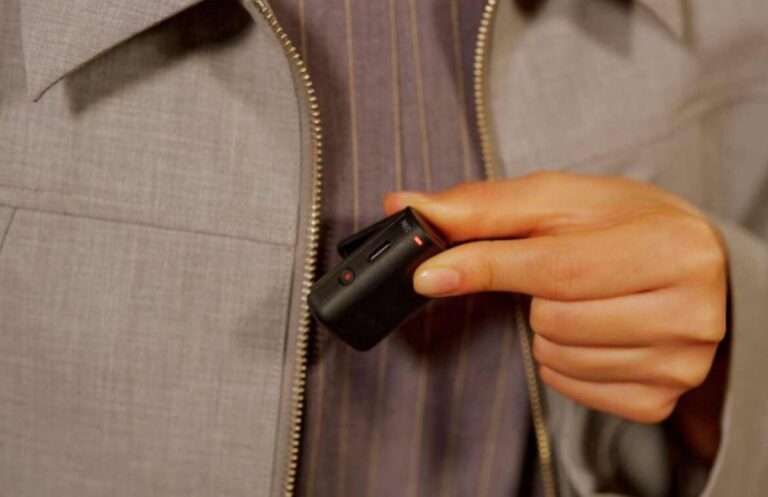
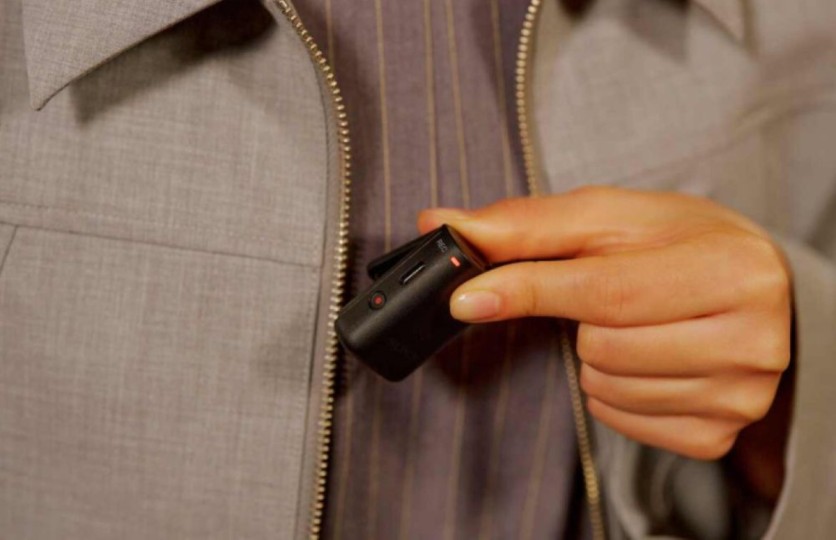
The ECM-W5T transmitter weighs 27.1g (0.96 oz) and measures 31.0 × 47.0 × 22.3mm (1.22 × 1.85 × 0.88 in), per Sony ECM-W5T transmitter specs. The built-in omnidirectional microphone handles primary capture; a 3.5mm screw-lock input jack accommodates lavalier microphones including Sony’s separately sold ECM-L1. Each transmitter holds 64GB of onboard storage, good for up to 90 hours of recording at 32-bit float / 48kHz or up to 60 hours at 24-bit / 96kHz — double the 32GB per transmitter offered by DJI’s Mic 3 and RØDE’s Wireless Pro, as shown on the DJI Mic 3 specs page. Battery life is rated at seven hours of continuous use, with the bundled charging case handling recharging in the field.
The ECM-W5R receiver weighs 35g (1.23 oz) without the MI Shoe adapter and measures 53.5 × 17.8 × 37.5mm (2.11 × 0.70 × 1.48 in). A new touch panel on the receiver’s face provides direct control over recording parameters, channel assignments, and level monitoring — eliminating the need to navigate camera menus during a shoot. One noted usability trade-off: when the receiver is mounted on a camera’s shoe, the touch panel faces away from the camera operator, meaning it cannot be seen or operated while filming yourself, as noted in the TechRadar Sony ECM-W5 review.
The receiver connects to smartphones and computers via USB-C at USB Audio Class 2.0, allowing the system to function as a two- or four-channel audio interface for podcasting, streaming, or laptop recording independent of the Sony camera ecosystem. It draws power from the camera when mounted digitally, removing one charging variable during longer shoots.
Four Channels, 500 Meters, and Why Range Matters
The standard kit ships with two transmitters and one receiver. Up to two additional ECM-W5T transmitters can be added, expanding the system to four simultaneous channels — sufficient for a panel discussion, a multi-camera interview, or a small event production.
Wireless range is rated at 500m (1,640 ft) line of sight. That is more than three times the 150m (492 ft) rating of the ECM-W3 predecessor, and approximately 25% beyond the 400m (1,312 ft) ceiling of the DJI Mic 3. RØDE’s Wireless Pro is rated to 260m (853 ft). Sony uses Bluetooth-based 2.4 GHz frequency-hopping transmission at low latency; the TechRadar ECM-W5 range test confirmed the signal held through two floors of a residential building during testing.
Independent range tests in complex RF environments — broadcast venues, dense urban areas — are not yet available, as the product has not shipped at the time of this writing.
Timecode and Wireless Monitoring
Timecode support is new to the ECM-W5 versus the ECM-W3 generation. The receiver functions as a timecode generator and can output timecode to compatible Sony camera bodies. In USB SYNC mode, a USB-C cable from the receiver to the camera allows ECM-W5 timecode sync metadata to synchronize directly — aligning a multi-camera shoot’s clips to a common reference in the editing timeline without manual scrubbing.
Audio monitoring has also been expanded. Compatible Sony wireless earbuds supporting Bluetooth LE Audio — including the WF-1000XM6 — can pair with the receiver for ECM-W5 Bluetooth monitoring during a shoot. The WF-1000XM6’s binaural microphone array can additionally serve as a wireless mic input when paired with the system, providing an ambient or wearable capture source beyond the clip-on transmitters.
Does the Sony ECM-W5 Beat DJI and RØDE?
The ECM-W5’s most direct competitors are the DJI Mic 3 (two-transmitter kit, $259) and the RØDE Wireless Pro (two-transmitter kit, $299 after a 25% PetaPixel RØDE price cut in September 2025).
Specification
Sony ECM-W5
DJI Mic 3
RØDE Wireless Pro
Kit price
$399.99
$259
$299
In-camera 32-bit float (Sony)
Yes (3 bodies)
No (24-bit max over shoe)
No
Per-transmitter storage
64GB
32GB
32GB
Wireless range (rated)
500m (1,640 ft)
400m (1,312 ft)
260m (853 ft)
Timecode
Yes
Yes
Yes
Lavalier input (3.5mm)
Yes (screw-lock)
No
Yes
Included lavalier mics
No (sold separately)
No
Yes (2×)
Noise cancellation
Mild
Strong
Moderate
Camera ecosystem
Sony MI Shoe native
Brand-agnostic
Brand-agnostic
The ECM-W5 wins on storage, range, and Sony ecosystem integration. DJI wins on size, noise cancellation, and price — a meaningful advantage for shooters who are not locked into the three-camera 32-bit float tier, as the Digital Camera World ECM-W5 comparison notes. RØDE wins on value per dollar for multi-brand shooters, given included lavaliers and timecode at $100 less than the ECM-W5 kit.
For Sony Alpha owners on one of the three fully compatible bodies, the ECM-W5’s in-camera float pipeline is a genuine differentiator that no competitor can currently replicate on a Sony camera. For everyone else, the decision is a cost-benefit calculation between better storage, longer range, and tighter Sony integration versus meaningfully lower prices from DJI and RØDE.
The TechRadar October ECM-W5 review, published October 16, 2026, called the ECM-W5 “an excellent wireless mic system” for Sony camera owners, while noting its price premium and relatively mild noise reduction as the primary weaknesses.
Availability and Pricing
Sony ECM-W5 pre-orders opened in the United States on October 14, 2026. The system ships on November 19, 2026. Japanese sales begin November 20, 2026, at a kit price of ¥59,400 (approximately $377 USD), per the Sony Japan pricing announcement.
The system is available for pre-order at Sony’s direct storefront and authorized US retailers.
Yen-to-dollar conversion is approximate and based on exchange rates at time of publication.
Frequently Asked Questions
Which Sony cameras support 32-bit float in-camera audio with the ECM-W5?
Only three Sony camera bodies currently support native 32-bit float recording directly into the video file via the ECM-W5: the Alpha 7R VI, the Alpha 7 V (firmware v2.00 or later required), and the Cinema Line FX5. More than 20 other Sony cameras — including the Alpha 1 II, Alpha 9 III, Alpha 7S III, FX3, and ZV series — receive digital audio from the ECM-W5 via the MI Shoe, but record it at the camera’s own internal audio format rather than 32-bit float. The 32-bit float audio from those shoots remains on the transmitter’s 64GB internal storage and requires a separate sync step in post, as detailed in the ECM-W5 full compatibility chart.
What does 32-bit float audio actually do, and why can’t it fix a clipped recording?
32-bit float stores each audio sample in IEEE 754 floating-point format, with an exponent field that dramatically extends the representable dynamic range beyond what a fixed 24-bit PCM recording can hold. In practice, this lets post-production software pull audio levels up or down by large amounts without introducing distortion — which means a shooter who didn’t set gain correctly before a scene can often recover usable audio in editing. However, if the audio clips at the analog stage — at the microphone pre-amplifier input, before the analog-to-digital converter — the waveform is permanently destroyed at that stage. The Sound Devices 32-bit float explainer confirms this: 32-bit float representation cannot recover what the analog circuit never captured. The format eliminates ADC-stage clipping risk, not pre-amp clipping.
Is the Sony ECM-W5 worth $140 more than the DJI Mic 3?
For Sony Alpha owners on the Alpha 7R VI, Alpha 7 V, or FX5 — the three bodies that record native in-camera 32-bit float — the ECM-W5’s single-file workflow eliminates post-production sync entirely, which can represent a meaningful time saving over a sustained shooting schedule. The ECM-W5 also doubles the per-transmitter storage (64GB vs. 32GB) and extends wireless range (500m vs. 400m / 1,640 ft vs. 1,312 ft). For Sony owners on any other Alpha body, the in-camera float feature is unavailable and the decision narrows to whether the storage and range advantages justify the premium over DJI (smaller, lighter, stronger noise cancellation at $259) or RØDE (included lavaliers, brand-agnostic at $299), as the Digital Camera World ECM-W5 review lays out.
Does the Sony ECM-W5 work with non-Sony cameras?
Yes, with limitations. The ECM-W5R receiver includes a USB-C output compatible with USB Audio Class 2.0, allowing it to function as a two- or four-channel audio interface when connected to smartphones, tablets, or computers via cable. It can also be mounted on any standard cold shoe with an adapter. However, the 32-bit float in-camera pipeline and the full digital MI Shoe integration are exclusive to compatible Sony camera bodies. The ECM-W5 USB connectivity guide confirms that on a non-Sony camera, the ECM-W5 is a capable wireless microphone system, but it loses its defining technical advantage.