HomeAuto Mark Marley Pins Brown Dwarf Cloud Clearing to 1,400 K, Predicting Census Pileup Near 1,300 K
Mark Marley Pins Brown Dwarf Cloud Clearing to 1,400 K, Predicting Census Pileup Near 1,300 K
November 1, 2026:
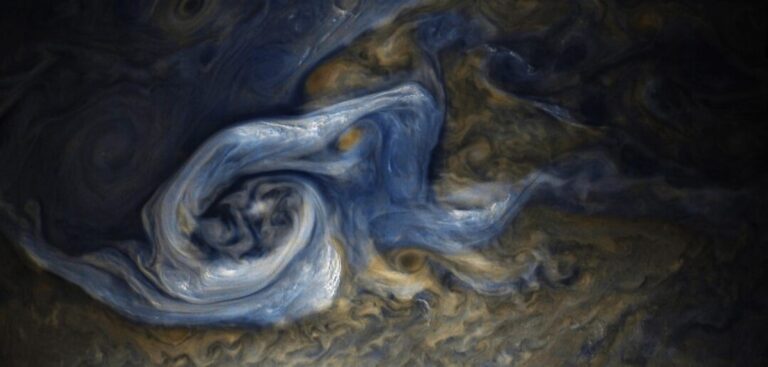
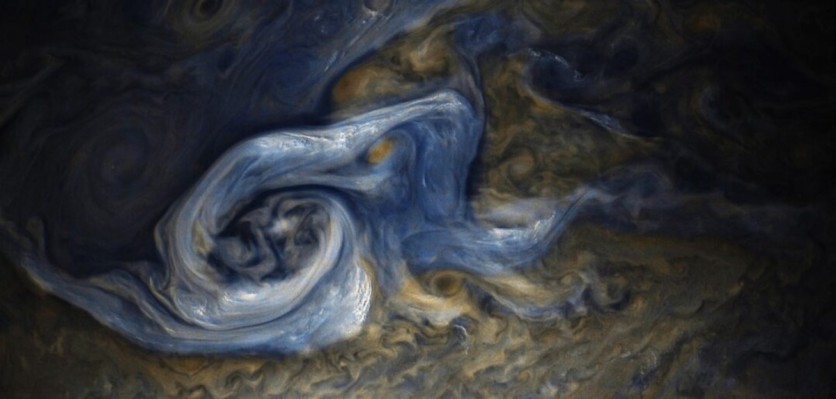
This enhanced-color image shows a storm in Jupiter’s northern hemisphere, as seen by the Juno spacecraft. Nasa.gov
A single temperature threshold — roughly 1,400 Kelvin (about 2,060°F) — now anchors where silicate and iron clouds must exist in brown dwarf atmospheres, and a second temperature, roughly 1,300 K (approximately 1,880°F), marks where those same physics predict a detectable statistical surplus of brown dwarfs in galaxy-wide population surveys. Planetary scientist Mark Marley laid out both numbers during his 2026 Kuiper Prize lecture at the 58th Annual Division for Planetary Sciences (DPS) meeting in Spokane, Washington — and the timing could not be more pointed: the observatories capable of testing the prediction are already collecting data or nearly ready to do so.
The lecture, titled “New Worlds — Legacy Processes,” was Marley’s formal acceptance of the DPS’s most prestigious research honor, awarded for his role as a founding architect of substellar atmospheric modeling. Marley, currently director of the Lunar and Planetary Laboratory at the University of Arizona and head of the Department of Planetary Sciences, organized the lecture around three physical processes first discovered in the solar system that turn out to govern the atmospheres of brown dwarfs — objects too massive to be planets but too small to sustain the hydrogen fusion that powers true stars.
What made the lecture notable beyond its career-retrospective format was the specific, falsifiable prediction it produced: a measurable pileup of brown dwarfs clustered near 1,300 K (1,880°F) in temperature surveys, derivable directly from first principles of atmospheric opacity. Upcoming wide-field infrared surveys — the Vera C. Rubin Observatory’s Legacy Survey of Space and Time (LSST) and the Nancy Grace Roman Space Telescope — along with the already-operating James Webb Space Telescope (JWST), are the three facilities positioned to confirm or revise that number.
Twenty-Five Years of Watching Brown Dwarfs Transform Between 1,400 K (2,060°F) and 1,300 K (1,880°F)
To understand why Marley’s 1,400 K (2,060°F) threshold matters, it helps to understand what has been puzzling atmospheric modelers since the first brown dwarfs were confirmed in 1995. Brown dwarfs cool continuously as they age, moving through a sequence of spectral classes: the warm, dusty L dwarfs (roughly 2,200 K to 1,300 K, or about 3,500°F to 1,880°F), the cooler methane-dominated T dwarfs (roughly 1,300 K to 500 K, or about 1,880°F to 440°F), and eventually the frigid Y dwarfs below that. The L-to-T transition — the pivot between these two very different-looking spectral populations — has been known since the early 2000s to be unusually abrupt.
What makes the transition so difficult to model is that the color and brightness changes happen faster, and in a narrower temperature window, than any smooth cloud-thinning scenario can easily reproduce. Late-L dwarfs are distinctly red in near-infrared light because thick clouds of condensed silicate minerals — forsterite, enstatite — and iron droplets blanket their photospheres. Early-T dwarfs are strikingly blue, and those clouds have largely vanished. In between lies what Marley described as one of the most consequential 100 K (180°F) temperature intervals in substellar atmospheric science.
One observational signature of this transition has been known for over a decade: some brown dwarfs in the late-L to early-T range vary in brightness by 10 to 26 percent in near-infrared wavelengths as they rotate. That variability is a sign of cloud patchiness — continent-scale clearings in an otherwise thick cloud deck, analogous to the bands, zones, and storms that stripe Jupiter’s disk. Marley’s patchy cloud model, developed with collaborators, invokes large-scale atmospheric circulation creating holes in a global silicate and iron cloud deck rather than a homogeneous thinning of a uniform layer.
Clouds Above 1,400 K (2,060°F), Clear Skies Below 1,300 K (1,880°F)
The specific contribution of Marley’s Kuiper Prize lecture was to sharpen an answer the literature had previously estimated across a range. Clouds were known to matter across the L-T transition, and various studies had placed the transition temperature somewhere between 1,100 K (about 1,520°F) and 1,400 K (2,060°F), depending on sample selection and model assumptions. Marley’s lecture moved the boundary to firmer ground.
Fits to observed spectra and photometry now reveal a clean boundary: brown dwarfs warmer than approximately 1,400 K (2,060°F) cannot be matched by cloudless atmospheric models. Remove the silicate and iron grain opacity from the simulations, and the modeled spectra diverge dramatically from what telescopes measure. Below approximately 1,300 K (1,880°F), the picture inverts: cloudless models begin to provide good fits, while fully cloudy models overshoot the observed near-infrared brightening and color shift that characterize early-T dwarfs. What happens in the 100 K (180°F) gap between those two temperatures is where the global dynamics operate — opening and closing cloud holes in a fashion that produces the rapid spectral transformation and the observed photometric variability.
How Does Brown Dwarf Cloud Clearing Slow Cooling and Create a Population Pileup?
This is the mechanistic question that connects Marley’s atmospheric finding to its population consequence, and the connection runs through a specific physical feedback loop.
A brown dwarf cools by radiating its interior heat outward. The rate at which its effective temperature falls depends on how much of that interior heat can escape through the atmosphere. That escape rate is controlled by atmospheric opacity: the more opaque the atmosphere, the more heat is bottled up, and the slower the effective temperature decreases.
When cloud clearing begins near 1,400 K (2,060°F), the opacity drops sharply. More interior heat escapes, causing a brief increase in the object’s luminosity. But by the Stefan-Boltzmann relation — which connects luminosity to effective temperature — an increase in outward radiation while the object’s radius stays roughly constant means the effective temperature stalls. The brown dwarf “lingers” in the temperature range where clearing is happening, spending more time there than it would if its atmosphere became uniformly less opaque at a steady rate. That lingering is the pileup: in any sufficiently large survey of brown dwarf effective temperatures, objects cluster near statistical surplus near 1,300 K because the opacity-luminosity feedback has slowed their passage through that temperature range.
This prediction has theoretical precedent. Saumon and Marley’s 2008 evolutionary models predicted a similar surplus of objects in this temperature range. A 2024 population demographics analysis found an observed excess of brown dwarfs in the 1,200–1,350 K (roughly 1,700°F–1,970°F) bin, attributable to the slowed cooling time in this region. Marley’s Kuiper Prize lecture sharpened the anchor: the cloud-required regime ends at approximately 1,400 K (2,060°F), the pileup lands near 1,300 K (1,880°F), and those numbers are now specific enough to serve as a survey science target.
Jupiter’s Chemistry, Fifty Light-Years Away: What Disequilibrium Carbon Monoxide Reveals
Marley organized the lecture around three processes the solar system revealed first and that substellar atmospheres amplify. The first was disequilibrium chemistry, and its story begins with carbon monoxide in Jupiter’s atmosphere.
Researchers discovered decades ago that Jupiter contains carbon monoxide at detectable levels — a molecule that thermodynamic equilibrium calculations predict should not exist there in any significant quantity. Temperatures at the observable depths of Jupiter’s atmosphere favor methane, not CO. The explanation is kinetic: vertical mixing carries CO upward from hot, deep layers faster than the chemical reactions that would convert it to methane can proceed. The convective mixing timescale beats the chemical timescale, and CO survives in the upper atmosphere as a tracer of how vigorously the interior circulates.
The same physics appears in Gliese 229B, the first unambiguously confirmed brown dwarf orbiting Gliese 229, discovered in 1995 when it was directly imaged orbiting the nearby star Gliese 229. It too harbors CO that equilibrium chemistry cannot explain at its temperatures. Mapping CO detections across many brown dwarfs as a function of effective temperature reveals a systematic pattern: the abundance of out-of-equilibrium chemical species traces how vigorously brown dwarf atmospheres mix vertically, and that mixing vigor changes systematically with temperature. Those changes in mixing depth are directly connected to cloud physics — vertical mixing is part of what determines whether cloud particles are lofted and maintained or allowed to settle below the photosphere.
Temperature Inversions: Brown Dwarf Atmospheric Science’s Open Question
The third process Marley raised in the lecture is the one with no solar system explanation adequate to the data: brown dwarfs appear to have temperature inversions in their upper atmospheres — layers where temperature increases with altitude rather than decreasing, the defining feature of Earth’s stratosphere.
On Earth, the stratosphere’s inversion is produced by ozone absorbing ultraviolet radiation from the Sun. On hot Jupiters orbiting extremely close to their host stars, temperature inversions have been attributed to upper-atmosphere absorbers such as gaseous titanium oxide, heated by intense stellar irradiation. Brown dwarfs, however, are isolated or nearly isolated from any nearby star. They receive negligible external radiation. Whatever is generating the apparent inversions must come from internal processes or some as-yet-unidentified heat source in the atmosphere itself — and no satisfactory candidate mechanism has been identified.
A student of Marley’s at the University of Arizona is currently investigating brown dwarf temperature inversions, making temperature inversions in brown dwarf atmospheres one of the cleaner open problems in substellar atmospheric physics that high-resolution spectroscopy instruments are now positioned to address.
Rubin, Roman, and JWST: Three Observatories Ready to Test the 1,300 K Prediction
The 1,300 K (1,880°F) pileup is not merely a theoretical curiosity. It is a prediction specific enough to test directly with the next generation of survey instruments, and the timing aligns with the start of their scientific operations.
The NSF-DOE Vera C. Rubin Observatory, whose Legacy Survey of Space and Time is already returning early science results — including, at this same DPS 58 meeting, the first confirmed trailing Neptune trojans — will detect brown dwarfs in large numbers across the solar neighborhood and beyond. The most recent volume-limited benchmark sample of L and T dwarfs extending to 25 parsecs (about 81.5 light-years) contained 369 confirmed members; the LSST’s scale and sensitivity will expand that by orders of magnitude. With sufficient statistics, the predicted surplus of brown dwarfs near 1,300 K (1,880°F) should become clearly visible as a bump in the effective-temperature distribution — and the width and sharpness of that bump will constrain how quickly cloud clearing happens and across how wide a temperature range.
The Nancy Grace Roman Space Telescope, with its wide infrared field of view, is similarly suited to conduct brown dwarf population surveys at depths and sky coverage that ground-based observatories cannot match. Marley’s involvement in pre-mission science cases for Roman, recognized in his Kuiper Prize citation for Roman, reflects the direct line between this atmospheric modeling work and the mission’s design priorities.
JWST, already operating, provides the spectroscopic resolution needed to measure effective temperatures directly from spectral fitting rather than photometric color estimates — a significant improvement at the L-T transition, where near-infrared color and effective temperature have a complex, non-monotonic relationship that makes photometry alone an unreliable thermometer. Together, the three facilities form a mutually reinforcing program: Rubin and Roman supply the population census; JWST anchors the temperature calibration. Marley’s 1,400 K (2,060°F) cloud threshold and 1,300 K (1,880°F) pileup prediction give survey planners specific targets against which the data will either confirm or revise the underlying atmospheric physics.
Mark Marley and the Sonora Models: Making Atmospheric Science Accessible
The 2026 Kuiper Prize, the DPS’s highest planetary science honor, placed Marley in the company of researchers who helped define modern planetary science. It was not his only major recognition in 2026: the Harvard-Smithsonian Center for Astrophysics awarded him the Lecar Prize in early 2026, recognizing his contributions to extrasolar planetary theory, with a formal prize lecture delivered in April.
Marley spent two decades at NASA Ames Research Center before joining the University of Arizona, where he directs the Lunar and Planetary Laboratory and leads the Department of Planetary Sciences. Among his most widely cited contributions are the Sonora atmospheric model grids for brown dwarf and exoplanet atmospheres — rigorously computed atmospheric models made publicly available, enabling researchers without deep modeling expertise to interpret their own spectroscopic and photometric observations. His involvement in designing science cases for the Roman Space Telescope and prior advisory roles for Astro2020 and the Planetary Science Decadal Survey positioned him at the intersection of community infrastructure planning and foundational theory at precisely the moment when wide-field infrared surveys and JWST began returning the data his models were built to interpret.
The Kuiper Prize lecture’s central theme — solar system processes extended to new worlds — also framed the DPS 58 meeting itself. Tad Komacek’s Urey Prize lecture, delivered at the same meeting, found that cloudless models cannot match WASP-43b’s phase curve, and that asymmetric cloud coverage on that planet’s nightside now requires coupled cloud-circulation-radiation models to explain. The same cloud-clearing physics Marley has traced in isolated brown dwarfs is showing up, in new forms, in the very different context of a giant planet orbiting six times closer to its star than Mercury orbits the Sun. Across the full spectral range of substellar objects — from hot Jupiters to Y dwarfs — clouds remain the single most uncertain element in atmospheric models, and Marley’s legacy is having built the scaffolding that is now collapsing that uncertainty into a testable number.
Frequently Asked Questions
What is a brown dwarf and how is it different from a star?
Brown dwarfs are substellar objects without hydrogen fusion with masses roughly between 13 and 80 times that of Jupiter. That range places them above the threshold for deuterium fusion but below the approximately 80-Jupiter-mass boundary where sustained hydrogen fusion — the process that powers main-sequence stars — becomes possible. Without hydrogen fusion, brown dwarfs cannot maintain stable luminosity; they cool and dim continuously from the moment of formation. Every brown dwarf’s effective temperature and spectral class is therefore a function of both its initial mass and its age, making them simultaneously harder to characterize and more physically information-rich than ordinary stars of the same brightness.
Why does atmospheric cloud clearing slow a brown dwarf’s cooling and create a population pileup at 1,300 K (1,880°F)?
The mechanism is an opacity-luminosity feedback loop. Brown dwarfs cool by radiating interior heat outward through their atmospheres, and the cooling rate depends on how much those atmospheres impede that heat flow. While thick silicate and iron clouds are present, the atmospheric opacity is high and heat escapes relatively slowly. When cloud clearing begins near 1,400 K (2,060°F), the opacity drops: less heat is retained and the object’s luminosity temporarily increases. The Stefan-Boltzmann relation connects luminosity to effective temperature — if luminosity rises while the object’s radius stays roughly constant, effective temperature stalls. The brown dwarf lingers in the 1,300–1,400 K (1,880–2,060°F) range longer than a simple gradual cooling model would predict, producing a statistical excess in population surveys right where the clearing is happening, as Saumon and Marley’s models predicted.
What will the Rubin Observatory’s Legacy Survey of Space and Time reveal about brown dwarf populations?
LSST will detect brown dwarfs in numbers vastly exceeding current catalogs. The most comprehensive recent benchmark sample of L and T dwarfs within 25 parsecs (about 81.5 light-years) of the Sun contained 369 confirmed objects; LSST’s scale and depth will expand that by orders of magnitude across much of the sky. With sufficient statistics, the predicted surplus of brown dwarfs near 1,300 K (1,880°F) should appear as a measurable bump in the effective-temperature distribution — and the shape of that bump will constrain how rapidly cloud clearing occurs across the 100 K (180°F) transition interval. That is a direct, falsifiable test of the atmospheric physics Marley’s models describe.
Are brown dwarfs’ silicate and iron clouds similar to Earth’s water clouds?
Not in composition, but the underlying condensation physics shares surprising parallels. Earth’s water clouds form when water vapor cools and condenses into liquid droplets or ice crystals. Brown dwarf clouds form the same way, but at temperatures so extreme that the condensing materials are silicate minerals — magnesium silicates such as forsterite (Mg₂SiO₄) and enstatite (MgSiO₃) — and liquid iron rather than water. In this sense, brown dwarf clouds are more analogous to Jupiter’s ammonia ice clouds than to Earth’s water clouds. And like Jupiter, the cloud structure in brown dwarf atmospheres appears to be organized by large-scale atmospheric circulation into bands, zones, and holes rather than being uniformly distributed — the same large-scale dynamics that produce the 10–26 percent photometric variability observed in the brown dwarfs straddling the L-T transition.