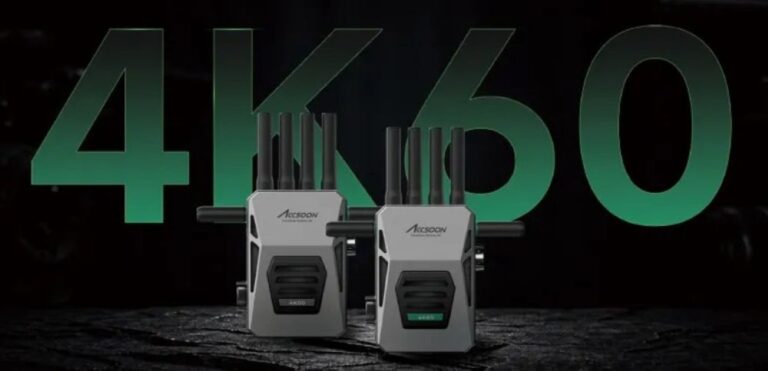
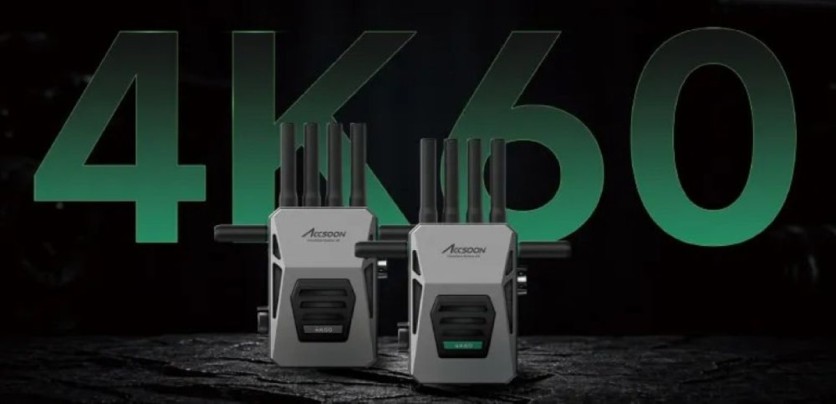
HomeAuto Accsoon CineView Master 4K II Adds DCI 4K Tri-Band; Real-World 4K60 Lag Is 77ms, Not 35ms
Accsoon CineView Master 4K II Adds DCI 4K Tri-Band; Real-World 4K60 Lag Is 77ms, Not 35ms
November 1, 2026:
Accsoon.com
Three days after Accsoon announced the CineView Master 4K II, the company’s second-generation flagship wireless video system has arrived with the upgrade cinema camera operators have been waiting for: native DCI 4K (4096 × 2160) transmission, ending the original system’s limitation to UHD (3840 × 2160) and making it the first wireless monitoring system under $900 to pass a cinema-native frame end-to-end without downconversion. The system also adds USB-C video output to the receiver unit, remote camera control through Accsoon’s SEE app, and bumps simultaneous monitoring to 10 devices — all for $899, a $50 premium over the original’s $849 launch price. Before buying in on those headline numbers, however, buyers should know two things: first, the independent hands-on review of the original CineView Master 4K documented real-world 4K60 latency of 77.66 milliseconds — more than twice the claimed
RTMS 4.0 Protocol: How Simultaneous Tri-Band Transmission Differs From Dual-Band Competing Products
The CineView Master 4K II uses Accsoon’s proprietary RTMS 4.0 (Radio Transmission Management System, version 4.0) protocol, which was introduced on the original CineView Master 4K in November 2024 and is unchanged in the Mark II. The protocol’s defining characteristic is simultaneous operation across all three major unlicensed Wi-Fi frequency bands: 2.4 GHz, 5 GHz, and 6 GHz — all active at the same time on both the transmitter and receiver.
This is not band steering (where a system selects one band to use) or sequential channel hopping. Both the TX and RX units are communicating across all three bands concurrently, with the audio and video data distributed intelligently across the available spectrum at any given moment. On a typical professional production set, 2.4 GHz and 5 GHz channels are heavily congested with tablets, smartphones, Wi-Fi hotspots, and production monitoring equipment. The 6 GHz band — which the FCC opened to unlicensed Wi-Fi use in April 2020 — was built with no legacy interference problem: virtually no non-Wi-Fi 6E devices transmit in the 6 GHz range. The result is an approximately 1,200 MHz-wide slice of spectrum that is effectively clear on most production sets, compared to the 5 GHz band’s roughly 700 MHz of available bandwidth, most of it shared with other crew devices.
The practical implication for set use: when a congested 2.4 or 5 GHz environment degrades signal quality, the 6 GHz portion of the RTMS 4.0 link continues carrying its assigned portion of the video stream, maintaining overall throughput. The system’s closest named competitor, the Hollyland Pyro Ultra uses no 6 GHz band. When both of those bands are congested simultaneously, the Pyro Ultra has no third frequency to fall back on.
The CineView Master 4K II’s H.265 (HEVC) encoding pipeline handles the compression and decompression on both ends. The onboard processor — described by Accsoon as “8K-capable” — compresses each video frame in real time at the transmitter; the receiver decodes it before outputting to an attached monitor. H.265 achieves 25 to 50 percent better compression at equivalent quality compared to H.264, which is what allows a Wi-Fi-based system to carry 4K60 video across an RF link in the first place — without HEVC efficiency, the bitrate requirements for 4K60 would exceed what the available unlicensed spectrum can reliably sustain.
What Is Actually New: DCI 4K, Receiver USB-C Output, and Camera Control
DCI 4K transmission. The single most significant technical change in the CineView Master 4K II relative to its predecessor is native support for DCI 4K resolution: 4096 × 2160 pixels, the 17:9 format established by Digital Cinema Initiatives for theatrical production. The original CineView Master 4K supported only UHD (3840 × 2160, the 16:9 consumer standard). Productions shooting on cinema cameras — including the Sony VENICE 2, Blackmagic PYXIS 12K, and ARRI systems operating in open-gate or DCI-native modes — capture a 4096-pixel-wide frame. Monitoring that signal over a wireless link that downconverts to 3840-wide introduces a scaling step that changes how the image appears in the video village and on AC carts: the horizontal crop means crew and directors are not seeing the exact frame the camera is capturing. The Mark II eliminates that step by transmitting the native 4096-wide signal end-to-end. The system supports both DCI 4K and UHD at up to 60 frames per second.
USB-C video output on the receiver. On the original CineView Master 4K, only the transmitter carried a USB-C video output — usable as a wired mobile monitoring connection at the camera position. The Mark II adds an identical USB-C output to the receiver unit. This means a production can maintain wired mobile monitoring at both ends of the wireless link simultaneously: one phone or tablet at the camera position connected to the transmitter, and a second device at the video village or on an AC’s cart connected to the receiver. Both USB-C connections also charge the connected device during monitoring.
10-device simultaneous monitoring. The monitoring count has increased to 10 devices per transmission link — up from the original system’s figure. For larger productions distributing the camera feed to a director, script supervisor, continuity photographer, production client, and multiple department heads, this provides meaningful headroom.
Camera control via the SEE app. With a supported camera connected to the transmitter’s dedicated USB-C camera-control port, operators running Accsoon’s SEE app on a mobile device connected to the transmitter’s Wi-Fi can control recording start/stop, touch-to-focus, ISO, aperture, white balance, and shutter speed without physically touching the camera. Camera control is not available through the receiver’s USB monitoring connection — the controlling device must connect directly to the transmitter. The practical structure is a camera-side workflow: a first AC or focus puller can make exposure adjustments from a phone at the transmitter while other crew at the video village receive monitoring feeds wirelessly. Supported camera models are listed on Accsoon’s camera control compatibility page; current support spans select Sony and Canon mirrorless bodies.
Camera control is not new to the CineView product family — Accsoon introduced it in the more affordable CineView SE 4K (announced in February 2026 at $499) and later added it to the CineView M7 Pro monitor-receiver via firmware update. The CineView Master 4K II is the first time the feature has appeared at the top of the professional range, in a system with SDI connectivity and multi-kilometer rated range.
Claimed Latency and Range vs. What Published Testing Documented
The CineView Master 4K II inherits the same claimed performance specifications as the original: transmission latency below 35 milliseconds at 4K60 and below 25 milliseconds at 1080p60, with a maximum rated range of 2.5 km (1.55 miles). Both figures come with explicit measurement conditions that the product announcement documents: the latency figures were measured at low bitrate and exclude any delay in the camera’s own output pipeline; the range figure was measured under line-of-sight, interference-free conditions at 1080p60.
The independent hands-on review of the original CineView Master 4K, conducted by Newsshooter’s Matthew Allard ACS in November 2024, documented real-world 4K60 latency of 77.66 milliseconds — approximately 2.2 times the claimed
The mechanism behind this gap is a characteristic of H.265 encoding. The standard allows encoders to trade encoding delay against each other in terms of computational complexity, compression efficiency, and error robustness. At low bitrate — the condition used to establish the claimed figures — the encoder operates in a faster, less compute-intensive mode that produces lower encoding delay. At the higher bitrates typical of production monitoring (where image quality matters and compression artifacts are unacceptable), the encoder applies more processing to each frame, increasing the time between when a frame is captured at the camera and when it appears on a downstream monitor. The
On range: the same review documented real-world performance of approximately 400 meters (0.25 miles) in a Tokyo urban environment — roughly one-sixth of the 2.5 km (1.55 miles) rated ceiling. That figure is consistent with what any radio link produces when operating in an environment with multipath interference, competing RF devices, and non-line-of-sight conditions. The 2.5 km specification accurately describes what the system can achieve under the best possible conditions; it does not describe what most productions will experience.
These limitations matter for the purchasing decision, but they do not disqualify the system. A 77 ms lag at 4K60 is approximately 4.7 frames at 60 fps — workable for general video-village monitoring by directors and script supervisors, where the visual check and not critical focus evaluation is the primary use case. It is less suitable for focus pullers who rely on wireless monitoring for precise rack focus work. Productions requiring sub-20 ms latency for critical applications will need to evaluate dedicated RF systems (including Teradek Bolt 6, which operates in 6 GHz at a substantially higher price point) or wired monitoring solutions for the critical position.
Frame.io Camera to Cloud and Ecosystem Compatibility
The CineView Master 4K II supports Frame.io Camera to Cloud integration through a compatible mobile workflow connected to the transmitter’s USB-C port — the same pathway supported by the original CineView Master 4K. The workflow routes lightweight H.265 proxy files from the camera to Frame.io’s servers in real time, enabling remote creative review and approval without a dedicated media ingest station on set. This integration is inherited functionality, not a new addition in the Mark II.
The system is backward-compatible with the existing Accsoon CineView ecosystem: the Mark II TX and RX pair with the CineView Master 4K, CineView Master 4K Lite, CineView SE 4K, CineView M7 Pro, and CineView M7H Pro. Productions with existing Accsoon gear can integrate the new hardware without replacing the full kit.
What China’s Intelligence Laws Mean for Buyers of Accsoon Devices
Accsoon (深圳市英讯科技有限公司, Shenzhen Accsoon Technology Co., Ltd.) is a Chinese technology company headquartered in Shenzhen, Guangdong Province. This is a fixed legal condition with concrete consequences for buyers, independent of the company’s stated privacy practices.
What the law requires. Three Chinese statutes apply to Accsoon as a PRC-registered company:
China’s National Intelligence Law (2017), Article 7, states: “Any organization and citizen shall, in accordance with the law, support, assist, and cooperate with national intelligence efforts.” This obligation applies to all Chinese organizations — including technology companies — regardless of where their products are sold, where their servers are located, or what their published privacy policy states.
China’s Cybersecurity Law (2017) requires network operators to provide “technical support and assistance” to security and intelligence agencies, and establishes data localization requirements for certain categories of data.
China’s Data Security Law (2021) regulates data processing activities and establishes government access rights to data classified as “important.”
What data the CineView Master 4K II collects. The hardware itself — the TX and RX units — functions as a local RF link. In standard wireless monitoring use, it does not send video or audio data to Accsoon’s servers or to the internet. This distinguishes the CineView Master 4K II from internet-connected devices (smart home hardware, cloud cameras) where the data pipeline more directly involves the manufacturer.
However, three points of potential data contact exist:
The Accsoon SEE App (required for camera control functionality) is a smartphone application developed and distributed by Accsoon. App-based data collection — device identifiers, usage patterns, network information — is governed by Accsoon’s app privacy policy, which buyers should independently review before installing.
Firmware updates for the device are distributed by Accsoon’s servers. Productions with security requirements should evaluate whether firmware update access should be restricted during sensitive shoots.
Frame.io Camera to Cloud integration, when used, routes proxy video to Adobe’s servers (US-based infrastructure), not to Accsoon’s — this integration does not add to Accsoon’s data exposure.
What has and has not been documented. No published independent security audit of Accsoon wireless video products has been found. No US government advisory, FCC Covered List entry, or export control action specifically targeting Accsoon has been identified as of October 31, 2026. Accsoon is not in the same regulatory category as Hikvision or Dahua, which face US government bans for their surveillance infrastructure roles. The risk for the CineView Master 4K II is structural — rooted in the Chinese legal framework — rather than incident-based.
Practical mitigations for sensitive productions. Buyers with security requirements should consider: keeping the device on an isolated RF environment during shoots involving sensitive content; reviewing SEE App permissions and data collection disclosures before installing; restricting firmware auto-updates during secure productions; and consulting a production security officer if the content being transmitted has national security or competitive sensitivity.
This disclosure is not a recommendation against the product. It is information the legal framework requires buyers to have.
Does It Clear the Bar Against Hollyland Pyro Ultra? A Dimension-by-Dimension Look
Performance and feature comparison. The Hollyland Pyro Ultra, priced at $1,199 for a 1TX+1RX kit, offers HDMI and 3G-SDI connectivity at 4K60 with H.265 encoding over a dual-band 2.4 and 5 GHz link. The Pyro Ultra does not operate in the 6 GHz band and does not offer the RF diversity that RTMS 4.0’s tri-band simultaneous operation provides. At $1,199 vs. $899, the $300 premium buys a different product from a company (Hollyland Technology, also headquartered in Shenzhen and subject to Chinese state law) without the 6 GHz band advantage. Buyers should apply the same state-law analysis to Hollyland as to Accsoon.
Benchmark reliability and independent verification. Accsoon’s claimed
Ecosystem and operational maturity. The CineView Master 4K II is available through B&H Photo; no US ship date was confirmed at announcement. The Hollyland Pyro Ultra launched in April 2026 and has established retail availability. On ecosystem depth: Accsoon’s lineup of companion monitors (CineView M7 Pro, M7H Pro) and the backward-compatible CineView ecosystem give the Master 4K II an integration advantage for productions already using Accsoon gear.
Price decision context. At $899, the CineView Master 4K II is the only wireless monitoring system at this price point with tri-band (2.4+5+6 GHz) simultaneous operation and DCI 4K support. For productions working in congested RF environments and shooting cinema-native formats, those two features represent genuine operational advantages over what competing products offer at a comparable cost.
Pricing, Physical Specs, and Availability
The CineView Master 4K II transmitter-and-receiver kit is priced at $899. Battery adapters for V-Mount and Gold-Mount connections are sold separately. The transmitter weighs 322 g (11.4 oz) and the receiver 320 g (11.3 oz), both measured without antennas, at dimensions of 130 × 95 × 32 mm (5.1 × 3.7 × 1.3 in). Both units accept NP-F (L-Series) batteries and DC power from 7.4 to 16.8 V. Selectable fan speeds allow users to balance thermal performance against acoustic noise, a practical option for interview setups or quiet sets. The transmitter carries one HDMI 2.0 input, one HDMI 2.0 loop output, one BNC 3G-SDI input, and one USB-C output. The receiver offers one HDMI 2.0 output, one BNC 3G-SDI output, and the newly added USB-C video output.
No US ship date or regional pricing has been confirmed as of the announcement. US availability through major retailers was not confirmed at announcement time.
Key Specifications: Accsoon CineView Master 4K II
Parameter
Specification
Protocol
Accsoon RTMS 4.0 (proprietary)
Frequency Bands
2.4 GHz + 5 GHz + 6 GHz (simultaneous)
Video Formats
DCI 4K (4096 × 2160) and UHD (3840 × 2160) up to 60 fps
Encoding
H.265 (HEVC)
Latency (claimed)
Latency (measured, 4K60)
77.66 ms (Newsshooter hands-on, original CineView Master 4K, Nov 2024)
Max Range (rated)
2.5 km / 1.55 miles (line-of-sight, interference-free, 1080p60)
Simultaneous Devices
Up to 10
TX Inputs
HDMI 2.0, 3G-SDI (BNC)
TX Outputs
HDMI 2.0 (loop), USB-C video
RX Outputs
HDMI 2.0, 3G-SDI (BNC), USB-C video (new in Mark II)
Camera Control
Via Accsoon SEE App over Wi-Fi (select Sony and Canon bodies)
Power
NP-F / L-Series battery, DC 7.4–16.8 V
TX Weight
322 g (11.4 oz), excl. antennas
RX Weight
320 g (11.3 oz), excl. antennas
Dimensions (TX/RX)
130 × 95 × 32 mm (5.1 × 3.7 × 1.3 in)
Manufacturer HQ
Shenzhen, Guangdong, China
Price
$899 USD (TX + RX kit)
Frequently Asked Questions
What is the difference between DCI 4K and UHD 4K, and why does it matter for wireless monitoring?
DCI 4K is 4096 × 2160 pixels — the 17:9 cinema-native resolution established by Digital Cinema Initiatives for theatrical acquisition. UHD 4K is 3840 × 2160 pixels, the 16:9 consumer standard used in broadcast and streaming. Many professional cinema cameras — including the Sony VENICE 2, Blackmagic PYXIS 12K, and ARRI open-gate modes — output DCI 4K natively. When a wireless video system supports only UHD, it must downscale or crop the 4096-wide frame to fit, which changes what crew and directors see in the video village relative to the actual image the camera is capturing. The CineView Master 4K II transmits the native 4096-wide DCI frame end-to-end, eliminating that discrepancy. For productions shooting standard 16:9 UHD cameras, the DCI 4K capability offers no practical benefit.
How much latency should I actually expect from the CineView Master 4K II at 4K60 on a production?
Accsoon claims encoding delay scales with bitrate: at low bitrate, the encoder processes each frame faster; at higher bitrates typical of production-quality monitoring, encoding takes longer, increasing the total delay. Buyers evaluating this system for focus pulling or any workflow requiring sub-40 ms monitoring should test the system at their intended working bitrate before committing.
Is Accsoon a Chinese company, and what does that mean for the data security of the hardware I buy?
Accsoon is headquartered in Shenzhen, China, and is registered under Chinese law. China’s National Intelligence Law (2017), Article 7, requires all Chinese organizations to support and cooperate with state intelligence efforts on demand. This obligation applies to Accsoon regardless of where its products are used or what its privacy policy states. The hardware itself — the TX and RX units — functions as a local RF link and does not send video data to Accsoon’s servers during normal wireless monitoring use. The Accsoon SEE App (required for camera control) and firmware update pathways are the two points where data contact with Accsoon infrastructure is most likely to occur. No government ban or documented security incident specific to Accsoon’s wireless video products has been identified, but the structural legal framework is a fixed condition of purchasing Chinese-manufactured electronics that buyers in sensitive production environments should understand.
How does the Accsoon CineView Master 4K II compare to the Hollyland Pyro Ultra?
The key differentiators: the Accsoon operates in 6 GHz alongside 2.4 and 5 GHz simultaneously (tri-band); the Hollyland Pyro Ultra is limited to 2.4 and 5 GHz (dual-band). On congested sets where both 2.4 and 5 GHz bands are busy, the Accsoon has a 6 GHz fallback the Pyro Ultra lacks. The Accsoon supports DCI 4K transmission; the Pyro Ultra’s supported formats should be independently verified for your workflow. The Accsoon is priced at $899; the Pyro Ultra at $1,199 for a comparable 1TX+1RX kit. Both companies are headquartered in China, so the state intelligence law obligation applies to both. Buyers should seek independent real-world latency testing for both systems at their intended working resolution and bitrate before purchasing.