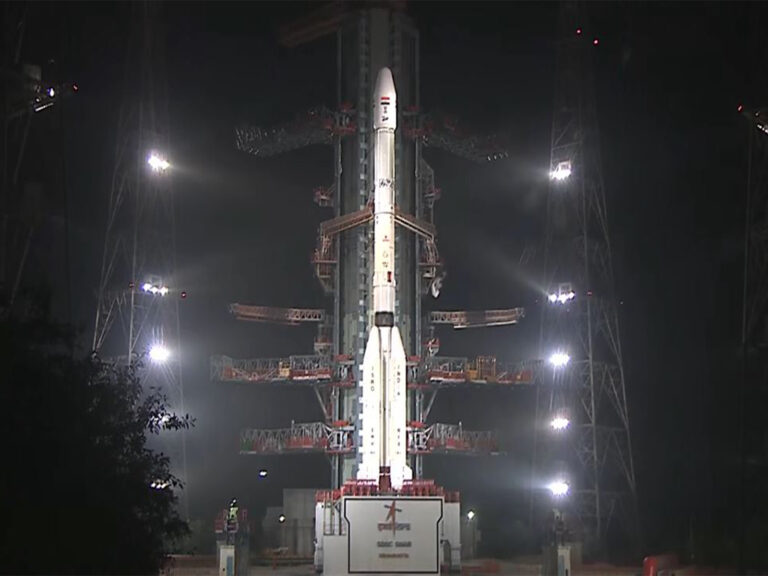
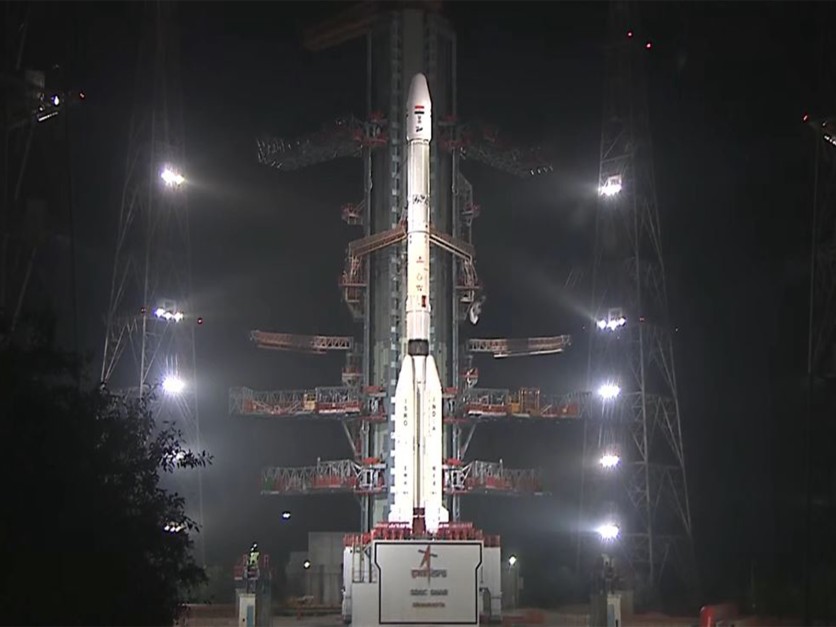
India placed a third homegrown atomic clock into orbit on Thursday night when its GSLV-F18 rocket successfully delivered the NVS-03 navigation satellite to its intended transfer orbit, restoring the country’s NavIC positioning system to a functional four-satellite constellation after seven months of operating below its minimum threshold. India delivered NVS-03 to transfer orbit alongside a milestone as much about manufacturing as launch: India now has three independently developed rubidium frequency standards — the precision timekeeping devices that make satellite navigation work — operating in space, proving that a capability once held exclusively by a handful of foreign suppliers can be produced domestically. ISRO’s announcement confirmed India built three orbital atomic clocks for the first time.
ISRO Chairman confirmed orbit injection to gathered engineers at Sriharikota in the early hours of Friday morning. “NVS-03 was precisely injected into its intended elliptical orbit by the GSLV-F18 rocket,” Narayanan said, adding that NavIC had now been restored to its minimum operational configuration of four satellites. Prime Minister Narendra Modi offered congratulations on X: “This mission marks an important step in strengthening NavIC, our indigenous satellite navigation system. Equipped with enhanced capabilities, NVS-03 will further our pursuit of self-reliance in critical technologies and support navigation services that benefit our people.”
The Clock Crisis NavIC Could Not Afford to Repeat
To understand why Thursday’s launch carried as much weight as it did, it helps to understand what a satellite navigation system’s atomic clocks actually do — and what happens when they stop.
Every navigation satellite broadcasts a precisely timestamped radio signal. A receiver on the ground compares the arrival time of signals from at least four satellites simultaneously and calculates its position by triangulating the tiny time differences. The math is simple; the precision is not. A timing error of just one nanosecond introduces roughly 30 centimeters (12 inches) of position error. Onboard atomic clocks — which use rubidium-87 atoms as frequency reference at 6.834 GHz as an unwavering physical reference — keep that timing accurate to within nanoseconds over months in orbit.
India’s first-generation IRNSS satellites carried rubidium clocks procured from SpectraTime, a Swiss manufacturer now owned by Safran. The relationship did not hold. By 2017, all three IRNSS-1A clocks failed, effectively removing that satellite from service. By May 2018, nine of the 24 imported clocks stopped working across the constellation — a failure rate that prompted serious scrutiny of the supply relationship. SpectraTime’s hardware faced similar scrutiny in Europe around the same period, when Galileo satellites also reported rubidium failures in the same period.
The crisis reached its most recent low point on March 13, 2026, when IRNSS-1F’s final atomic clock stopped — one of the older nodes in the network that had already completed its designed operational lifespan. With IRNSS-1F sidelined, NavIC dropped to just three fully operational satellites: IRNSS-1B, IRNSS-1I, and the newer NVS-01. Three is one below the four-satellite minimum required for reliable positioning.
The situation had already been complicated by the loss of NVS-02 in January 2025. ISRO’s GSLV-F15 mission successfully launched NVS-02, but NVS-02 was stranded by oxidizer valve malfunction after separation. Without the ability to raise its orbit, NVS-02 was declared a loss. That failure put the full weight of NavIC’s recovery on NVS-03.
How India Built Its Own Atomic Clock — and Why That Matters
The iRAFS — India’s Indigenous Rubidium Atomic Frequency Standard — was developed at the Space Applications Centre (SAC) in Ahmedabad, led by Dr. Thejesh N Bandi and the SAC precision frequency team. India’s indigenous atomic frequency standard represents a compact rubidium oscillator built from the ground up, optimized for the mass and power constraints of the NVS satellite bus while meeting the Allan deviation specifications that navigation accuracy demands. Rather than modifying an existing design, the SAC team engineered a new solution.
The first iRAFS flew on NVS-01 in 2023 and performed to expectations through its first years in orbit, providing early confirmation that the domestic design was ready for operational service. NVS-03 carries the third such unit — and Narayanan’s post-flight remarks made clear that this accumulation is itself the goal.
The shift matters beyond NavIC’s immediate operational needs. Narayanan has publicly framed ISRO’s broader trajectory around what he describes as the “Viksit Bharat 2047” goal: the complete elimination of imported space components in India’s critical national infrastructure by India’s 100th year of independence. An atomic clock that India designs, validates, and manufactures domestically is not just a navigation fix. It is flight-proven expertise in quantum-precision metrology — the engineering discipline that produces atomic frequency standards — that can eventually serve telecommunications timing infrastructure, financial network synchronization that depends on nanosecond-accurate time stamps, and military positioning and timing systems that cannot risk reliance on a foreign-controlled supplier.
India joins a short list of nations that have flight-validated domestically produced rubidium atomic standards in navigation-class satellites. That list previously included the United States, Russia, European nations through Galileo, and China through BeiDou. Adding India to it has implications not only for NavIC but for India’s standing as a producer of precision space hardware.
In addition to the indigenous iRAFS, NVS-03 also carries procured atomic clocks as a bridge measure — ISRO’s acknowledgment that the program cannot yet depend solely on domestic production and that redundancy requires maintaining access to proven foreign hardware while the iRAFS track record matures.
The Pyro Valve Fix That Kept NVS-03 From Repeating NVS-02’s Fate
The engineering lesson from NVS-02’s January 2025 failure was specific and actionable. ISRO’s pyro valve failure analysis identified a connector fault in the command path for the oxidizer pyrotechnic valve — the mechanism that opens propellant flow to the satellite’s apogee motor — which failed to transmit the “fire” signal. The valve never opened, the motor never fired, and the satellite could not raise itself from the parking orbit.
ISRO’s corrective design for NVS-03 addressed the command path by eliminating the in-flight command entirely. The pyrotechnic valves were pre-opened during satellite integration on the ground — fired before the rocket ever left the launch pad. This makes the valve state fixed and permanent rather than dependent on an electrical command surviving launch vibration and the vacuum of space. The trade-off is that the valve cannot be reversed, but for a satellite that needs its propellant flow opened exactly once, that is not a trade-off at all.
This kind of targeted, traceable engineering correction — identify the specific failure mode, eliminate the mechanism that produced it — is the type of iterative improvement that distinguishes a maturing launch program from one still learning from first-principles failures.
NVS-03’s L1 Signal Opens NavIC to Your Smartphone
The first generation of IRNSS satellites transmitted navigation signals in two bands: L5 (1176.45 MHz) and the S-band (2492.028 MHz, a higher frequency used for India’s restricted service). L5 is used in aviation and some dedicated receivers, but it is not the primary frequency built into the GNSS chipsets that power most consumer smartphones.
NVS-03 — like its NVS-series predecessors — adds L1 transmission. L1 (approximately 1575 MHz) is the primary frequency used by GPS, Galileo, and BeiDou. It is the frequency that Qualcomm Snapdragon chipsets support NavIC L1, MediaTek, and the chipsets in the vast majority of consumer Android devices are designed to receive. With L1 support, NavIC-capable chipsets can integrate NavIC signals alongside GPS and other global systems in a single receiver solution — without requiring separate dedicated hardware.
This is the technical prerequisite for putting NavIC into the hands of India’s roughly 800 million smartphone users. But the L1 signal alone is not sufficient: chipmakers and device manufacturers certify their products against navigation systems only when a constellation is sufficiently complete and stable to guarantee coverage. A four-satellite constellation, while operationally functional, is not yet that. NVS-04 and NVS-05 — the next planned NVS launches — are needed before NavIC can deliver the coverage continuity that consumer-device integration requires.
As of August 27, 2026, NavIC’s role in India has also acquired a statutory dimension. The Legal Metrology IST Rules 2026, notified on that date under the “One Nation, One Time” initiative, designate NavIC as an approved source for Indian Standard Time dissemination across the country. NavIC is no longer merely an alternative navigation option; it is now a legally designated component of India’s national time infrastructure.
GSLV’s 56-Day Turnaround: A Maturing Launch Cadence
The GSLV-F18 mission completed India’s 20th GSLV mission — a rocket with a history almost as eventful as the navigation program it has now helped rescue. Early GSLV missions suffered from repeated cryogenic upper-stage failures during the 2000s, forcing ISRO to develop its own CE-7.5 cryogenic engine after Western suppliers declined to transfer the technology in the 1990s under export control pressure. The GSLV’s rehabilitation began with its first fully successful cryogenic mission in 2014 and has continued since.
Narayanan noted a specific operational milestone alongside Thursday’s orbital success: the interval between GSLV-F17, which launched EOS-05 on September 3, and GSLV-F18 on October 30 was just 56 days. He described it as GSLV’s shortest-ever launch pad turnaround in program history.
A 56-day launch-pad turnaround is not unusual by international commercial launch-industry standards, but it marks a meaningful shift for a program that spent much of its early years recovering from failures and rebuilding vehicles. For India’s ambitions to fill out the NavIC constellation and pursue future planetary missions, the ability to recycle and reuse Second Launch Pad infrastructure at this cadence matters as much as any single mission outcome.
NVS-03 was the third ISRO mission in 2026, following PSLV-C62 and GSLV-F17.
From Kargil to Orbit: India’s Navigation Sovereignty in Context
NavIC’s origins are strategic rather than commercial. During the 1999 Kargil conflict, US denied India GPS positioning data for military targeting — a refusal that exposed, in real time, the risks of depending on another nation’s space infrastructure during a crisis. India’s response was to begin planning an independent regional navigation system, initially called the Indian Regional Navigation Satellite System (IRNSS) and later rebranded as NavIC: Navigation with Indian Constellation.
The strategic logic has only grown more applicable since 1999. Satellite navigation has expanded from a military precision-guidance tool into a civilian and commercial foundation: logistics, ride-sharing, precision agriculture, maritime positioning, disaster-response coordination, and an expanding array of fintech and mobility services all run on reliable positioning and timing. A functioning NavIC gives India the option to route these civilian services through a signal its own government controls, rather than one controlled and potentially managed by a foreign power under conditions India does not set.
India’s seven-satellite regional system is designed to provide coverage across the Indian subcontinent and approximately 1,500 km (932 miles) beyond its borders, serving both a civilian service and an encrypted restricted service for military and strategic users. With four satellites now operational — IRNSS-1B, IRNSS-1I, NVS-01, and the newly arrived NVS-03 — that architecture is back above its minimum functional threshold. But Narayanan was clear that four satellites represent a floor, not a ceiling. “For that, seven satellites are supposed to be in orbit,” he said, describing the full constellation requirement. Three more are needed.
The indigenous atomic clock, in particular, embodies what navigation sovereignty actually requires at the component level. A system built around imported frequency standards is only as independent as the supplier relationships that sustain it. Three flight-proven iRAFS units in orbit, and an ISRO team capable of building more, mean that NavIC’s most critical hardware dependency has been addressed at its root.
How Many Satellites Does NavIC Still Need?
With NVS-03 in orbit, NavIC stands at four of its seven planned operational satellites. ISRO’s roadmap calls for NVS-04 and NVS-05 to follow in the coming years, and the pace of those missions — and the performance of the launch vehicles that carry them — will determine how quickly the constellation reaches full operational capability.
The significance of reaching full complement goes beyond coverage. Chipmakers’ decisions about which navigation systems to support in mass-market devices are driven by constellation reliability. A seven-satellite NavIC constellation with multiple redundant satellites would make failure of any single satellite a manageable contingency rather than a crisis. The atomic clock track record — three indigenous units now operational, a growing body of performance data — adds a further layer of confidence that the program has addressed its most persistent historical vulnerability.
India’s navigation ambitions are now within reach of the infrastructure they require. The question is no longer whether India can build the technology. It can. The question is the pace at which NVS-04 and NVS-05 follow NVS-03 into orbit — and whether ISRO’s 56-day GSLV cadence can sustain the momentum Thursday’s launch has restored.
Frequently Asked Questions
What is an atomic clock, and why does a navigation satellite need one?
An atomic clock uses the vibration frequency of atoms — in NavIC’s indigenous clocks, rubidium-87 atoms as frequency reference oscillating at 6.834 GHz — as an unwavering physical reference to keep time. Satellite navigation works by measuring the travel time of radio signals from multiple satellites to a receiver on the ground. Because those signals travel at the speed of light, a timing error of just one nanosecond produces roughly 30 centimeters (12 inches) of position error. Onboard atomic clocks keep each satellite’s time accurate to within nanoseconds over months — something a conventional quartz clock cannot do. When NavIC lost several first-generation satellites to imported clock failures between 2016 and 2018, it was the clock hardware, not the satellite bus or the rocket, that proved to be the system’s critical vulnerability. The iRAFS program was ISRO’s answer to that vulnerability. The record of all three IRNSS-1A clocks failing demonstrates how critical this hardware is to the system’s reliability.
When will NavIC signals appear on consumer smartphones?
The technical prerequisite — an L1-band signal compatible with mass-market chipsets — is present on NVS-series satellites including NVS-03. Qualcomm Snapdragon chipsets support NavIC L1 band. But chipmakers and device manufacturers certify products against a navigation system only when the constellation is large and stable enough to guarantee coverage. With four of seven planned NavIC satellites now operational, the constellation is functional but not yet complete. NVS-04 and NVS-05 launches — planned for the coming years — are needed before NavIC reaches the coverage density that would prompt large-scale consumer-device certification. A reasonable expectation is that widespread NavIC integration in consumer handsets follows the completion of those next two satellites.
Why did India develop its own navigation system instead of using GPS?
During the 1999 Kargil conflict with Pakistan, the US denied India GPS positioning data it needed for military targeting operations. That refusal made clear to Indian strategic planners that dependence on another nation’s navigation infrastructure was a structural vulnerability: the service could be denied, degraded, or withdrawn at a foreign government’s discretion, including at the moment it was most needed. India began developing NavIC — initially called IRNSS — as a direct response. The underlying logic applies with equal force today to civilian services: logistics, agriculture, maritime operations, and financial time-stamping that run on GPS are running on signals controlled by the US Department of Defense. NavIC gives India the option to run those services on signals its own government controls.
What does India’s homegrown atomic clock mean beyond NavIC?
The iRAFS is a flight-validated rubidium atomic frequency standard — a category of precision hardware in demand globally for telecommunications network timing, financial exchange time-stamping, military positioning infrastructure, and scientific instrumentation. India previously had no domestically produced flight-proven unit in this class. With three iRAFS units now operating in orbit and a development team at SAC Ahmedabad that has proven the capability, India has joined a small group of nations — the US, Russia, European Union, and China — that can produce satellite-grade atomic standards domestically. Whether ISRO licenses this technology for commercial or military applications beyond NavIC, or uses it as a foundation for future quantum-sensing satellite payloads, is a question ISRO’s leadership has not yet answered publicly — but India’s indigenous atomic frequency standard capability now exists.