Dark Carbon Fingerprints Pluto-Scale Wreck in Beta Pictoris Cat’s Tail

October 30, 2026:

Dark Carbon Fingerprints Pluto-Scale Wreck in Beta Pictoris Cat’s Tail
debris disk which includes comets asteroids rocks
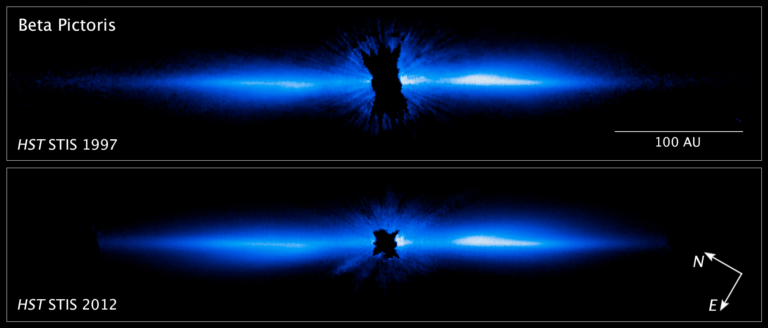
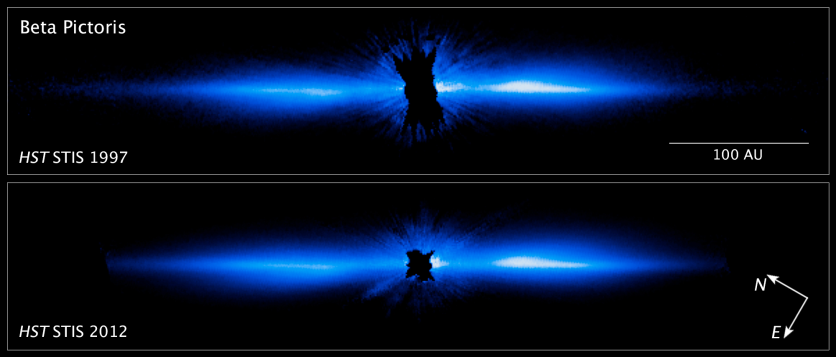
A debris disk, which includes comets, asteroids, rocks of various sizes, and plenty of dust, orbits the star Beta Pictoris, which is blocked at the center of this 2012 image by a coronagraph aboard the Hubble Space Telescope. This is the visible-light view of the system. NASA’s James Webb Space Telescope will view Beta Pictoris in infrared light, both using its coronagraphs and capturing data known as spectra to allow researchers to learn significantly more about the gas and dust in the debris disk, which includes lots of smaller bodies like exocomets.
Nasa.gov

A curved plume of dust jutting out from the Beta Pictoris debris disk — named the Cat’s Tail after its sinuous shape — is composed almost entirely of dark organic carbon, the same material found in the most primitive bodies of our own solar system. A new study combining six epochs of Hubble Space Telescope coronagraphic imaging with James Webb Space Telescope mid-infrared data has pinned the Cat’s Tail’s grain composition at roughly 96 percent organic refractory material, pointing to a violent collision between two worlds at least as large as Pluto that occurred approximately a century ago.

The result — published to arXiv by Avsar and collaborators and accepted by The Astrophysical Journal Letters — closes a gap left open since JWST first captured Cat’s Tail in 2024: knowing what the tail’s dust is actually made of. The answer now appears to be carbonaceous rubble from the shattered interiors of Kuiper Belt-class objects, still spreading through the disk long after the collision itself.

Beta Pictoris: A Young System With a Violent Resume

Beta Pictoris sits roughly 63 light-years away in the southern constellation Pictor and has attracted sustained scientific attention ever since its disk was imaged in 1984 by Bradford Smith and Richard Terrile — the first time any extrasolar debris disk had been photographed directly. The star is only about 20 million years old, placing it deep in the epoch of active planetary formation, and it already hosts at least two confirmed giant planets (Beta Pictoris b and c) and, following a separate study published in 2026, a third candidate world designated Beta Pictoris d at around 2.4 Jupiter masses.

All of that architecture makes the system a natural laboratory for studying what debris disks do when planets are young and collisions are common. The Cat’s Tail itself — an asymmetric, curved extension of the disk first confirmed by JWST MIRI coronagraphy that could resolve fine disk structure — appears to be one direct product of that still-violent environment.

How Hubble Finally Saw the Tail — Barely

Detecting the Cat’s Tail in optical light was not straightforward. The feature is intrinsically faint and sits close to the bright inner disk, making it easy for scattered starlight to wash out. The Avsar 2026 team worked around this by using Hubble’s STIS coronagraph handbook occulting bars — in particular the 10-arcsecond and 5-arcsecond apertures of the 50CORON mode — to suppress the central star across six observing epochs between 2012 and 2025.

After applying angular differential imaging and KLIP point-spread function subtraction to the combined data set, the team recovered the Cat’s Tail as a coherent structure extending to roughly 500 AU from the star. That detection alone was significant: the feature had never been seen in scattered optical light before. But more scientifically valuable was the ratio between that Hubble brightness and JWST MIRI’s F1550C mid-infrared measurement of the same structure.

The STIS-to-MIRI flux ratio — coming in between 0.1 and 0.4 percent — is the diagnostic at the heart of the new study. “We were really pushing the limits of what Hubble can do,” one co-author noted. The extreme faintness in scattered visible light relative to mid-infrared emission is a chemical signature: it rules out bright silicate grains and points directly toward dark, absorbing carbon compounds.

What the STIS-to-MIRI Ratio Reveals About Grain Chemistry

To translate the flux ratio into grain composition, the team ran Mie scattering calculations on particle populations drawn from the Bruggeman effective-medium mixing rule — a standard framework for modeling how light interacts with porous particles made of mixed materials — and fit the results to the data using a Markov Chain Monte Carlo algorithm (emcee, 32 walkers, 10,000 steps, 1,000 burn-in steps for each model run).

The posterior distributions from those fits converged on a consistent answer. The grain chemistry recovered by the MCMC fits places organic refractory material at between 85 and 99 percent of grain volume, with a median around 96 percent. Grain porosity runs from 0.55 to 0.93, consistent with loosely packed aggregates rather than dense rocky fragments. The models also favor particles in the micron-to-millimeter size range — small enough to be pushed outward by radiation pressure, which would naturally explain the Cat’s Tail’s curved, swept-back geometry.

“Honestly, this is one of the most extreme compositions we’ve ever fit to a debris disk feature,” commented the lead author in remarks to MEDIA INAF. The result places the Cat’s Tail’s dust in the same compositional family as the darkest primitive asteroids in our own system and the reddish outer Kuiper Belt objects measured by telescopes and returned-sample missions.

Dark Carbon: The Signature of Destroyed Worlds

The second major finding concerns the size of whatever objects produced this much dark organic material. The progenitor sizes inferred from grain mass — working backward from the dust’s total estimated mass and assuming it originated from catastrophic disruption of one or more bodies — point to objects with radii between 600 and 800 kilometers. That range sits squarely in Pluto and Charon territory (Pluto’s radius is about 1,188 km; Charon’s is about 606 km), and it overlaps with objects like Makemake and Eris in our own Kuiper Belt.

An earlier analysis of the Cat’s Tail based on JWST data alone had placed the progenitor bodies at 100–500 km radii, which would correspond to smaller trans-Neptunian object-class bodies. The new Hubble constraint pushes that estimate upward, toward objects that would genuinely be called dwarf planets if they existed in our solar system.

“The grains are so dark and so porous that you really need massive progenitors to supply enough material,” a co-author explained at MEDIA INAF. “A collision between two Pluto-class bodies is consistent with the mass budget.”

The physical reason for the extreme carbon dominance is straightforward once the progenitor sizes are accepted. Large Kuiper Belt-type objects — those above a few hundred kilometers in radius — are generally thought to retain volatile-rich, carbonaceous mantles processed by cosmic rays and ultraviolet radiation over billions of years. When two such objects collide at the velocities typical of young debris disks, those carbon-rich outer layers are the first material to be dispersed as fine dust. Silicate cores, if shattered, tend to produce larger fragments that do not scatter optical light as efficiently and are harder to detect in coronagraphic images.

The collision that produced the Cat’s Tail is estimated to have occurred roughly 100 years ago, based on the structure’s angular extent and the dynamical timescales for radiation pressure to sweep the observed grains to their current positions. That timing is consistent with NASA’s 2024 Cat’s Tail announcement and the original Rebollido et al. analysis.

A 2014 ALMA Detection Now Makes More Sense

A data point from more than a decade ago fits neatly into this picture. In 2014, a team using the Atacama Large Millimeter/submillimeter Array reported an ALMA-detected CO gas clump located at roughly 80 AU southwest of Beta Pictoris — precisely the region where the Cat’s Tail originates. Carbon monoxide at that location was puzzling at the time: CO is photodissociated rapidly by ultraviolet radiation and should not persist in a system this age unless it is being continuously replenished.

The new result offers a natural explanation. A catastrophic collision between two carbonaceous Kuiper Belt-class objects would liberate not just dust but also trapped volatiles — including CO — from their interiors. The spatial coincidence between the ALMA gas detection and the Cat’s Tail’s origin point is now much harder to dismiss as accidental.

What the Outer Halo Warp Adds

The Cat’s Tail is not the only large-scale structural puzzle in the Beta Pictoris disk. A diffuse outer halo — a broad, faint extension of the disk at large stellocentric distances — shows a warp that is misaligned with the main disk plane. The Avsar 2026 paper also reports new constraints on the outer halo’s morphology from the STIS imaging, extending previous multi-epoch measurements of disk structure from the HST archive.

That warp has been interpreted in at least one recent dynamical study as the product of secular perturbations from an inclined planet — possibly Beta Pictoris c or d — acting on a population of outer disk material over millions of years. The secular dynamics model for the halo warp published by Sefilian and collaborators in 2025 showed that a moderately inclined planet can reproduce the broad features of the outer structure. The new Hubble data place tighter spatial bounds on where the warp begins and how it propagates, constraints that future dynamical models will need to reproduce.

A New Compositional Fingerprint for the Universe

Beyond Beta Pictoris itself, the study’s authors argue that the STIS-to-MIRI flux ratio technique is generalizable. The same combination of instruments — Hubble’s STIS coronagraph in scattered optical light and JWST’s MIRI coronagraph in mid-infrared thermal emission — is available for any nearby debris disk that is bright enough and close enough to resolve.

Debris disks around dozens of nearby young stars have now been imaged at mid-infrared wavelengths by JWST, many of them with resolved substructure that hints at recent or ongoing collisions. The Cat’s Tail analysis demonstrates that adding archival or new Hubble STIS imaging to any of those systems can, in principle, yield a grain composition constraint without requiring a flyby, a sample return, or a spectrum resolving individual grain species. “We’re essentially building a compositional vocabulary for debris disks observable from Earth,” a co-author noted. “Every ratio we measure is one more word in that vocabulary.”

For a star system that was first photographed forty years ago, Beta Pictoris continues to generate genuinely new science — and the Cat’s Tail, barely detected in visible light, is now one of the most compositionally characterized structures in any extrasolar debris disk.


Frequently Asked Questions

What is the Beta Pictoris Cat’s Tail made of?

The Cat’s Tail is composed of roughly 96 percent organic refractory material — dark, carbon-rich compounds similar to those found in the most primitive asteroids and Kuiper Belt objects in our own solar system. The grain modeling also indicates high porosity (0.55–0.93), consistent with loosely aggregated dust rather than dense rocky fragments.

How did scientists figure out what the Cat’s Tail is made of?

The key diagnostic was the ratio between how bright the Cat’s Tail appears in Hubble’s optical coronagraphic images (very faint) versus how bright it appears in JWST’s mid-infrared measurements (relatively brighter). That STIS-to-MIRI flux ratio — between 0.1 and 0.4 percent — is characteristic of dark, absorbing carbon grains and is inconsistent with the silicate compositions typical of brighter, more reflective dust.

How big were the objects that collided to produce the Cat’s Tail?

The grain mass and composition together imply progenitor bodies with radii between 600 and 800 kilometers — comparable to Pluto’s moon Charon (about 606 km radius) and in the size range of recognized dwarf planets like Makemake. This is larger than earlier estimates from JWST data alone, which had pointed to bodies of 100–500 km.

Does a collision like this have any parallel in our own solar system?

Not an exact one, but the building blocks are familiar. Collisions between large Kuiper Belt objects are thought to have been common during the early history of our solar system and are invoked to explain the origin of Pluto’s moon system and the scattered disk population. The Beta Pictoris collision is taking place in a much younger system — about 20 million years old versus our solar system’s 4.6 billion — so the rate of such events is expected to be higher.

Source link