October 29, 2026:


Twelve South’s AirFly View, announced yesterday and on sale now for $79.99 (€89.99 in Europe), finally solves the AirFly line’s most stubborn complaint: you can now see what’s happening during Bluetooth pairing. The catch is that the View’s most ambitious new feature — Auracast Broadcast Audio, which lets a single transmitter reach unlimited receivers simultaneously — is currently unusable for the majority of the device’s most likely buyers, because Apple has not implemented the standard on any iPhone, iPad, or AirPods model, including iPhone 17 and iOS 26, as SoundGuys confirmed in April.
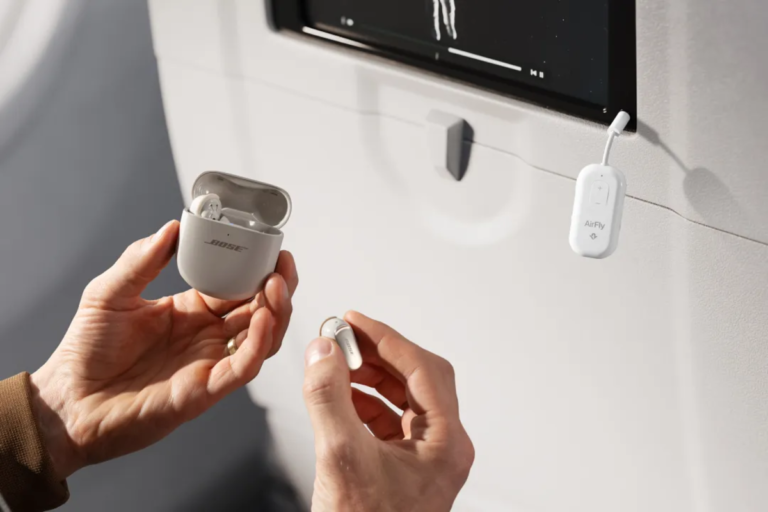
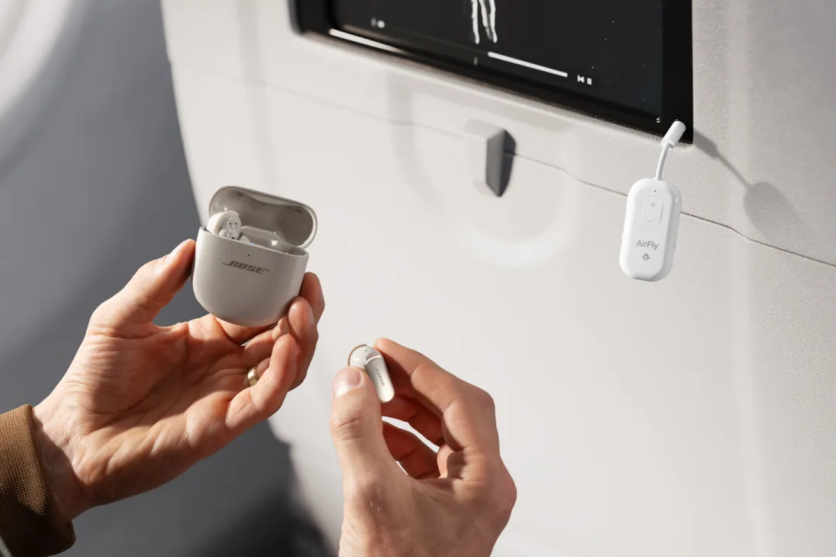
The AirFly line debuted in 2018 as a way to connect wireless earbuds to the 3.5mm audio jacks on airplane seatback screens, gym treadmills, hotel televisions, and other audio sources that never got the Bluetooth memo. The core functionality was always sound — the device worked reliably — but the user experience was, as 9to5Mac found at launch, frustrating because “pairing was fiddly because there’s no display at either end to see what’s going on.” Users had to interpret blink-code LED sequences while working against an aggressive pairing timeout, often in a dark airplane cabin with the clock running.
That critique survived across multiple product generations — the AirFly Pro, the AirFly Pro 2, the AirFly SE — none of which added a display. The View finally does. A small screen is embedded behind the device’s casing — German tech publication Caschys Blog describes the display as one that “leuchtet direkt durch das Gehäuse” (lights through the housing itself) — showing setup prompts in 24 languages, the name of the connected Bluetooth device, and the current battery percentage. When audio is playing, the display turns itself off to avoid becoming a light nuisance in low-light environments.
The AirFly View’s other major addition is Auracast Broadcast Audio, a capability built into Bluetooth’s LE Audio specification, finalized by the Bluetooth SIG in 2022. Where standard Bluetooth creates a private link between one transmitter and a small number of paired receivers, Auracast uses a different transport layer called BIS — Broadcast Isochronous Stream — that works more like a radio station than a private phone call. As the Bluetooth SIG describes it, Auracast “enables audio transmitters — such as smartphones, laptops, televisions, or public address systems — to broadcast audio to an unlimited number of nearby receivers, including speakers, earbuds, or hearing devices,” with no per-device pairing required.
The technical underpinning is the LC3 codec, developed by Fraunhofer IIS and Ericsson and mandatory for all LE Audio devices. LC3 matches the audio quality of Bluetooth’s older SBC codec at roughly half the bitrate, which matters for broadcast scenarios where efficient transmission to many receivers simultaneously places higher demands on the radio. The AirFly View uses Bluetooth 5.3, which provides the Isochronous Channel hardware required for Auracast.
The problem for most AirFly users is on the receiver end. Auracast requires LE Audio hardware and software support on the headphones or earbuds doing the listening. As of October 2026, the receivers that support it include Samsung Galaxy earbuds, select Sennheiser headphones, and hearing aids designed for the standard. LG and Samsung have also included Auracast in their 2026 television lineups. Android 16 includes native Auracast support, making the experience relatively seamless for most Android phone users.
Apple, however, has not enabled Auracast on any device it sells. iPhone 17 has the Bluetooth 5.3 hardware that could support it; iOS 26 does not activate it. AirPods Max 2, AirPods Pro 2, and AirPods 4 are all absent from the Auracast compatible device list. For a product whose entire brand identity is helping AirPods users listen wirelessly in places that only have a headphone jack, this is a notable irony: the AirFly View’s biggest new feature simply doesn’t apply to the overwhelming majority of the people most likely to buy one.
The Bluetooth SIG, at CES 2026, framed 2025 as a turning point, saying it “will be remembered as the year Auracast broadcast audio moved from promise to practice, fundamentally changing the accessibility landscape.” The accessibility angle is real: Auracast is genuinely transformative for hearing aid users who can now receive synchronized audio from TVs and public address systems directly, without FM loop infrastructure. For general travelers using AirPods, it remains a future benefit rather than a present one.
One technical nuance worth noting: Auracast broadcasts by default are receivable by any compatible device in range, the same way a radio signal is. The specification supports optional Broadcast Codes (a PIN-style lock on a broadcast stream), but the AirFly View product page does not specify whether it supports this feature. For private travel use — listening to the movie playing on your seatback screen — this is unlikely to matter. For shared use cases in sensitive settings, it is worth understanding that Auracast’s one-to-many model is, architecturally, a public broadcast.
The AirFly View is rated for up to 16 hours of battery on a USB-C charge. That is a meaningful reduction from the 25-hour figure Twelve South quotes for the AirFly Pro 2. The trade-off is the cost of running the display and the Auracast radio stack: the View operates both Classic Bluetooth (for standard paired connections, listed as A2DP on the product spec sheet) and LE Audio (for Auracast broadcasts), plus the display. Two radios and a screen draw more power than one radio and an LED.
For most transatlantic or transcontinental flights, 16 hours is sufficient. For a multi-leg travel day with extended ground time, the difference from 25 hours becomes relevant.
What’s included in the box is above category average. Alongside the USB-C charging cable, Twelve South packs a hard travel case — an upgrade over the simple travel pouch in earlier models — and the dual-pronged airline headphone adapter that converts the older two-pin audio jack found on many legacy aircraft into a standard 3.5mm connection. That adapter is the small, easy-to-forget thing that determines whether the whole kit actually works on a given flight; bundling it rather than making it a separate purchase is a quality-of-life improvement AirFly veterans will recognize immediately.
The AirFly View also retains dual-pairing — the ability to connect two pairs of headphones to the same audio source simultaneously — and both transmit (wired-to-wireless) and receive (wireless-to-wired) operating modes.
The 3.5mm Bluetooth transmitter category has no shortage of cheaper options. Caschys Blog notes a UGreen Bluetooth 6.0 transmitter currently listed on Amazon for under €18 (approximately $20 USD). The AirFly View at $79.99 is roughly four times that price.
Twelve South’s product pitch, consistent with its broader accessory lineup, is design quality, bundled accessories, and thoughtful software (24-language setup prompts are not an accident — the company built this explicitly for international travelers). The Auracast feature is genuinely differentiated; no generic $20 alternative offers it. Whether that differentiation is worth $60 today depends entirely on whether the buyer owns Auracast-compatible earbuds — and right now, most don’t.
The long-term calculus is more favorable. Auracast’s infrastructure buildout is real: airports, transit systems, and conference venues have strong incentives to deploy it for accessibility reasons. As Samsung, Sennheiser, and eventually (presumably) Apple expand compatible device counts, the AirFly View’s broadcast capability becomes progressively more useful. An Auracast-capable transmitter purchased today is a hedge on an ecosystem that does not yet fully exist — but that the Bluetooth SIG’s deployment trajectory suggests is arriving.
The AirFly View is available now at Twelve South in Black and Coastal Blue.
Currency conversions in this article are approximate and based on the exchange rate as of October 28, 2026.
The AirFly View works with AirPods for standard Bluetooth pairing — that core function is unchanged from previous AirFly models and uses Classic Bluetooth (A2DP). What AirPods cannot do is receive Auracast broadcasts from the View, because Apple has not implemented the LE Audio standard required to receive Auracast on any of its current devices, including AirPods Pro 2, AirPods 4, AirPods Max 2, iPhone 17, or iOS 26. For AirPods users, the AirFly View is a useful upgrade for its display and bundled accessories, but the Auracast feature does not apply.
Auracast uses Bluetooth LE Audio’s Broadcast Isochronous Stream (BIS) transport, which is fundamentally different from the Classic Bluetooth connection most headphones use. Rather than establishing a paired, acknowledged link between devices, BIS transmits audio in one direction to any receiver that’s listening — no pairing required, unlimited receivers. The audio is encoded using LC3, a codec developed by Fraunhofer IIS and Ericsson that delivers better efficiency than the older SBC codec. Headphones or earbuds must have specific LE Audio hardware and firmware to receive BIS streams; older headphones using Classic Bluetooth A2DP cannot receive Auracast broadcasts even if they appear to pair successfully with the AirFly View.
For the display alone — which shows the connected device name, battery percentage, and pairing prompts in 24 languages — the upgrade argument is strong if you use an AirFly regularly and have experienced the old blink-code pairing frustration. The hard travel case, dual-plug airline adapter, and USB-C charging are meaningful conveniences. At $79.99, the premium over both generic alternatives (~$20) and the AirFly Pro 2 (available around $79) is essentially the cost of the display and the Auracast hardware you may not be able to use yet. If you own Samsung Galaxy earbuds, Sennheiser LE Audio headphones, or other Auracast-compatible receivers, the value proposition is significantly stronger today.
Auracast’s most developed real-world deployment is in accessibility: hearing aids from major manufacturers (Phonak, Oticon, Starkey, and others) support LE Audio, and venues can broadcast synchronized audio directly to hearing device wearers without FM loop infrastructure. The Bluetooth SIG has documented growing deployment at airports, conference venues, and transit systems for multilingual announcements — airport departure boards that broadcast audio in multiple languages simultaneously, with each traveler receiving the language their device is set to. Samsung and LG’s 2026 TV ranges include Auracast so compatible earbuds can receive audio without pairing.