HomeAuto Vietnam Primary Care Reform Sends 79 Hospital Doctors to HCMC Neighborhoods
Vietnam Primary Care Reform Sends 79 Hospital Doctors to HCMC Neighborhoods
October 28, 2026:
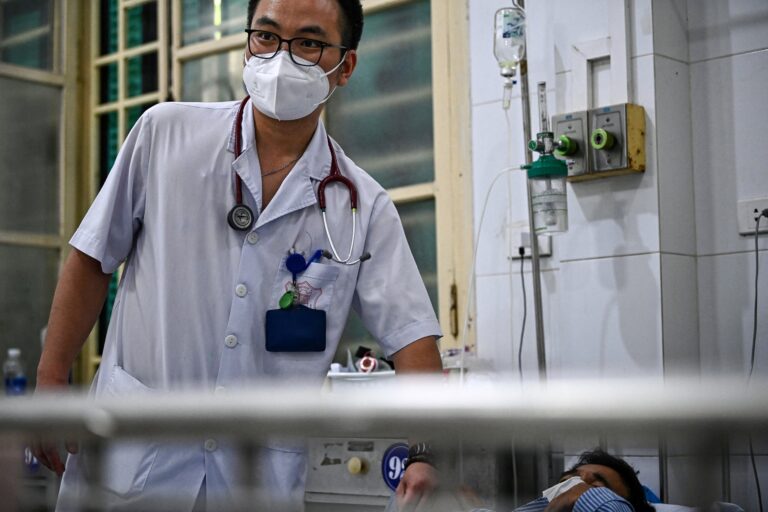
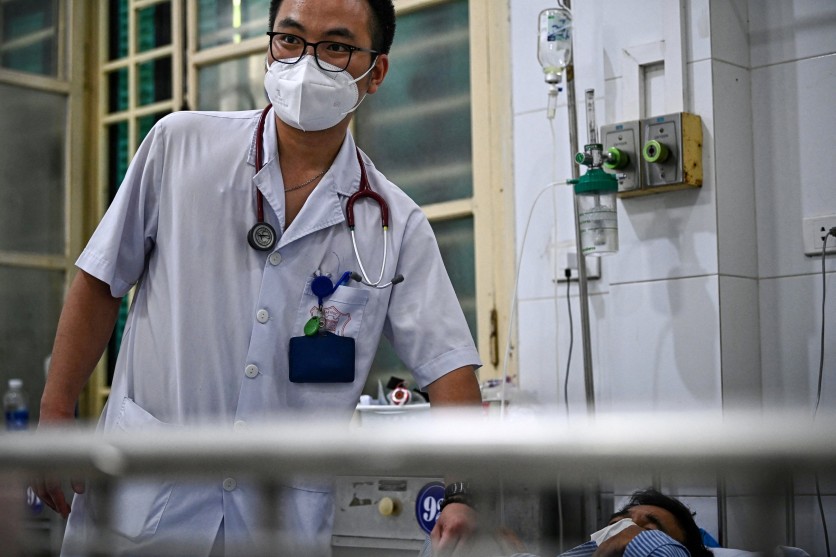
This picture taken on April 2, 2024 shows Vietnamese doctor Truong Duc Thai checking a drug-resistant tuberculosis patient at National Lung Hospital in Hanoi. A faster and vastly more effective treatment for drug-resistant tuberculosis is being rolled out in the Asia-Pacific region, raising hopes of a “new era” in tackling one of the world’s deadliest infectious diseases. (Photo by Nhac NGUYEN / AFP) / TO GO WITH “ASIA-HEALTH-TUBERCULOSIS” REPORTAGE BY PAM CASTRO NHAC NGUYEN/AFP via Getty Images
Ho Chi Minh City formally dispatched 79 experienced hospital physicians to 37 chronically understaffed commune and ward health stations on Wednesday, October 28 — the opening wave of a restructuring effort designed to rebuild the city’s primary care layer from the bottom up and ease crippling patient overload at its major hospitals.
The deployment ceremony, held Wednesday morning Vietnam time at the HCMC Department of Health, was attended by Nguyễn Phước Lộc, a Central Committee member and the city’s Deputy Party Secretary — a signal that the program is a political priority, not a departmental experiment. Each of the 79 physicians will serve a one-year rotation at the assigned station, seeing patients directly while mentoring the permanent clinical staff already on site.
A City of 14 Million With No Reliable First Stop
Ho Chi Minh City now serves more than 14 million residents — a population that expanded substantially after its 2025 merger with the neighboring provinces of Bà Rịa–Vũng Tàu and Bình Dương. That population is served, in theory, by a layered system: 169 hospitals, 168 commune and ward health stations, and nearly 300 satellite points affiliated with those stations, part of a city-wide push toward an HCMC integrated multi-tier healthcare system.
In practice, the lower layer has long suffered from a failure mode that health systems researchers call healthcare bypassing in Vietnam: when patients perceive a neighborhood-level station as inadequately staffed, they skip it entirely and travel directly to secondary or tertiary hospitals for care those hospitals were not designed to provide. The result is chronic congestion at the top of the system and an effective dismantling of the three-tier architecture that is supposed to distribute demand across all levels.
The staffing data explains why. As of January 1, 2026, HCMC had 6,603 healthcare workers at the commune and ward level, of whom only 1,371 were physicians — against a Ministry of Health requirement of 8,494 workers in total, leaving a gap of 1,891 positions. Health centers across the city’s districts, wards, and communes have historically struggled to attract both staff and patients because of this shortage of medicines, facilities, and doctors.
The result is familiar to residents of any rapidly growing city where primary care infrastructure has not kept pace with population: neighbors who could be treated at a station two blocks away instead take buses to state hospitals that may be miles away — and wait.
What Wave One Looks Like on the Ground
The 79 physicians deployed this week are drawn from hospitals across the city and represent a mix of general practitioners and specialists. Each has been assigned to one of the 37 stations identified as most acutely understaffed.
Dr. Nguyễn Văn Vĩnh Châu, Deputy Director of the HCMC Department of Health, described the deployed physicians as performing two simultaneous functions: direct clinical care — examining patients, managing non-communicable diseases including diabetes and hypertension, providing initial emergency stabilization, and supporting epidemic prevention at the community level — and capacity building, mentoring each station’s existing staff and raising the facility’s professional standard for the long term.
“The 79 doctors in Wave 1 will set the template for subsequent waves and for all other health stations,” Dr. Nguyễn Văn Vĩnh Châu said at the ceremony. “If they do well, residents will have a more positive view of health stations, and hundreds of colleagues who follow will see grassroots service as something to be proud of.”
One of those 79 physicians is Dr. Phan Trung Việt, an emergency and resuscitation specialist from Nhân dân Gia Định Hospital, assigned to Châu Pha Commune Health Station. He described his planned approach as combining emergency support, chronic-condition management, and identification of cases exceeding the station’s capacity for timely referral up the system.
Electronic Health Records, Elderly Care, and the Conceptual Hierarchy
At the ceremony, Deputy Party Secretary Nguyễn Phước Lộc articulated the architecture the city intends to build: health stations as the focal point, senior hospitals as the foundation, and the rotating physicians as the connective tissue linking hospital-grade expertise to primary care delivery.
He instructed the 37 receiving wards and communes to immediately form continuous community healthcare teams, to use electronic health records to map local disease patterns, and to integrate elderly care programs with the stations now being staffed up. He also called on central-level hospitals and ministry-affiliated facilities to join subsequent waves, widening the contributing institution pool beyond the city’s own hospital network.
Lộc’s EHR instruction is not incidental: HCMC’s Department of Health has, under Prof. Dr. Tăng Chí Thượng’s leadership, digitized 99.4 percent of hospital records across the city — one of the most advanced health data systems in Southeast Asia. The rotation program is being built on top of that digital infrastructure: telemedicine links and consultation protocols between the community stations and their sponsoring hospitals are being built out simultaneously, so that a physician at a neighborhood station can draw on specialist backup without requiring a patient to physically travel for a consultation.
Prof. Dr. Tăng Chí Thượng, Director of the HCMC Department of Health, cited the city’s earlier experience rotating doctors to Côn Đảo island as the proof of concept for this model — an isolated district where a hospital-linked station rotation demonstrated that telemedicine-backed primary care could function reliably when the technology and coordination infrastructure were built first.
“The health sector is determined to bring doctors to the stations and build capacity so that health stations truly become a trusted address for residents’ primary healthcare needs,” Prof. Tăng Chí Thượng said.
What Makes the Program Logistically Feasible
Attending officials were specifically asked to provide practical support for deployed physicians’ housing and daily-life needs — a detail that names the historically primary reason experienced hospital doctors have declined grassroots postings: not clinical reluctance, but logistics.
To address the financial disincentive, HCMC has proposed monthly allowances for rotating doctors of up to 20 million Vietnamese đồng (approximately $776 USD) — a meaningful premium above baseline salaries that city leadership intends to make multi-wave participation financially viable.
National Tailwinds Behind a Local Initiative
HCMC’s deployment is the most ambitious single-city expression of Vietnam national primary care reform efforts taking shape throughout 2025 and 2026. Vietnam’s national plans call for at least 1,000 doctors on fixed-term contracts to be assigned to grassroots healthcare facilities each year during the 2025–2030 period — accompanying the rollout of free annual health check-ups for all citizens that began in 2026.
The governing policy framework is Politburo Resolution 72, which sets specific national benchmarks: by 2027, all commune health stations across Vietnam are to have four to five physicians per station working on a regular basis. By 2030, commune stations are to be fully staffed, essential healthcare costs covered by health insurance, and the entire system reoriented from hospital-based treatment toward prevention and primary care.
Other provinces are already implementing parallel programs. Thai Nguyên province assigned 46 seconded doctors to commune and ward health stations on March 27, 2026, targeting a full complement of four physicians at each station by April 1 of this year. HCMC’s program is larger in absolute terms and more explicit in its clinical-and-mentoring dual mandate, but the structural logic — rotating hospital talent to shore up the primary care layer — is becoming a national implementation template rather than a local experiment.
Quảng Ninh province has already exceeded the national baseline: its commune health stations average 27 health workers per station and at least four doctors per station.
How Do You Rebuild a Tier That Was Never Fully Built?
The wave-one deployment is explicitly designed as a model to be tested, refined, and replicated. HCMC has announced a restructuring of its healthcare network into a three-tier integrated healthcare model — primary care at commune stations, general treatment at regional hospitals, and advanced care at top-level facilities. The doctor-rotation program is central to making that architecture functional rather than notional: a three-tier system in which the lowest tier lacks reliable physician access is not a three-tier system in any operational sense. It is a two-tier system with an aspirational floor.
The 79 physicians heading to 37 stations under Wave 1 are, in the framing of city health authorities, simultaneously practitioners and demonstrators — showing patients, policymakers, and future participants what a hospital-linked primary care station can do for a neighborhood that has historically lacked it.
Whether the initiative breaks the bypassing pattern will depend substantially on how local governments support deployed physicians in practical terms, on whether telemedicine and electronic health records deliver the backup infrastructure Lộc and Tăng described, and on whether subsequent waves can sustain the momentum beyond the high-visibility opening deployment.
For now, the largest city in Vietnam has placed an explicit bet on its base: the answer to tertiary hospital overload is not more tertiary hospitals, but a primary care layer capable of absorbing the demand that should never have reached them.
Exchange rate as of October 21, 2026: 25,784 Vietnamese đồng per U.S. dollar; all currency conversions in this article are approximate.
Frequently Asked Questions
What is a commune health station in Vietnam, and why do residents often skip them?
A commune health station is the first tier in Vietnam’s three-tier healthcare system — a government-operated primary care facility at the neighborhood or ward level where residents are supposed to receive routine care, chronic-disease management, and preventive services. Many residents have historically bypassed these stations because they lacked sufficient doctors, medicines, and equipment, making hospitals — which are harder to access but perceived as higher-quality — the de facto first stop for a large share of care that primary care facilities are designed to handle. WHO Vietnam research confirms that nearest care is often best for patients with non-communicable diseases — but only when the nearest facilities are adequately staffed. HCMC’s rotation program targets this behavioral pattern directly by placing experienced hospital physicians at the stations most identified as understaffed.
What does Vietnam’s Resolution 72 require, and what are the deadlines?
Resolution 72 is a Politburo directive setting national targets for Vietnam’s commune health station network. Resolution 72 commune staffing targets require every commune health station in the country to have at least four to five physicians working on a regular basis by 2027. By 2030, stations are to be fully staffed, essential care costs covered by health insurance, and the national system reoriented from hospital-based treatment toward prevention and primary care. HCMC’s Wave 1 deployment directly advances the 2027 physician benchmark for the city’s most acutely understaffed stations.
How will a one-year rotation change anything lasting at these stations?
The program’s dual mandate — direct clinical care alongside formal mentoring of each station’s existing staff — is designed to build durable capability at the facility level, not merely to provide temporary physician coverage. Deputy Director Dr. Nguyễn Văn Vĩnh Châu described each rotating doctor as responsible for raising the professional level of their assigned station, not simply filling a roster slot. The telemedicine links and consultation protocols being built out alongside the deployments give station staff ongoing access to specialist advice even after a rotation ends. Whether one year is sufficient to establish lasting capacity depends on how subsequent waves follow and whether the permanent staff at each station have the resources — medicines, equipment, referral pathways — to sustain the practices the rotating physicians demonstrate.
Do rotating doctors keep their hospital jobs, and what support are they receiving?
The rotation is a fixed-term assignment, typically one year, after which physicians are expected to return to their originating hospital posts. To make the logistical reality of a community posting manageable, attending authorities at the ceremony were specifically asked to support rotating physicians’ housing and daily-life needs — an acknowledgment that practical barriers have historically been the main disincentive for experienced hospital doctors accepting grassroots assignments. HCMC has also proposed supplementary allowances for rotating doctors of up to 20 million Vietnamese đồng (approximately $776 USD at current exchange rates) above baseline salaries for doctors in the rotation program.