HomeAuto ISS Spacewalk Thursday: Roll-Out Solar Arrays Deploy by Stored Spring Tension
ISS Spacewalk Thursday: Roll-Out Solar Arrays Deploy by Stored Spring Tension
October 27, 2026:
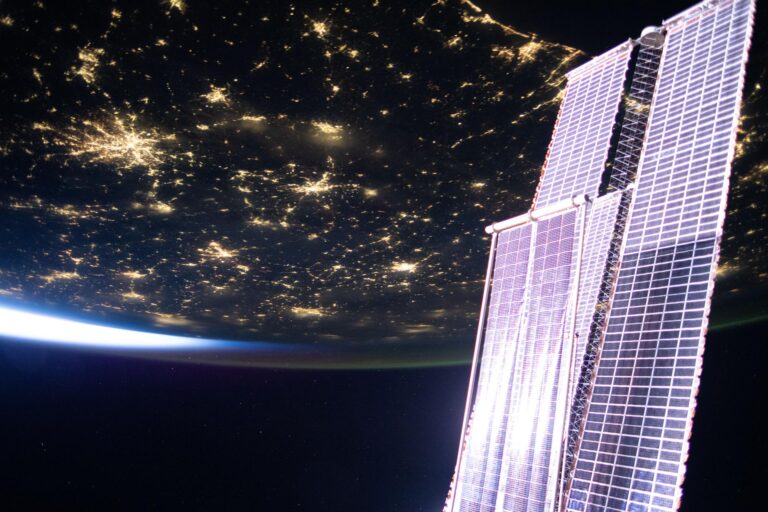
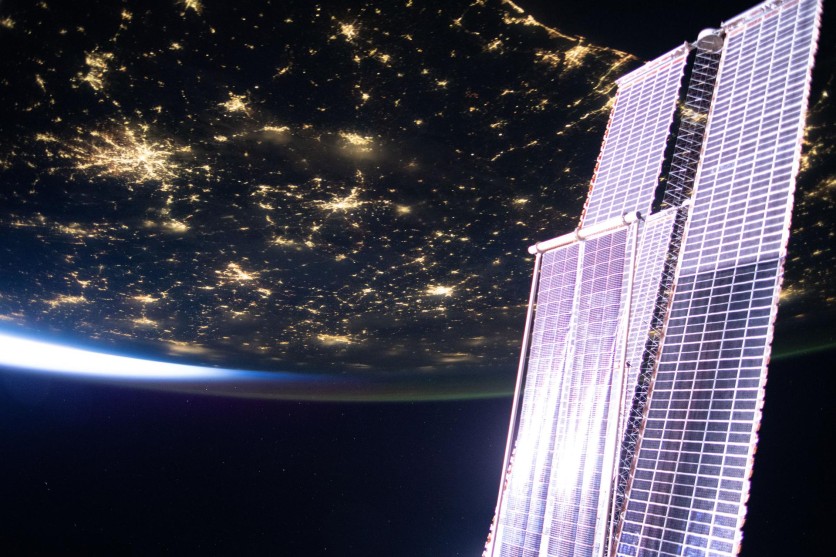
City lights sparkle across the southern United States in this photograph from the International Space Station is it orbited above Florida. At right, is a set of the orbital outpost’s main solar arrays augmented by a smaller set of roll-out solar arrays. Nasa.gov
On Thursday, October 29, NASA astronaut Anil Menon and Canadian Space Agency (CSA) astronaut Joshua Kutryk will exit the International Space Station’s Quest airlock at 8 a.m. EDT to install the seventh of eight ISS Roll-Out Solar Arrays — motorless flexible panels that extend themselves using nothing but mechanical spring tension stored in their rolled-up carbon composite structure. Live coverage begins on NASA+ at 6:30 a.m. EDT, ahead of an excursion expected to last approximately six hours and 45 minutes, bringing a five-year ISS power renovation campaign to its penultimate step.
One more spacewalk, currently scheduled for November 5, will install the eighth and final array — completing an upgrade that engineers say will give the station the robust electrical infrastructure it needs for a safe, controlled deorbit around 2030.
Final Pair of Eight
The iROSA program began as a practical answer to a structural problem. The ISS’s original Solar Array Wings were designed for a 15-year service life and, by the late 2010s, had accumulated more than two decades of damage from solar degradation, micrometeoroid impacts, and rocket-plume deposits from resupply ships. Rather than attempt a wholesale replacement of structures that had always been intended as permanent, engineers devised a more efficient approach: lightweight, flexible roll-out arrays that could be mounted in front of the aging wings to capture additional sunlight while the original panels continued to produce whatever power they could still generate.
The concept was first demonstrated on the ISS in June 2017, when a prototype ROSA unit flew up aboard SpaceX’s CRS-11 resupply mission and was unfurled by Canadarm2 outside the station for a week of performance testing. The first operational pair arrived aboard CRS-22 in June 2021 and were installed on the P6 truss during three spacewalks by NASA astronaut Shane Kimbrough and ESA astronaut Thomas Pesquet. A second pair followed in December 2022, mounted by Expedition 68 crew members Josh Cassada and Frank Rubio. A third pair arrived aboard CRS-28 and was installed in June 2023 by Expedition 69’s Stephen Bowen and Warren Hoburg. With each installation, the station moved incrementally toward what engineers describe as a rejuvenated power capacity of roughly 215 kilowatts — approximately 20 to 30 percent above the degraded output the original arrays alone had been producing.
The seventh and eighth panels arrived at the station on October 15, when SpaceX’s CRS-35 Dragon cargo spacecraft docked at the station at 10:27 a.m. EDT — two days after launching from Kennedy Space Center on October 13. The iROSAs rode in the Dragon’s unpressurized trunk alongside more than 6,300 pounds of other supplies, and that same Dragon remains docked at the station today. Canadarm2, the Canadian-built robotic arm, retrieved the panels from the trunk after docking and will serve as an elevated robotic work platform for one of the two spacewalkers during installation — a role it has played in every previous iROSA deployment.
How Roll-Out Solar Arrays Deploy Without Motors
What makes the iROSA engineering notable is not primarily its flexibility but its deployment mechanism. Unlike nearly every other large solar array ever installed in orbit — which use electric motors or pneumatic actuators to extend their panels — the iROSA contains no powered deployment system at all. The panel is stored rolled around a cylindrical spool, and the act of unrolling it requires no actuator: the deployment force from slit-tube booms comes entirely from strain energy stored in the array’s carbon composite structure.
The booms operate on the same physical principle as a steel measuring tape. A measuring tape is a strip of springy metal formed into a slight longitudinal arc; when you coil it, you are storing elastic potential energy in the material’s structure. When you release it, that stored energy drives the tape to extend. The iROSA’s booms are analogous structures, but fabricated from carbon fiber composites rather than steel — optimized for low mass, high deployed stiffness, and tolerance to thermal cycling in orbit. When astronauts release the mechanical locks holding the spool, the stored strain energy drives the blanket to unroll across a span of roughly 60 feet in a matter of minutes, with no motors, no commands, and no external power required for the deployment itself.
The absence of motors is not merely an engineering elegance; it is also a reliability feature. Every powered actuator is a potential single-point failure. By eliminating the deployment motor, engineers removed an entire failure mode from the sequence. The trade-off is that iROSAs are permanent installations — the 2017 prototype was deliberately jettisoned after its test week rather than restowed, because rewinding the blanket against the booms’ stored spring energy was not part of that prototype’s design. Operational units are designed with this constraint accepted upfront: they go up and stay.
Each iROSA is mounted at a 10-degree cant angle relative to the original Solar Array Wing it augments, allowing both the new and existing panel to track the sun simultaneously without one shadowing the other. That geometric solution means two generations of hardware can operate as a coordinated unit rather than competing for the same arc of sunlight.
Months of Groundwork
Thursday’s installation did not arrive without significant preparation. Before any iROSA can be attached to the 2A power channel on the station’s Port 4 truss, astronauts had to build a mounting bracket capable of holding it in place. That bracket work was completed on March 18, 2026, during an Expedition 74 spacewalk by NASA astronauts Jessica Meir and Christopher Williams — the first American EVA in ten months, following a gap since May 2025. The companion bracket for the 3B power channel, which will receive iROSA #8 on November 5, was assembled by Meir and Menon on August 6 during the first Expedition 75 spacewalk — a 6-hour, 27-minute excursion that completed the last of seven modification kits needed across the station’s eight power channels.
With both mounting structures in place, Menon and Kutryk will be able to move directly to the installation steps on Thursday: extracting the iROSA from its stowage location, routing electrical cabling to connect it into the 2A power circuit, and tensioning the mounting hardware before releasing the deployment locks. Once freed, the flexible blanket will extend across roughly 60 feet under its own stored spring energy. If time permits, the pair will tackle get-ahead tasks for the November 5 excursion.
Canada’s Fifth Spacewalker
For Joshua Kutryk, Thursday’s EVA will be his first time working in the vacuum of space — and his presence outside the station will make him the fifth Canadian spacewalker in history. He follows Chris Hadfield, who took Canada’s inaugural spacewalk in April 2001 while helping attach Canadarm2 to the station; Steve MacLean, who walked in September 2006 during Space Shuttle Atlantis’s STS-115 mission; Dave Williams, who performed three spacewalks on STS-118 in August 2007; and David Saint-Jacques, whose most recent EVA was in April 2019.
Kutryk, a Royal Canadian Air Force CF-18 fighter pilot and colonel who was selected by the CSA in 2017, arrived at the station on October 1 aboard SpaceX Crew-13, which launched from Cape Canaveral Space Force Station and completed its rendezvous with the ISS in under eight hours — among the fastest docking approaches on record for a US crewed spacecraft.
He has described the mission as a demonstration of what international space cooperation can achieve, noting that Canada’s crew access to ISS flows directly from its contribution of Canadarm2 and other station robotics — hardware that has been used in every iROSA installation to date. Thursday’s excursion will likely be among the last long-duration Canadian crew missions to the ISS before the station’s planned retirement around 2030.
Seven Aboard, One Job Left
The station currently carries seven crew members representing three nations. NASA astronauts Menon, Jessica Watkins, and Luke Delaney are joined by CSA astronaut Kutryk and Roscosmos cosmonauts Pyotr Dubrov, Anna Kikina, and Sergey Teteryatnikov. Menon, Dubrov, and Kikina arrived aboard Soyuz MS-29, which launched July 14, 2026; Kutryk, Teteryatnikov, Watkins, and Delaney arrived aboard Crew-13 in October. Watkins and Delaney will support the EVA from inside the station Thursday; Dubrov, Kikina, and Teteryatnikov will manage systems from the Russian segment.
For Menon, Thursday will be his fourth spacewalk, following three excursions in August 2026. Menon, 50, is a US Space Force colonel, emergency medicine physician, and mechanical engineer on his first spaceflight. He is notably one half of a two-astronaut household: his wife, Anna Menon, flew on the private Polaris Dawn mission in September 2024 and was subsequently selected as a NASA astronaut candidate in September 2025.
Power for a Controlled Exit
The iROSA campaign is often described as a life-extension program, but it carries a second, less-publicized function that will become critical before the decade ends: adequate electrical power is a prerequisite for the ISS’s planned controlled deorbit around 2030.
Deorbiting a 420,000-kilogram (926,000-pound) structure from low Earth orbit is not a passive operation. The current plan calls for dedicated propulsive deorbit vehicles to provide thrust, but the ISS’s own systems — attitude control thrusters, thermal management loops, guidance computers, and communication links — must remain fully operational throughout the process, and those systems all draw electrical power. An ISS running on degraded original arrays alone would be managing a constrained and aging electrical budget at exactly the moment reliability is most critical. The full complement of eight iROSAs eliminates that constraint.
NASA has stated in planning documents that the upgraded power architecture is a prerequisite for executing a safe, controlled deorbit. When Menon and Kutryk install iROSA #7 on Thursday morning, and when a follow-on crew installs iROSA #8 on November 5, they will be completing not just a renovation but a readiness milestone for the station’s final chapter — one the ISS program has been building toward for five years.
Frequently Asked Questions
What is an iROSA, and how does it deploy without motors?
An iROSA — ISS Roll-Out Solar Array — is a flexible photovoltaic blanket stored coiled around a spool. Unlike conventional rigid solar arrays, which use electric actuators to extend their panels, iROSAs contain no powered deployment mechanism. Their carbon composite slit-tube booms function like a giant steel measuring tape: the spring energy built into the material when the array is rolled up drives the blanket to extend itself across roughly 60 feet once the mechanical locks are released. No commands, no motors, and no external power are required for the deployment itself. Once deployed, the array cannot be restowed — the spring energy drives it to its final position and there is no mechanism for rewinding it.
Why does the ISS need a full power complement to safely deorbit in 2030?
A controlled deorbit of the ISS is not simply a matter of firing a propulsive vehicle and letting physics take over. The station’s own systems — attitude thrusters, thermal loops, guidance computers — must stay operational throughout the deorbit process, and they all require electrical power. Running that operation on degraded original arrays means managing a constrained power budget at exactly the moment operational reliability matters most. NASA has identified the complete iROSA installation as a prerequisite for executing the deorbit safely and under control. Without the full eight arrays, the electrical margin for the deorbit sequence is reduced in ways engineers are not willing to accept for a 420,000-kilogram (926,000-pound) structure reentering over populated areas.
Who is Joshua Kutryk, and why does this spacewalk matter for Canada?
Joshua Kutryk is a Canadian Space Agency astronaut, Royal Canadian Air Force colonel, and CF-18 fighter pilot who was selected by the CSA in 2017. Thursday’s EVA will be his first spacewalk and will make him only the fifth Canadian in history to work in the vacuum of space, following Chris Hadfield, Steve MacLean, Dave Williams, and David Saint-Jacques. Canada’s access to ISS crew positions is directly tied to its contribution of Canadarm2 and other station robotics — the same hardware that has played a critical role in retrieving and positioning every iROSA installed to date.
Can iROSA deployment fail — and what happens if it does?
When the mechanical locks release and the slit-tube booms drive deployment, the process is self-powered by stored strain energy and requires no additional commands. The operational iROSA design has deployed successfully on all six previously installed units. However, if a partial or anomalous deployment were to occur, the panel cannot be restowed — a contingency EVA would be required to secure the hardware in whatever state it reached. The non-restowability of the design is a known trade-off that engineers accepted in exchange for eliminating the complexity and failure modes of a powered retraction mechanism.