HomeAuto Loss and Damage Fund Gave Nepal $20M; World Court Already Said States Owe Reparations
Loss and Damage Fund Gave Nepal $20M; World Court Already Said States Owe Reparations
October 24, 2026:
Frld.org
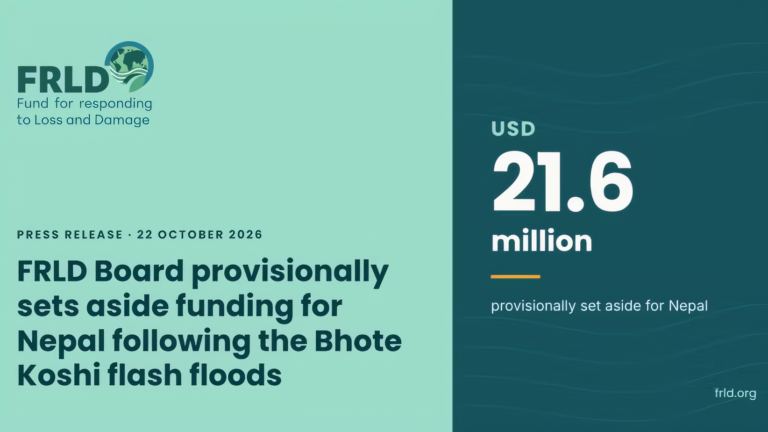
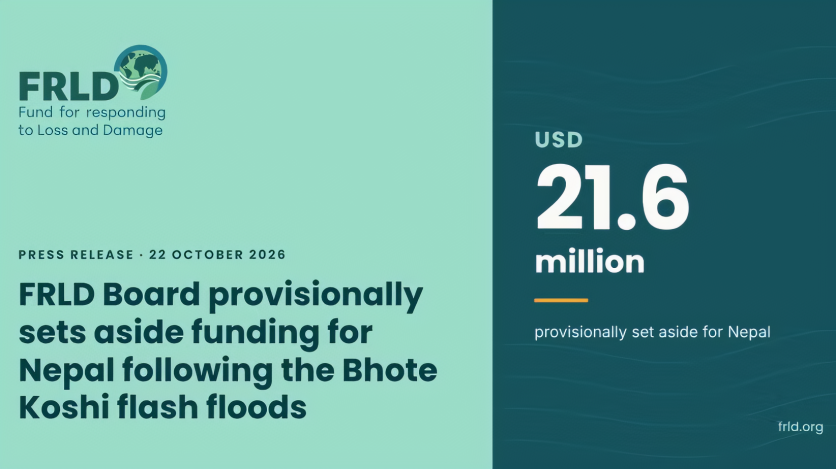
Nepal became the first country in history on October 22 to receive a disaster-specific allocation from the world’s loss and damage climate fund — and the same day, Germany, the EU’s Jan Dusik, and Japan made clear they do not intend for it to happen again. The Fund for Responding to Loss and Damage voted unanimously to set aside $21.6 million for Nepal following the glacier-triggered floods that killed more than 1,400 people in August, but developed-country representatives immediately framed the vote as a singular, “truly exceptional” act rather than a template. That tension — between the unanimous vote and the equally unanimous resistance to drawing any structural lesson from it — now defines what the fund is, and what it is not prepared to become before COP31.
What Collapsed in August — and Why It Was Predictable
On August 26, a massive rock-and-ice avalanche released from the flanks of Langtang Lirung — a 7,234-meter (23,734-foot) peak in Rasuwa district near the Nepal-China border — and sent a wall of water and debris cascading through the Bhotekoshi and Trishuli river systems. The event, technically a rock-ice avalanche that cascaded into a glacial lake outburst flood, tore through multiple hydropower dams, buried riverside villages, and severed road and bridge infrastructure across a string of districts.
Scientists with World Weather Attribution, the group that systematically quantifies climate change’s contribution to specific disasters, identified warming temperatures and accelerating glacial instability in the Hindu Kush Himalaya as primary factors in triggering the August disaster. The International Centre for Integrated Mountain Development confirmed at least 1,451 deaths and 5,745 still missing, with roughly 60,000 people across 15,000 households directly affected. Seven hundred fifty-seven private houses were destroyed, along with schools, health clinics, and 30 cultural heritage sites.
None of this should have come as a surprise. Nepal has more than 2,000 glacial lakes; 21 had been formally classified as potentially dangerous before August. The Green Climate Fund took seven years from Nepal’s application to approve a $36.1 million project designed to reduce glacial lake outburst flood risks — a project whose scope included early warning systems and protective infrastructure for four of the most dangerous lakes. It was approved weeks before the floods hit. The Asian Development Bank and World Bank’s International Finance Corporation financed hydropower projects in the Trishuli basin despite their own risk assessments flagging climate and disaster exposure.
Seven Weeks, $20 Million, and a Proposal Still Required
Nepal’s Finance Minister Dr. Swarnim Wagle and Agriculture, Forests and Environment Minister Gita Chaudhary wrote to the fund on August 31, five days after the disaster. Their letter declared that “time is of the essence.”
The fund’s next scheduled board meeting was in December 2026.
Eight board members representing developing countries signed a letter urging an extraordinary meeting. Developed-country members initially preferred an informal consultation. It took 45 days from Nepal’s letter for the fund’s co-chairs — Camila Minerva Rodríguez Tavárez and Georg Børsting — to announce a virtual extraordinary session for October 22. Two informal drafting sessions on October 5 and October 8, each involving four developed- and four developing-country representatives, produced the motion the board would ultimately adopt.
The October 22 extraordinary session lasted several hours. The board voted unanimously to set aside $21.6 million: $20 million in potential recovery assistance and $1.6 million in administrative and oversight fees. Co-chair Rodríguez described the decision as “truly historic,” noting it was the first time the fund had allocated any money since its establishment three years ago. Maheshwar Dhakal, a senior official from Nepal’s climate ministry, called it “a powerful expression of humanity, compassion, solidarity and hope.”
What was not announced was a disbursement date. Under the fund’s Barbados Implementation Modalities framework — the pilot operational structure launched at COP30 in Belém, Brazil in November 2025 — Nepal must now submit a formal project proposal. That proposal will go before the board at its next regular meeting, in the Philippines in December. Until that board approves a specific plan, no money moves.
Why the Numbers Make the Vote Symbolic
Nepal’s joint post-disaster assessment from the National Disaster Risk Reduction and Management Authority and the National Planning Commission put full reconstruction costs at approximately $4.77 billion. Physical damage and economic losses from the disaster alone total roughly $2.7 billion.
The $20 million set aside represents approximately 0.42 percent of the reconstruction estimate — a figure first highlighted by Carbon Brief and echoed by the Fill the Fund campaign. Brandon Wu, director of policy and campaigns at ActionAid USA, noted that after three years of existence, the fund had still sent no money to any country before October 22 and had provided no concrete timeline for when Nepal’s $20 million would actually arrive.
The fund’s structural position is even tighter than the Nepal shortfall suggests. Twenty-seven countries have pledged a total of approximately $822 million to the fund, with roughly $629.68 million in contributions received — but the fund currently has only around $350 million available to allocate against operational needs. Under its first Barbados Implementation Modalities round, 119 countries submitted 176 funding proposals requesting approximately $2.8 billion — eight times what the fund has available to distribute.
The fund also caps individual project allocations at $20 million — meaning Nepal’s entire current claim is already at the ceiling. UN Secretary-General António Guterres previously described the fund’s total resources as “ridiculously small.”
Why ‘No Precedent’ Is More Than Caution
The most consequential language from the October 22 meeting was not in the motion that passed. It was in the statements made after it.
Germany’s board member and the EU’s Jan Dusik both said the Nepal allocation must not be considered a “precedent.” Japan’s representative called the decision “truly exceptional” and emphasized that any support must remain “in accordance with established rule and procedure.”
Pakistan’s Ali Sheikh pushed back directly. Responding to Dusik’s openness to “learning” but opposition to “setting precedent,” Sheikh said: “Please do not define the boundaries for learning.” Ecuador’s Walter Schuldt, who helped negotiate the draft decision, said the board “should not put limits on lesson learning.”
To understand what these words mean in context, it helps to understand the legal architecture they are defending. The concept of loss and damage was first raised in United Nations climate negotiations in 1991, when the island nation of Vanuatu proposed a mechanism to compensate vulnerable states for climate-driven harm. Developed countries resisted it for more than three decades. The Paris Agreement of 2015 included a mention of loss and damage but contained an explicit clause — inserted at the insistence of the United States — stating that the provision does not involve or provide a basis for any liability or compensation. The Fund for Responding to Loss and Damage was explicitly designed to operate within that constraint: it is technically “not a compensation mechanism,” regardless of what its advocates understand it to represent in moral terms. The Paris Agreement’s no-liability clause is the legal architecture wealthy nations defended at the October 22 meeting.
The International Court of Justice further complicated that legal architecture when it delivered a unanimous advisory opinion on July 23, 2025. The court affirmed that states have obligations under customary international law, climate treaties, and human rights frameworks to prevent significant climate harm — and that states which fail to prevent such harm are under “an obligation to make full reparation for the damage caused.” The court did not make the advisory opinion binding, but it opened clear legal pathways for affected countries and communities to pursue accountability. Lien Vandamme, a climate justice campaigner at the Center for International Environmental Law, invoked the ICJ ruling explicitly at the October 22 meeting. Communities on the climate frontline “are owed reparations as a matter of legal obligation,” she said. “Setting aside millions is not the same as delivering billions.”
When Germany, Czechia, and Japan say the Nepal vote must not set a precedent, they are doing something more specific than expressing fiscal caution. They are guarding the legal distinction between a voluntary, exceptional, one-time allocation and a systemic obligation — because once systematic rapid response to climate disasters becomes routine practice, the distance between “not a compensation mechanism” and “a compensation mechanism” shrinks considerably.
What Advocates Are Demanding
Harjeet Singh, Global Convenor of the Fill the Fund campaign and Founding Director of the Satat Sampada Climate Foundation, called the vote “a historic first step” while drawing a sharp line between milestone and mission. “No country should have to endure a catastrophe and wait seven weeks, through historic letters and relentless pressure, just to unlock the Fund’s first-ever emergency meeting,” he said. “We must set up a permanent rapid-response system that moves support in days, not months.”
Ajay Mathur, a veteran Indian climate negotiator who represented his country at COP21 in Paris and previously served as Director General of the International Solar Alliance, called the vote “a landmark operational step” while flagging the gap between allocation and disbursement. He argued the fund should consider releasing support immediately when other funding is already engaged, rather than waiting for a second round of proposal approval.
Savio Carvalho, head of campaigns at the 350.org climate advocacy group, was direct. “Rich nations can’t show up at COP31 with empty hands: they need to deliver on climate finance.”
Tasneem Essop, Executive Director of Climate Action Network International, noted that a large portion of the fund’s pledges remain unpaid. “Pledges on paper cannot rebuild homes or restore lives,” she said.
Jocelyn Perry, senior advocate at Refugees International advocacy group, called for a “simplified direct access window for community organizations,” including small grants accessible to informal groups and unregistered collectives leading recovery on the ground.
How Nepal’s Case Will Now Proceed — and What COP31 Inherits
Nepal’s formal project proposal must now be submitted under the Barbados Implementation Modalities process and approved by the board at its December 2026 meeting in the Philippines. The fund’s secretariat will oversee monitoring and implementation, with the $1.6 million in administrative fees supporting that function.
The fund is expected to formally approve its first set of Barbados Implementation Modalities projects — drawn from the 176 applications requesting $2.8 billion — at the same December meeting. Nepal’s disaster-response proposal will compete for attention alongside long-planned resilience projects from countries that applied through standard channels.
The structural test will come at COP31, expected in Antalya, Turkey in 2027. The central questions are familiar: how much will wealthy nations pledge to the fund, how quickly will they honor those pledges, and whether they will agree to any mechanism that converts voluntary one-time exceptions into something closer to automatic response. With the ICJ’s advisory opinion on the table and Nepal’s case establishing what “historic” looks like in practice — 0.42 cents on the dollar, arrived at after seven weeks and a bureaucratic process that advocates called a “marathon” — the terms of that debate are clearer than they have ever been.
Nepal is the first country in history to receive a disaster-specific climate fund payout. The week it received that payout, three wealthy nations told the world it should not expect the experience to be repeatable.
Frequently Asked Questions
Why are wealthy nations resisting a rapid-response precedent for climate disasters?
The resistance is not simply about money — it reflects a deliberate legal and structural position. The Paris Agreement of 2015 includes an explicit clause stating that loss and damage provisions “do not involve or provide a basis for any liability or compensation.” Wealthy nations, particularly those whose historical emissions are most responsible for climate change, have consistently defended this principle to avoid legal exposure for climate-driven harm. A systematic, automatic rapid-response mechanism would blur the line between voluntary generosity and legal obligation — a line that the July 2025 ICJ advisory opinion on climate obligations has already significantly narrowed. Germany, Czechia, and Japan’s “no precedent” language at the October 22 meeting is a defense of that architecture, not simply fiscal caution.
How does $20 million compare to what Nepal actually needs to rebuild?
Nepal’s National Disaster Risk Reduction and Management Authority and National Planning Commission estimated full reconstruction costs at approximately $4.77 billion. The $20 million set aside by the FRLD board represents roughly 0.42 percent of that figure. Separately, the fund has only $350 million available to allocate in total — against $2.8 billion in requests from 119 countries submitted through a single funding round. Under the fund’s current rules, $20 million is the maximum any single project can receive, meaning Nepal’s entire present claim is already at the ceiling.
What actually triggered the August 2026 Nepal floods, and does climate change bear responsibility?
Scientists from World Weather Attribution identified the event as a rock-ice avalanche from Langtang Lirung — a peak in Rasuwa district near the Nepal-China border — that cascaded into the Bhotekoshi and Trishuli river systems, a variant of what glaciologists classify as a glacial lake outburst flood. The group concluded that warming temperatures and glacial instability in the Hindu Kush Himalaya were primary contributing factors. Nepal contributes less than 0.1 percent of global greenhouse gas emissions but is ranked among the world’s most climate-vulnerable nations. The Green Climate Fund had approved a $36.1 million glacial lake protection project for Nepal just before the disaster — a project that had taken seven years to move through the approval process.
When will Nepal actually receive the money?
The October 22 vote set aside $21.6 million but did not disburse any funds. Under the Barbados Implementation Modalities framework, Nepal must now submit a formal project proposal to the fund’s secretariat. That proposal will be considered at the FRLD’s next regular board meeting, scheduled for December 2026 in the Philippines. No disbursement timeline has been publicly confirmed. Brandon Wu of ActionAid USA noted that three years after the fund’s establishment, no country had received funds from it.