October 24, 2026:


DC Studios’ Clayface carries the rarest pitch in blockbuster cinema: no hero, no redemption arc, and a genuine R-rated body-horror spine that would not look out of place in a retrospective of David Cronenberg’s most unsettling work. That distinction matters because DC cannot afford another Supergirl. After that film closed its global run at roughly $126.5 million worldwide against a production budget estimated between $170 million and $186 million, Clayface enters the Halloween corridor needing to prove that a $40 million villain origin story — with a relatively unknown lead and presale figures trailing its predecessor by about 80% — can still command a crowd.
Following Superman in 2025 and Supergirl in summer 2026, Clayface represents James Gunn’s most tonally adventurous swing — a deliberate departure from the franchise’s opening chapters and their more hopeful superhero register. At San Diego Comic-Con 2026, during the Jim Lee & Friends panel, director James Watkins drew a clear line in the sand: “It’s not a superhero movie. It’s a supervillain story.”
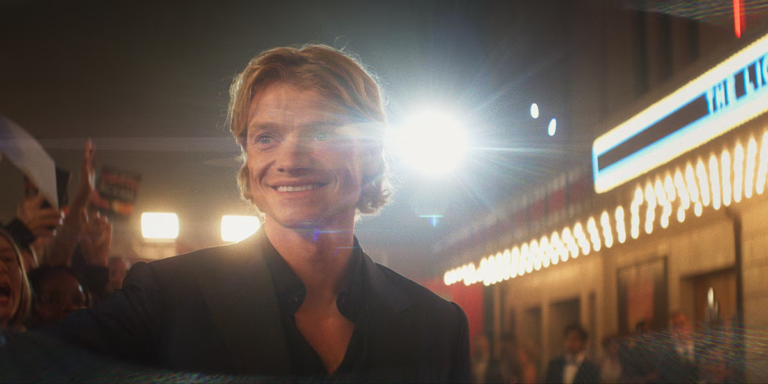
The film centers on Matt Hagen, a rising actor played by Welsh newcomer Tom Rhys Harries, whose face is disfigured by a gangster before he consents to an experimental treatment that reshapes his body into living clay. Where the standard comic book origin tilts toward empowerment, this one tilts toward tragedy — and visceral physical unraveling.
The film grew out of an unsolicited pitch: horror writer Mike Flanagan delivered a Clayface screenplay that convinced Gunn to greenlight a project he had never planned to make. Gunn later told CBS Mornings that “although it’s in the same universe, it’s a complete horror film.” Flanagan went on to share the screenplay credit with Hossein Amini — who was brought in for rewrites — while retaining a Story By credit on the final film.
James Watkins stepped in to direct, bringing a track record of effective genre work: Eden Lake (76% on Rotten Tomatoes), the Speak No Evil remake (83%), and The Woman in Black (66%) — a filmography that suggested the material would land somewhere between watchable and strong. Amini, who wrote the screenplay for Nicolas Winding Refn’s Drive and co-created the BBC crime series McMafia, brought a different register of tension to the dialogue and structure.
The film was produced by Matt Reeves (through his 6th & Idaho banner), Lynn Harris, James Gunn, and Peter Safran. It carries an R rating for strong bloody violence, gore, language, some nudity, and brief drug use — a deliberate boundary-push for a studio that has operated mostly at PG-13 under its previous ownership.
With 74 reviews counted at the time of embargo lift on October 21, Clayface debuted with a 73% Fresh score on Rotten Tomatoes before climbing to Certified Fresh at 75% across 83 reviews. The Metacritic average settled at 59 out of 100, placing it in “mixed or average” territory by that platform’s own classification.
Dread Central summed up the divide with a headline calling the film a “muddy, mixed bag of melty body horror.” Audience voters on Letterboxd landed at 3.7 out of 5 from 130 early reviews as of October 21 — a warmer response that placed it among the better-regarded DC films of the decade on that platform.
The performance generating the most consistent praise is Harries himself. Multiple critics singled him out for capturing a character whose descent into monstrosity never fully extinguishes the human logic underneath it.
Advanced ticket sales tracked at roughly 80% below Supergirl‘s pace at the same point in that film’s cycle — a figure that alarmed some analysts. The most cautious current forecast, from Bam Smack Pow, puts the domestic opening weekend at $15M–$20M. BoxOffice Pro’s updated opening-day forecast revises that range upward to $25M–$30M — a meaningful gap between the two sets of projections that reflects genuine uncertainty about how far the film’s horror credibility will extend beyond committed genre audiences.
With a production budget of $40 million, the film needs roughly $80M–$100M in total worldwide gross to reach breakeven under standard Hollywood accounting. The Halloween timing is a structural advantage — horror films historically hold better from week to week than front-loaded superhero titles — and the absence of major franchise competition in the immediate weeks ahead gives the film room to breathe.
A Clayface that outperforms tracking would validate something worth watching: that DC can sustain audience interest between its major tentpoles by rooting smaller, genre-specific films in committed character work. A result that mirrors Supergirl‘s underwhelming global run would sharpen questions about whether the DCU’s Chapter One has enough commercial depth to carry six films and counting.
Today’s numbers will begin to answer that.