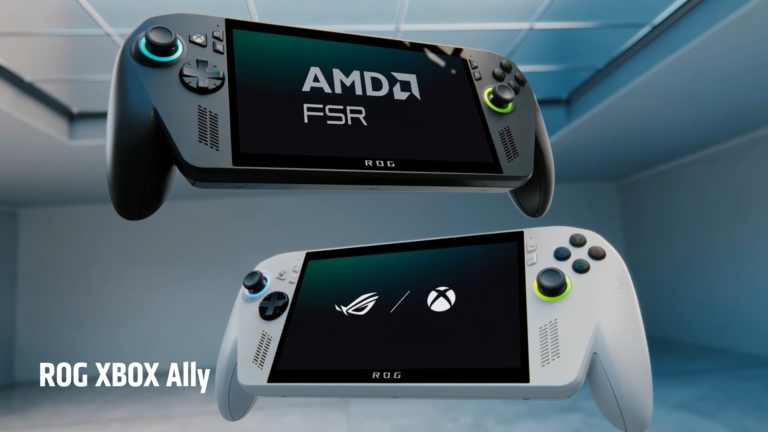
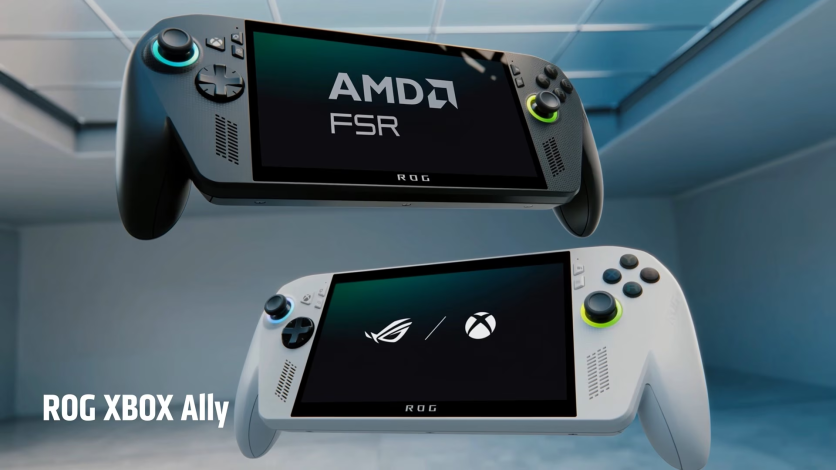
AMD FSR 4.1 Lands on ROG Xbox Ally X Today: Performance Mode Now Beats FSR 3.1 Quality

October 23, 2026:

AMD FSR 4.1 Lands on ROG Xbox Ally X Today: Performance Mode Now Beats FSR 3.1 Quality
ROG Xbox Ally X
Amd.com

ASUS is rolling out a preview driver today that brings AMD’s FSR Upscaling 4.1 — the company’s latest machine-learning-based image reconstructor — to the ROG Xbox Ally X and the ROG Xbox Ally X20 handheld gaming PCs, making both devices the first AMD-powered handhelds to officially receive the technology.

Installation is intentionally low-friction: open Armoury Crate SE on the device, navigate to Update Center > Preview Updates, and install. Once active, FSR 4.1 toggles on through the Command Center and applies across more than 400 games that already support FSR 3.1 or later — no per-game patching, no developer updates required. Because this is a preview build, ASUS flags that it “may still contain bugs or instability,” following the same model as the Xbox Insider and Windows Insider programs.

The release is the handheld-specific delivery of a broader platform expansion AMD announced on October 20 alongside the Adrenalin Edition 26.10.1 desktop driver. That update extended FSR 4.1 support to Radeon RX 6000 Series graphics cards, Ryzen AI Max processors, and Ryzen AI 9 laptop processors. The Ally preview arrives three days later precisely because handheld gaming devices do not receive AMD’s standard Adrenalin driver directly — ASUS customizes and distributes its own GPU driver packages, meaning Ally owners have always depended on ASUS’s timeline rather than AMD’s.

What AMD’s ML Model Actually Does — and What It Costs on APU Hardware

FSR 4 (the broader platform, launched in 2025) marked AMD’s pivot from spatial and temporal upscaling to machine-learning image reconstruction. Where FSR 3.1 applied deterministic algorithms to a low-resolution frame — useful but producing softer output with more temporal instability — FSR 4.1 runs a trained convolutional neural network that infers plausible fine detail from the input frame and motion vectors, producing reconstruction closer to native resolution than any prior FSR version.

The engineering problem for handhelds is that RDNA 4 desktop graphics cards carry dedicated hardware for FP8 (8-bit floating point) neural network acceleration, while the Ryzen AI Z2 Extreme APU inside the Ally X and X20 does not. AMD’s solution for desktop RDNA 2 cards (the RX 6000 Series) was to re-optimize the FSR 4.1 model using INT8 (8-bit integer) arithmetic, which runs on conventional shader cores without specialized AI silicon. For the Ally’s APU, AMD went further, developing what it calls a “dedicated lightweight model” purpose-built for the thermal and power constraints of handheld hardware, with engineering emphasis on image quality and low latency rather than raw throughput. Jack Huynh, AMD’s Senior Vice President and General Manager of Computing and Graphics, described the model as purpose-built for the APU environment rather than simply porting the desktop version.

Running ML inference on shader cores does carry a performance cost. Independent benchmarks on RDNA 3 desktop hardware (RX 7000 Series) show FSR 4.1 incurring up to 14% lower frame rates in Performance mode compared to FSR 3.1 at equivalent settings. What makes that tradeoff broadly favorable is a counterintuitive result in image quality: FSR 4.1’s Performance mode typically produces a visibly sharper, more temporally stable image than FSR 3.1’s Quality mode — while also delivering comparable or higher frame rates in many titles. AMD has not yet published benchmark data specifically for the APU-targeted lightweight model on handheld hardware; independent reviewers will produce that data now that the preview driver is available. In the meantime, AMD’s own demonstration of The Blood of Dawnwalker on Ally hardware showed a frame-rate improvement on Ally hardware from roughly 54 fps under FSR 3.1 to approximately 63 fps under FSR 4.1, alongside sharper reconstruction in motion.

The ROG Xbox Ally X20: OLED Showcase Device

The ROG Xbox Ally X20 is ASUS’s twenty-year anniversary edition of the Ally line, and the most premium device receiving today’s update. It launched at US retail on October 15, 2026, priced at $1,299.99 — and ¥258,800 in Japan (approximately $1,629 USD at current exchange rates; exchange rate as of October 23, 2026, approximately 159 JPY/USD — conversions are approximate).

The device shares the same AMD Ryzen AI Z2 Extreme processor and 24 GB of LPDDR5X RAM as the ROG Xbox Ally X, but upgrades the display from a 7-inch (17.8 cm) LCD to a 7.4-inch (18.8 cm) ROG Nebula HDR OLED panel with a peak brightness of 1,400 nits, a 120 Hz refresh rate, and FreeSync Premium Pro certification for variable refresh rate support. The chassis adopts a translucent black finish with gold accents, and the standard analog sticks are replaced with Tunnel Magnetoresistance TMR joysticks that are inherently more resistant to drift than traditional potentiometer-based controls. The D-pad rotates between a strict four-way cross position for platformers and an eight-way configuration for fighting games.

ASUS chose to use this device — alongside the ROG Xbox Ally X — as the primary showcase for FSR 4.1’s handheld performance in AMD’s official announcement event on October 20. The Blood of Dawnwalker, a graphically intensive open-world title, was AMD’s chosen demonstration game, a pointed illustration of the headroom FSR 4.1 can recover on a thermally constrained portable device running a demanding modern title.

The Driver Ecosystem Split: Why Ally Owners Can’t Use AMD’s Standard Package

A detail worth understanding before reaching for the standard AMD Adrenalin installer: AMD’s official Adrenalin Edition 26.10.1 explicitly states that it does not support handheld gaming devices. Desktop and laptop users install directly from AMD’s support page; Ally owners must go through Armoury Crate SE. The same constraint applies to the Steam Deck (Valve distributes its own SteamOS driver) and to any other OEM handheld — the FSR 4.1 rollout timeline for non-ASUS handhelds depends entirely on when those manufacturers distribute their own custom driver packages.

This ecosystem split is what made the Ally’s position significant in AMD’s announcement: ASUS moved quickly enough that the Ally is receiving FSR 4.1 within three days of the desktop driver’s release, a narrower gap than in prior driver cycles.

Xbox Consoles: No Date Yet, Holiday Season Expected

The ROG Xbox Ally hardware receives FSR 4.1 first for a structural reason: it runs Windows 11 with ASUS-distributed GPU drivers, essentially the same software pipeline as a gaming laptop. Xbox Series X and Xbox Series S operate on a closed console platform without that pathway.

Scott Van Vliet, Xbox CTO, confirmed in AMD’s announcement video that Microsoft and AMD spent significant engineering time optimizing FSR 4.1 for Xbox devices, citing more than two decades of collaboration across console hardware, DirectX, and shader technology. Console support is described as “coming soon” with no release date attached, but reporting from Windows Central indicates that a handful of FSR 4.1-enabled titles are expected to reach Xbox Series X and Xbox Series S during the holiday season, with broader game adoption continuing through 2027. On console, FSR 4.1 is not a retroactive injection — each game must be individually updated or built with support.

What Compatible Games Get Automatically

On the Ally, the story is different from consoles. Any title in the 400-plus-game FSR compatibility library that supports FSR 3.1 or later receives FSR 4.1 automatically when the driver is installed and the Command Center toggle is enabled. AMD’s official FSR games list includes 007 First Light, Gears of War: E-Day, and Call of Duty: Modern Warfare 4, among many others. A game already on the device’s storage — not one that needs to be redownloaded or updated — qualifies immediately.

Looking Further Ahead: FSR Diamond and Project Helix

AMD has confirmed that its next-generation FSR platform, named FSR Diamond, will include multi-frame generation capabilities — generating more than one output frame per rendered frame, extending performance headroom even further. FSR Diamond is set to power Project Helix, Microsoft’s next-generation Xbox hardware platform, whose vision was unveiled at GDC 2026. No consumer availability date for FSR Diamond has been announced.

The staged rollout — desktop driver, then handheld preview, then console integration, then next-generation platform — maps the realistic arc of how a technology that began as an RDNA 4 exclusive in late 2025 is reaching the full spectrum of AMD-powered gaming hardware, from a desktop workstation all the way to a 7.4-inch (18.8 cm) OLED portable.

Is FSR 4.1 in Performance Mode Better Than FSR 3.1 in Quality Mode?

This is the practical question for most Ally owners considering whether to enable the update. Based on benchmark data from desktop RDNA 3 hardware — the closest available proxy until handheld-specific results emerge from today’s preview — the answer is generally yes. FSR 4.1’s Performance mode typically produces reconstruction that is sharper and more temporally stable than FSR 3.1’s Quality mode, and in many titles it achieves that at similar or higher frame rates. The lightweight APU-specific model AMD built for the Ally may show different results than the desktop INT8 model, and reviewers who download the preview today will produce the data that answers that question conclusively.

How to Install the FSR 4.1 Preview Driver on ROG Xbox Ally X or X20

  1. Open Armoury Crate SE on the device
  2. Navigate to Update Center > Preview Updates
  3. Download and install the FSR 4.1 preview driver
  4. Open AMD’s Command Center (accessible within Armoury Crate or separately)
  5. Enable the FSR 4.1 toggle
  6. Launch any FSR 3.1-or-later compatible game — the upscaler applies automatically

Patience and bug reporting are part of the preview arrangement: AMD and ASUS are treating early adopters as a feedback channel before a broader, stable release.


Frequently Asked Questions

Does the ROG Xbox Ally X20 FSR 4.1 update cost anything?

No. The preview driver is a free software update distributed through Armoury Crate SE. The device hardware remains unchanged; only the GPU driver and the upscaling model it includes are updated. The only “cost” is accepting that a preview build may include bugs or instability before a stable release follows.

Why can’t Ally owners just install AMD’s standard Adrenalin Edition driver?

AMD’s official Adrenalin Edition 26.10.1 driver package explicitly does not support handheld gaming devices. Handheld APUs require OEM-customized driver distributions that account for the specific hardware configuration, power profiles, and display pipeline of each device. ASUS produces and distributes its own GPU driver for the Ally line via Armoury Crate SE; Valve does the same for the Steam Deck via SteamOS. This means FSR 4.1 availability on other AMD-powered handhelds depends entirely on when those manufacturers release their own compatible builds.

How is FSR 4.1 different from FSR 3.1, which the Ally was already using?

FSR 3.1 uses spatial and temporal algorithms — deterministic mathematical filters applied to motion data and pixel history — to reconstruct a higher-resolution frame from a lower-resolution input. FSR 4.1 replaces that with a trained neural network that has learned, from large datasets of high-quality images, how to infer plausible fine detail. The practical result is that FSR 4.1’s Performance mode (which renders the game at a significantly lower internal resolution) typically produces an image that looks sharper and more stable than FSR 3.1’s Quality mode (which renders at a higher internal resolution). For a power-constrained handheld, that tradeoff can translate into meaningful frame-rate gains or battery-life savings at equivalent visual quality.

When will Xbox Series X and Xbox Series S get FSR 4.1?

Microsoft and AMD have confirmed the technology is “coming soon” to both consoles but have not announced a specific date. Reporting from Windows Central indicates a handful of FSR 4.1-enhanced titles are targeted for the holiday season on Xbox Series X|S. Unlike the Ally — where FSR 4.1 applies automatically to all compatible games via a driver toggle — console games require individual developer implementation, so adoption will build gradually throughout 2027 and beyond.

Source link