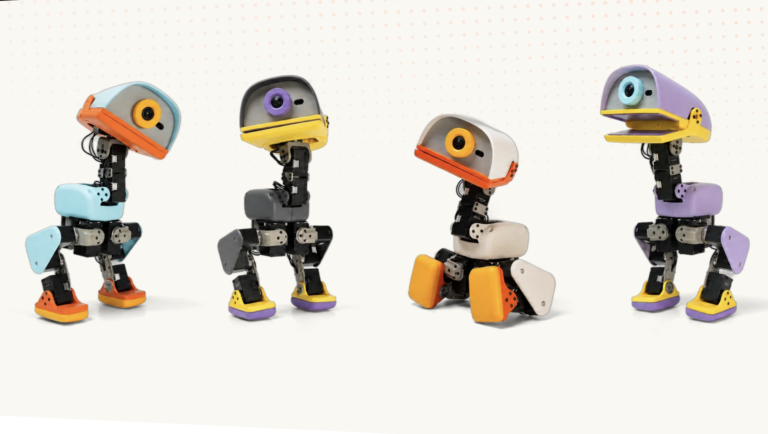
A robot trained entirely in a computer simulation can now walk, turn, and recover from being knocked over on real hardware that costs $399—with no hardware-specific tuning, no adaptation step, and no modification of the exported policy file. That result, published today in a joint tutorial published today on Hugging Face by NVIDIA and Pollen Robotics researchers, closes a gap that has limited low-cost bipedal robotics research for years: you no longer need an expensive hardware fleet to develop a working locomotion policy.
The deeper consequence is a structural shift in who can run this class of research. Until now, bridging simulation physics to real-world hardware required either precision-characterized industrial actuators or enough physical robots to empirically profile the unit-to-unit variation in the cheaper ones. A $399 consumer robot plus GPU cloud time now replaces both. The cost barrier to conducting comparative bipedal locomotion experiments has not merely dropped — it has collapsed.
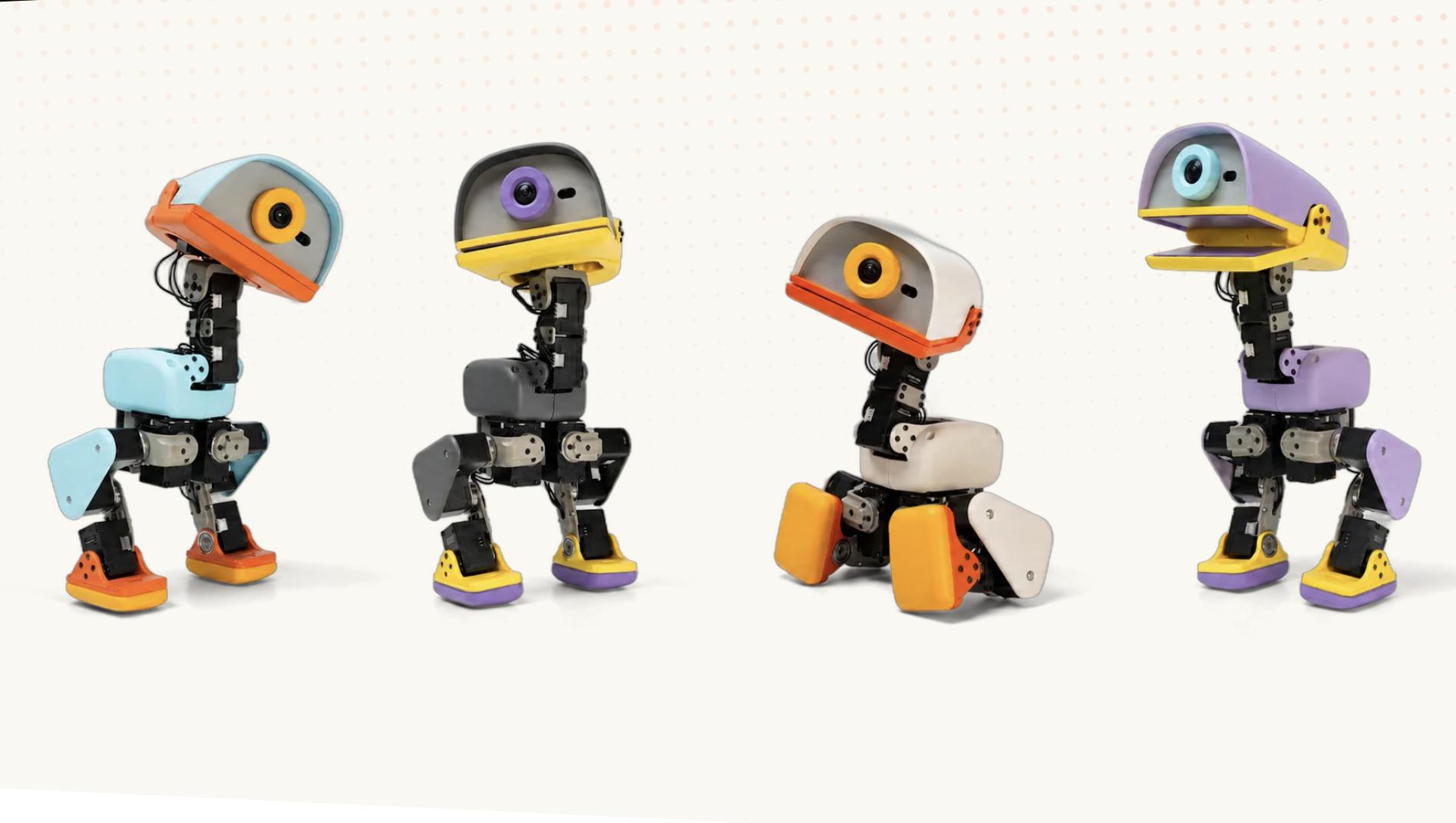
The robot is Microduck: a 25 cm (9.8 in) tall, approximately 780 g (1.7 lbs) bipedal duck from Pollen Robotics, the French startup Hugging Face acquired in April 2025. It runs 15 consumer-grade hobby servos at a 50 Hz control loop on a Rockchip RK3566 processor with a 1 TOPS neural processing unit — the kind of hardware found in budget single-board computers, not research labs. Microduck pre-orders opened August 27 at $399 and sold more than 10,000 units within days, generating about $4 million in pre-order revenue. The simulation framework is NVIDIA Isaac Lab 3.0, the open-source reinforcement-learning platform built atop Isaac Sim 6.0 and the Newton physics engine.
Why Sim-to-Real Has Been Hard for Cheap Hardware
Simulation-to-real transfer fails when the physics model diverges from reality—the so-called reality gap. For high-cost research robots, engineers invest heavily in precisely characterized actuators, rigid hardware specs, and documented tolerances. Microduck is a different animal: its hobby servos have real friction, mechanical play in the gearboxes, response lag, and unit-to-unit variation in every joint.
These characteristics collectively guarantee that a policy trained on idealized, frictionless simulation joints will stumble immediately on the physical robot. The servo that worked perfectly in simulation sags under load; the gearbox that reversed cleanly in the model has dead-zone play that makes the real joint lag behind. Closing that gap without custom actuator characterization rigs — typically the most expensive part of low-cost-hardware robotics research — is exactly what the NVIDIA-Pollen Robotics work demonstrates.
What Isaac Lab 3.0 Does Differently: Actuator Models That Feel Like Real Servos
The technical answer is threefold, and each element targets a specific source of sim-to-real divergence.
Newton-based Better Actuator Models. Standard rigid-body simulation treats servo joints as ideal torque sources with instantaneous response. NVIDIA’s Newton physics engine instead builds Better Actuator Models (BAM) that encode four sources of real servo behavior: the embedded firmware PID loop’s delay and overshoot; motor electrical limits that cap how quickly the servo responds to a position command; friction in the gear train that creates a stiction threshold the servo must overcome before moving; and the position-command-to-physical-movement latency inherent in hobby servos — typically 10 to 30 milliseconds versus sub-millisecond for industrial actuators. The result is a simulation that behaves more like the specific class of hardware Microduck uses than any standard physics model would.
Per-joint backlash modeling. Every gearbox has backlash: a small amount of mechanical play that means reversing direction moves the transmission before the output shaft responds. Isaac Lab 3.0 introduces a backlash preset that models this dead-zone nonlinearity and varies it independently per joint at each training reset, representing the uneven wear and manufacturing tolerance variation across different production units. For a robot built around hobby-grade gear trains rather than precision industrial servos, per-joint backlash randomization is a realistic and important source of behavioral variation.
Aggressive domain randomization across seven parameter categories. On every simulated Microduck in the training run, the researchers varied seven parameter categories — mass and center-of-mass position, ground friction coefficient, joint inertia values, encoder offsets (simulating miscalibrated joint zero points), battery voltage and voltage sag, and command latency. They also varied terrain — flat surfaces, stairs, slopes, and rough ground — and applied external perturbation forces equivalent to digital shoves during training. The purpose: expose the policy to enough variation during training that the specific conditions of any single real Microduck unit fall well within the distribution it has already learned to handle.
How Does Training 4,096 Robots at Once Make This Possible?
The domain randomization approach described above would be computationally intractable without GPU-parallel simulation. Isaac Lab ran 4,096 simulated environments simultaneously on a single GPU, reaching up to 1.25 million simulation steps per second when training with rough terrain and backlash enabled — and distributed training across 16 GPUs further increased both throughput and the diversity of training scenarios.
This throughput is what makes the economics work. A few hours of GPU cloud compute at this scale costs less than one Microduck unit. The Newton BAM eliminates the need for hardware-fleet characterization because it models actuator behavior from physical principles — firmware controller dynamics, electrical limits, friction, delay — rather than from empirical measurement on physical hardware. The fleet of robots that would previously have been required to profile unit-to-unit variation is replaced by a randomization parameter and a simulator that runs 4,096 instances per second.
The policy architecture is deliberately minimal: 61 observations covering robot joint positions, velocities, inertial measurements, and velocity commands feed into a network that outputs 14 joint position targets. The training library is RSL-RL, the PPO-based reinforcement learning framework originally developed at ETH Zurich for quadruped locomotion research. The policy trains on-policy, updating from fresh rollouts collected across all 4,096 environments.
It Works on the Real Robot
The deployed policy demonstrates three behaviors that have historically required significant hardware-specific tuning to achieve together: forward walking, turning, and fall recovery. Video from the Pollen Robotics team shows a physical Microduck navigating an office floor on carpet, responding to gamepad-issued velocity commands, and — after being physically knocked over — returning to an upright stance and resuming its gait without human intervention.
Fall recovery is the most demanding test of the approach. The robot must generalize from the external-push perturbations it encountered during training to the specific dynamics of an actual fall from an orientation it may never have seen in exactly that form. The fact that the policy handles it without a dedicated fall-recovery training phase reflects the breadth of the domain randomization rather than any specialized engineering for the recovery case.
Deployment requires no adaptation. Once training completes, the policy exports automatically to both TorchScript (.pt) and ONNX (.onnx) formats. The ONNX file transfers to the physical Microduck via a standard scp command and loads with a single robotctl policy load walk call. The onboard Rockchip RK3566 runs inference at 50 Hz using its ARM CPU cores and 1 TOPS NPU. Observation order, normalization, and action scaling remain consistent between training and deployment, but no modification of the exported file is required.
An Open Training Pipeline Anyone Can Clone
The publication is a research result and a tutorial simultaneously. The full Microduck training environment ships inside Isaac Lab’s open-source GitHub training repository: robot model, scene configuration, reward functions, and domain randomization settings for both flat-terrain and rough-terrain training variants. Developers can clone the repository, install dependencies via the uv package manager, and launch a 4,096-environment training run with a single command.
NVIDIA and Pollen Robotics have also launched Microduck Arena, a Hugging Face Space that accepts ONNX policy submissions meeting a standard interface — 61 observations, 14 actions, files under 64 MiB — and benchmarks them on shared leaderboard challenges. Researchers who improve on the baseline walking policy can publish their work directly to the Hugging Face Hub alongside model cards and configuration files, creating a community benchmark for locomotion policy development on commodity hardware.
The tutorial also previews extensions under development: head-camera depth integration for perception-based navigation, ramp traversal, and multi-fingered manipulation tasks using Isaac Lab’s Kuka-Allegro examples.
Context: Isaac Lab 3.0 and the NVIDIA-Hugging Face Acquisition
Isaac Lab 3.0 was introduced by NVIDIA at GTC 2026 in March 2026, as part of a broader physical AI stack that includes Cosmos world foundation models for synthetic data generation and the Newton physics engine that powers the actuator modeling used here. Earlier versions of Isaac Lab contained a critical security vulnerability — CVE-2025-32210, a deserialization flaw that could allow malicious code execution — which was patched in Isaac Sim v2.3.0; the current Isaac Sim 6.0 release resolves this issue.
The Microduck collaboration carries additional corporate context. Reports based on SEC filings indicate NVIDIA entered into a definitive agreement signed September 2, 2026, to acquire Hugging Face for approximately $12.9 billion — $11.9 billion purchase price plus approximately $1 billion in retention packages. The transaction is pending regulatory approval, with close expected in the first half of 2027. If completed, it would bring Pollen Robotics and the Microduck platform directly into NVIDIA’s portfolio. NVIDIA has committed to keeping the Hugging Face platform open and continuing support for hardware from other silicon vendors.
The depth of integration on display today — shared infrastructure, co-authored publications, joint leaderboard tooling — reflects a closely aligned engineering relationship that predates the acquisition announcement. Hugging Face CEO Clement Delangue described the platform at Microduck’s launch as aimed at democratizing physical AI; the Isaac Lab integration is what provides the engineering mechanism behind that claim.
What This Means for Robotics Research Access
For the field of legged robotics, the direction is clear. The sim-to-real gap has been narrowed before — but always on expensive, precisely documented hardware. The contribution of the NVIDIA-Pollen Robotics tutorial is demonstrating it on hardware that any university lab, independent researcher, or well-funded hobbyist can afford.
A graduate student at a university without a robotics hardware budget can pre-order a Microduck, run training on Hugging Face’s cloud GPU infrastructure, and reproduce a working locomotion policy from scratch. A research team in a lower-income country, where a Boston Dynamics or Agility Robotics platform represents an unattainable budget item, can work at the same capability level using $399 hardware and a few hours of compute. The Arena leaderboard gives that work a public benchmark — and a community to compete with.
Microduck walking across a carpeted office floor on a policy that never touched real carpet during training is a single data point. But it lands in a clear trend: as simulation fidelity improves and domain randomization becomes more systematic, the hardware cost required to develop competent locomotion policies is trending toward the price of a consumer product.
Frequently Asked Questions
What is sim-to-real transfer in robotics, and why has it been difficult?
Sim-to-real transfer is the process of training a robot’s control policy entirely in computer simulation and then deploying that same policy on a physical robot without modification. It has historically been difficult because simulation physics are always imperfect approximations of the real world — servos have friction, gearboxes have mechanical play, battery voltage sags under load, and every physical unit differs slightly from every other. A policy trained on an idealized simulation fails on real hardware because those real-world imperfections fall outside the conditions the policy learned to handle. Isaac Lab 3.0 addresses this through Newton-based Better Actuator Models that simulate the specific behavior of hobby servos (including firmware delay, friction, and electrical limits) and aggressive domain randomization that exposes the policy to thousands of variations during training, so the real robot’s imperfections look like just another sample from a distribution the policy already knows.
Can I train my own Microduck walking policy using the published tutorial?
Yes. The full training environment — robot model, reward functions, scene configuration, and domain randomization settings — is included in the Isaac Lab open-source repository on GitHub. You can clone the repository, install dependencies with the uv package manager, and launch a 4,096-environment training run with a single command. Once training completes, the policy exports automatically to ONNX format and loads onto the physical robot via a single robotctl command. If you lack a local GPU, Hugging Face Jobs provides cloud compute access. Trained policies can be submitted to the Microduck Arena leaderboard on Hugging Face for public benchmarking.
What does the NVIDIA-Hugging Face acquisition mean for Microduck and open-source robotics?
A definitive agreement for NVIDIA to acquire Hugging Face for approximately $12.9 billion was signed September 2, 2026, and is pending regulatory approval expected in the first half of 2027. If the transaction closes, Pollen Robotics — the French startup that built Microduck and was itself acquired by Hugging Face in April 2025 — would become part of NVIDIA’s portfolio. NVIDIA has committed to keeping the Hugging Face platform open and continuing support for non-NVIDIA hardware, which would preserve the open-source training pipeline and community leaderboard that the Microduck tutorial establishes. The acquisition is not yet final, and the current tutorial and training infrastructure are available regardless of the transaction’s outcome.
Does training locomotion policies in simulation now require expensive GPU hardware?
Not necessarily. The NVIDIA-Pollen tutorial used 16 GPUs for distributed training to maximize scenario diversity, but the baseline training configuration runs on a single GPU. Hugging Face Jobs provides cloud GPU access for users who do not have local hardware. The key insight of the tutorial is that the expensive part of traditional locomotion research — maintaining a fleet of physical robots to characterize hardware variation — is replaced by simulation parameter randomization, which runs on a single GPU. The economics shift from hardware capital expenditure to cloud compute time, which is rented by the hour.