HomeAuto Miss Kobayashi’s Dragon Maid Movie Frames Faction War as Entropy: Found Family Wins by Physics
Miss Kobayashi’s Dragon Maid Movie Frames Faction War as Entropy: Found Family Wins by Physics
October 21, 2026:
Crunchyroll.com
One year after Miss Kobayashi’s Dragon Maid: A Lonely Dragon Wants to Be Loved launched the Crunchyroll Anime Nights inaugural program as its first US theatrical feature, the film deserves a closer examination of what it is actually doing — because what it is doing is not typical anime fantasy. The hidden antagonist of this 105-minute Kyoto Animation theatrical release is not a villain with a name and a motivation. It is entropy. And the household at the center of the franchise does not win through love alone. It functions, in formal thermodynamic terms, as a Maxwell’s Demon thought experiment operating at the scale of an interspecies civilizational conflict — a structure so specific that it demands a physicist’s vocabulary alongside a folklorist’s.
Chaos Forces and Harmony Forces Are Entropy and Negentropy, Not Good and Evil
The film opens the Dragon Maid universe’s factional conflict to its full scope. The Chaos Forces (混沌勢) drive toward destruction and dissolution — the natural endpoint of any system left to run according to the Second Law of Thermodynamics, which states that in any isolated system, entropy can only increase. The Harmony Forces (調和勢) resist that dissolution, preserving structure, history, and continuity — a negentropic faction in the technical sense: they locally decrease entropy by adding order, at the cost of exporting greater disorder elsewhere.
This is not a metaphor the franchise stumbled into. The naming is precise. 混沌 (konton) is the Japanese rendering of “chaos” in the ancient cosmological sense — the formless void preceding creation. 調和 (chōwa) means “harmony” and “accord” — the maintenance of integrated structure. The film’s faction war is an argument about the direction of time itself.
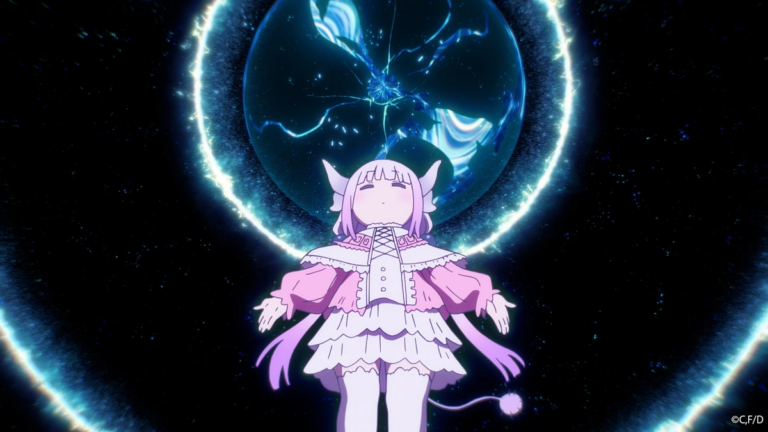
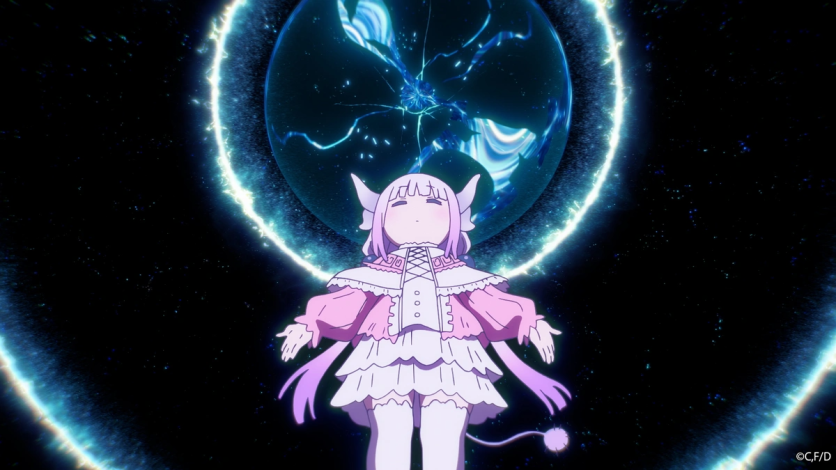
The young dragon Kanna Kamui (voiced by Maria Naganawa) is a Chaos-faction dragon whose homeworld has sent an emissary — her blood-kin Kimun Kamui (voiced by Fumihiko Tachiki) — to demand her return. Against him stands the Harmony faction’s elder dragon Felicitas (voiced by Sachiko Kobayashi). Between them stands Kanna’s chosen household: Kobayashi (Mutsumi Tamura as Kobayashi), a human software engineer who has, without any evolutionary logic to support it, become Kanna’s primary attachment figure and functional parent.
Kobayashi’s Household Operates as a Maxwell’s Demon — and the Thermodynamic Cost Is Real
James Clerk Maxwell described his famous Maxwell’s 1867 thought experiment as an imaginary being stationed at a trapdoor between two chambers of gas, able to observe individual molecules and sort the fast ones from the slow ones, creating a temperature difference without doing work — an apparent violation of the Second Law. The paradox was resolved by Leo Szilard (1929) and confirmed formally by Charles Bennett in 1982: the Demon must pay a thermodynamic cost in information processing — specifically, in the erasure of its own memory to operate the next cycle, per Landauer’s 1961 erasure principle. Information, Bennett proved, is physically real and thermodynamically costly.
Kobayashi functions as Maxwell’s Demon not because she is extraordinarily powerful but because she is extraordinarily perceptive. She observes each member of her household — Tohru (Yuki Kuwahara), Kanna, Iruru (Shiori Sugiura), Fafnir (Daisuke Ono), Elma (Yuki Takada), Lucoa (Minami Takahashi) — and sorts their energies. She routes Tohru’s fidelity drive toward domestic productivity. She channels Kanna’s loneliness into structured care rituals. She absorbs Iruru’s aggression and reflects it back as respect. Each act of sorting costs Kobayashi something: attention, patience, social capital, sleep. The household maintains local order — negentropic stability — only because Kobayashi continuously pays the thermodynamic information sorting cost that the Second Law demands.
The franchise’s central argument follows directly: the household defeats both the Chaos faction and the Harmony faction not by being more powerful than either, but by being a more efficient Maxwell’s Demon than any pure-faction system can construct. A homogeneous system — all Chaos, all Harmony — generates no internal differentiation for a Demon to sort. A heterogeneous household provides exactly the molecular variety that makes sorting productive and stable.
Why Hamilton’s Rule Cannot Explain Kanna’s Loyalty to Kobayashi
The evolutionary biology of the film’s emotional center is surprisingly precise — and the film is pointing at the right framework, even if it does not name it. W.D. Hamilton’s formal model of altruism, published in 1964, states that natural selection favors a behavior when r·B > C: the coefficient of genetic relatedness (r) times the benefit to the recipient (B) must exceed the cost to the actor (C), per Hamilton’s 1964 formal model. Kanna’s genetic relatedness to Kobayashi is, by any reasonable model, zero. Dragons and humans in this franchise’s cosmology inhabit different dimensional realms modeled on inter-dimensional bulk-brane cosmology, forming interspecies bonds that kin selection, which operates on shared hereditary information, cannot account for.
Trivers’ reciprocal altruism framework (1971) also fails here. Reciprocal altruism requires that the cost to the helper be offset by anticipated future benefits. The cost to Kanna of remaining in the human world — permanent separation from her natal faction, forgoing the power resources faction membership confers, living indefinitely in a body constrained to human-safe scale — vastly exceeds any plausible return from Kobayashi’s provision of meals and shelter. The arithmetic does not work under Trivers’ model.
What Bowlby’s 1969 attachment theory provides that neither framework can is a mechanism independent of genetic overlap and fitness accounting. Attachment forms in response to consistent, responsive caregiving over time — not in response to genetic similarity. Bowlby argued that consistent caregiving from any figure could establish the bond, and that “mothering” was a behavioral rather than biological category. Kobayashi has done precisely this. The film is not asking audiences to suspend biological reasoning. It is pointing toward the correct biological framework: not the one that predicts behavior from genes, but the one that predicts bond formation from behavioral history.
Dragonkind’s Morphogenesis Is Phenotypic Plasticity Without a Known Mechanism
Dragons in this franchise shift between full-scale serpentine forms and human-appearing bodies at will, in seconds, across the entire spectrum of skeletal, muscular, and organ architecture. West-Eberhard’s developmental plasticity textbook (2003) defines phenotypic plasticity as environmentally induced changes in an organism’s observable traits without changes to underlying DNA. Dragonkind’s morphogenesis exceeds this framework in one critical dimension: it is voluntary, not environmentally triggered, and operates at millisecond timescales across whole-body structural reorganization.
The closest real-world analogs — cuttlefish chromatophore surface displays, flatfish dorsal-ventral coloration adjustments — operate at the surface level only, driven by muscular contraction of pre-existing pigment cells. No known biological mechanism allows voluntary reorganization of gross body plan, bone mass, and organ volume at the speed the franchise depicts. Dragonkind’s morphogenesis is something beyond phenotypic plasticity as biology understands it: a being whose phenotype is genuinely decoupled from its developmental history, whose body is chosen as an expression of social role rather than grown as a consequence of genes and environment.
This matters for the film’s argument. Kanna choosing a human-scale body is not concealment. It is a statement of attachment expressed in tissue.
Iruru’s Strategic Neutrality Is Georg Simmel’s Tertius Gaudens in Dragon Form
Georg Simmel’s Simmel’s 1908 triadic conflict theory identified three structurally distinct positions within triadic conflict. The mediator works to reduce conflict between the other two parties. The divide et impera agent manufactures conflict to exploit both sides. The tertius gaudens — “the rejoicing third,” from the Latin — benefits structurally from the ongoing conflict without actively causing or resolving it. Both opposing parties have incentive to court the tertius, making the position unusually stable: commitment to either side ends the structural advantage immediately.
Iruru (Shiori Sugiura), introduced as a Chaos-faction antagonist and gradually integrated into Kobayashi’s household, occupies the tertius gaudens position with formal precision. She has not allied with the Harmony faction despite living alongside its members. She has not maintained loyalty to the Chaos faction despite her origin. Both factions require her cooperation; neither has secured it. Simmel’s structural analysis predicts exactly this behavior: in a triadic conflict, the third party who rejoices is rational to remain uncommitted as long as the conflict persists, exploiting the tertius gaudens structural advantage, and irrational to resolve it. Iruru is not confused or undecided. She is structurally optimal.
Felicitas Sings Enka Because Enka Is Jan Assmann’s Cultural Memory Archive
Sachiko Kobayashi career biography, who voices the Harmony faction elder Felicitas and performs the film’s ending theme “Bokutachi no Hibi,” debuted as a professional enka singer in approximately 1963, making her active career span more than six decades at the time of the film’s Japan theatrical premiere on June 27, 2025. She has made Kohaku Uta Gassen regular appearances — more than thirty — at NHK’s Kōhaku Uta Gassen, Japan’s premier New Year’s Eve broadcast. She is a living cultural archive in a measurable, institutional sense.
Assmann’s 1992 cultural memory framework, Das kulturelle Gedächtnis, distinguishes between communicative memory — the living, embodied memory of a community, lasting approximately three generations or eighty years — and cultural memory: institutionalized forms that extend beyond living witness through texts, rituals, monuments, and performed arts. Enka genre vocal traditions, with pentatonic minor scales, melismatic kobushi vocal ornaments, and recurring themes of rain, longing, and hometown nostalgia, function as a cultural memory archive in precisely the sense Assmann describes: transmitting collective emotional identity across generations that share no living memory of the original grief encoded.
Casting Sachiko Kobayashi as the Harmony faction’s elder is an analytical statement about what the Harmony faction fundamentally is. It is not the preservation of power structures or hierarchical order. It is the preservation of collective memory — the negentropic act of preventing a community from losing knowledge of who it was. In thermodynamic terms, enka is a structure that continuously reduces the entropy of cultural forgetting, at the cost of sustained effort across generations: performances, recordings, apprenticeships, broadcast slots on New Year’s Eve. Felicitas is not the Harmony faction’s warrior. She is its entropy-reduction mechanism.
What Happened to Kyoto Animation, and Why Does This Film Matter More Because of It?
On July 18, 2019, Shinji Aoba perpetrated the 2019 Kyoto Animation arson attack, setting fire to Kyoto Animation’s No. 1 studio building in Uji, Kyoto. Thirty-six employees died. Among them was Yasuhiro Takemoto, who had directed the original Miss Kobayashi’s Dragon Maid television series in 2017. Aoba was convicted and sentenced to death January 2024, his death sentence issued on January 25, 2024.
The theatrical film was directed by Tatsuya Ishihara, who had directed the franchise’s second season in 2021 and who carried the theatrical production forward as KyoAni rebuilt its operation. Takemoto received a posthumous credit. The film surpassed 400 million yen Japan in theatrical box office earnings, bringing in over ¥400 million (approximately $2.52 million USD) following its Japanese theatrical premiere.
The found-family argument the franchise has always made — that the household you choose can outlast the faction you were born into — carries different weight knowing who built it and what they survived. The Chaos faction’s drive toward destruction is not a theoretical physics concept for a studio that watched its building burn with thirty-six people inside. The household that resists that drive is not a sentimental construction. It is a documented institutional response.
Crunchyroll Anime Nights Brought the Film to US Theaters
Crunchyroll launched its Anime Nights theatrical program in October 2025 with Miss Kobayashi’s Dragon Maid: A Lonely Dragon Wants to Be Loved as the inaugural feature, placing it in 225+ US theater Anime Nights locations. The monthly program brings anime theatrical films to US audiences on a rotating basis. The film became available for streaming through Crunchyroll’s service following the theatrical window; Crunchyroll holds worldwide distribution rights outside Japan and serves more than 21 million subscribers worldwide. The film’s opening theme “Namida no Parade” is performed by fhána; the insert song “Negaigoto” is by kotringo.
Exchange rate as of October 20, 2026; conversions are approximate.
Frequently Asked Questions
What is Miss Kobayashi’s Dragon Maid: A Lonely Dragon Wants to Be Loved actually about?
The 105-minute theatrical film follows Kanna Kamui, a young dragon from the franchise’s established found-family household, as emissaries from her birth faction — the entropy-driving Chaos Forces — arrive demanding her return to the dragon world. Director Tatsuya Ishihara widens the scope to reveal the full factional cosmology: the Chaos Forces pushing toward dissolution, the Harmony Forces preserving structure and collective memory, a hidden third power that manipulates both factions as instruments, and the human household at the center that defeats all three by functioning as a more efficient information-sorting system than any pure faction can build. The emotional question — whether the family Kanna and software engineer Kobayashi have made is durable enough to survive a civilizational-scale conflict — is answered thermodynamically as well as emotionally. The film is a tender and formally rigorous argument that found families are structurally superior to birth factions, expressed in the vocabulary of physics.
Does the franchise’s STEM framework hold up?
It holds up better than most science-adjacent anime, with one significant gap. The thermodynamic framework is structurally coherent: Chaos as an entropy-maximizing force, Harmony as a negentropic preservation system, and the hidden manipulator as a Maxwell’s Demon — per the Maxwell’s Demon thermodynamics article — are all defensible applications of established physics. The attachment theory argument — that Hamilton’s Rule (1964) cannot explain Kanna’s loyalty to Kobayashi across zero genetic relatedness, but Bowlby’s attachment theory framework (1969) can — is sound evolutionary biology correctly applied. Where the franchise outstrips known science is phenotypic plasticity: voluntary whole-body morphogenesis at millisecond timescales, across gross skeletal architecture, has no known biological mechanism per West-Eberhard’s 2003 plasticity study. Even extreme real-world plasticity — cephalopod chromatophore displays — operates only at the surface-coloration level. Dragonkind’s shapeshifting requires a biology the franchise has not yet invented, but the gap is precisely located.
Why does the film argue that a diverse household defeats pure-faction armies?
This is the franchise’s largest structurally implied claim, and it is thermodynamic rather than merely sentimental. A Maxwell’s Demon information sorting entity that maintains local order against entropy requires differentiation among the things it sorts. In a monoculture, every member is identical; there is nothing for the Demon to distinguish. In Kobayashi’s household, each member carries a different factional origin, a different energy profile, and a different relationship to the entropy-negentropy axis. Kobayashi’s perceptiveness gives her the information she needs to sort them productively. The household is more efficient at maintaining local order than any faction precisely because its members are heterogeneous. Assmann’s cultural memory theory (1992) adds a second dimension: the household also preserves collective memory across the species gap, with Felicitas’s enka tradition transmitting civilizational identity that pure force cannot generate. The film’s argument is that heterogeneity is not merely ethically preferable to faction loyalty — it is thermodynamically and mnemonically superior.
What is Crunchyroll Anime Nights, and where can I watch the film?
Crunchyroll Anime Nights theatrical program is a monthly US theatrical program that brings anime films to 225+ theaters nationwide. Miss Kobayashi’s Dragon Maid: A Lonely Dragon Wants to Be Loved was the program’s inaugural feature when it launched in October 2025. The film is available for streaming through Crunchyroll’s service for the platform’s more than 21 million subscribers worldwide. Crunchyroll holds Crunchyroll worldwide distribution rights outside Japan.