October 20, 2026:


Japan’s space agency has launched an ambitious mission to investigate the origins of Mars’ two moons and bring extraterrestrial material back to Earth.
Known as the Martian Moons eXploration (MMX) mission, the project aims to collect samples from Phobos, the larger of Mars’ two natural satellites, and return them to laboratories for detailed scientific analysis.
Led by the Japan Aerospace Exploration Agency (JAXA), the mission represents a major step in planetary exploration.
By examining material directly from Phobos, researchers hope to determine whether the moon is a captured asteroid or the remains of an ancient collision involving Mars.
Ars Technica reports that the MMX mission is a robotic space exploration project designed to study Phobos and Deimos, the two moons orbiting Mars. Its primary objective is to collect samples from Phobos and deliver them to Earth for laboratory examination.
The spacecraft launched aboard Japan’s H3 rocket from Tanegashima Space Center in southern Japan. The launch vehicle used an upgraded configuration with four solid rocket boosters, powerful main engines, and an extended payload fairing to accommodate the spacecraft.
Weighing approximately 4.5 metric tons, the MMX spacecraft carries a substantial amount of propellant for its journey through the Martian system. Following separation from the rocket, the spacecraft established contact with ground controllers and deployed its solar panels.
The mission builds on Japan’s experience with the Hayabusa and Hayabusa2 asteroid sample-return programs. Those projects demonstrated the country’s ability to collect material from small celestial bodies and transport it back to Earth.
One of the biggest questions surrounding Mars is how its two moons formed. Although Phobos and Deimos have been observed by spacecraft for decades, their origins remain uncertain.
Scientists generally consider two leading explanations. The first proposes that the moons are asteroids captured by Mars’ gravitational pull. Their appearance and some observed characteristics resemble primitive objects found in the asteroid belt.
The second theory suggests that the moons formed from debris produced by a massive collision involving Mars early in the planet’s history. Under this scenario, material ejected by the impact eventually gathered into orbiting bodies.
The Phobos sample return mission could help distinguish between these possibilities. Remote observations provide valuable information about surface characteristics and composition, but samples analyzed in laboratories can reveal details that instruments operating millions of kilometers away cannot easily establish.
By studying the mineral composition and chemical properties of Phobos, researchers hope to identify evidence that supports one formation theory over the other.
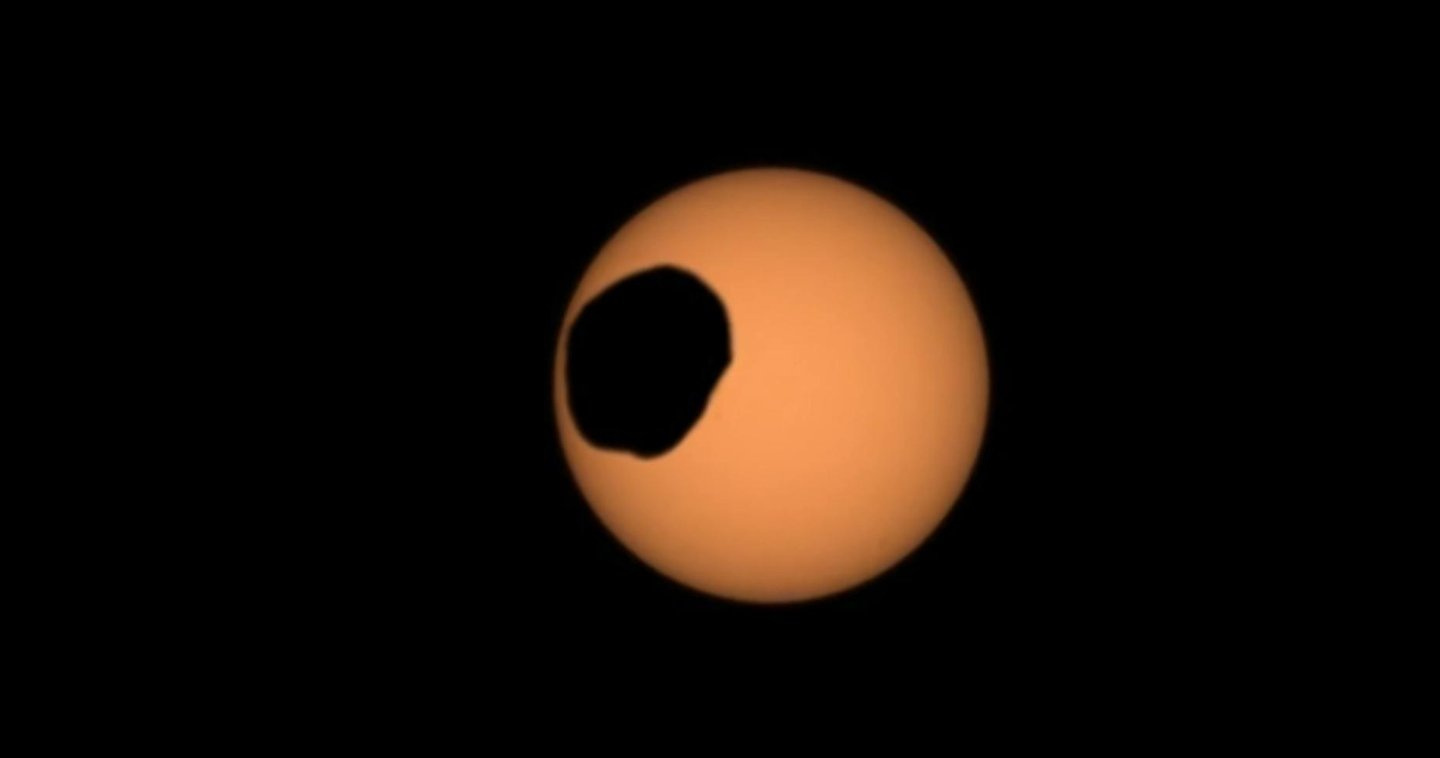
Phobos is the larger of Mars’ two moons, with an irregular, potato-like shape and an average diameter of approximately 22 kilometers. Despite its small size, it offers a potentially valuable record of the early Solar System.
Phobos also orbits unusually close to Mars, at roughly 40 times closer to its planet than Earth’s Moon is to Earth. This proximity makes the moon particularly interesting because material from Mars may have reached its surface through ancient impacts.
Deimos, the smaller and more distant moon, is another target of the MMX mission’s scientific observations. Studying both objects could help researchers determine whether they share a common origin or developed through different processes.
The mission’s observations of the Martian moons will provide important context for interpreting the material collected from Phobos.
After reaching the Martian system, the MMX spacecraft is expected to spend approximately three years conducting observations and maneuvers around Mars and its moons.
Because Phobos has extremely weak gravity, the spacecraft cannot rely on a conventional stable orbit around the moon. Mars’ gravitational influence makes the orbital environment more complicated, requiring MMX to use a quasi-satellite orbit that allows it to remain near Phobos while still orbiting Mars.
The spacecraft will map the moon’s surface and identify suitable locations for landing and sample collection. These observations will help mission planners account for its rough terrain and uneven gravitational field.
A major part of the exploration phase involves deploying Idefix, a small four-wheeled rover developed with contributions from the French and German space agencies. Roughly the size of a large shoebox, the rover is designed to investigate Phobos’ surface and operate for up to 100 days under challenging conditions.
Its observations will help scientists better understand the surface environment before the main spacecraft attempts to collect samples.
The most technically demanding stage involves landing on Phobos and gathering material without bouncing back into space. Its weak and irregular gravity makes even a brief landing a significant engineering challenge.
The spacecraft is designed to attempt up to two landings, with landing gear intended to absorb impact energy and reduce the risk of tipping over.
Two separate sampling mechanisms will collect material from the surface. A coring device attached to a robotic arm will retrieve a cylindrical specimen, while a pneumatic sampler supplied by NASA will use a high-pressure nitrogen gas cartridge to propel surface particles into a collection container.
Researchers expect the spacecraft to retrieve at least 10 grams of material. Although that amount may appear small, carefully preserved samples could provide years of scientific research.
The returned material will undergo detailed laboratory analysis, allowing scientists to investigate its composition, mineral structure, and possible relationship to Mars or primitive asteroids.
Although JAXA leads the project, the MMX mission is an international effort involving contributions from NASA and European space agencies.
NASA is providing a pneumatic sampling device and a gamma-ray and neutron spectrometer designed to measure the elemental composition of the Martian moons. In exchange for its contributions, US researchers are expected to receive 15 percent of the returned Phobos samples.
France and Germany are contributing the Idefix rover, expanding the mission’s ability to examine the moon’s surface.
This international collaboration builds on Japan’s previous success with asteroid sample-return missions and combines expertise in spacecraft engineering, surface exploration, and planetary science.
According to the mission timeline described by JAXA, the spacecraft is expected to collect samples during 2029 before beginning its return journey to Earth in 2030.
The mission plan calls for a sample-return capsule to reach a remote landing area in South Australia in 2031. After recovery, the samples will be transported to laboratories in Japan for scientific examination, with international partners participating in the analysis.
If successful, the mission will provide researchers with material from a Martian moon for direct study, helping address questions that have remained unresolved since the first spacecraft observations of Phobos and Deimos.
The mission could also provide useful information for future human exploration. Understanding Phobos’ surface, terrain, and physical properties may help scientists assess whether the moon could serve as a staging point for certain Mars exploration activities.
MMX stands for Martian Moons eXploration. It is a JAXA-led mission designed to study Phobos and Deimos and return samples from Phobos to Earth.
Its primary goal is to determine how Mars’ moons formed by collecting and analyzing samples from Phobos. The findings could help establish whether the moon originated as a captured asteroid or formed from debris following a major impact on Mars.
The mission aims to return at least 10 grams of material. Scientists will analyze the samples in laboratories to investigate their chemical composition, mineral properties, and possible origins.
The mission timeline described in the source anticipates a return in 2031, following sample collection in 2029 and departure from the Martian system in 2030.
Phobos may preserve clues about the formation of Mars’ moons and the early Solar System. Its proximity to Mars also makes it a potential location of interest for future robotic and human exploration.