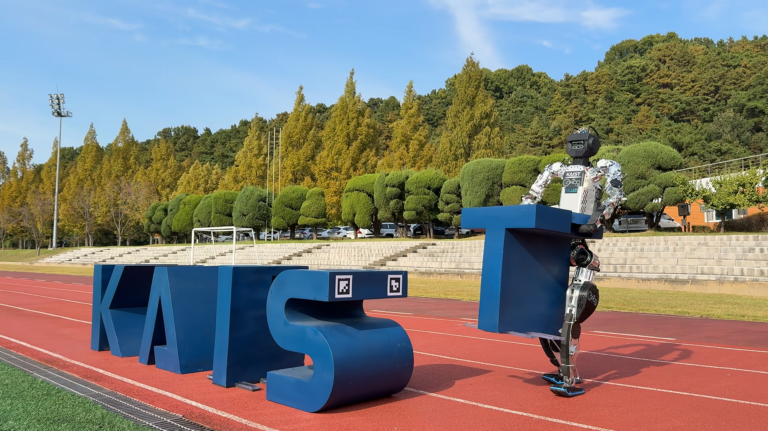
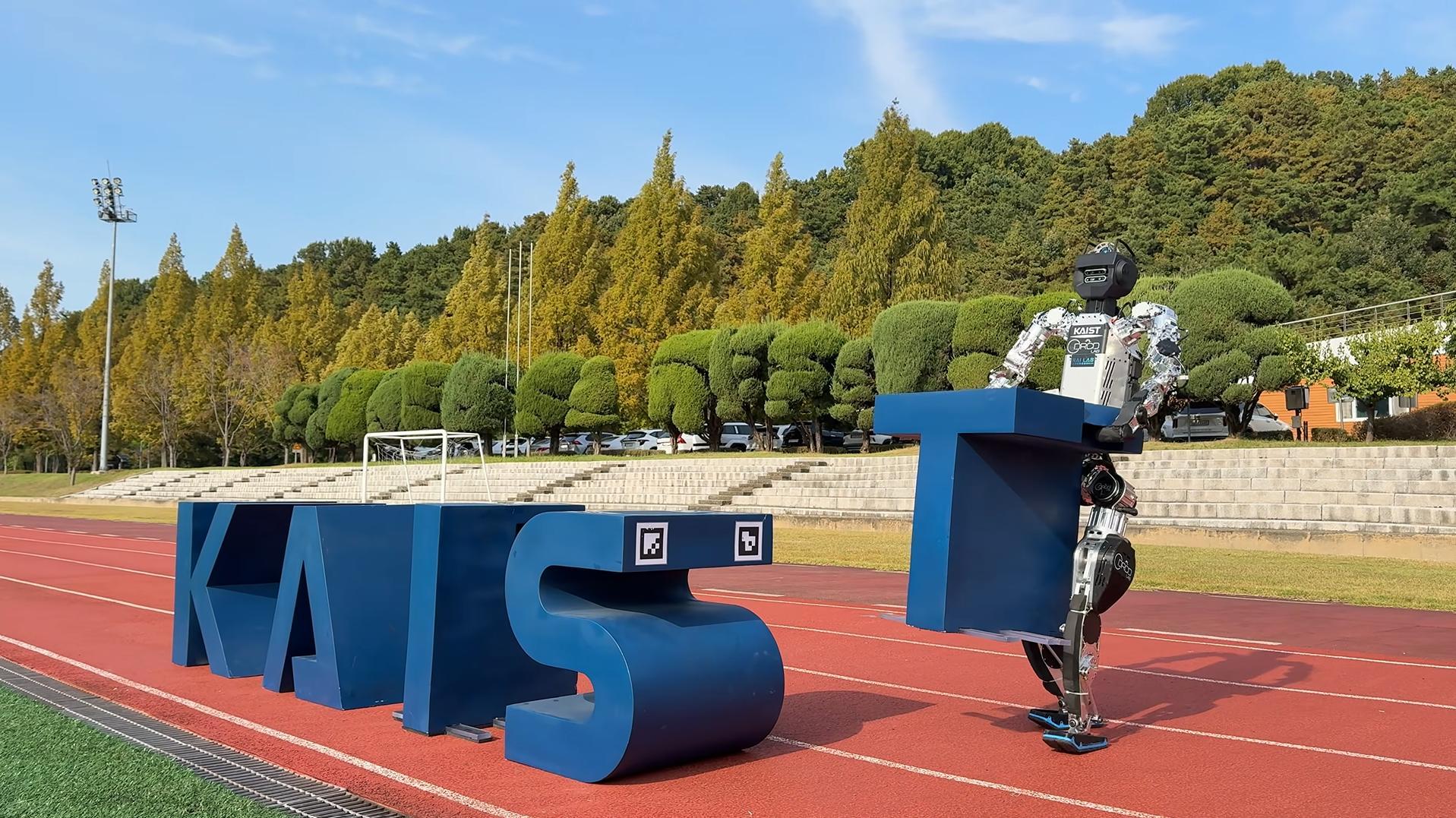
South Korea’s KAIST released a v0.9 whole-body locomanipulation video on Monday, October 19, showing its Humanoid v0.9 pushing objects weighing up to 35 kg (77 lbs) and lifting objects weighing up to 20 kg (44 lbs) while walking — guided entirely by onboard cameras, without external motion capture equipment. The demonstrated 20 kg (44 lb) lifting figure already meets the Korean government’s own K-Humanoid Alliance specification for commercial deployment readiness, a benchmark the Alliance set as its 2028 commercial readiness target when it launched with roughly 1,300 member organizations in April 2025.
The Korea Advanced Institute of Science and Technology released the footage through its KAIST DRCD Lab page, the Dynamic Robot Control and Design Laboratory. The video, titled Whole-Body Locomanipulation with KAIST Humanoid v0.9, shows the robot arranging letter blocks to spell out “KAIST” — navigating its workspace, making contact with objects, and adjusting its balance in real time throughout, as captured in the official v0.9 demo video.
From Legs to Hands
To understand what the v0.9 represents, it helps to understand where the platform came from.
The DRCD Lab, led by Professor Hae-Won Park of KAIST’s Department of Mechanical Engineering, operates under a philosophy of technical independence — designing and manufacturing core components in-house, including a quasi-direct drive actuator design built around a custom 3K planetary gearbox, rather than purchasing industrial off-the-shelf motors.
That commitment produced the KAIST Humanoid v0.7 platform, revealed in March 2026: a 75 kg (165 lbs), 165 cm (5 ft 5 in) platform capable of running at 12 km/h (7.5 mph), walking on uneven terrain using proprioceptive sensing alone, without cameras. Video of the v0.7 moonwalking and playing soccer circulated internationally. Professor Park described the milestone as demonstrating KAIST’s hardware software independence in humanoid research, and framed it as groundwork for exactly the industrial capability the v0.9 is beginning to demonstrate.
The v0.9 is the first public evidence of what comes next. The platform adds upper-body capability developed by RAILAB, the Robust AI Locomotion Lab led by Associate Professor Jemin Hwangbo, also of KAIST’s Department of Mechanical Engineering. Hwangbo’s group has published extensively on whole-body manipulation for legged robots, and the KAIST collaboration — pooling the DRCD Lab’s lower-body expertise and proprietary actuator hardware with RAILAB’s arm design and manipulation research — represents the kind of internal academic partnership South Korea has been explicitly trying to foster at the national level. RAILAB is also collaborating with MIT’s Biomimetic Robotics Lab and Rainbow Robotics as part of the broader KAIST humanoid effort, funded by South Korea’s Ministry of Trade, Industry and Energy.
The result is a robot that no longer treats walking and grasping as separate problems.
What Whole-Body Locomanipulation Actually Means
The term “whole-body locomanipulation” describes a deceptively difficult coordination challenge. When a robot pushes a heavy object, the force applied through its arms travels through its torso and into its legs, changing the balance equations that keep it upright. A robot that treats its walking controller and its arm controller as independent systems — commanding one while the other adjusts — will either stumble under the transferred load or fail to apply enough force to move the object. The problem compounds as the object gets heavier.
The KAIST v0.9 addresses this with a unified policy that coordinates leg movement and arm contact simultaneously, trained through KAIST’s DynaFlow reinforcement learning framework — a combination of deep reinforcement learning and human motion capture data used as a behavioral prior. Rather than training a manipulation policy entirely from scratch in simulation, the team uses motion capture recordings to give the robot kinematically valid reference trajectories — abstract representations of how a person braces their body when pushing or carrying weight. These priors give the policy a physically plausible starting point that reduces the unstable, jerky artifacts common in purely RL-trained systems, and dramatically cuts the training time that pure simulation-based reinforcement learning would otherwise require.
The two figures from Monday’s demonstration — 35 kg (77 lbs) for pushing and 20 kg (44 lbs) for lifting — measure different things deliberately. Pushing along a surface requires generating horizontal force against friction, but the robot does not have to support the object’s full weight against gravity. Lifting does. The gap between the two numbers reflects that physical distinction honestly, and both figures are presented as current demonstrated capability rather than certified payload ratings.
Onboard visual feedback — the robot using its own cameras rather than an external motion capture system — is the key practical qualifier for any of those numbers. Most whole-body manipulation results in the research literature rely on precise object-pose data from external tracking systems. The v0.9’s demonstration runs on sensors the robot carries, which is the only architecture that functions outside a lab with tracking cameras installed in the ceiling.
Already Clearing the Government’s Own Bar
The K-Humanoid Alliance — South Korea’s Ministry of Trade, Industry and Energy-led consortium launched in April 2025 with roughly 1,300 member organizations from academia, industry, and research — set K-Humanoid Alliance 2028 specifications for humanoid robots that include, among other requirements, a lifting capacity of 20 kg (44 lbs) or more. The v0.9’s demonstrated 20 kg (44 lb) lifting figure matches that target exactly — with more than 14 months before the 2028 deadline arrives.
The Alliance’s full 2028 spec also calls for a body weight under 60 kg (132 lbs), more than 50 degrees of freedom, and locomotion speed above 2.5 meters per second (8.2 feet per second). Monday’s demonstration does not directly address all of those figures. But the lifting capacity — the single specification most directly tied to commercial utility in industrial and logistics settings — is one that KAIST’s research platform already clears, as reported in Korea JoongAng Daily coverage.
KAIST is a founding participant in the Alliance. Its research feeds directly into the domestic capability roadmap the Korean government is funding, and a demonstration that clears the 2028 lifting target at the academic research stage, more than a year ahead of the commercial deadline, makes visible to industry partners and government sponsors what that investment has already produced.
A Field That Has Been Waiting for This Benchmark
For most of the past three years, the humanoid robotics field has been publicly debating the same question: locomotion is largely solved — now what? The consensus answer has converged on loco-manipulation, the ability to move and handle objects simultaneously, as the capability that separates research demonstrations from genuinely deployable systems.
Boston Dynamics’ Atlas, which began shipping to commercial customers including Hyundai Motor in 2026, has demonstrated whole-body object handling in structured factory environments, trained through reinforcement learning over millions of simulated repetitions, per the Atlas commercial deployment announcement. Research groups worldwide have published progressively more capable results: a 2026 paper from UT Austin showed a Booster T1 humanoid pushing objects up to 17 kg using onboard egocentric perception — a notable achievement at the time. The KAIST v0.9’s 35 kg (77 lb) pushing figure is roughly double that, with onboard sensing.
The field does not yet have a standardized benchmark for this capability — though that is changing. The 25th IEEE-RAS Humanoids Conference, scheduled for December 2026, is expected to include a Loco-Manipulation Challenge bringing multiple teams through the same task circuit. Until that kind of controlled comparison exists, individual demonstrations like Monday’s provide reference points rather than definitive rankings. What the v0.9 video establishes is that a full-size academic research robot — built from the ground up by a university lab using custom-designed hardware and a homegrown training framework — can now handle loads comparable to what a human warehouse worker might push on a cart, while walking.
The Geopolitical Backdrop
KAIST’s timing is not incidental to a broader national story. South Korea has committed 2.3 trillion Korean won (approximately $1.73 billion at current exchange rates) to humanoid robot development through 2030, and has announced plans to purchase 250 domestically developed humanoid robots in 2027, per the South Korea humanoid investment plan, as part of an early industrial deployment push. The K-Humanoid Alliance membership details confirm roughly 1,300 member organizations. Goldman Sachs analysts identified South Korea in mid-2026 as likely to become a leading global supplier of humanoid components — particularly actuators, a hardware category in which KAIST’s in-house development program has been accumulating proprietary capability for years.
The DRCD Lab’s custom quasi-direct drive actuator, built around an in-house 3K planetary gearbox, is central to that actuator story. Unlike high-ratio industrial gearboxes that are stiff and opaque to external contact forces, KAIST’s quasi-direct drive actuator approach uses low gear ratios that make joints naturally backdrivable — they feel compliant under external loads and reflect back-force transparently, properties essential for legged locomotion and manipulation systems that must absorb unpredictable contact without breaking joints. KAIST’s in-house variant gives the program proprietary hardware that industry partners and competitors cannot simply source off a shelf.
What Comes Next
Today’s demonstration does not establish production readiness, sustained task performance, or the reliability industrial deployment requires. The letter-block arrangement task is structured and controlled — well-chosen to showcase coordinated perception and manipulation, but not the open-ended adaptability that real factory environments demand. KAIST’s own language around the platform is appropriately careful: the v0.9 is a research platform demonstrating current capability, not a commercially rated system.
What it does establish is a concrete, publicly documented number — 35 kg (77 lbs) of pushing, 20 kg (44 lbs) of lifting, onboard vision — against which other research programs can measure themselves and against which the Korean government’s own 2028 commercial target can now be evaluated. In a field where progress has sometimes been opaque and comparison between systems difficult, a university lab putting specific load figures on the record and demonstrating them on video is a contribution to the field’s shared research infrastructure.
The DynaFlow framework, developed by the DRCD Lab for DynaFlow human motion training, generates physically consistent motions from human demonstration data but is not yet fully detailed in public documentation — its role in the v0.9’s training pipeline suggests the lab is working toward a more general solution for teaching manipulation skills from human data, one that could eventually generalize beyond the structured tasks shown today.
The broader KAIST humanoid program has a lineage stretching back more than two decades. The KHR-1 platform, developed in the early 2000s, was among South Korea’s first bipedal research robots. HUBO gained international recognition and eventually competed in DARPA’s Robotics Challenge, where Team KAIST won the 2015 DRC finals — at the time the most grueling public test of humanoid capability ever organized, requiring robots to drive vehicles, open doors, use power tools, and traverse rubble. The v0.9 is what a decade of hardware refinement and a new generation of learning algorithms looks like on the other side of that milestone.
(Exchange rate as of October 19, 2026; conversions are approximate.)
Frequently Asked Questions
What is whole-body locomanipulation, and why does it matter for humanoid robots?
Whole-body locomanipulation means a robot coordinates its legs and arms under a single unified control policy — so it can push or carry objects while continuing to walk, rather than stopping, planting its feet, and then acting. This matters because it is the capability gap between a humanoid that can demonstrate impressive locomotion in a lab and one that can do useful work in a warehouse or factory. A robot that must freeze to pick something up is not a practical industrial robot; a robot that can handle loads while navigating is. The KAIST v0.9’s figures — 35 kg (77 lbs) pushing, 20 kg (44 lbs) lifting — are the first publicly documented benchmarks from a full-size academic platform using only onboard cameras to perceive its environment.
Does KAIST’s v0.9 already meet South Korea’s 2028 humanoid deployment standard?
On the lifting specification, yes. The K-Humanoid Alliance — South Korea’s government-led industry consortium — set its 2028 commercial readiness target at a lifting capacity of 20 kg (44 lbs) or more. The v0.9 demonstrates exactly that figure, with more than 14 months remaining before the 2028 target date. The Alliance’s full 2028 spec also requires a body weight under 60 kg (132 lbs), more than 50 degrees of freedom, and locomotion speed above 2.5 meters per second (8.2 feet per second) — parameters Monday’s video does not directly address. But the lifting capacity, which is the specification most directly tied to industrial utility, is already met by an academic research platform.
What makes KAIST’s DynaFlow training framework different from standard reinforcement learning?
Standard deep reinforcement learning trains a robot policy through simulated trial and error, which can require enormous numbers of training episodes and often produces physically implausible motions that fail to transfer cleanly to real hardware. DynaFlow supplements RL with human motion capture data used as a behavioral prior — giving the robot abstract examples of how a human body braces and balances when pushing or carrying weight. This provides a physically plausible starting point, reduces training artifacts, and appears to improve the stability of the resulting behavior on real hardware. The framework was first developed for the v0.7’s locomotion work and is extended to whole-body manipulation in the v0.9.
How does the v0.9 compare to other humanoid manipulation systems currently being demonstrated?
The most directly comparable publicly documented result is a 2026 UT Austin study showing a Booster T1 humanoid pushing up to 17 kg (38 lbs) using onboard egocentric perception — the v0.9’s 35 kg (77 lb) figure is roughly double that under the same onboard-vision constraint. Boston Dynamics’ Atlas has demonstrated whole-body manipulation in factory settings, but its published figures are not directly comparable due to different hardware configurations and deployment contexts. The field’s first standardized multi-team comparison is expected at the Loco-Manipulation Challenge planned for the 25th IEEE-RAS Humanoids Conference in December 2026.